Gentamicin and betamethasone Zentiva
Italy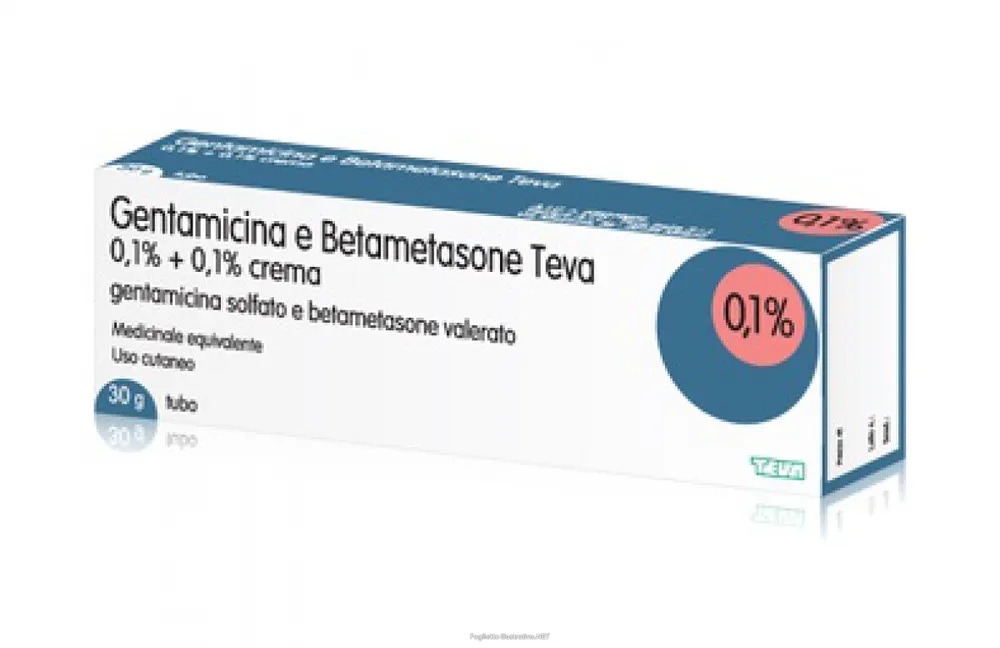
Table of Contents
- PACKAGE LEAFLET: INFORMATION FOR THE PATIENT
- Gentamicin and Betamethasone Zentiva 0.1% + 0.1% cream
- 1. What Gentamicina e Betametasone Zentiva is and what it is used for
- 2. What you need to know before using Gentamicina e Betametasone Zentiva
- 3. How to use Gentamicina e Betametasone Zentiva
- 4. Possible side effects
- 5. How to store Gentamicina e Betametasone Zentiva
- 6. Package contents and other information
PACKAGE LEAFLET: INFORMATION FOR THE PATIENT
Gentamicin and Betamethasone Zentiva 0.1% + 0.1% cream
Generic medicine
Please read all of this leaflet carefully before you start using this medicine, as it contains important information for you.
- Keep this leaflet. You may need to read it again.
- If you have any questions, ask your doctor or pharmacist.
- This medicine has been prescribed for you only. Do not give it to other people, even if their symptoms are the same as yours, as it may be harmful.
- If you experience any side effects, including those not listed in this leaflet, tell your doctor or pharmacist. See section 4.
Contents of this leaflet:
- What Gentamicin and Betamethasone Zentiva is and what it is used for
- What you need to know before using Gentamicin and Betamethasone Zentiva
- How to use Gentamicin and Betamethasone Zentiva
- Possible side effects
- How to store Gentamicin and Betamethasone Zentiva
- Contents of the pack and other information
1. What Gentamicina e Betametasone Zentiva is and what it is used for
Gentamicina e Betametasone Zentiva is a topical cream containing two active substances: gentamicin and betamethasone. Gentamicin belongs to a group of medicines called aminoglycoside antibiotics, used to treat bacterial infections. Betamethasone belongs to the group of corticosteroids, used to relieve inflammation and allergic reactions.
Gentamicina e Betametasone Zentiva is indicated for the topical treatment of allergic or inflammatory skin irritations (dermatitis) that have become infected or are at risk of becoming infected, such as:
- various types of eczema (atopic, infantile, nummular), an inflammatory reaction of the skin characterized by redness, small blisters, and itching;
- anal and genital itching (anogenital) and itching occurring in the elderly (senile pruritus);
- contact dermatitis (irritations caused by contact with objects or various substances);
- seborrheic dermatitis (irritation affecting areas rich in sebaceous glands, such as the scalp, face, and chest);
- neurodermatitis, an irritation characterized by dryness and itching of the skin;
- redness due to friction in body folds (intertriginous forms);
- irritation caused by exposure to sunlight (sunburn);
- skin peeling (exfoliative dermatitis);
- radiation-induced irritation;
- irritation due to circulatory problems (stasis dermatitis);
- psoriasis, a chronic inflammatory skin disease involving the immune system.
2. What you need to know before using Gentamicina e Betametasone Zentiva
Do not use Gentamicina e Betametasone Zentiva
- if you are allergic to the active substances or to any of the other ingredients of this medicine (listed in section 6);
- if you have any of the following skin conditions: cutaneous tuberculosis, herpes simplex, viral infections.
Warnings and precautions
Talk to your doctor or pharmacist before using Gentamicina e Betametasone Zentiva.
This medicine must not be applied to the eyes.
Stop treatment and inform your doctor if you experience irritation or an allergic reaction (sensitization) after using this medicine. These events, often caused by the growth of bacteria resistant to this antibiotic or of new bacteria or certain types of fungi (mycetes), may occasionally occur with all antibiotics used on the skin, especially when used for prolonged periods.
Contact your doctor if blurred vision or other visual disturbances occur.
Use this medicine with caution and inform your doctor if treatment is to be started over large areas of skin or for long periods, as corticosteroids (betamethasone) may pass through the skin. This is even more likely if the cream is applied under an occlusive dressing (see "How to use Gentamicina e Betametasone Zentiva") or if the patient is a child.
Children
In children, this medicine should be used only when strictly necessary and under direct medical supervision, as there may be an increased risk of adverse effects due to higher absorption of corticosteroids (see section "Additional adverse effects in children").
Other medicines and Gentamicina e Betametasone Zentiva
Inform your doctor or pharmacist if you are currently using, have recently used, or might use any other medicines.
No negative effects (interactions) with other medicines are known.
Pregnancy, breastfeeding and fertility
If you are pregnant, think you might be pregnant, are planning a pregnancy, or are breastfeeding, consult your doctor or pharmacist before using this medicine.
If you are pregnant, use this medicine only if strictly necessary and under direct medical supervision, after the doctor has evaluated the benefit-risk balance for the fetus and mother. During pregnancy, this medicine should not be used in large amounts or for prolonged periods.
If you are breastfeeding, use this medicine with caution and under direct medical supervision, as it may be necessary to discontinue breastfeeding or stop the treatment.
Driving and using machines
This medicine does not affect the ability to drive or operate machinery.
Gentamicina e Betametasone Zentiva contains chlorocresol and cetyl stearyl alcohol
This medicine contains chlorocresol, which may cause allergic reactions.
This medicine contains cetyl stearyl alcohol, which may cause local skin irritation (e.g. contact dermatitis).
3. How to use Gentamicina e Betametasone Zentiva
Use this medicine exactly as directed by your doctor or pharmacist. If you have any doubts,
consult your doctor or pharmacist.
This medicine must not be applied to the eyes.
Apply a small amount of cream to the affected area 2–3 times daily.
For the treatment of difficult-to-heal psoriasis or more severe irritations that have become infected,
occlusive dressing may be used to achieve a better therapeutic response with this medicine.
Apply the occlusive dressing as follows:
- apply a thick layer of cream over the entire lesion surface and cover with a light gauze; cover the gauze with a transparent, waterproof, flexible plastic material extending beyond the edges of the treated area;
- seal the edges onto the healthy skin with adhesive tape or other means;
- leave this dressing in place for 1–3 days and repeat the procedure 3–4 times as needed.
With this method, significant improvement is often observed within a few days. However, if you notice new skin irritation with small blisters and spots, remove the plastic covering.
If you use more Gentamicina e Betametasone Zentiva than you should
Using a single excessive dose of the medicine generally does not cause problems.
Repeated or prolonged overuse of this medicine may cause undesirable effects due to betamethasone (a corticosteroid), such as certain disorders: impaired function of the adrenal glands (adrenal insufficiency), increased levels of steroids in the body (hypercorticism and Cushing's syndrome). New infections caused by bacteria and fungi may also develop.
In such cases, consult your doctor, who will determine the appropriate treatment.
In case of accidental ingestion/ingestion of this medicine, contact your doctor immediately or go to the nearest hospital.
If you have any questions about the use of this medicine, consult your doctor or pharmacist.
4. Possible side effects
Like all medicines, this medicine can cause side effects, although not everyone experiences them.
During treatment with this medicine, some of the following side effects due to the corticosteroid (betamethasone) may occur on the skin:
- temporary skin irritation such as redness and itching, which usually does not require discontinuation of treatment;
- burning sensation;
- dryness of the skin;
- infections associated with hair follicles, sometimes with pimples (folliculitis, acneiform eruptions);
- increased hair growth (hypertrichosis);
- irritation around the mouth (perioral dermatitis);
- allergic irritation (allergic contact dermatitis);
- reduced skin pigmentation (hypopigmentation).
The use of occlusive dressings (see "How to use Gentamicin and Betametasone Zentiva") may increase the occurrence of side effects such as: development of skin lesions (skin maceration), worsening of infection (secondary infection), thinning of the skin (cutaneous atrophy), stretch marks (striae), and appearance of small blisters or spots (miliaria).
Systemic side effects (not limited to the skin) caused by corticosteroids (such as betamethasone) may also occur, including changes in the regulation and production of certain hormones; children are particularly sensitive to these effects compared to adults. Among the side effects caused by corticosteroids (such as betamethasone), blurred vision has been reported, with unknown frequency.
Additional side effects in children
Children, who are more sensitive than adults to systemic effects of corticosteroids (such as betamethasone), may experience:
- alterations in the regulation and production of certain hormones (suppression of the hypothalamic-pituitary-adrenal axis) and reduced levels of cortisol (a hormone) in the blood;
- a condition called Cushing's syndrome, characterized by increased production of certain hormones;
- growth delay, both in height and weight;
- increased pressure in the head (intracranial hypertension), manifesting as bulging of the fontanelles, causing various disturbances including headache and eye problems (bilateral papilledema).
Reporting of side effects
If you experience any side effect, including those not listed in this leaflet, please consult your doctor or pharmacist. You may also report side effects directly via the national reporting system at http://www.aifa.gov.it/content/segnalazioni-reazioni-avverse.
By reporting side effects, you can help provide more information on the safety of this medicine.
5. How to store Gentamicina e Betametasone Zentiva
Keep this medicine out of the sight and reach of children.
Do not use this medicine after the expiry date stated on the packaging after “Exp”.
The expiry date refers to the last day of that month.
Do not dispose of any medicine via wastewater or household waste. Ask your pharmacist how to dispose of
medicines you no longer use. This will help protect the environment.
6. Package contents and other information
What Gentamicina e Betametasone Zentiva contains
- The active substances are gentamicin sulfate and betamethasone valerate. 100 g of cream contain 0.1 g of gentamicin sulfate and 0.1 g of betamethasone valerate.
- The other components are: chlorocresol, macrogol ceteareth, cetyl alcohol, stearyl alcohol, white soft paraffin, liquid paraffin, sodium dihydrogen phosphate, phosphoric acid, purified water.
Description of the appearance of Gentamicina e Betametasone Zentiva and contents of the pack
Pack containing one 30 g tube of cream.
Marketing Authorization Holder
ZENTIVA ITALIA S.r.l., Viale Bodio 37/b, 20158, Milan
Manufacturer
Doppel Farmaceutici S.r.l., Via Martiri delle Foibe 1, 29016, Cortemaggiore (PC)