Fareston
Italy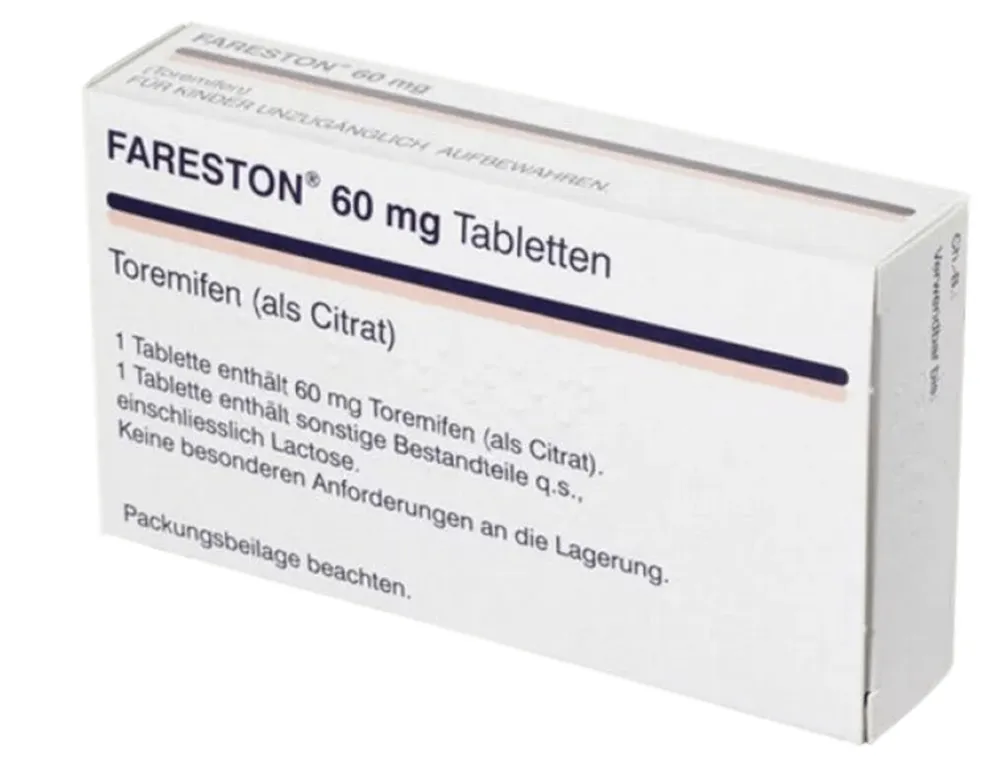
Table of Contents
Package leaflet: Information for the user
Fareston 60 mg tablets
toremifene
Please read all of this leaflet carefully before taking this medicine because it contains
important information for you.
- Keep this leaflet. You may need to read it again.
- If you have any questions, ask your doctor or pharmacist.
- This medicine has been prescribed for you only. Do not give it to other people, even if their symptoms are the same as yours, as it may be harmful.
- If you experience any side effects, including those not listed in this leaflet, tell your doctor or pharmacist. See section 4.
Contents of this leaflet:
- What Fareston is and what it is used for
- What you need to know before taking Fareston
- How to take Fareston
- Possible side effects
- How to store Fareston
- Contents of the pack and other information
1. What Fareston is and what it is used for
Fareston contains the active substance toremifene, an anti-oestrogen. Fareston is indicated for the treatment of certain types of breast cancer in women who have already reached the menopause.
2. What you should know before taking Fareston
Do not take Fareston
- if you are allergic to toremifene or to any of the other ingredients of this medicine (listed in section 6).
- if you have thickening of the uterine wall
- if you have severe liver problems
- if you were born with or have any condition causing abnormal changes in the heart's electrical activity (electrocardiogram or ECG)
- if you have an imbalance of salts in your blood, especially low levels of potassium in the blood (hypokalaemia) not yet corrected by treatment
- if you have a very slow heart rate (bradycardia)
- if you suffer from heart failure
- if you have a history of abnormal heart rhythms (arrhythmias)
- if you are taking other medicines that may affect the heart (see section 2 “Other medicines and Fareston”). This is because Fareston can affect the heart by delaying the conduction of electrical signals within the heart (prolongation of the QT interval).
Warnings and precautions
Talk to your doctor or pharmacist before taking Fareston:
- if you have unstable diabetes
- if your general condition has severely worsened
- if you have previously had a condition in which blood clots formed in blood vessels, for example in the lungs (pulmonary embolism) or in the leg veins (deep vein thrombosis).
- if an abnormal heart rhythm occurs during treatment with Fareston. Your doctor may advise you to stop taking Fareston and perform a test to check how your heart is working (ECG). (See section 2 “Do not take Fareston”).
- if you have any heart condition, including chest pain (angina)
- if the cancer has spread to the bones (bone metastases), as an increase in blood calcium levels may occur at the beginning of treatment with Fareston. Your doctor will carry out regular medical checks.
- if your doctor has told you that you have an intolerance to certain sugars, such as lactose (see section 2 Fareston contains lactose).
You should undergo gynaecological examinations before starting treatment with Fareston and at least once a year after starting treatment. Your doctor will carry out regular medical checks if you have high blood pressure, diabetes, have taken hormone replacement therapy, or if you are obese (BMI over 30).
Other medicines and Fareston
Inform your doctor if you are taking, have recently taken, or might take any other medicines. During treatment with Fareston, the dosage of some of these medicines may need to be adjusted. In particular, inform your doctor if you are taking any of the following medicines:
- diuretics (thiazide diuretics)
- medicines to prevent blood clotting such as warfarin
- medicines used to treat epilepsy, such as carbamazepine, phenytoin, phenobarbital
- medicines used to treat fungal infections such as ketoconazole, itraconazole, voriconazole, posaconazole
- medicines used to treat bacterial infections such as erythromycin, clarithromycin and telithromycin
- medicines used to treat viral infections such as ritonavir and nelfinavir.
Do not take Fareston together with the following medicines, as this increases the risk that your heartbeat may be altered (see section 2 “Do not take Fareston”):
- medicines used to treat abnormal heart rhythms (antiarrhythmics) such as quinidine, hydroquinidine, disopyramide, amiodarone, sotalol, dofetilide and ibutilide
- medicines used to treat mental or behavioural disorders (neuroleptics) such as phenothiazines, pimozide, sertindole, haloperidol and sulpiride
- medicines used to treat infections (antimicrobials) such as moxifloxacin, erythromycin (infusion), pentamidine and antimalarials (particularly halofantrine)
- certain medicines used to treat allergies such as terfenadine, astemizole and mizolastine
- other cisapride, intravenous vincamine, bepridil, difemanil.
If you are admitted to hospital or are prescribed a new medicine, inform the doctor that you are taking Fareston.
Pregnancy and breastfeeding
Do not use Fareston during pregnancy or breastfeeding.
Driving and using machines
Fareston does not affect the ability to drive or use machines.
Fareston contains lactose
Fareston contains 28.5 mg of lactose (as monohydrate) per tablet. If your doctor has diagnosed you with an intolerance to certain sugars, contact him before taking this medicine.
Other excipients
This medicine contains less than 1 mmol (23 mg) of sodium per dose, i.e. essentially ‘sodium-free’.
3. How to take Fareston
Take this medicine exactly as your doctor has told you. If you have any doubts, consult your doctor or pharmacist. The usual dose is one 60 mg oral tablet once daily.
Fareston may be taken with or without food.
If you take more Fareston than you should
Contact your doctor, pharmacist, or nearest hospital immediately. Symptoms of overdose may include dizziness and headache.
If you forget to take Fareston
If you miss a dose, take the next tablet at your usual time and continue treatment as recommended. Do not take a double dose to make up for the missed tablet. If you have missed several doses, contact your doctor and follow their instructions.
If you stop taking Fareston
Treatment with Fareston should only be stopped when advised by your doctor.
If you have any questions about the use of this medicine, ask your doctor or pharmacist.
4. Possible side effects
Like all medicines, this medicine can cause side effects, although not everyone gets them.
Very common (affects more than 1 in 10 people):
- hot flushes, sweating.
Common (affects up to 1 in 10 people):
- fatigue, dizziness, depression
- nausea (feeling of sickness), vomiting
- skin rash, itching, oedema (swelling)
- uterine bleeding, white vaginal discharge.
Uncommon (affects up to 1 in 100 people):
- headache, sleep disturbances
- weight gain, constipation, loss of appetite
- thickening of the uterine lining (endometrial hyperplasia)
- blood clots, for example in the lung (thromboembolic events)
- shortness of breath.
Rare (affects up to 1 in 1,000 people):
- sensation of dizziness (vertigo)
- growth of the uterine lining (endometrial polyps)
- increased liver enzymes (elevated liver transaminases).
Very rare (affects up to 1 in 10,000 people):
- changes in the lining of the uterus (endometrium), tumour of the uterine lining (endometrial tumour)
- hair loss (alopecia)
- transient corneal opacity (blurred surface of the eye)
- yellowing of the skin or whites of the eyes (jaundice).
Not known (frequency cannot be estimated from the available data):
- low white blood cell count, which are important for fighting infections (leucopenia)
- low red blood cell count (anaemia)
- low platelet count (thrombocytopenia)
- inflammation of the liver (hepatitis)
- high levels of triglycerides, a type of fat, in the blood.
You must contact your doctor immediately if you notice:
- Swelling or tenderness in the calves
- unexplained shortness of breath or sudden chest pain
- vaginal bleeding or changes in vaginal discharge.
Fareston may cause certain abnormal changes in the electrical recording of the heart (electrocardiogram or ECG). See section 2 “Warnings and precautions”.
Reporting of side effects
If you get any side effects, including any not listed in this leaflet, talk to your doctor or pharmacist. You can also report side effects directly via the national reporting system listed in Annex V*.
By reporting side effects, you can help provide more information on the safety of this medicine.
5. How to store Fareston
Keep this medicine out of the sight and reach of children.
Do not use this medicine after the expiry date stated on the pack. The expiry date refers to the last day of that month. This medicine does not require any special storage conditions.
Do not dispose of medicines via wastewater or household waste. Ask your pharmacist how to dispose of medicines you no longer use. This will help protect the environment.
6. Package contents and other information
What Fareston contains
- The active substance is toremifene; each tablet contains 60 mg (as citrate).
- The excipients are maize starch, monohydrate lactose, povidone, sodium starch glycolate, microcrystalline cellulose, anhydrous colloidal silicon dioxide, and magnesium stearate.
Description of the appearance of Fareston and pack contents
White, round, flat tablet, bevelled at the edges, with "TO 60" marked on one side.
Available in packs of 30 and 100 tablets. Not all pack sizes may be marketed.
Marketing Authorisation Holder
Orion Corporation
Orionintie 1
FI-02200 Espoo
Finland
Manufacturer
Orion Corporation Orion Pharma
Joensuunkatu 7
FI-24100 Salo
Finland
For further information about this medicinal product, please contact the local representative of the Marketing Authorisation Holder:
België/Belgique/Belgien Lietuva
Orion Corporation Orion Corporation
Tél/Tel: +358 10 4261 Tel: +358 10 4261
България Luxembourg/Luxemburg
Orion Corporation Orion Corporation
Tel: +358 10 4261 Tél/Tel: +358 10 4261
Česká republika Magyarország
Orion Corporation Orion Corporation
Tel: +358 10 4261 Tel.: +358 10 4261
Danmark Malta
Orion Corporation Orion Corporation
Tlf: +358 10 4261 Tel: +358 10 4261
Deutschland Nederland
Orion Corporation Orion Corporation
Tel: +358 10 4261 Tel: +358 10 4261
Eesti Norge
Orion Corporation Orion Corporation
Tel: +358 10 4261 Tlf: +358 10 4261
Ελλάδα Österreich
Orion Corporation Orion Corporation
Τηλ: +358 10 4261 Tel: +358 10 4261
España Polska
Orion Corporation Orion Corporation
Tel: +358 10 4261 Tlf: +358 10 4261
France Portugal
Orion Pharma Orion Corporation
Tel: +33 (0) 1 85 18 00 00 Tel: +358 10 4261
Hrvatska România
Orion Corporation Orion Corporation
Tel.: +358 10 4261 Tel: +358 10 4261
Ireland Slovenija
Orion Corporation Orion Corporation
Tlf: +358 10 4261 Tel: +358 10 4261
Ísland Slovenská republika
Orion Corporation Orion Corporation
Sími: +358 10 4261 Tel: +358 10 4261
Italia Suomi/Finland
Orion Pharma S.r.l. Orion Corporation
Tel: +39 02 67876111 Puh./Tel: +358 10 4261
Κύπρος Sverige
Orion Corporation Orion Pharma AB
Τηλ: +358 10 4261 Tel: +46 8 623 6440
Latvija
Orion Corporation
Tel: +358 10 4261
More detailed information on this medicinal product is available on the website of the European Medicines Agency: http://www.ema.europa.eu.
ANNEX IV
SCIENTIFIC CONCLUSIONS AND REASONS FOR THE VARIATION OF THE TERMS OF THE MARKETING AUTHORISATIONS
Scientific conclusions
Taking into account the evaluation by the Pharmacovigilance and Risk Assessment Committee (PRAC) of the Periodic Safety Update Reports (PSURs) for toremifene, the PRAC's scientific conclusions are as follows:
In light of available data on hypertriglyceridemia from the literature and spontaneous case reports, including some cases with a close temporal relationship, a positive de-challenge and/or re-challenge, and considering a plausible mechanism of action, the PRAC considers that there may be a reasonable possibility of a causal relationship between toremifene and hypertriglyceridemia. The PRAC concluded that the product information for medicinal products containing toremifene should therefore be amended accordingly.
Having reviewed the PRAC's recommendation, the Committee for Human Medicinal Products (CHMP) agrees with its overall conclusions and the rationale behind the recommendation.
Reasons for the variation of the terms of the marketing authorisation
Based on the scientific conclusions regarding toremifene, the CHMP considers that the benefit-risk balance of the medicinal product containing toremifene remains unchanged, subject to the proposed amendments to the product information.
The CHMP recommends the variation of the terms of the marketing authorisation.