Dicloreum Actigel
Italy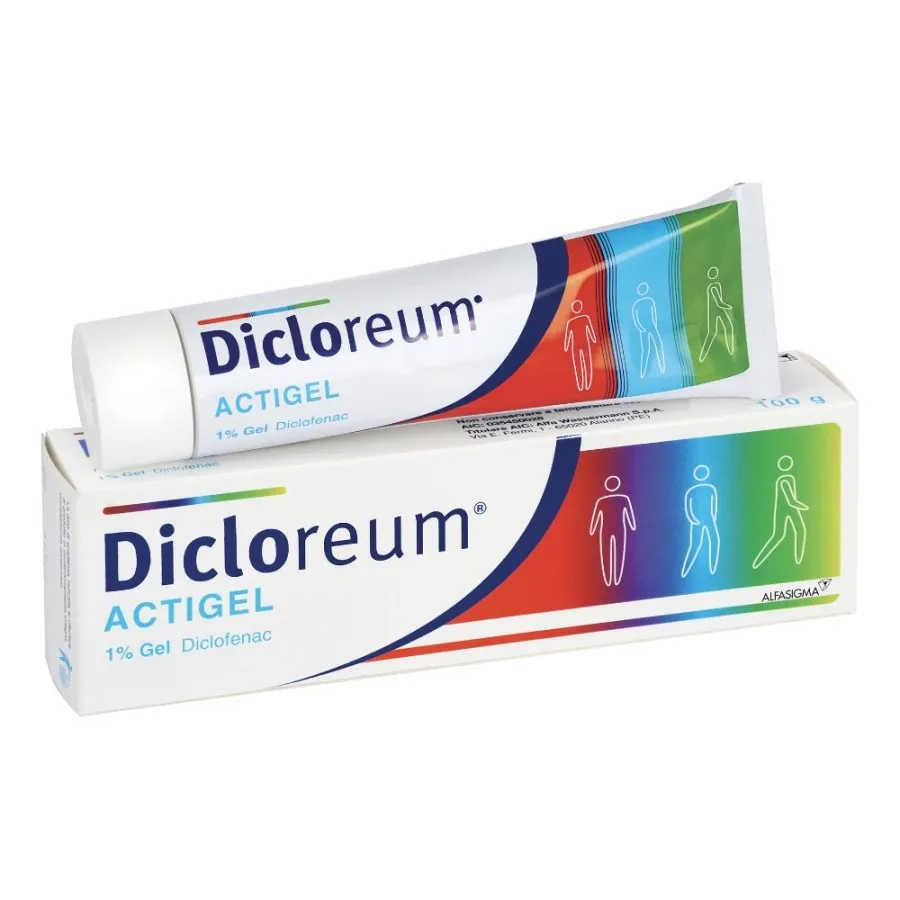
Table of Contents
- Package leaflet: Information for the user
- Dicloreum Actigel 1% Gel
- 1. What Dicloreum Actigel is and what it is used for
- 2. What you need to know before using Dicloreum Actigel
- 3. How to use Dicloreum Actigel
- 4. Possible side effects
- 5. How to store Dicloreum Actigel
- 6. Package contents and other information
PACKAGE LEAFLET
Package leaflet: Information for the user
Dicloreum Actigel 1% Gel
diclofenac
Please read this entire leaflet carefully before using this medicine because it contains important information for you.
Use this medicine exactly as described in this leaflet or as your doctor or pharmacist has instructed.
- Keep this leaflet. You may need to read it again.
- If you need more information or advice, consult your pharmacist.
- If you experience any side effects, including those not listed in this leaflet, contact your doctor or pharmacist. See section 4.
- Contact your doctor if you do not notice improvement or if your symptoms worsen after a short period of treatment.
Contents of this leaflet:
- What Dicloreum Actigel is and what it is used for
- What you need to know before using Dicloreum Actigel
- How to use Dicloreum Actigel
- Possible side effects
- How to store Dicloreum Actigel
- Contents of the pack and other information
1. What Dicloreum Actigel is and what it is used for
Dicloreum Actigel is a topical gel containing the active substance diclofenac hydroxyethylpyrrolidine, which belongs to a group of medicines called non-steroidal anti-inflammatory drugs (NSAIDs).
Dicloreum Actigel is indicated for the local treatment of pain and inflammation affecting joints, muscles, tendons and ligaments due to rheumatic diseases or trauma.
2. What you need to know before using Dicloreum Actigel
Do not use Dicloreum Actigel
- if you are allergic to diclofenac or to any of the other ingredients of this medicine (listed in section 6).
- if you have previously experienced asthma attacks, skin rash (urticaria), or cold-like symptoms (acute rhinitis) after taking medicines containing acetylsalicylic acid (e.g. aspirin), other non-steroidal anti-inflammatory drugs, or isopropanol.
- during the last 3 months of pregnancy, as it may cause harm to the heart, lungs, and kidneys of the fetus (see section "Pregnancy, breastfeeding and fertility").
- in children and adolescents under 14 years of age, as safety and efficacy data in this age group are not available.
Warnings and precautions
The use of topical anti-inflammatory medicines, especially if prolonged and applied over large skin areas, may lead to systemic adverse effects and allergic reactions. In such cases, treatment must be discontinued and a doctor should be consulted.
Use Dicloreum Actigel:
- only on intact, healthy skin without wounds or open lesions.
- only with dressings that allow air passage (non-occlusive bandages).
Ensure that the gel does not come into contact with the eyes or mucous membranes (e.g. mouth or vagina):
if this occurs, rinse immediately with running water and contact your doctor.
Do not ingest the gel.
Use Dicloreum Actigel with particular caution:
- if you suffer from asthma, chronic obstructive bronchial disease, allergic rhinitis, or inflammation of the nasal mucosa (nasal polyps), as you may be more likely than other patients to experience asthma attacks, local skin or mucosal inflammation (Quincke's edema), or skin rash (urticaria).
Other medicines and Dicloreum Actigel
Inform your doctor or pharmacist if you are taking, have recently taken, or might take any other medicines.
Since this medicine acts locally on the skin, absorption of the active ingredient into the body is very low, and interactions with other medicines or food are unlikely.
However, if the medicine is used at high doses and for prolonged periods, it is advisable to consult your doctor or pharmacist.
Concomitant use of anti-inflammatory medicines is not recommended in elderly patients and/or those with gastric disorders.
Pregnancy, breastfeeding and fertility
If you are pregnant, think you may be pregnant, planning to become pregnant, or breastfeeding, consult your doctor or pharmacist before using this medicine.
Pregnancy
Do not use Dicloreum Actigel during the last 3 months of pregnancy. Do not use Dicloreum Actigel during the first 6 months of pregnancy unless strictly necessary and under medical advice.
If treatment is required during this period, the lowest effective dose for the shortest possible duration should be used.
Do not use the medicine during the last 3 months of pregnancy (see section "Do not use Dicloreum Actigel") because non-steroidal anti-inflammatory drugs may cause:
- harm to the heart, lungs, and kidneys of the fetus
- prolonged bleeding time in both mother and newborn
- inhibition of uterine contractions in the mother, leading to delayed or prolonged labour.
Oral forms (e.g. tablets) of diclofenac may cause adverse effects in the newborn. It is not known whether the same risk applies to Dicloreum Actigel when used on the skin.
Breastfeeding
As with other non-steroidal anti-inflammatory drugs, diclofenac contained in this medicine is excreted in breast milk.
At the recommended doses of Dicloreum Actigel, effects on the breastfed infant are not expected. However, due to the lack of adequate studies, breastfeeding women should use this medicine only under the advice of a doctor or pharmacist. In such cases, remember not to apply the medicine on the breast or over large skin areas and for prolonged periods (see section "Warnings and precautions").
Driving and using machines
Dicloreum Actigel does not affect the ability to drive or operate machinery.
3. How to use Dicloreum Actigel
Use this medicine exactly as stated in this leaflet or as instructed by your doctor or pharmacist. If you are unsure, consult your doctor or pharmacist.
Use in adults
Apply Dicloreum Actigel 3 or 4 times a day to the affected area, with gentle massage.
The amount to apply depends on the size of the area to be treated. For example, 2–4 g of Dicloreum Actigel (an amount varying in size between a cherry and a walnut) is sufficient to treat an area of 400–800 cm².
After application, wash your hands; otherwise, they will also be exposed to the gel.
Use only for short-term treatment.
Use in adolescents aged 14 to 18 years
Apply Dicloreum Actigel 3 or 4 times a day to the affected area, with gentle massage.
The amount to apply depends on the size of the area to be treated. For example, 2–4 g of Dicloreum Actigel (an amount varying in size between a cherry and a walnut) is sufficient to treat an area of 400–800 cm².
After application, wash your hands; otherwise, they will also be exposed to the gel.
If the medicine is needed for more than 7 days to relieve pain, or if symptoms worsen, consult a doctor.
Use in children and adolescents under 14 years of age
Dicloreum Actigel must not be used in children and adolescents under 14 years of age, as there are insufficient data available to assess the safety and efficacy of the medicine in this age group.
Use in the elderly
The usual adult dosage may be used.
If you use more Dicloreum Actigel than you should
Immediately inform your doctor or go to the nearest hospital if you have used excessive doses or accidentally ingested Dicloreum Actigel orally.
Since this medicine acts locally on the skin, systemic absorption of the active ingredient is very low, and overdose is unlikely. However, excessive use of the medicine or accidental oral ingestion may cause adverse effects.
4. Possible side effects
Like all medicines, Dicloreum Actigel can cause side effects, although not everybody gets them.
Common side effects (may affect up to 1 in 10 people):
- skin rash
- intense reddening of the skin (erythema) and appearance of blisters (eczema)
- inflammatory skin reactions (dermatitis, including contact dermatitis)
- itching
Rare side effects (may affect up to 1 in 1,000 people):
- skin inflammation with blisters (bullous dermatitis)
Very rare side effects (may affect up to 1 in 10,000 people):
- allergic reactions, including skin rash (urticaria)
- rapid swelling of the skin (angioneurotic edema)
- skin rash with pustules
- absence of or difficulty breathing (asthma)
- skin reactions to sunlight (photosensitivity)
Dicloreum Actigel in combination with other medicines containing diclofenac may cause the
following side effects:
- increased sensitivity to light
- intense reddening of the skin (erythema) and appearance of blisters (eczema)
- severe skin reactions (Stevens-Johnson syndrome, Lyell syndrome)
Reporting of side effects
If you experience any side effect, including those not listed in this leaflet, talk to your doctor or pharmacist.
You can also report side effects directly via the national reporting system at https://www.aifa.gov.it/content/segnalazioni-reazioni-avverse.
By reporting side effects, you can help provide more information on the safety of this medicine.
5. How to store Dicloreum Actigel
Keep this medicine out of sight and reach of children.
Do not use this medicine after the expiry date stated on the packaging. The expiry date refers to the last day of that month.
Store this medicine in its original packaging at a temperature below 30 °C.
After first opening of the tube, the gel can be used for a period not exceeding 12 months.
Do not use this medicine if the packaging is open or damaged.
Do not dispose of any medicine via wastewater or household waste. Ask your pharmacist how to dispose of medicines you no longer use. This will help protect the environment.
6. Package contents and other information
What Dicloreum Actigel contains
- The active substance is diclofenac hydroxyethylpyrrolidine. 100 g of gel contain 1.32 g of diclofenac hydroxyethylpyrrolidine (equivalent to 1.0 g of sodium diclofenac).
- The other ingredients of the medicine are: macrogols, macrogol stearate, cetyl stearyl-2-ethylhexanoate, carbomers, triethanolamine, isopropyl alcohol, fragrance, purified water.
Description of the appearance of Dicloreum Actigel and contents of the pack
Dicloreum Actigel is presented as a gel in aluminum tubes of 50 g or 100 g.
It is possible that not all pack sizes are marketed.
Marketing Authorization Holder and Manufacturer
Marketing Authorization Holder:
Alfasigma S.p.A. – Via Ragazzi del ‘99, n. 5 - 40133 Bologna (BO)
Manufacturer:
Doppel Farmaceutici S.r.l. - Via Martiri delle Foibe, 1 - 29016 Cortemaggiore (PC)
September 2024