Citocartin
Italy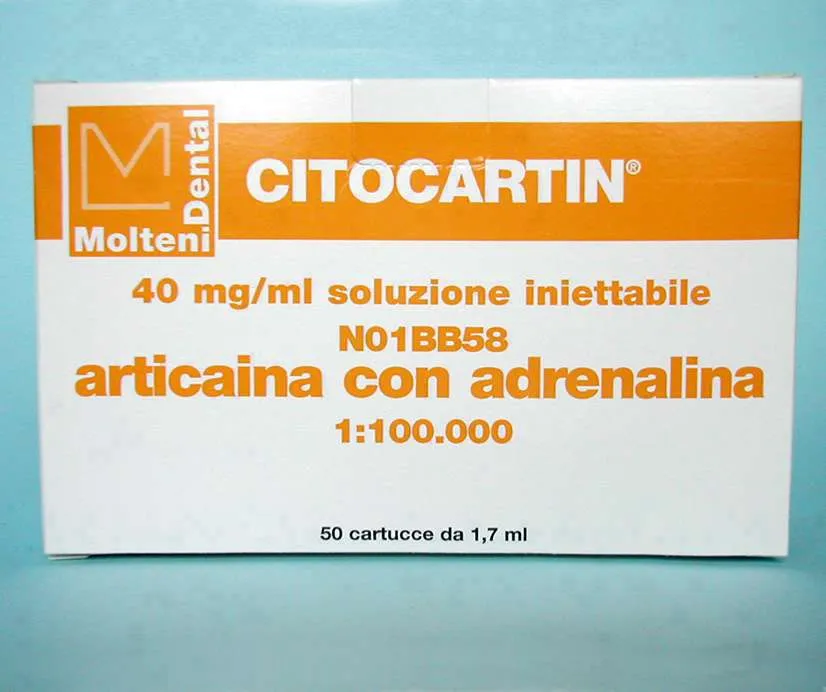
Table of Contents
- PACKAGE LEAFLET: INFORMATION FOR THE USER
- CITOCARTIN 40 mg/ml + 5 micrograms/ml injection solution with adrenaline, 40 mg/ml + 10 micrograms/ml injection solution with adrenaline
- 1. WHAT CITOCARTIN IS AND WHAT IT IS USED FOR
- 2. BEFORE USING CITOCARTIN
- 3. HOW TO USE CITOCARTIN
- 4. POSSIBLE ADVERSE REACTIONS
- 5. HOW TO STORE CITOCARTIN
- 6. OTHER INFORMATION
PACKAGE LEAFLET: INFORMATION FOR THE USER
CITOCARTIN 40 mg/ml + 5 micrograms/ml injection solution with adrenaline, 40 mg/ml + 10 micrograms/ml injection solution with adrenaline
(articaine)
Read this leaflet carefully before using this medicine.
- Keep this leaflet. You may need to read it again.
- If you have any questions, consult your doctor.
- If any of the side effects worsens, or if you notice any side effect not listed in this leaflet, inform your doctor.
Contents of this leaflet:
- What Citocartin is and what it is used for
- Before you use Citocartin
- How to use Citocartin
- Possible side effects
- How to store Citocartin
- Further information
1. WHAT CITOCARTIN IS AND WHAT IT IS USED FOR
Citocartin is a local anaesthetic (a substance that reduces or abolishes sensitivity in a specific area of the body). This medicinal product is used by dentists to anaesthetize certain areas of the mouth before performing:
- Routine procedures, such as simple or uncomplicated single or multiple tooth extractions, cavity and core preparations for crown placement;
- More complicated surgical procedures requiring deep analgesia and reduction of blood flow in the operative field, such as surgical interventions on mucosa, bone or pulp (soft tissue located inside the tooth), osteotomy (removal of fractured teeth), prolonged surgical procedures, percutaneous osteosynthesis, cystectomy, mucogingival surgery, apicectomy.
2. BEFORE USING CITOCARTIN
Do not use CITOCARTIN
- If you are allergic (hypersensitive) to the active substances (articaine and adrenaline), or to any of the excipients of CITOCARTIN, or to other amide-type local anesthetics; or if you have heart problems, particularly serious rhythm and cardiac conduction disorders such as: paroxysmal tachycardia (sudden increase in heart rate), high-frequency arrhythmias (very frequent irregular heartbeats), severe bradycardia (greatly reduced heart rate), second- or third-degree atrioventricular block.
- If you have acute heart failure (the heart's inability to pump blood throughout the body).
- If you have recently suffered a myocardial infarction or undergone coronary bypass surgery (cardiac surgery).
- If you suffer from unstable angina (severe chest pain).
- If you have severe hypotension (low blood pressure).
- If you suffer from severe, untreated or uncontrolled hypertension (high blood pressure).
- If you have severe arteriopathy (arterial obstruction).
- If you suffer from severe myasthenia (muscle weakness).
- If you have a known eye disease called closed-angle glaucoma.
- If you suffer from hyperthyroidism (a condition caused by excess thyroid hormones in the blood).
- If you have been diagnosed with a pheochromocytoma (a rare tumor of the adrenal glands).
- If you are taking medications for depression such as monoamine oxidase inhibitors (MAOIs) or tricyclic antidepressants.
- CITOCARTIN is contraindicated in children under 4 years of age.
Never use the product for anesthesia in areas of terminal circulation.
Furthermore, intravenous administration and injection into particularly inflamed or infected areas are contraindicated.
Use particular caution with CITOCARTIN:
- In case of kidney or liver disorders;
- In case of diabetes;
- In case of heart problems (angina pectoris);
- In case of arteriosclerosis (hardening and progressive narrowing of the arteries);
- In case of significant blood coagulation disorders or if you are taking anticoagulants (medications that prevent blood clot formation);
- If you are taking non-cardioselective β-blockers (used to treat hypertension);
- In case of a previous history of epilepsy.
Before treatment with Citocartin, your dentist will assess your health status and inject the anesthetic cautiously and in small doses, after prior aspiration. Your dentist will maintain verbal contact with you at all times and will stop administration at the first sign of alarm (burning, tingling, electric shock sensation).
Use of CITOCARTIN with other medicines:
This product must be used with extreme caution if you are taking:
- Oral antidiabetic agents (medications for the treatment of diabetes).
- Anticoagulants such as heparin or acetylsalicylic acid (medications that prevent blood clot formation): patients taking these medications have an increased tendency to bleed.
- Non-cardioselective β-blockers (medications used to treat hypertension): combined treatment may cause a sudden increase in arterial blood pressure.
- Halothane (an inhaled anesthetic): combined treatment may cause arrhythmias.
- Digoxin: risk of arrhythmias.
Inform your doctor if you are taking or have recently taken any other medicines, including those without a prescription.
Use of CITOCARTIN with food and beverages:
The patient may eat once normal sensation has returned.
Pregnancy and breastfeeding:
Ask your doctor for advice before taking any medicine.
During pregnancy and breastfeeding, Citocartin should only be used after consulting your doctor and carefully evaluating the risk/benefit ratio in your individual case.
Consult your doctor if you suspect you may be pregnant or if you plan to become pregnant.
Driving and use of machinery:
No studies have been conducted on the ability to drive vehicles or operate machinery.
Your dentist should assess whether you are fit to drive or operate machinery after the procedure.
Important information about some excipients in CITOCARTIN:
The product contains sodium metabisulfite: in sensitive individuals, especially those with a history of asthma or allergy, this may rarely cause severe allergic reactions and bronchospasm.
CITOCARTIN contains less than 1 mmol of sodium (23 mg) per maximum daily dose and is therefore considered essentially sodium-free.
CITOCARTIN contains adrenaline, which may cause local tissue necrosis and systemic toxicity; therefore, standard precautions for adrenaline administration must be observed.
3. HOW TO USE CITOCARTIN
Dosage and method of administration
This product must be administered only by your dentist, who will determine the amount of product to be administered in your case.
The dental physician must use the lowest effective dose, taking into account the type of procedure, age, weight, and physical condition of the patient.
The maximum dose for adults and children over 4 years of age is 7 mg/kg of body weight.
The anesthetic solution must be injected slowly into the oral cavity.
In case of overdose:
If any of the following symptoms occur, inform your doctor immediately:
restlessness, tremor, drowsiness, headache, difficulty speaking, hearing disturbances, nausea, vomiting, metallic taste, dizziness, ringing in the ears, difficulty breathing, drop in blood pressure, sensation of warmth, sweating, cardiac disturbances (increased heart rate, feeling of chest tightness), muscle contractions.
If you have any doubts about the use of CITOCARTIN, consult your doctor.
4. POSSIBLE ADVERSE REACTIONS
Like all medicines, CITOCARTIN can cause adverse reactions, although not everyone experiences them.
The frequency of adverse reactions is defined as follows:
very common (more than 1 in 10 people)
common (more than 1 in 100 and less than 1 in 10 people)
uncommon (more than 1 in 1,000 and less than 1 in 100 people)
rare (more than 1 in 10,000 and less than 1 in 1,000 people)
very rare (less than 1 in 10,000 people, including isolated cases).
Cardiac disorders
Rare:
Bradycardia (reduced heart rate), tachycardia (increased heart rate), cardiocirculatory depression, and cardiac arrest.
Nervous system disorders
Rare:
Restlessness, disorientation, tremors, somnolence, paresthesia (tingling), headache, metallic taste, dizziness, tinnitus (ringing in the ears), mydriasis, trismus, seizures, anxiety.
Nerve injury, reduced sensitivity (hypoesthesia), and taste disturbances may occur following incorrect injection technique or in patients with specific conditions.
Eye disorders
Rare:
Transient visual disturbances (diplopia), photophobia (increased sensitivity to light), and ptosis (drooping eyelid) may rarely occur during and immediately after anesthesia.
Respiratory, thoracic and mediastinal disorders
Rare:
Tachypnea (rapid breathing), bronchodilation, retrosternal and pharyngeal pain.
Gastrointestinal disorders
Rare:
Nausea, vomiting.
Skin and subcutaneous tissue disorders
Very rare:
Skin rashes, pruritus, urticaria, angioedema, necrosis.
Metabolism and nutrition disorders
Rare:
Increased metabolism.
Vascular disorders
Rare:
Hypotension (lowered blood pressure), hypertension (elevated blood pressure).
General disorders and administration site conditions
Very rare:
Allergic reactions with bronchospasm, laryngeal edema, up to cardiorespiratory collapse due to anaphylactic shock.
Rare: sensation of warmth, sweating, increased body temperature; occurrence of lesions at the injection site (ischemia and necrosis).
If any of the adverse reactions worsens, or if you notice any adverse reaction not listed in this leaflet, inform your doctor immediately.
5. HOW TO STORE CITOCARTIN
Expiry date: see the expiry date stated on the packaging.
The expiry date refers to the product in its original, undamaged packaging, correctly stored.
Warning: do not use the medicinal product after the expiry date stated on the packaging.
Do not store above 25°C.
Keep cartridges in the outer packaging to protect them from light.
Medicinal products must not be disposed of via wastewater or household waste. Ask your
pharmacist how to dispose of medicines no longer in use. This will help protect the
environment.
Keep the medicine out of the reach and sight of children.
The doctor must not use CITOCARTIN after the expiry date indicated on the
cartridge or on the outer packaging.
The expiry date refers to the last day of the month.
The dentist must not use CITOCARTIN if visible signs of deterioration are observed, such as change in colour of the solution, presence of foreign particles, or damaged cartridge.
6. OTHER INFORMATION
What CITOCARTIN contains
The active substances are articaine hydrochloride and L-adrenaline. Each millilitre of solution contains
articaine hydrochloride 40 mg and L-adrenaline tartrate equivalent to 10 or 5 micrograms of adrenaline.
The excipients are: sodium chloride, sodium metabisulfite and water for injectable preparation.
For further information, contact the Marketing Authorization Holder.
Description of the appearance of CITOCARTIN and contents of the pack
CITOCARTIN is a clear, colourless solution packed in 1.7 ml glass cartridges with a closure consisting of a plunger and a penetrable seal made of elastomeric material, and an aluminium cap. Each package contains 50 cartridges of 1.7 ml.
MARKETING AUTHORIZATION HOLDER
Molteni Dental s.r.l.
Via I. Barontini 8 Loc Granatieri, 50018 SCANDICCI (FI-ITALY), Tel. +39 055 73611
MANUFACTURER
- COSMO SpA Via C. Colombo 1 - 20020 Lainate (MI)
- Pierrel SpA Strada Statale Appia 7 bis 46/48, 81043 Capua (CE)
- Laboratorios Normon, S.A., Ronda de Valdecarrizo, 6 - 28760 Tres Cantos - Madrid (Spain)
- Weimer Pharma GmbH Im Steingerüst, 30; D-76437 Rastatt - Germany