Aprepitant Teva
Italy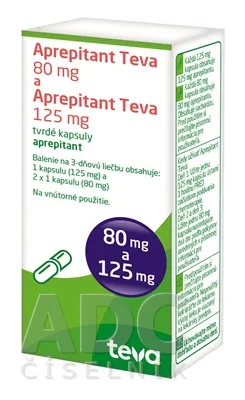
Table of Contents
- Package leaflet: Information for the user
- Aprepitant Teva 125 mg + 80 mg hard capsules
- 1. What Aprepitant Teva is and what it is used for
- 2. What you need to know before taking or administering Aprepitant Teva
- 3. How to take Aprepitant Teva
- 4. Possible side effects
- 5. How to store Aprepitant Teva
- 6. Package contents and other information
Package leaflet: Information for the user
Aprepitant Teva 125 mg + 80 mg hard capsules
Aprepitant
Equivalent medicine
Please read all of this leaflet carefully before taking this medicine because it contains important information for you. If you are the parent of a child being treated with Aprepitant Teva, please read these instructions carefully.
- Keep this leaflet. You may need to read it again.
- If you have any questions, ask your doctor, pharmacist, or nurse.
- This medicine has been prescribed for you or your child only. Do not give it to others, even if they have the same symptoms, as it may be harmful.
- If you or your child experience any side effects, including those not listed in this leaflet, tell your doctor, pharmacist, or nurse. See section 4.
Contents of this leaflet
- What Aprepitant Teva is and what it is used for
- What you need to know before taking Aprepitant Teva
- How to take Aprepitant Teva
- Possible side effects
- How to store Aprepitant Teva
- Contents of the pack and other information
1. What Aprepitant Teva is and what it is used for
Aprepitant Teva contains the active substance aprepitant and belongs to a group of medicines
called “neurokinin 1 (NK1) receptor antagonists”. The brain has a specific area that
controls nausea and vomiting. Aprepitant Teva works by blocking the signals sent to this area,
thereby reducing nausea and vomiting. Aprepitant Teva capsules are used in adults and
adolescents from 12 years of age in combination with other medicines to prevent nausea and
vomiting caused by chemotherapy treatments (cancer treatments) that are highly and moderately
likely to cause nausea and vomiting (e.g. cisplatin, cyclophosphamide, doxorubicin or epirubicin).
2. What you need to know before taking or administering Aprepitant Teva
Do not take Aprepitant Teva:
- if you or the child is allergic to aprepitant or to any of the other ingredients of this medicine (listed in section 6),
- with medicines containing pimozide (a substance used to treat psychiatric disorders), terfenadine and astemizole (used for hay fever and other allergies), or cisapride (used to treat digestive problems). Tell your doctor if you or the child is taking these medicines, as treatment must be adjusted before starting Aprepitant Teva.
Warnings and precautions
Talk to your doctor, pharmacist, or nurse before taking Aprepitant Teva or administering this medicine to the child.
Before treatment with Aprepitant Teva, inform your doctor if you or the child has liver disease, as the liver is important for metabolizing the medicine in the body. Your doctor may therefore need to check the condition of your liver or that of the child.
Children and adolescents
Do not administer Aprepitant Teva 125 mg and 80 mg capsules to children under 12 years of age, as the 125 mg and 80 mg capsules have not been studied in this population.
Other medicines and Aprepitant Teva
Aprepitant Teva may affect other medicines both during and after treatment with Aprepitant Teva. There are some medicines that must not be taken with Aprepitant Teva (such as pimozide, terfenadine, astemizole, and cisapride) or that require dose adjustment (see also “Do not take Aprepitant Teva”).
The effects of Aprepitant Teva or of other medicines may be influenced if you or the child takes Aprepitant Teva together with other medicines, including those listed below. Inform your doctor or pharmacist if you or the child is taking any of the following medicines:
- medicines for birth control, including oral contraceptives, contraceptive patches, implants, and certain hormone-releasing intrauterine devices (IUDs), may not work properly when taken together with Aprepitant Teva. During treatment with Aprepitant Teva and for up to 2 months after taking Aprepitant Teva, another method or an additional non-hormonal method of birth control should be used,
- ciclosporin, tacrolimus, sirolimus, everolimus (immunosuppressants),
- alfentanil, fentanyl (used to treat pain),
- quinidine (used to treat irregular heartbeat),
- irinotecan, etoposide, vinorelbine, ifosfamide (medicines used to treat cancer),
- medicines containing ergot alkaloids such as ergotamine and dihydroergotamine (used to treat migraine),
- warfarin, acenocoumarol (anticoagulants; blood tests may be required),
- rifampicin, clarithromycin, telithromycin (antibiotics used to treat infections),
- phenytoin (a medicine used to treat seizures),
- carbamazepine (used to treat depression and epilepsy),
- midazolam, triazolam, phenobarbital (medicines used to induce calmness or help with sleep),
- St. John’s wort (a herbal preparation used to treat depression),
- protease inhibitors (used to treat HIV infections),
- ketoconazole (except shampoo) (used to treat Cushing's syndrome—characterized by excessive cortisol production by the body),
- itraconazole, voriconazole, posaconazole (antifungals),
- nefazodone (used to treat depression),
- corticosteroids (such as dexamethasone and methylprednisolone),
- anti-anxiety medicines (such as alprazolam),
- tolbutamide (a medicine used to treat diabetes). Inform your doctor or pharmacist if you or the child is taking, has recently taken, or might take any other medicines.
Pregnancy, breastfeeding, and fertility
This medicine should not be used during pregnancy unless clearly necessary. If you or your daughter is pregnant, suspects she may be pregnant, is planning to become pregnant, or is breastfeeding, consult your doctor before taking this medicine.
For information on birth control, see “Other medicines and Aprepitant Teva”.
It is not known whether Aprepitant Teva is excreted in human milk; breastfeeding is therefore not recommended during treatment with this medicine. Before taking this medicine, it is important to tell your doctor if you or your daughter is breastfeeding or considering breastfeeding.
Driving and using machines
It should be noted that some people may experience dizziness and drowsiness after taking Aprepitant Teva. If you or the child experiences dizziness or drowsiness, avoid driving, cycling, or operating machinery or tools after taking this medicine (see “Possible side effects”).
Aprepitant Teva contains sucrose
If your doctor has diagnosed you or the child with an intolerance to certain sugars, contact your doctor before taking this medicine.
3. How to take Aprepitant Teva
Always take this medicine or give this medicine to the child exactly as instructed by your doctor, pharmacist, or nurse. If you are unsure, consult your doctor, pharmacist, or nurse. Always take Aprepitant Teva together with other medicines to prevent nausea and vomiting. After treatment with Aprepitant Teva, your doctor may instruct you or the child to continue taking other medicines, including a corticosteroid (such as dexamethasone) and a "5-HT3 antagonist" (such as ondansetron), to prevent nausea and vomiting. Consult your doctor, pharmacist, or nurse if you are not sure.
The recommended oral dose of Aprepitant Teva is:
Day 1:
- one 125 mg capsule taken 1 hour before starting the chemotherapy session.
and
Days 2 and 3:
- one 80 mg capsule each day,
- if chemotherapy is not being administered, take Aprepitant Teva in the morning,
- if chemotherapy is being administered, take Aprepitant Teva 1 hour before starting the chemotherapy session.
Aprepitant Teva may be taken with or without food.
Swallow the capsule whole with liquid.
If you take more Aprepitant Teva than you should
Do not take more capsules than recommended by your doctor. If you or the child has taken too many capsules, contact your doctor immediately.
If you forget to take Aprepitant Teva
If you or the child forgets a dose, consult your doctor. Do not take a double dose to make up for a forgotten dose.
If you have any doubts about how to use this medicine, consult your doctor or pharmacist.
4. Possible side effects
Like all medicines, this medicine can cause side effects, although not everybody gets them.
Stop taking Aprepitant Teva and seek immediate medical attention if you or the child experience any of the following side effects, which may be serious and require urgent medical treatment:
- hives, rash, itching, difficulty breathing or swallowing (frequency not known, cannot be estimated from the available data); these are signs of an allergic reaction.
Other side effects that have been reported are listed below.
Common side effects (may affect up to 1 in 10 people) are:
- constipation, indigestion;
- headache;
- fatigue;
- loss of appetite;
- hiccups;
- increased liver enzymes in the blood.
Uncommon side effects (may affect up to 1 in 100 people) are:
- dizziness, drowsiness;
- acne, rash;
- anxiety;
- belching, nausea, vomiting, heartburn, stomach pain, dry mouth, passing wind;
- increased pain or burning during urination;
- weakness, general feeling of being unwell;
- hot flushes/flushing of the face or skin;
- rapid or irregular heartbeat;
- fever with increased risk of infection, reduction in red blood cells.
Rare side effects (may affect up to 1 in 1,000 people) are:
- difficulty thinking, lack of energy, altered taste;
- skin sensitivity to sunlight, excessive sweating, oily skin, skin lesions, itchy rash, Stevens-Johnson syndrome/toxic epidermal necrolysis (a rare, serious skin reaction);
- euphoria (feeling of extreme happiness), disorientation;
- bacterial infection, fungal infection;
- severe constipation, stomach ulcer, inflammation of the small intestine and colon, mouth sores, intestinal gas;
- frequent urination, increased volume of urine, presence of sugar or blood in the urine;
- chest discomfort, swelling, change in walking pattern;
- cough, mucus in the back of the throat, throat irritation, sneezing, sore throat;
- eye discharge and itching;
- ringing in the ears;
- muscle spasms, muscle weakness;
- excessive thirst;
- slowed heart rate, heart and blood vessel disease;
- reduction in white blood cells, decreased sodium levels in the blood, weight loss.
Reporting of side effects
If you or the child experience any side effect, including those not listed in this leaflet, please inform your doctor, pharmacist, or nurse. You can also report side effects directly through the national reporting system at the following website:
www.agenziafarmaco.gov.it/content/come-segnalare-una-sospetta-reazione-avversa. By reporting side effects, you can help provide more information on the safety of this medicine.
5. How to store Aprepitant Teva
Keep this medicine out of the sight and reach of children.
Do not use this medicine after the expiry date stated on the carton or blister after "Exp". The expiry date refers to the last day of that month.
This medicine does not require any special storage conditions.
Do not remove the capsule from the blister pack until you are ready to take it.
Do not dispose of medicines via wastewater or household waste. Ask your pharmacist how to dispose of medicines you no longer use. This will help protect the environment.
6. Package contents and other information
What Aprepitant Teva contains
- The active substance is aprepitant. Each 125 mg capsule contains 125 mg of aprepitant. Each 80 mg capsule contains 80 mg of aprepitant.
- The other components are: sucrose (see section 2 “Aprepitant Teva contains sucrose”), microcrystalline cellulose (E 460), hydroxypropylcellulose (E 463), sodium lauryl sulfate, gelatin, titanium dioxide (E 171); the 125 mg capsule also contains iron oxide red (E172).
Description of the appearance of Aprepitant Teva and package contents
The 125 mg capsules are opaque with a white body and pink cap. They are approximately 19.0 mm in length and contain granules of white to almost white colour.
The 80 mg capsules are opaque with white body and white cap. They are approximately 17.4 mm in length and contain granules of white to almost white colour.
Aprepitant Teva is supplied in the following pack sizes:
- 3-day treatment pack: 1 blister containing one 125 mg capsule and 1 single-dose blister containing two 80 mg capsules.
It is possible that not all pack sizes are marketed.
Marketing Authorisation Holder and Manufacturer
Marketing Authorisation Holder
TEVA B.V.
Swensweg 5,
2031 GA Haarlem
Manufacturer
Teva Operations Poland Sp. z.o.o,
ul. Mogilska 80, Kraków, 31-546, Poland
Merckle GmbH
Ludwig-Merckle-Strasse 3, Blaubeuren, Baden-Wuerttemberg, 89143, Germany
Rontis Hellas Medical and Pharmaceutical Products S.A.
P.O. BOX 3012, Larisa Industrial Area, Larisa 41004, Greece
This medicinal product is authorised in the European Economic Area Member States with the following names:
| Netherlands: | Aprepitant Teva 125 mg + 80 mg, hard capsules |
| Austria: | Aprepitant ratiopharm 80 mg/125 mg Hard Capsules |
| Belgium: | Aprepitant Teva 125 mg + 80 mg hard capsules, hard capsules, Hard Capsules |
| Czech Republic: | Aprepitant Teva |
| Germany: | Aprepitant-ratiopharm 125 mg + 80 mg Hard Capsules |
| France: | Aprepitant Teva 125 mg capsule and Aprepitant Teva 80 mg capsule |
| Croatia: | Aprepitant Teva 125 mg + 80 mg hard capsules |
| Poland: | Aprepitant Teva |
| Portugal: | Aprepitant Teva |
| Slovenia: | Aprepitant Teva 125 mg hard capsules and Aprepitant Teva 80 mg hard capsules |
| Slovakia: | Aprepitant Teva 80 mg and Aprepitant Teva 125 mg |
This leaflet was last updated on