Antireumina
Italy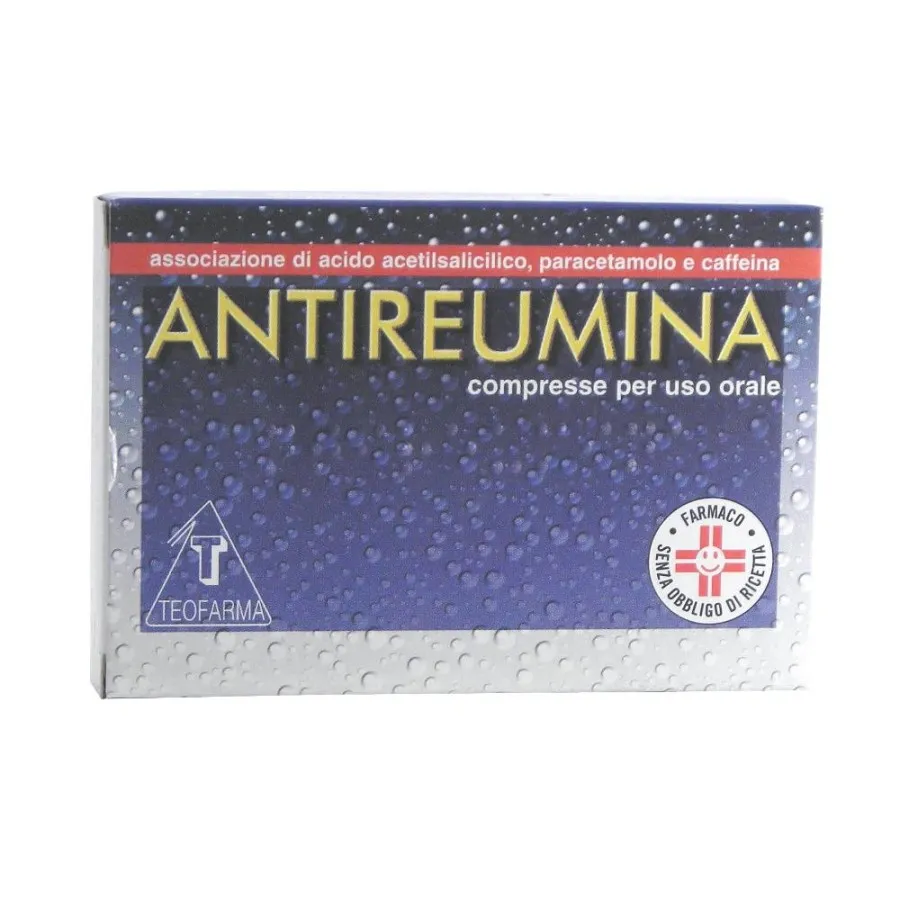
Table of Contents
Package leaflet: Information for the patient
ANTIREUMINA
Tablets
Read this leaflet carefully before taking this medicine because it contains important information for you.
Always take this medicine exactly as described in this leaflet or as your doctor or pharmacist has told you to do.
- Keep this leaflet. You may need to read it again.
- If you need more information or advice, consult your pharmacist.
- If you experience any side effects, including those not listed in this leaflet, contact your doctor or pharmacist. See section 4. Contact your doctor if you do not notice any improvement or if you notice a worsening of symptoms after 3 days.
Contents of this leaflet:
- What Antireumina is and what it is used for
- What you need to know before taking Antireumina
- How to take Antireumina
- Possible side effects
- How to store Antireumina
- Contents of the pack and other information
1. What Antireumina is and what it is used for
Antireumina contains three active ingredients: acetylsalicylic acid and paracetamol, which have analgesic, antipyretic, and anti-inflammatory properties, and caffeine, a mild stimulant that enhances the analgesic effects of the first two compounds.
Antireumina is indicated for the relief of headache and other types of pain such as neuralgia, toothache, menstrual pain, and joint pain. Antireumina is effective in reducing fever and relieving symptoms of colds.
2. What you need to know before taking Antireumina
Do not use Antireumina:
- If you are allergic to acetylsalicylic acid, paracetamol, caffeine, or to any of the other ingredients of this medicine (listed in section 6)
- During the third trimester of pregnancy
- In children and adolescents under sixteen years of age. If you have or have had:
- A confirmed tendency towards bleeding
- Documented presence of stomach or duodenal ulcers
- Glucose-6-phosphate dehydrogenase deficiency (G6PD deficiency, a hereditary disease characterized by deficiency of the enzyme glucose-6-phosphate dehydrogenase)
- Severe haemolytic anaemia (anaemia due to destruction of red blood cells)
- Severe liver function impairment
- Severe asthma
Warnings and precautions
Talk to your doctor or pharmacist before taking Antireumina.
In particular, consult your doctor if:
- You frequently suffer from stomach or intestinal problems
- You are taking other medicines containing paracetamol, because paracetamol, when taken at high doses, may cause serious adverse effects
- You are planning to become pregnant, as the use of this medicine is not recommended
- You have fertility problems or are undergoing fertility investigations, as treatment should be discontinued
- You are being treated with other anti-inflammatory medicines
- You suffer from severe liver or kidney disease
- You are over 70 years old and are receiving concomitant therapies
Do not use this medicine for more than 3 consecutive days without consulting your doctor.
In case of allergic reactions, stop treatment immediately and inform your doctor without delay.
Other medicines and Antireumina
Inform your doctor or pharmacist if you are currently taking, have recently taken, or might take any other medicines.
Use Antireumina with caution and under strict medical supervision if you are taking medicines that may induce hepatic mono-oxygenases, or if you are exposed to substances that may have such an effect (e.g. rifampicin, cimetidine, antiepileptic drugs such as butethimide, phenobarbital, carbamazepine).
Inform your doctor if you are taking:
- Medicines used to reduce blood clotting (anticoagulants),
- Medicines used to lower uric acid levels (uricosuric agents),
- Medicines used in the treatment of diabetes mellitus (sulfonylureas, hypoglycaemic agents),
- Flucloxacillin (an antibiotic), due to a serious risk of blood and fluid disorders (metabolic acidosis with high anion gap) that require urgent treatment and may occur particularly in cases of severe renal impairment, sepsis (when bacteria and their toxins circulate in the blood causing organ damage), malnutrition, chronic alcoholism, or when maximum daily doses of paracetamol are used.
Inform your doctor if you are scheduled for surgery, as this medicine may interfere with stopping blood flow during the procedure (intraoperative haemostasis).
Pregnancy, breastfeeding and fertility
If you are pregnant, think you might be pregnant, planning to become pregnant, or breastfeeding, consult your doctor or pharmacist before taking this medicine.
This product is contraindicated during the third trimester of pregnancy.
If necessary, Antireumina may be used during the first and second trimesters of pregnancy.
It is advisable to use the lowest possible dose that relieves pain and/or fever, and to take it for the shortest possible duration.
Contact your doctor if pain and/or fever do not improve, or if you need to take the medicine more frequently.
Administration of Antireumina should be discontinued in women who have fertility problems or who are undergoing fertility investigations.
Driving and using machines
Antireumina does not impair the ability to drive or operate machinery.
3. How to take Antireumina
Take this medicine exactly as stated in this leaflet or as instructed by your doctor or pharmacist. If you have any doubts, consult your doctor or pharmacist.
The recommended dose of Antireumina is 1 tablet, up to a maximum of 4 tablets per day.
The tablet should be swallowed whole with a little water.
Elderly patients should use reduced doses. This preparation should be taken with a full stomach.
Do not exceed the recommended doses.
If you take more Antireumina than you should:
In case of accidental ingestion/overdose of Antireumina, contact your doctor immediately or go to the nearest hospital. Take the medicine with you.
Overdose may cause:
- liver failure (hepatic cytolysis, which may progress to massive and irreversible necrosis),
- a hyperstimulation syndrome with agitation, insomnia, tinnitus, muscle tremor, nausea, vomiting, increased diuresis, tachycardia, extrasystoles, scotoma.
If you forget to take Antireumina
Do not take a double dose to make up for the missed dose.
If you stop taking Antireumina
If you have any doubts about using this medicine, consult your doctor.
4. Possible side effects
Like all medicines, this medicine can cause side effects, although not everybody will experience them.
Hearing disorders (such as tinnitus, etc.), dizziness and bleeding, particularly affecting the nasal mucosa ("epistaxis") and gums, have also been reported.
With the use of paracetamol, various types and severities of skin reactions, including allergic reactions, have been reported, such as cases of erythema multiforme, Stevens-Johnson syndrome and toxic epidermal necrolysis, conditions which involve varying degrees of widespread skin redness, appearance of blisters on the skin, skin peeling associated with general malaise. Hypersensitivity reactions have also been reported, for example angioedema (i.e. localized and self-limiting swelling affecting tissues under the skin and mucous membranes), laryngeal edema (swelling of the throat causing a sensation of obstruction), anaphylactic shock (a severe, rapidly developing allergic reaction which may even be fatal). Furthermore, the following adverse effects have been reported: reduction in platelet count (blood components that facilitate blood coagulation) and in leukocytes (white blood cells), anaemia, agranulocytosis (absence or reduction of a particular type of white blood cells called granulocytes), alterations in liver function and hepatitis, kidney disorders possibly leading to blood in the urine, gastrointestinal disturbances.
Reporting of side effects
If you experience any side effect, including those not listed in this leaflet, talk to your doctor or pharmacist. You can also report side effects directly via the national reporting system at www.aifa.gov.it/content/segnalazioni-reazioni-avverse. By reporting side effects, you can help provide more information on the safety of this medicine.
5. How to store Antireumina
Keep this medicine out of the sight and reach of children.
Do not use this medicine after the expiry date stated on the packaging. The expiry date refers to the last day of that month.
This medicine does not require any special storage conditions.
Do not dispose of any medicine via wastewater or household waste. Ask your pharmacist how to dispose of medicines no longer required. This will help protect the environment.
6. Package contents and other information
What Antireumina contains
Each tablet contains:
The active substances are:
Acidum acetylsalicylicum 275 mg, Paracetamolum 175 mg, Caffeina 25 mg.
The other components are:
Maize starch, magnesium stearate, precipitated silica, microcrystalline cellulose.
Description of the appearance of Antireumina and the contents of the pack
Antireumina is supplied in a carton containing 10 tablets.
Marketing Authorization Holder and Manufacturer
Marketing Authorization Holder
Teofarma S.r.l. - Via F.lli Cervi 8 - 27010 Valle Salimbene (PV)
Manufacturer
Teofarma S.r.l. - Viale Certosa, 8/A - 27100 Pavia