Wetirin 0.1 mg tablets
Spain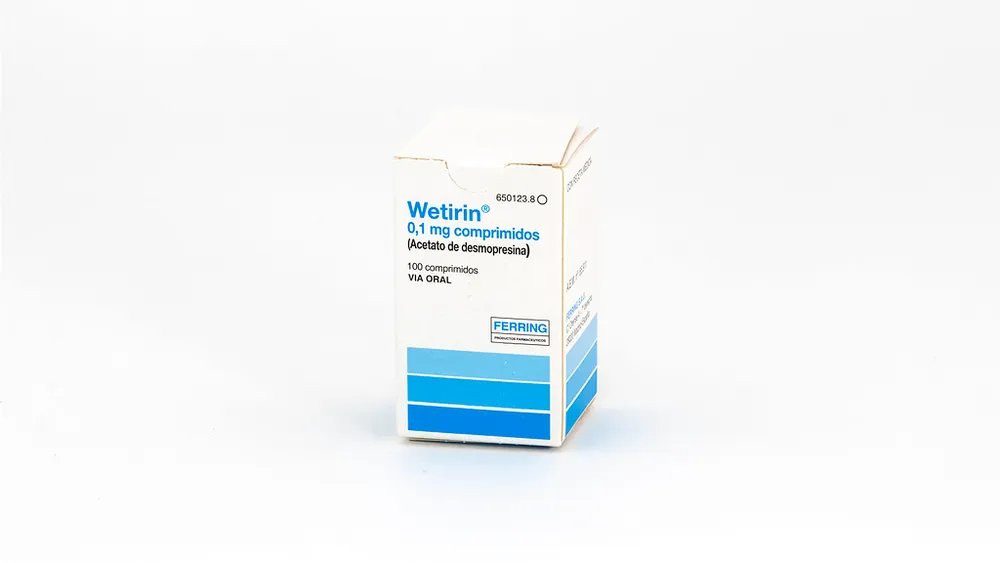
Table of Contents
- Package leaflet: Information for the user
- Introduction
- 1. What Wetirin is and what it is used for
- 2. What you need to know before starting to take Wetirin
- **Warnings and precautions**
- **Use of other medicines and Wetirin**
- **Pregnancy, breastfeeding and fertility**
- 3. How to take Wetirin
- 4. Possible adverse effects
- 5. Storage of Wetirin
- 6.
Package leaflet: Information for the user
Introduction
Package leaflet: Information for the patient
Wetirin 0.1 mg tablets
Desmopressin
Read all of this leaflet carefully before you start taking this medicine, because it contains important information for you.
-
Keep this leaflet, as you may need to read it again.
-
If you have any questions, ask your doctor or pharmacist.
-
This medicine has been prescribed for you only and must not be given to other people, even if they have the same symptoms as you, because it could harm them.
-
If you experience any adverse effects, consult your doctor or pharmacist, even if these effects are not listed in this leaflet. See section 4.
Leaflet contents:
- What Wetirin is and what it is used for
- What you need to know before taking Wetirin
- How to take Wetirin
- Possible side effects
- How to store Wetirin
6. Contents of the pack and other information
1. What Wetirin is and what it is used for
Wetirin contains desmopressin, a structural analogue of the natural pituitary hormone arginine vasopressin. Desmopressin belongs to the group of antidiuretic hormone (vasopressin) analogues, which temporarily reduce the amount of urine produced by the body.
Wetirin is used to treat central diabetes insipidus (continuous thirst and excretion of large amounts of very dilute urine) and primary nocturnal enuresis (urinary incontinence during the night) in patients over 5 years of age who have a normal urine concentrating ability.
2. What you need to know before starting to take Wetirin
Do not take Wetirin
- if you are allergic to the active substance or to any of the other components of this medicine (listed in section 6),
- if you have habitual polydipsia (prolonged excessive thirst) or psychogenic polydipsia (of emotional or psychological origin),
- if you have heart failure or other conditions requiring treatment with diuretics (medicines that increase urine secretion),
- if you have moderate or severe renal failure,
- if you have known hyponatremia (low sodium levels in the blood),
- if you have syndrome of inappropriate antidiuretic hormone secretion (SIADH).
Warnings and precautions
Consult your doctor or pharmacist before starting to take this medicine.
If you have primary nocturnal enuresis, take special care to restrict fluid intake, avoiding drinking from 1 hour before administration until 8 hours afterwards.
Treatment without simultaneous reduction of water intake may cause water retention and/or decreased blood sodium levels, with or without symptoms and warning signs (headache, nausea/vomiting, weight gain, and in severe cases, seizures). See section 4.
Special care must be taken to avoid decreased blood sodium levels in the following cases:
-
Systemic infections, fever, and gastroenteritis (syndrome of inappropriate ADH secretion).
-
Risk of increased intracranial pressure.
-
Imbalance in body water and electrolyte content.
-
Concomitant treatment with medications that may induce nephrogenic diabetes insipidus themselves, such as: antidepressants of the tricyclic type, for example amitriptyline; selective serotonin reuptake inhibitors, for example fluoxetine; chlorpromazine; and carbamazepine.
-
Concomitant treatment with NSAIDs (non-steroidal anti-inflammatory drugs) such as acetylsalicylic acid.
Use of other medicines and Wetirin
Inform your doctor or pharmacist if you are taking, have recently taken, or might need to take any other medicines.
Wetirin may interact with drugs that can cause diabetes insipidus on their own, such as: antidepressant medications including tricyclic antidepressants (e.g. amitriptyline), selective serotonin reuptake inhibitors (e.g. fluoxetine), chlorpromazine, carbamazepine, and certain antidiabetic agents of the sulfonylurea group, particularly chlorpropamide.
Non-steroidal anti-inflammatory drugs (NSAIDs) may induce water retention and decreased blood sodium levels.
Caution is advised if you are being treated with loperamide (a medicine used to treat diarrhea), as it may increase the risk of water retention and low blood sodium levels.
Use of Wetirin with food and drink
It is recommended to take Wetirin with food (not high in fat).
It is recommended not to drink liquids with Wetirin.
Pregnancy, breastfeeding and fertility
If you are pregnant or breastfeeding, think you may be pregnant, or are planning to become pregnant, consult your doctor or pharmacist before using this medicine.
There are insufficient clinical data to support the use of this medicine during pregnancy. Animal studies have not shown any fetal risk potential with desmopressin administration.
Desmopressin passes into breast milk, although in small amounts. Therefore, if treatment with this medicine is required during breastfeeding, replacement of natural breastfeeding is recommended.
Driving and use of machines
Wetirin does not affect the ability to drive or operate machinery.
Important information about excipients:
This medicine contains lactose. If your doctor has informed you of an intolerance to certain sugars, consult him before taking this medicine.
3. How to take Wetirin
Follow exactly the instructions for using this medicine given by your doctor. If in doubt, consult your doctor or pharmacist again.
Usual dose
Central diabetes insipidus: The doctor will adjust the dose individually.
The recommended initial dose is 0.1 mg (one tablet of Wetirin 0.1 mg) taken three times a day. Subsequently, the doctor will adjust the dose according to each patient's response.
The maintenance dose usually ranges between 0.1 mg and 0.2 mg of wetirin (one or two tablets of Wetirin 0.1 mg) three times a day.
Normally, the total daily dose ranges from 0.2 mg to 1.2 mg of desmopressin.
Primary nocturnal enuresis:
The recommended initial dose is 0.2 mg of wetirin at bedtime. If this dose is not sufficiently effective, the dose may be increased up to 0.4 mg of wetirin.
It is important to control fluid intake.
If symptoms or signs of water retention and/or decreased sodium in the blood (headache, nausea and vomiting, weight gain, and in severe cases, seizures) occur, treatment must be discontinued until the patient has recovered. Once treatment is resumed, fluid intake must be strictly controlled.
Swallow the tablet, preferably with a glass of water. It is better to take some food together with the tablet. The tablet should be taken three times a day, preferably with meals in the case of diabetes insipidus. If you are being treated for nocturnal enuresis, it is recommended to take the tablet at bedtime with dinner, once daily.
If you feel that the effect of Wetirin is too strong or too weak, inform your doctor or pharmacist.
Duration of treatment
Your doctor will indicate how long your treatment with Wetirin should last. Do not stop the treatment prematurely, as it may not have the intended effect.
Treatment for nocturnal enuresis will last for 3 months. Then, the doctor will assess whether further treatment is necessary. If so, treatment will be restarted after at least one week of rest.
If you take more Wetirin than you should
In case of overdose or accidental ingestion, contact the Toxicology Information Service at telephone number (91) 562 04 20, indicating the medicine and the amount ingested. It is recommended to bring the package and the leaflet to the healthcare professional.
If an overdose occurs, the duration of action of desmopressin will be prolonged, and some of the symptoms may include water retention and/or decreased sodium in the blood, resulting in headache, nausea and vomiting, weight gain, and in severe cases, seizures. It is recommended to discontinue treatment, restrict fluid intake, and provide symptomatic treatment if necessary.
If you forget to take Wetirin
Do not take a double dose to make up for forgotten doses.
If you stop taking Wetirin
Do not stop treatment with this medicine before completing it, as it may not have the intended effect. You should only change or discontinue treatment if instructed to do so by your doctor.
If you have any further questions about the use of this medicine, ask your doctor or pharmacist.
If you have any further questions about the use of this product, ask your doctor or pharmacist.
4. Possible adverse effects
Like all medicines, this medicine can cause adverse effects, although not everyone experiences them.
Common* (may affect up to 1 in 10 patients):* Headache.
Uncommon* (may affect up to 1 in 100 patients):* Mood changes, aggression, abdominal pain, nausea, vomiting, diarrhoea, symptoms affecting the bladder and urethra, peripheral oedema, fatigue.
Rare* (may affect up to 1 in 1,000 patients):* Anxiety symptoms, nightmares, mood changes, somnolence, hypertension, irritability.
Frequency not known*:* Anaphylactic reaction, hyponatraemia, dehydration, hypernatraemia, abnormal behaviour, emotional disorder, depression, hallucinations, insomnia, attention disturbance, psychomotor hyperactivity, seizures, epistaxis, allergic dermatitis, exanthema, sweating, urticaria.
Due to decreased sodium in the blood caused by water retention as a consequence of treatment, together with reduced fluid intake, headache, nausea, vomiting, decreased sodium levels, weight gain, and in severe cases, seizures may occur.
Reporting of adverse effects:
If you experience any type of adverse effect, consult your doctor or pharmacist, even if it is a possible adverse effect not listed in this leaflet. You can also report them directly via the Spanish Pharmacovigilance System for Human Medicines: http;//www.notificaram.es. By reporting adverse effects, you can help provide more information on the safety of this medicine.
5. Storage of Wetirin
Keep this medicine out of sight and reach of children.
Store in the original container, below 25°C and in a dry place. Do not remove the desiccant from the cap.
Do not use this medicine after the expiry date stated on the container, following “EXP”. The expiry date is the last day of the month indicated.
Medicines must not be disposed of via wastewater drains or household waste. Dispose of unused medicines and their containers at the SIGRE Point at your pharmacy. If you are in doubt, ask your pharmacist how to dispose of medicines and containers you no longer need. This will help protect the environment.
6.
Composition of Wetirin 0.1 mg tablets:
-
The active substance is desmopressin acetate. Each tablet contains 0.1 mg of desmopressin acetate, equivalent to 0.089 mg of desmopressin base.
-
The other components are: monohydrate lactose, potato starch, povidone, and magnesium stearate.
Appearance of the product and contents of the pack
The tablets are white, oval-shaped, biconvex, with a unique imprint on one side stating “0.1 milligrams”.
The product is supplied in 30 ml high-density polyethylene bottles with a polypropylene cap and child-resistant closure. A silica gel capsule is included in the cap, acting as a desiccant.
The bottle contains 100 tablets.
Marketing Authorization Holder
FERRING, S.A.U
C/ del Arquitecto Sánchez Arcas nº3, 1º
28040 Madrid
Spain
Manufacturer responsible
FERRING GmbH
Wittland 11,
D-24109 Kiel
GERMANY
Date of the most recent review of the leaflet: November 2020
Detailed and up-to-date information on this medicinal product is available on the website of the Spanish Agency of Medicines and Medical Devices (AEMPS) http://www.aemps.gob.es/