Vildagliptin/metformin Tecnigen 50 mg/1,000 mg film-coated tablets EFG
Spain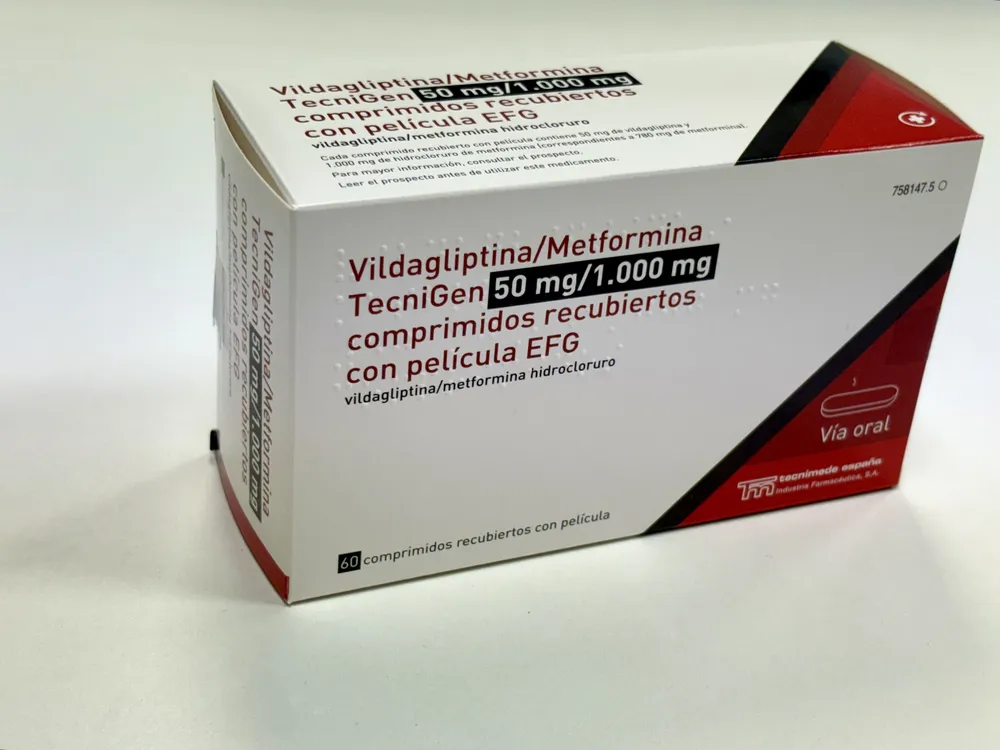
Table of Contents
- Package leaflet: Information for the user
- Introduction
- **Package Leaflet: Information for the Patient**
- **Read the entire leaflet carefully before starting to take this medicine, as it contains important information for you.**
- **Package leaflet contents**
- 1. What Vildagliptin/Metformin TecniGen is and what it is used for
- **How vildagliptin/metformin works**
- 2. What you need to know before starting to take Vildagliptin/Metformin TecniGen
- 3. How to take Vildagliptin/Metformin TecniGen
- **Instructions for use of vildagliptin/metformin**
- **If you take more vildagliptin/metformin than you should**
- **If you forget to take vildagliptin/metformin**
- **If you stop treatment with vildagliptin/metformin**
- 4. Possible side effects
- 5. Storage of Vildagliptin/Metformin TecniGen
- 6. Package contents and other information
Package leaflet: Information for the user
Introduction
Package Leaflet: Information for the Patient
Vildagliptin/Metformin TecniGen 50 mg/850 mg Film-coated Tablets EFG
Vildagliptin/Metformin TecniGen 50 mg/1,000 mg Film-coated Tablets EFG
vildagliptin/metformin hydrochloride
Read the entire leaflet carefully before starting to take this medicine, as it contains important information for you.
- Keep this leaflet, as you may need to read it again.
- If you have any questions, consult your doctor, pharmacist, or nurse.
- This medicine has been prescribed for you only, and you should not give it to others, even if they have the same symptoms as you, as it may harm them.
- If you experience any adverse effects, consult your doctor, pharmacist, or nurse, even if they are adverse effects not listed in this leaflet. See section 4.
Package leaflet contents
- What Vildagliptin/Metformin TecniGen is and what it is used for
- What you need to know before taking Vildagliptin/Metformin TecniGen
- How to take Vildagliptin/Metformin TecniGen
- Possible side effects
- How to store Vildagliptin/Metformin TecniGen
- Contents of the pack and other information
1. What Vildagliptin/Metformin TecniGen is and what it is used for
The active substances in this medicine, vildagliptin and metformin, belong to a group of medicines called "oral antidiabetics".
Vildagliptin/metformin is used to treat adult patients with type 2 diabetes. This type of diabetes is also known as non-insulin-dependent diabetes mellitus.
Vildagliptin/metformin is used when diabetes cannot be controlled by diet and exercise alone and/or with other medications used to treat diabetes (insulin or sulfonylureas).
Type 2 diabetes occurs when the body does not produce enough insulin or when the insulin produced does not work properly. It may also occur when the body produces too much glucagon.
Insulin and glucagon are produced in the pancreas. Insulin helps reduce blood sugar levels, especially after meals. Glucagon promotes sugar production by the liver and causes blood sugar levels to rise.
How vildagliptin/metformin works
Both active substances, vildagliptin and metformin, help control blood sugar levels. The active substance vildagliptin stimulates the pancreas to produce more insulin and less glucagon. The active substance metformin helps the body use insulin more effectively. This medicine has been shown to reduce blood sugar, which will help prevent complications of your diabetes.
2. What you need to know before starting to take Vildagliptin/Metformin TecniGen
Do not take vildagliptin/metformin
- if you are allergic to vildagliptin, metformin, or any of the other ingredients of this medicine (listed in section 6). If you think you might be allergic to any of these ingredients, consult your doctor before taking vildagliptin/metformin.
- if you have uncontrolled diabetes, for example, severe hyperglycemia (high blood glucose), nausea, vomiting, diarrhea, rapid weight loss, lactic acidosis (see “Risk of lactic acidosis” below), or ketoacidosis. Ketoacidosis is a condition in which substances called “ketone bodies” accumulate in the blood, which may lead to diabetic pre-coma. Symptoms include stomach pain, deep and rapid breathing, drowsiness, or a fruity, unusual odor on your breath.
- if you have recently had a heart attack, or if you have heart failure or severe circulatory problems or breathing difficulties that may be signs of heart problems.
- if you have severely reduced kidney function.
- if you have a severe infection or severe dehydration (massive loss of body water).
- if you are scheduled to undergo contrast radiology (a specific type of diagnostic X-ray procedure using an injectable contrast agent). For more information, see the section “Warnings and precautions”.
- if you have liver problems.
- if you drink alcohol excessively (either daily or only occasionally).
- if you are breastfeeding (see also “Pregnancy and breastfeeding”).
Warnings and precautions
Risk of lactic acidosis
Vildagliptin/metformin may cause a very rare but serious adverse effect called lactic acidosis, especially if your kidneys are not functioning properly. The risk of developing lactic acidosis is also increased in uncontrolled diabetes, severe infections, prolonged fasting or alcohol consumption, dehydration (see further information below), liver problems, and any medical condition in which a part of the body has a reduced oxygen supply (such as acute and severe heart diseases).
If any of the above applies to you, consult your doctor for further instructions.
Stop taking vildagliptin/metformin temporarily if you develop a condition that may be associated with dehydration (significant loss of body fluids), such as severe vomiting, diarrhea, fever, heat exposure, or if you are drinking less fluid than usual. Consult your doctor for further instructions.
Stop taking vildagliptin/metformin and contact your doctor or the nearest hospital immediately if you experience any of the symptoms of lactic acidosis, as this condition may lead to coma.
Symptoms of lactic acidosis include:
- vomiting
- stomach pain (abdominal pain)
- muscle cramps
- general feeling of discomfort with severe fatigue
- difficulty breathing
- decreased body temperature and heart rate
Lactic acidosis is a medical emergency and must be treated in a hospital.
Contact your doctor promptly for advice if:
- You are known to have a genetic mitochondrial disease (components that produce energy inside cells), such as MELAS syndrome (mitochondrial encephalopathy, myopathy, lactic acidosis, and stroke-like episodes) or maternally inherited diabetes and deafness (MIDD).
- You experience any of the following symptoms after starting metformin treatment: seizures, cognitive decline, difficulty with body movements, signs of nerve damage (e.g., pain or numbness), migraine, or deafness.
Vildagliptin/metformin is not a substitute for insulin. Therefore, you should not take vildagliptin/metformin for the treatment of type 1 diabetes.
Consult your doctor, pharmacist, or nurse before starting vildagliptin/metformin if you have or have had a pancreatic disease.
Consult your doctor, pharmacist, or nurse before starting vildagliptin/metformin if you are taking an antidiabetic medicine known as a sulfonylurea. Your doctor may wish to reduce your sulfonylurea dose when taken together with vildagliptin/metformin to prevent low blood glucose levels (hypoglycemia).
If you previously took vildagliptin but had to discontinue it due to liver disease, you should not take this medicine.
Skin lesions are common complications of diabetes. Follow your doctor's or nurse's recommendations for skin and foot care. Pay special attention to the appearance of blisters or ulcers while taking vildagliptin/metformin. If this occurs, you must consult your doctor immediately.
If you require major surgery, you must stop taking vildagliptin/metformin during the procedure and for a period afterward. Your doctor will decide when to interrupt and when to restart treatment with vildagliptin/metformin.
Liver function tests should be performed before starting treatment with vildagliptin/metformin, every three months during the first year, and periodically thereafter. This is done to detect as early as possible any signs indicating elevated liver enzymes (transaminases).
During treatment with vildagliptin/metformin, your doctor will check your kidney function at least once a year, or more frequently if you are elderly and/or if your kidney function is deteriorating.
Your doctor will periodically monitor your blood and urine glucose levels.
Children and adolescents
The use of vildagliptin/metformin is not recommended in children and adolescents under 18 years of age.
Other medicines and vildagliptin/metformin
If you need to receive an intravenous injection of an iodine-containing contrast agent, for example, during an X-ray or scan, you must stop taking vildagliptin/metformin before or at the time of the injection. Your doctor will decide when to interrupt and when to restart treatment with vildagliptin/metformin.
Inform your doctor if you are taking, have recently taken, or might need to take any other medicine. You may require more frequent blood glucose and kidney function tests, or your doctor may need to adjust the dose of vildagliptin/metformin. It is especially important to mention the following:
- corticosteroids, generally used to treat inflammation
- beta-2 agonists, generally used to treat respiratory disorders
- other active substances used to treat diabetes
- medicines that increase urine production (diuretics)
- medicines used to treat pain and inflammation (NSAIDs and COX-2 inhibitors, such as ibuprofen and celecoxib)
- certain medicines used to treat hypertension (ACE inhibitors and angiotensin II receptor antagonists)
- certain active substances affecting the thyroid gland
- certain active substances affecting the nervous system
- certain active substances used to treat angina pectoris (e.g., ranolazine)
- certain active substances used to treat HIV infection (e.g., dolutegravir)
- certain active substances used to treat a specific type of thyroid cancer (medullary thyroid cancer) (e.g., vandetanib)
- certain active substances used to treat stomach acidity and peptic ulcers (e.g., cimetidine)
Taking vildagliptin/metformin with alcohol
Avoid excessive alcohol consumption while taking vildagliptin/metformin, as this may increase the risk of lactic acidosis (see section “Warnings and precautions”).
Pregnancy and breastfeeding
- If you are pregnant, think you may be pregnant, or plan to become pregnant, consult your doctor before using this medicine. Your doctor will inform you about the potential risks of taking vildagliptin/metformin during pregnancy.
- Do not take vildagliptin/metformin if you are pregnant or breastfeeding (see also “Do not take vildagliptin/metformin”).
Consult your doctor or pharmacist before using any medicine.
Driving and use of machines
If you feel dizzy while taking vildagliptin/metformin, do not drive or operate tools or machinery.
Vildagliptin/Metformin TecniGen contains sodium
This medicine contains less than 23 mg of sodium (1 mmol) per tablet, i.e., essentially “sodium-free”.
3. How to take Vildagliptin/Metformin TecniGen
The dose of vildagliptin/metformin required varies depending on the individual's condition. Your doctor will tell you exactly what dose of vildagliptin/metformin you should take.
Always follow exactly the instructions provided by your doctor for taking this medicine. If you are unsure, consult your doctor or pharmacist again.
The recommended dose is one 50 mg/850 mg or 50 mg/1,000 mg film-coated tablet twice daily.
If you have reduced kidney function, your doctor may prescribe a lower dose. Your doctor may also prescribe a lower dose if you are taking another diabetes medicine such as a sulfonylurea.
Your doctor may prescribe this medicine alone or together with certain other medicines that lower your blood sugar levels.
Instructions for use of vildagliptin/metformin
- Swallow the tablets whole with a glass of water.
- Take one tablet in the morning and one in the evening with meals or after meals. Taking the tablet after meals will reduce the risk of gastrointestinal discomfort.
Follow your doctor's dietary advice. In particular, if you are following a diabetic weight-control diet, continue with this diet while taking vildagliptin/metformin.
If you take more vildagliptin/metformin than you should
If you have taken too many tablets of this medicine or if someone else has taken your tablets, consult your doctor or pharmacist immediately. You may need medical attention. If you need to visit a doctor or go to the nearest hospital, take the pack and this leaflet with you.
In case of overdose or accidental ingestion, contact your doctor or pharmacist immediately or call the Toxicology Information Service at telephone number: 91 562 04 20, indicating the medicine and the amount ingested.
If you forget to take vildagliptin/metformin
If you forget to take a tablet, take it with your next meal, unless it is already time for your usual dose. Do not take a double dose (two tablets at the same time) to make up for a missed dose.
If you stop treatment with vildagliptin/metformin
Continue taking this medicine for as long as your doctor prescribes it to maintain control of your blood sugar. Do not stop treatment with vildagliptin/metformin unless your doctor tells you to. If you have any doubts about how long you should continue treatment, consult your doctor.
If you have any further questions about the use of this medicine, ask your doctor, pharmacist, or nurse.
4. Possible side effects
Like all medicines, this medicine can cause side effects, although not everyone will experience them.
You must stop taking vildagliptine/metformin and contact your doctor immediately if you experience any of the following side effects:
- Lactic acidosis (very rare: may affect up to 1 in 10,000 people): Vildagliptine/metformin may cause a very rare but serious side effect called lactic acidosis (see section “Warnings and precautions”). If this occurs, you must stop taking vildagliptine/metformin and contact a doctor or go to the nearest hospital immediately, as lactic acidosis can lead to coma.
- Angioedema (rare: may affect up to 1 in 1,000 people): symptoms including swelling of the face, tongue or throat, difficulty swallowing, difficulty breathing, sudden appearance of rash or hives, which may indicate a reaction called “angioedema”.
- Liver disease (hepatitis) (rare): symptoms including yellowing of the skin and eyes, nausea, loss of appetite, or dark urine, which may indicate liver disease (hepatitis).
- Inflammation of the pancreas (pancreatitis) (frequency not known): symptoms including severe and persistent abdominal pain (stomach area), which may radiate to your back, as well as nausea and vomiting.
Other side effects
Some patients have experienced the following side effects while taking vildagliptine/metformin:
- Very common (may affect more than 1 in 10 people): nausea, vomiting, diarrhoea, stomach-area pain (abdominal pain), loss of appetite.
- Common (may affect up to 1 in 10 people): dizziness, headache, uncontrollable tremor, metallic taste, decrease in blood glucose.
- Uncommon (may affect up to 1 in 100 people): joint pain, fatigue, constipation, swollen hands, ankles or feet (oedema).
- Very rare (may affect up to 1 in 10,000 people): sore throat, nasal congestion and fever; signs of high levels of lactic acid in the blood (known as lactic acidosis) such as drowsiness or dizziness, severe vomiting and nausea, abdominal pain, irregular heartbeat or deep, rapid breathing; skin redness, itching; decreased levels of vitamin B12 (pallor, tiredness, mental symptoms such as confusion or memory disturbances).
Some patients have experienced the following side effects while taking vildagliptine/metformin and a sulphonylurea:
- Common: dizziness, tremor, weakness, low blood glucose levels, excessive sweating.
Some patients have experienced the following side effects while taking vildagliptine/metformin and insulin:
- Common: headache, chills, nausea (feeling unwell), low blood glucose levels, heartburn.
- Uncommon: diarrhoea, flatulence.
Since the marketing of this product, the following side effects have also been reported:
- Frequency not known (cannot be estimated from available data): itchy rash, inflammation of the pancreas, localized skin peeling or blistering, muscle pain.
Reporting of side effects
If you experience any type of side effect, talk to your doctor or pharmacist, even if it is a possible side effect not listed in this leaflet. You can also report them directly via the Spanish Pharmacovigilance System for Human Medicines: https://www.notificaram.es. By reporting side effects, you can help provide more information on the safety of this medicine.
5. Storage of Vildagliptin/Metformin TecniGen
Keep this medicine out of the sight and reach of children.
Do not use this medicine after the expiry date which is stated on the blister pack and on the outer packaging following EXP. The expiry date refers to the last day of the month indicated.
This medicine does not require any special storage conditions.
Medicines should not be disposed of via wastewater or household waste. Medicines and their containers should be taken to the SIGRE point at your pharmacy. If you have any doubts, ask your pharmacist how to dispose of medicines and containers you no longer need. This will help protect the environment.
6. Package contents and other information
Composition of Vildagliptin/Metformin TecniGen
-
The active substances are vildagliptin and metformin hydrochloride:
-
Each film-coated tablet of Vildagliptin/Metformin TecniGen 50 mg/850 mg contains 50 mg of vildagliptin and 850 mg of metformin hydrochloride (equivalent to 660 mg of metformin).
-
Each film-coated tablet of Vildagliptin/Metformin TecniGen 50 mg/1.000 mg contains 50 mg of vildagliptin and 1.000 mg of metformin hydrochloride (equivalent to 780 mg of metformin).
-
The other components are: In the tablet core: sodium carbonate, hydroxypropyl cellulose, magnesium stearate. In addition, the film coating contains: hypromellose, macrogol, titanium dioxide (E-171), yellow iron oxide (E-172), talc.
Appearance of the product and contents of the package
Vildagliptin/Metformin TecniGen 50 mg/850 mg film-coated tablets EFG
Film-coated tablets, oval-shaped, with bevelled edges and yellow in colour, smooth on both sides, measuring 19.90 ± 0.2 mm in length and 7.90 ± 0.2 mm in width.
Vildagliptin/Metformin TecniGen 50 mg/1.000 mg film-coated tablets EFG
Film-coated tablets, oval-shaped, with bevelled edges and dark yellow in colour, smooth on both sides, measuring 21.00 ± 0.2 mm in length and 8.30 ± 0.2 mm in width.
Presented in ALU/ALU-aluminum blisters, in packs of 60 film-coated tablets.
Marketing Authorisation Holder and Manufacturer
Marketing Authorisation Holder
Tecnimede España Industria Farmacéutica, S.A.
Avda. de Bruselas, 13, 3º D. Edificio América. Polígono Arroyo de la Vega,
28108 Alcobendas (Madrid)
Spain
Manufacturer
Atlantic Pharma – Produções Farmacêuticas, S.A.
Rua da Tapada Grande, n.º 2
Abrunheira, 2710-089 Sintra
Portugal
or
Tecnimede – Sociedade Técnico-Medicinal S.A.
Quinta da Cerca, Caixaria
2565-187 Dois Portos
Portugal
Date of latest revision of this leaflet: March 2025
Detailed and up-to-date information on this medicinal product is available on the website of the Spanish Agency for Medicines and Health Products (AEMPS) http://www.aemps.gob.es/.