Verrupatch 3.75 mg cutaneous patches
Spain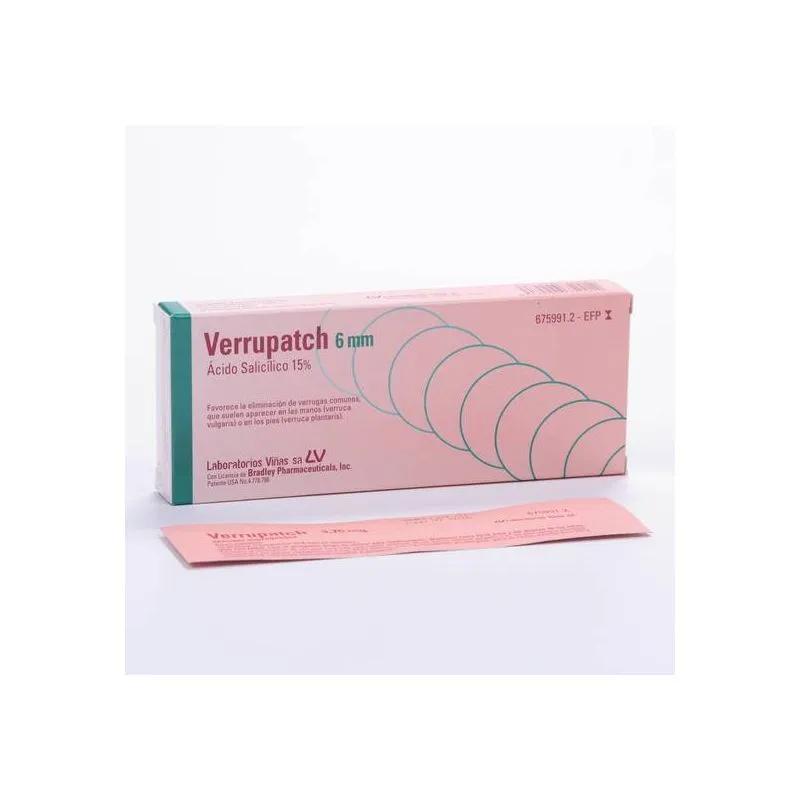
Table of Contents
- Patient Information Leaflet
- Introduction
- **Package leaflet contents**
- 1. What Verrupatch is and what it is used for
- 2. What you need to know before using Verrupatch
- **Warnings and precautions**
- Young children may have a higher risk of adverse effects.
- **Driving and use of machines**
- 3. How to use Verrupatch
- 4. Possible adverse effects
- 5. Storage of Verrupatch
- 6. Contents of the pack and other information
- **Composition of Verrupatch**
Patient Information Leaflet
Introduction
Patient Information Leaflet
Verrupatch 3.75 mg cutaneous patches
salicylic acid
Read the entire leaflet carefully before you start using this medicine, as it contains important information for you. Always follow exactly the instructions for use provided in this leaflet or those given by your doctor or pharmacist.
|
Package leaflet contents
- What Verrupatch is and what it is used for
- What you need to know before using Verrupatch
- How to use Verrupatch
- Possible side effects
- Storage of Verrupatch
- Contents of the pack and other information
1. What Verrupatch is and what it is used for
Verrupatch is a medication in the form of cutaneous patches and belongs to the group of antiverruga medications.
It contains salicylic acid as the active ingredient, which has antiverruga properties due to its keratolytic activity, producing softening and subsequent destruction of the stratum corneum, thereby enabling the removal of warts.
Verrupatch is indicated for the local treatment of common warts, which usually appear on the hands or feet (plantar warts).
2. What you need to know before using Verrupatch
Do not use Verrupatch
- If you are allergic to salicylic acid or any of the other ingredients of this medicine (listed in section 6).
- Do not apply to moles, birthmarks, warts with hairs, genital warts, facial warts, or to mucous membranes.
- Do not use this product on irritated or broken skin, or on any area that is infected, inflamed, or red.
- Do not use in children under 2 years of age.
Warnings and precautions
Consult your doctor or pharmacist before starting to use Verrupatch.
Do not ingest. For cutaneous use only (on the skin only).
Avoid contact with healthy skin.
Avoid contact with the eyes.
In case of accidental contact with the eyes, rinse thoroughly with plenty of water.
Diabetic patients or those with poor circulation should consult their doctor before using this medicine.
Children
Do not use in children between 2 and 12 years of age without medical advice (See Do not use Verrupatch).
Young children may have a higher risk of adverse effects.
Other medicines and Verrupatch
Inform your doctor or pharmacist if you are taking, have recently taken, or might need to take any other medicines.
Do not use this medicine together with other keratolytic agents (anti-wart treatments) on the same area, as they may enhance its effect.
Pregnancy and breastfeeding
If you are pregnant or breastfeeding, think you may be pregnant, or are planning to become pregnant, consult your doctor or pharmacist before using this medicine.
You should not use Verrupatch during pregnancy, except for short-term treatment of a small wart.
Oral forms (e.g., tablets) of this class of medicine may cause adverse effects on the fetus. It is unknown whether the same risks apply to Verrupatch when used for warts.
A decision must be made whether to discontinue breastfeeding or to discontinue treatment, taking into account the benefit of breastfeeding for the child and the benefit of treatment for the mother.
Driving and use of machines
The influence of Verrupatch on the ability to drive and use machines is none or negligible.
Verrupatch contains propylene glycol (E-1520)
This medicine contains 11.25 mg of propylene glycol in each dose unit (patch).
Propylene glycol may cause skin irritation.
3. How to use Verrupatch
Follow exactly the instructions for use provided in this leaflet or those given by your doctor or pharmacist. If in doubt, consult your doctor or pharmacist.
For topical use (on the skin).
The recommended dose is one Verrupatch patch once daily, preferably applied before going to bed.
Use in children
Do not use in children under 2 years of age.
In children under 12 years and over 2 years of age, do not use without medical advice and avoid prolonged use in children.
Instructions for correct application


|
|
|


 Leave the patch in place overnight (approximately 8 hours) and remove it in the morning. Repeat this process daily for up to 12 weeks, until the wart has been completely removed. Noticeable improvement generally occurs within the first few days, so complete resolution can be expected after a treatment period of between 3 and 6 weeks.
Consult your doctor or pharmacist if you do not notice any improvement after 1 week, if you have numerous warts, or if infection or inflammation occurs.
If you use more Verrupatch than you should
Overdose is not expected due to the method of application of this medicine. Excessive use may cause irritation, especially on healthy skin. In such cases, use emollients.
In case of overdose or accidental ingestion, consult your doctor or pharmacist immediately, go to a medical center, or contact the Toxicology Information Service at telephone number 91 562 04 20, indicating the medication and the amount used.
If you forget to use Verrupatch
Do not apply a double dose to make up for a missed dose. Apply the product again at your usual time.
If you stop treatment with Verrupatch
If you have any further questions about the use of this medicine, ask your doctor or pharmacist.
4. Possible adverse effects
Like all medicines, this medicine may produce adverse effects, although not everyone will experience them.
Local irritation may occur if the patches come into contact with the healthy skin surrounding the wart. In such cases, it is recommended to temporarily discontinue treatment until the irritation subsides. When resuming treatment, special care should be taken to ensure that the patch is properly trimmed so that it only contacts the wart tissue.
Excessive desquamation has been reported when applied to open lesions; serious allergic reactions have also been reported.
Reporting of adverse effects
If you experience any type of adverse effect, consult your doctor or pharmacist, even if it is a possible adverse effect not listed in this leaflet. You may also report them directly via the Spanish Pharmacovigilance System for Human Medicinal Products: www.notificaRAM.es. By reporting adverse effects, you can help provide more information on the safety of this medicine.
5. Storage of Verrupatch
Keep this medicine out of the sight and reach of children.
No special storage conditions are required.
Do not use this medicine after the expiry date stated on the packaging after EXP. The expiry date refers to the last day of the month indicated.
Do not use this medicine if you notice any visible signs of deterioration in the appearance of the skin patches.
Medicines must not be disposed of via wastewater or household waste. Dispose of empty containers and unused medicines at the SIGRE Point located at your pharmacy. If in doubt, ask your pharmacist how to properly dispose of unused containers and medicines. This will help protect the environment.
6. Contents of the pack and other information
Composition of Verrupatch
- The active substance is salicylic acid. Each patch contains 3.75 mg of salicylic acid.
- The other components (excipients) are: propylene glycol (E-1520), karaya gum, polyethylene glycol 300 (Macrogol 300), and quaternium-15.
Appearance of the product and contents of the pack
Verrupatch is presented as circular skin patches, 6 mm in diameter, beige in colour, covered by a blue polyethylene film that retains moisture, providing an occlusive effect.
Each pack contains 20 patches arranged in two moisture-resistant sealed pouches, with 10 patches each.
To secure the patches in position, 20 dermatologically compatible adhesive strips are included. A file is also provided to remove residual material from the surface of the wart.
Marketing Authorization Holder
Laboratorios Viñas, S.A.
Provenza, 386
08025 - Barcelona
Spain
Manufacturer
Laboratorios Viñas, S.A.
Torrente Vidalet, 29
08012 - Barcelona
Spain
Date of most recent review of this leaflet: November 2024
Detailed information on this medicinal product is available on the website of the Spanish Agency for Medicines and Health Products (AEMPS) http://www.aemps.es/