Treprostinil Ferrer 2.5 mg/ml solution for infusion EFG
Spain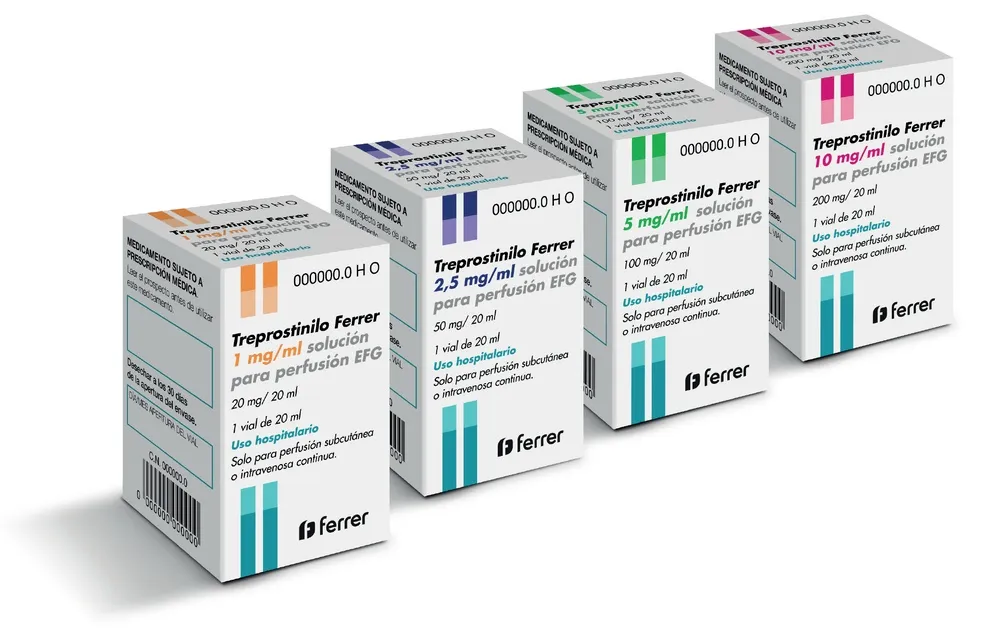
Table of Contents
- Package leaflet: Information for the user
- Introduction
- 1. What Treprostinil Ferrer is and what it is used for
- 2. What you need to know before using Treprostinil Ferrer
- 3. How to use Treprostinil Ferrer
- 4. Possible adverse effects
- 5. Storage of Treprostinil Ferrer
- 6. Contents of the pack and other information
Package leaflet: Information for the user
Introduction
Package leaflet: information for the user
Treprostinil Ferrer 1mg/ml solution for infusion EFG
Treprostinil Ferrer 2.5mg/ml solution for infusion EFG
Treprostinil Ferrer 5mg/ml solution for infusion EFG
Treprostinil Ferrer 10mg/ml solution for infusion EFG
Read the entire leaflet carefully before you start using this medicine, because it contains important information for you.
- Keep this leaflet, as you may need to read it again.
- If you have any questions, consult your doctor.
- This medicine has been prescribed for you only, and you should not give it to other people, even if they have the same symptoms as you, because it could harm them.
- If you experience any adverse effects, consult your doctor or pharmacist, even if they are effects not listed in this leaflet. See section 4.
Leaflet contents
- What Treprostinil Ferrer is and what it is used for
- What you need to know before using Treprostinil Ferrer
- How to use Treprostinil Ferrer
- Possible adverse effects
- How to store Treprostinil Ferrer
- Contents of the pack and other information
1. What Treprostinil Ferrer is and what it is used for
What treprostinil is
The active substance in Treprostinil Ferrer is treprostinil.
Treprostinil belongs to a group of medicines whose action is similar to that of natural prostacyclins. Prostacyclins are hormone-like substances that reduce blood pressure by relaxing blood vessels, thereby widening them and allowing blood to flow more easily. Prostacyclins can also prevent blood from clotting.
What treprostinil is used for
Treprostinil is used to treat idiopathic or hereditary pulmonary arterial hypertension (PAH) in patients with moderate symptoms. Pulmonary arterial hypertension is a condition in which blood pressure is too high in the blood vessels between the heart and the lungs. This causes shortness of breath, dizziness, fatigue, fainting, palpitations or irregular heartbeats, dry cough, chest pain, and swelling of the ankles or legs.
Treprostinil Ferrer is initially administered by continuous subcutaneous infusion (under the skin). Some patients may not tolerate this route of administration due to local pain and swelling. Your doctor will decide whether you can be given Treprostinil Ferrer by continuous intravenous infusion (directly into a vein). This method requires the insertion of a central venous catheter, which is usually placed in the neck, chest, or groin.
How treprostinil works
Treprostinil reduces blood pressure in the pulmonary artery by improving circulation and decreasing the workload of the heart. Improved blood circulation increases oxygen delivery to the body and reduces the effort required by the heart, enabling it to work more efficiently. Treprostinil improves symptoms associated with PAH and exercise capacity in patients with reduced activity levels.
2. What you need to know before using Treprostinil Ferrer
Do not use Treprostinil Ferrer:
-
if you are allergic to treprostinil or to any of the other components of this medicine (listed in section 6);
-
if you have been diagnosed with a condition called "pulmonary veno-occlusive disease." In this disease, the blood vessels carrying blood through the lungs become swollen and blocked, increasing pressure in the blood vessels between the heart and lungs;
-
if you have severe liver failure;
-
if you have a heart condition, for example:
- a myocardial infarction (heart attack) within the last six months
- significant changes in heart rate
- severe coronary artery disease or unstable angina
- a diagnosed heart defect, such as a faulty heart valve causing improper heart function
- any untreated heart disease or one under close medical monitoring;
-
if you are at specific high risk of bleeding, for example, due to active stomach ulcers, injuries, or other bleeding disorders;
-
if you have had a stroke within the last 3 months, or any interruption of blood supply to the brain.
Warnings and precautions
Talk to your doctor before starting Treprostinil Ferrer:
- if you have any liver disease
- if you have been diagnosed as clinically obese (BMI greater than 30 kg/m²)
- if you have human immunodeficiency virus (HIV) infection
- if you have high blood pressure in the liver veins (portal hypertension)
- if you have a congenital heart defect affecting blood flow through the heart
- if you are on a low-salt diet
During treatment with this medicine, inform your doctor:
- if your blood pressure drops (hypotension)
- if you experience a rapid worsening of breathing difficulties or persistent cough (which may be related to pulmonary congestion, asthma, or another condition)—contact your doctor immediately.
- if you experience excessive bleeding, as treprostinil may increase the risk by interfering with blood clotting.
- if you develop fever while receiving treprostinil intravenously, or if the intravenous administration site becomes red, swollen, or painful to touch, as these may be signs of infection.
Use of Treprostinil Ferrer with other medicines
Inform your doctor or pharmacist if you are taking, have recently taken, or might need to take any other medicines.
Tell your doctor if you are taking:
- medicines to treat high blood pressure (antihypertensives or other vasodilators)
- medicines used to increase urine output (diuretics), including furosemide
- medicines that interfere with blood clotting (anticoagulants), such as products containing warfarin, heparin, or nitric oxide
- any non-steroidal anti-inflammatory drugs (NSAIDs) (such as acetylsalicylic acid or ibuprofen)
- medicines that may increase or decrease the effect of treprostinil (such as gemfibrozil, rifampicin, trimethoprim, deferasirox, phenytoin, carbamazepine, phenobarbital, St. John’s wort), as your doctor may need to adjust the dose of treprostinil.
Pregnancy and breastfeeding
If you are pregnant or breastfeeding, think you may be pregnant, or plan to become pregnant, consult your doctor before using this medicine.
Treprostinil is not recommended if you are pregnant, planning to become pregnant, or think you may be pregnant, unless considered essential by your doctor. The safety of this medicine during pregnancy has not been established.
Treprostinil is not recommended during breastfeeding unless considered essential by your doctor. You are advised to discontinue breastfeeding if prescribed treprostinil, as it is unknown whether this medicine is excreted in breast milk.
It is strongly recommended to use contraceptive methods during treatment with treprostinil.
Driving and use of machines
Treprostinil Ferrer may cause low blood pressure, dizziness, and fainting. In such cases, do not drive or operate machinery and consult your doctor.
Treprostinil Ferrer contains sodium
This medicine contains up to 78.4 mg (3.41 mmol) of sodium (the main component of table/cooking salt) in each 20 ml. This corresponds to 4% of the maximum daily sodium intake recommended for an adult.
3. How to use Treprostinil Ferrer
Follow exactly the administration instructions for this medicine as given by your doctor. If in doubt, consult your doctor again.
Treprostinil Ferrer is administered as a continuous infusion:
- Subcutaneously (under the skin) through a small tube (cannula) placed in the abdomen or thigh; or,
- Intravenously through a tube (catheter) usually placed in the neck, chest, or groin.
In both cases, a portable pump delivers treprostinil through the tube.
Before leaving the hospital or clinic, your doctor will instruct you on how to prepare Treprostinil Ferrer and at what rate the pump should deliver the medication. You should also be provided with information on how to properly use the pump and what to do if it stops working. This information should include emergency contact persons.
Purging the infusion line while it is connected may cause accidental overdose.
Treprostinil Ferrer is diluted only when administered intravenously:
For intravenous infusion only: The Treprostinil Ferrer solution should be diluted only with sterile water for injection or with 0.9% sodium chloride solution for infusion if administered by continuous intravenous infusion.
Adult patients
Treprostinil Ferrer is available as a 1 mg/mL, 2.5 mg/mL, 5 mg/mL, or 10 mg/mL solution for infusion. Your doctor will determine the appropriate infusion rate and dose for your condition.
Patients with overweight
If you are overweight (weighing 30% or more above your ideal body weight), your doctor will determine the initial and subsequent doses based on your ideal body weight. See section 2, "Warnings and precautions."
Elderly patients
Your doctor will determine the appropriate infusion rate and dose for your condition.
Dose adjustment
The infusion rate for each individual patient may be reduced or increased only under medical supervision.
The goal of adjusting the infusion rate is to establish an effective maintenance dose that improves symptoms of PAH while minimizing adverse effects.
If your symptoms worsen, if you require complete rest, are confined to bed or a chair, or if any physical activity causes discomfort and your symptoms occur at rest, do not increase the dose without consulting your doctor. It is possible that treprostinil is no longer sufficient to treat your condition and you may require additional therapy.
How can bloodstream infections be prevented during intravenous treprostinil administration?
As with all long-term intravenous treatments, there is a risk of developing a bloodstream infection. Your doctor will advise you on how to prevent these infections.
Use in children and adolescents
Limited data are available in children and adolescents.
If you use more Treprostinil Ferrer than you should
If an overdose of treprostinil is accidentally administered, you may experience nausea, vomiting, diarrhea, low blood pressure (dizziness, lightheadedness, or fainting), flushing, or headache.
If any of these symptoms become severe, you must contact your doctor or hospital immediately. Your doctor may reduce the dose or interrupt administration until symptoms resolve. Then, treprostinil administration will be resumed at the dose recommended by your doctor.
In case of overdose, contact your doctor immediately or call the Toxicology Information Service at telephone number: 91 562 04 20, indicating the medication and the amount used.
If you stop treatment with Treprostinil Ferrer
Always use treprostinil exactly as prescribed by your doctor or hospital specialist. Do not stop using treprostinil unless your doctor instructs you to do so.
Sudden interruption or abrupt dose reductions of treprostinil may cause recurrence of pulmonary arterial hypertension, possibly leading to rapid and severe deterioration of your condition.
If you have any further questions about the use of this medicine, ask your doctor.
4. Possible adverse effects
Like all medicines, this medicine can cause adverse effects, although not everyone experiences them.
Very common adverse effects (may affect more than 1 in 10 people)
- widening of blood vessels with flushing
- pain or tenderness around the site of administration
- skin discoloration or bruising around the site of administration
- headache
- skin rashes
- nausea
- diarrhoea
- jaw pain
Common adverse effects (may affect up to 1 in 10 people)
- dizziness
- vomiting
- drowsiness or fainting due to low blood pressure
- itching or redness of the skin
- swelling of feet, ankles, legs or fluid retention
- bleeding episodes such as nosebleeds, coughing up blood, blood in urine, bleeding from gums, blood in stools
- joint pain
- muscle pain
- pain in a limb
Other possible adverse effects (Frequency not known (cannot be estimated from available data))
-
infection at the site of administration
-
abscess at the site of administration
-
reduction in blood cells responsible for blood clotting (platelets) (thrombocytopenia)
-
bleeding at the site of administration
-
bone pain
-
skin rashes with discoloration or lumps
-
infection of the tissue beneath the skin (cellulitis)
-
excessive pumping of blood from the heart leading to difficulty breathing, fatigue, swelling of legs and abdomen due to fluid accumulation, persistent cough.
Other side effects associated with intravenous administration
-
inflammation of the vein (thrombophlebitis)
-
bacterial infection in the bloodstream (bacteraemia)*. See section 3.
-
sepsis (serious bacterial infection of the blood)
-
Fatal and potentially fatal cases of bacterial infection in the bloodstream have been reported.
Reporting of adverse effects
If you experience any type of adverse effect, consult your doctor, even if it is a possible adverse effect not listed in this leaflet. You may also report them directly through the Spanish Pharmacovigilance System for Human Medicines: https://www.notificaram.es. By reporting adverse effects, you can help provide more information on the safety of this medicine.
5. Storage of Treprostinil Ferrer
Keep this medicine out of the sight and reach of children.
This medicine does not require special storage conditions.
Do not use this medicine after the expiry date stated on the carton and vial after EXP. The expiry date refers to the last day of the month indicated.
Do not use this medicine if you notice damage to the vial, colour change, or other signs of deterioration.
Treprostinil Ferrer vials must be discarded 30 days after first opening.
During continuous subcutaneous infusion, a single reservoir (syringe) containing undiluted Treprostinil Ferrer must be used within 14 days.
During continuous intravenous infusion, a single reservoir (syringe) containing diluted Treprostinil Ferrer must be used within 24 hours.
Any unused diluted solution must be discarded.
For instructions on use, see section 3, "How to use Treprostinil Ferrer".
Medicines must not be disposed of via wastewater or household waste. Unused containers and medicines should be returned to the SIGRE Point at your pharmacy. If you have any doubts, ask your pharmacist how to dispose of unused containers and medicines. This will help protect the environment.
6. Contents of the pack and other information
Composition of Treprostinil Ferrer
-
The active substance is treprostinil 1 mg/ml, 2.5 mg/ml, 5 mg/ml, 10 mg/ml.
-
The other components are: sodium citrate (E-331iii), sodium chloride, sodium hydroxide (E-524), hydrochloric acid (E-507), metacresol, and water for injections.
Appearance of the product and contents of the pack
Treprostinil Ferrer is a clear, colourless to slightly yellowish solution, available in a 20 ml transparent glass vial closed with a rubber stopper and a colour-coded capsule:
- Treprostinil Ferrer 1 mg/ml solution for infusion has a yellow rubber stopper cap.
- Treprostinil Ferrer 2.5 mg/ml solution for infusion has a blue rubber stopper cap.
- Treprostinil Ferrer 5 mg/ml solution for infusion has a green rubber stopper cap.
- Treprostinil Ferrer 10 mg/ml solution for infusion has a red rubber stopper cap.
Each carton contains one vial.
Marketing Authorization Holder and Manufacturer:
Marketing Authorization Holder:
Ferrer Internacional, S.A.
Gran Vía Carlos III, 94
08028 Barcelona
Spain
Manufacturer:
Ferrer Internacional, S.A.
Joan Buscallà, 1-9
08173 - Sant Cugat del Vallès (Barcelona)
Spain
or
Kwizda Pharmadistribution GmbH
Achauerstrasse 2
2333 Leopoldsdorf
Austria
For further information about this medicinal product, please contact the local representative of the Marketing Authorization Holder:
Ferrer Farma, S.A.
Av. Diagonal nº 549, 5th floor
08029 Barcelona
Spain
Date of the latest revision of this leaflet: 02/2026
Other sources of information
Detailed information on this medicinal product is available on the website of the Spanish Agency of Medicines and Medical Devices (AEMPS) (http://www.aemps.gob.es/).