Trajenta 5 mg film-coated tablets
Spain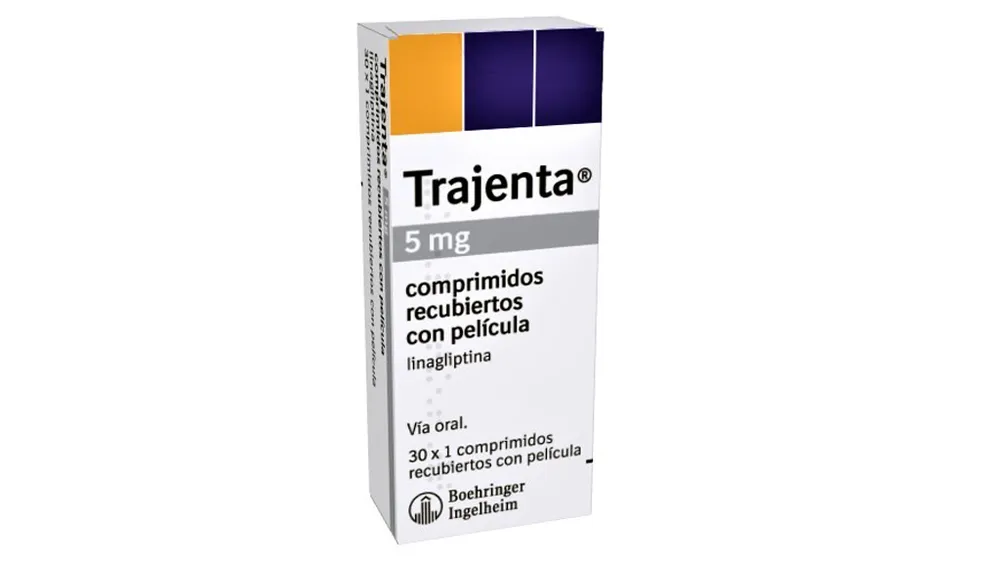
Table of Contents
Patient Information Leaflet
Introduction
Patient Information Leaflet
Trajenta 5mg film-coated tablets
linagliptin
Read the entire leaflet carefully before you start taking this medicine, as it contains important information for you.
- Keep this leaflet, as you may need to read it again.
- If you have any questions, consult your doctor, pharmacist, or nurse.
- This medicine has been prescribed for you only, and you should not give it to others, even if they have the same symptoms as you, since it could harm them.
- If you experience any adverse reactions, consult your doctor, pharmacist, or nurse, even if they are adverse reactions not listed in this leaflet. See section 4.
Leaflet Contents
- What Trajenta is and what it is used for
- What you need to know before taking Trajenta
- How to take Trajenta
- Possible adverse effects
- How to store Trajenta
- Contents of the pack and other information
1. What Trajenta is and what it is used for
Trajenta contains the active substance linagliptin, which belongs to a group of medicines known as "oral antidiabetics". Oral antidiabetics are used to treat high blood sugar levels. They work by helping the body lower blood sugar levels.
Trajenta is used to treat "type 2 diabetes" in adults when the condition cannot be adequately controlled by a single oral antidiabetic medicine (metformin or sulfonylureas) or by diet and exercise alone. Trajenta may be used in combination with other antidiabetic medicines, e.g., metformin, sulfonylureas (e.g., glimepiride, glipizide), empagliflozin, or insulin.
It is important that you follow your doctor's or nurse's advice regarding diet and exercise.
2. What you need to know before taking Trajenta
Do not take Trajenta
- if you are allergic to linagliptin or to any of the other ingredients of this medicine (listed in section 6).
Warnings and precautions
Talk to your doctor, pharmacist, or nurse before taking Trajenta if you:
- have type 1 diabetes (your body does not produce insulin) or diabetic ketoacidosis (a diabetes complication with high blood sugar levels, rapid weight loss, nausea, or vomiting). Trajenta should not be used to treat these medical conditions.
- are taking an antidiabetic medicine known as a “sulfonylurea” (e.g., glimepiride, glipizide); your doctor may want to reduce your sulfonylurea dose when taken together with Trajenta to avoid your blood sugar levels dropping too low.
- have had allergic reactions to any other medicine you take to control your blood sugar levels.
- have or have had a disease of the pancreas.
If you experience symptoms of acute pancreatitis, such as severe and persistent stomach (abdominal) pain, you should consult your doctor.
If you develop blisters on your skin, this could be a sign of a condition called bullous pemphigoid. Your doctor may advise you to stop taking Trajenta.
Diabetic skin lesions are a common complication of diabetes. Follow the skin and foot care recommendations provided by your doctor or nurse.
Children and adolescents
Trajenta is not recommended for use in children and adolescents under 18 years of age. It is not effective in children and adolescents between 10 and 17 years of age. It is unknown whether this medicine is safe and effective in children under 10 years of age.
Other medicines and Trajenta
Tell your doctor or pharmacist if you are taking, have recently taken, or might need to take any other medicines.
In particular, you must inform your doctor if you are taking medicines containing any of the following active substances:
- Carbamazepine, phenobarbital, or phenytoin. These may be used to control epileptic seizures or chronic pain.
- Rifampicin. This is an antibiotic used to treat infections such as tuberculosis.
Pregnancy and breastfeeding
If you are pregnant or breastfeeding, think you may be pregnant, or are planning to become pregnant, consult your doctor or pharmacist before using this medicine.
It is unknown whether Trajenta is harmful to the fetus. Therefore, it is preferable to avoid using Trajenta during pregnancy.
It is unknown whether Trajenta passes into breast milk. Your doctor will decide whether breastfeeding should be discontinued or treatment with Trajenta should be stopped.
Driving and using machines
The influence of Trajenta on the ability to drive and use machines is none or negligible.
Taking Trajenta in combination with medicines called sulfonylureas and/or insulin may cause blood sugar levels to become too low (hypoglycaemia), which may affect your ability to drive and use machines or work without a secure support. However, more frequent blood glucose monitoring may be recommended to reduce the risk of hypoglycaemia, especially when Trajenta is used in combination with a sulfonylurea and/or insulin.
3. How to take Trajenta
Follow exactly the instructions for using this medicine as given by your doctor. If in doubt, consult your doctor or pharmacist again.
The recommended dose of Trajenta is one 5 mg tablet once daily.
You may take Trajenta with or without food.
Your doctor may prescribe Trajenta together with another oral antidiabetic medicine. Remember to take all your medicines as instructed by your doctor to achieve the best results for your health.
If you take more Trajenta than you should
If you take more Trajenta than you should, consult a doctor immediately.
If you forget to take Trajenta
- If you forget to take a dose of Trajenta, take it as soon as you remember. However, if it is almost time for your next dose, do not take the missed dose.
- Do not take a double dose to make up for forgotten doses. Never take two doses on the same day.
If you stop taking Trajenta
Do not stop taking Trajenta without consulting your doctor first. Your blood sugar levels may increase when you stop taking Trajenta.
If you have any further questions about the use of this medicine, ask your doctor, pharmacist, or nurse.
4. Possible adverse effects
Like all medicines, this medicine may cause adverse effects, although not everyone experiences them.
Some symptoms require immediate medical attention
You must stop taking Trajenta and seek immediate medical advice if you experience the following symptoms of low blood sugar: trembling, sweating, anxiety, blurred vision, tingling in the lips, paleness, mood changes or confusion (hypoglycaemia). Hypoglycaemia (frequency: very common, may affect more than 1 in 10 people) is an identified adverse effect when Trajenta is taken together with metformin and a sulphonylurea.
Some patients have experienced allergic reactions (hypersensitivity; frequency: uncommon, may affect up to 1 in 100 people) while taking Trajenta alone or in combination with other diabetes medications, which may be serious, including wheezing (whistling sounds when breathing) and shortness of breath (bronchial hyperreactivity; frequency not known, cannot be estimated from available data). Some patients developed rash (skin reaction; frequency: uncommon), hives (urticaria; frequency: rare, may affect up to 1 in 1,000 people), and swelling of the face, lips, tongue, and throat that may cause difficulty breathing or swallowing (angioedema; frequency: rare). If you experience any of the above-mentioned signs of illness, stop taking Trajenta and contact your doctor immediately. Your doctor may prescribe medication to treat your allergic reaction and a different medicine for your diabetes.
Some patients have experienced inflammation of the pancreas (pancreatitis; frequency: rare, may affect up to 1 in 1,000 people) while taking Trajenta alone or in combination with other diabetes medications.
STOP taking Trajenta and consult a doctor immediately if you notice any of the following serious adverse effects:
- Severe and persistent pain in the abdomen (stomach area), which may radiate to the back, along with nausea and vomiting, as this could be a sign of an inflamed pancreas (pancreatitis).
The following adverse effects have been reported in some patients while taking Trajenta alone or in combination with other diabetes medications:
- Common: increased levels of the enzyme lipase in the blood.
- Uncommon: inflammation of the nose or throat (nasopharyngitis), cough, constipation (in combination with insulin), increased levels of the enzyme amylase in the blood.
- Rare: blisters on the skin (bullous pemphigoid).
Reporting of adverse effects
If you experience any adverse effects, consult your doctor, pharmacist, or nurse, even if they are possible adverse effects not listed in this leaflet. You may also report them directly through the national reporting system included in Appendix V. By reporting adverse effects, you can help provide more information on the safety of this medicine.
5. Storage of Trajenta
Keep this medicine out of the sight and reach of children.
Do not use this medicine after the expiry date stated on the blister and on the outer packaging following EXP. The expiry date refers to the last day of the month indicated.
This medicine does not require any special storage conditions.
Do not use Trajenta if the packaging is damaged or shows signs of tampering.
Medicines must not be disposed of via wastewater or household waste. Ask your pharmacist how to dispose of unused medicines and their packaging. This will help protect the environment.
6. Package contents and other information
Composition of Trajenta
- The active substance is linagliptin.
Each film-coated tablet (tablet) contains 5 mg of linagliptin.
- The other components are:
Tablet core: mannitol, pregelatinized starch (from maize), maize starch, copovidone, magnesium stearate.
Film coating: hypromellose, titanium dioxide (E171), talc, macrogol (6000), iron oxide red (E172).
Appearance of Trajenta and contents of the pack
-
Trajenta 5 mg tablets are light red, round, film-coated tablets, 8 mm in diameter, engraved with the code “D5” on one side and the Boehringer Ingelheim logo on the other.
-
Trajenta is available in single-dose aluminum/aluminum blister packs. Pack sizes are 10 × 1, 14 × 1, 28 × 1, 30 × 1, 56 × 1, 60 × 1, 84 × 1, 90 × 1, 98 × 1, 100 × 1 and 120 × 1 tablets.
Please note that only certain pack sizes may be available in your country.
Marketing Authorization Holder
Boehringer Ingelheim International GmbH
Binger Strasse 173
55216 Ingelheim am Rhein
Germany
Manufacturer
Boehringer Ingelheim Pharma GmbH & Co. KG
Binger Strasse 173
55216 Ingelheim am Rhein
Germany
Boehringer Ingelheim Hellas Single Member S.A.
5th km Paiania – Markopoulo
Koropi Attiki, 19441
Greece
Dragenopharm Apotheker Püschl GmbH
Göllstraße 1
84529 Tittmoning
Germany
For further information about this medicinal product, please contact the local representative of the Marketing Authorization Holder:
Belgium/Belgium/Belgium Boehringer Ingelheim SComm Tel/Tel: +32 2 773 33 11 | Lithuania Boehringer Ingelheim RCV GmbH & Co KG Lithuania Branch Tel: +370 5 2595942 |
Bulgaria Boehringer Ingelheim International GmbH – Bulgarian Branch Tel: +359 2 958 79 98 | Luxembourg/Luxembourg Boehringer Ingelheim SComm Tel/Tel: +32 2 773 33 11 |
Czech Republic Boehringer Ingelheim spol. s r.o. Tel: +420 234 655 111 | Hungary Boehringer Ingelheim RCV GmbH & Co KG Hungarian Branch Tel.: +36 1 299 8900 |
Denmark Boehringer Ingelheim Danmark A/S Tlf: +45 39 15 88 88 | Malta Boehringer Ingelheim Ireland Ltd. Tel: +353 1 295 9620 |
Germany Boehringer Ingelheim Pharma GmbH & Co. KG Tel: +49 (0) 800 77 90 900 | Netherlands Boehringer Ingelheim B.V. Tel: +31 (0) 800 22 55 889 |
Estonia Boehringer Ingelheim RCV GmbH & Co KG Estonian Branch Tel: +372 60 80 940 | Norway Boehringer Ingelheim Norway KS Tlf: +47 66 76 13 00 |
Greece Boehringer Ingelheim Hellas Monoprosopos E.P.E. Tel: +30 2 10 89 06 300 | Austria Boehringer Ingelheim RCV GmbH & Co KG Tel: +43 1 80 105-7870 |
Spain Boehringer Ingelheim España, S.A. Tel: +34 93 404 51 00 | Poland Boehringer Ingelheim Sp. z o.o. Tel.: +48 22 699 0 699 |
France Boehringer Ingelheim France S.A.S. Tél: +33 3 26 50 45 33 | Portugal Boehringer Ingelheim Portugal, Lda. Tel: +351 21 313 53 00 |
Croatia Boehringer Ingelheim Zagreb d.o.o. Tel: +385 1 2444 600 | Romania Boehringer Ingelheim RCV GmbH & Co KG Vienna - Bucharest Branch Tel: +40 21 302 28 00 |
Ireland Boehringer Ingelheim Ireland Ltd. Tel: +353 1 295 9620 | Slovenia Boehringer Ingelheim RCV GmbH & Co KG, Ljubljana Branch Tel: +386 1 586 40 00 |
Iceland Vistor hf. Tel: +354 535 7000 | Slovakia Boehringer Ingelheim RCV GmbH & Co KG, Slovak Branch Tel: +421 2 5810 1211 |
Italy Boehringer Ingelheim Italia S.p.A. Tel: +39 02 5355 1 | Finland Boehringer Ingelheim Finland Ky Tel: +358 10 3102 800 |
Cyprus Boehringer Ingelheim Hellas Monoprosopos E.P.E. Tel: +30 2 10 89 06 300 | Sweden Boehringer Ingelheim AB Tel: +46 8 721 21 00 |
Latvia Boehringer Ingelheim RCV GmbH & Co KG Latvia Branch Tel: +371 67 240 011 | United Kingdom (Northern Ireland) Boehringer Ingelheim Ireland Ltd. Tel: +353 1 295 9620 |
Date of the most recent review of this leaflet:
Detailed information on this medicine is available on the website of the European Medicines Agency: http://www.ema.europa.eu.