SueroRoral hiposódico
Spain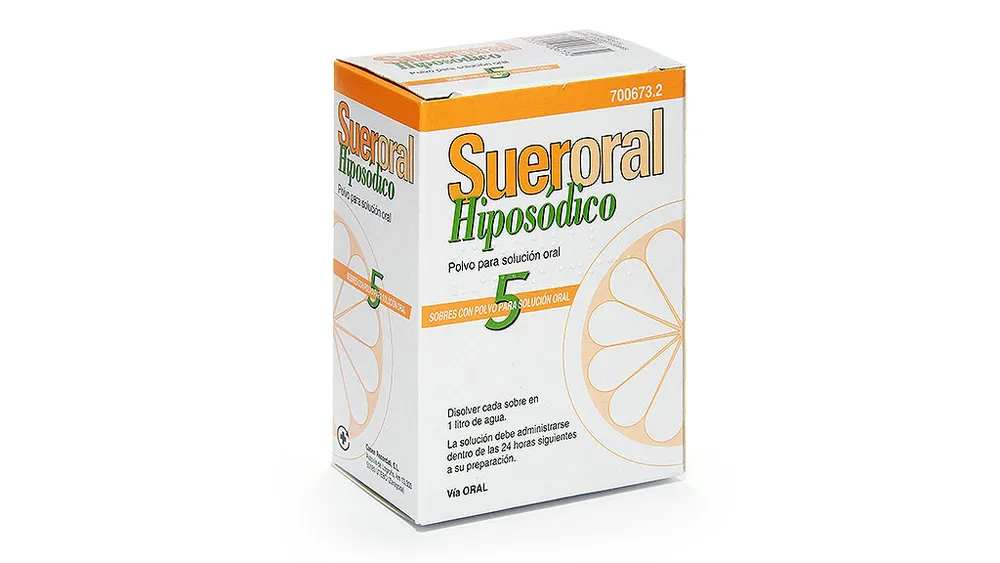
Table of Contents
Package leaflet: Information for the user
Introduction
PACKAGE LEAFLET: INFORMATION FOR THE USER
Sueroral Hyposodic Powder for oral solution
(Sodium chloride, Potassium chloride, Sodium citrate, Glucose)
Read the entire leaflet carefully because it contains important information for you.
This medicine can be purchased without a prescription. However, to achieve the best results, it must be used correctly.
- Keep this leaflet, as you may need to read it again.
- If you need advice or further information, consult your pharmacist.
- If symptoms worsen or persist beyond 5 days, you should consult your doctor.
- If you consider any of the adverse effects you experience to be severe, or if you notice any adverse effects not listed in this leaflet, inform your doctor or pharmacist.
Leaflet contents:
- What Sueroral Hyposodic is and what it is used for
- Before taking Sueroral Hyposodic
- How to take Sueroral Hyposodic
- Possible side effects
5 Storage of Sueroral Hyposodic
- Further information
1. What Sueroral Hyposodic is and what it is used for
Sueroral Hyposodic belongs to a group of medicines called oral rehydration solutions.
Sueroral Hyposodic is indicated for the prevention and treatment of dehydration caused by vomiting or diarrhoea, whether of infectious origin or not, infantile diarrhoea, summer diarrhoea, acidosis, and ketosis.
2. Before taking Sueroral Hiposódico
Do not take Sueroral Hiposódico
-
if you are allergic (hypersensitive) to the active substances or to any of the other components of Sueroral Hiposódico.
-
In premature infants and children under 1 month of age.
-
if you are unable to swallow.
-
if you have severe and persistent vomiting.
-
if you have intestinal obstruction.
-
if you have intestinal perforation.
-
if you have known glucose malabsorption.
-
if you are diabetic.
- if you have any kidney impairment.
Take special care with Sueroral Hiposódico
- If you regularly consume cow's milk, you should not take more than 150 ml every four hours; if diarrhea worsens, you should discontinue its use.
- You may eat normal foods once diarrhea has resolved.
Use of other medicines
Inform your doctor or pharmacist if you are using or have recently used any other medicines, including those obtained without a prescription.
Pregnancy and breastfeeding
-
Consult your doctor or pharmacist before using any medicine.
-
Sueroral Hiposódico may be taken during pregnancy and breastfeeding.
- If you are breastfeeding, you may continue breastfeeding while taking this medicine.
Driving and use of machines
Sueroral Hiposódico will not affect your ability to drive or operate machinery.
Important information about some of the components of Sueroral Hiposódico
This medicine contains glucose. If your doctor has informed you that you have an intolerance to certain sugars, consult with him before taking this medicine.
Patients with diabetes mellitus should be aware that this medicine contains 20 g of glucose per sachet.
Patients on low-sodium diets should be aware that this medicine contains 1.15 g (50.11 mmol) of sodium per sachet.
This medicine may cause allergic reactions because it contains Sunset Yellow FCF (E-110) as an excipient.
It may provoke asthma, especially in patients allergic to acetylsalicylic acid.
Patients with renal insufficiency or on low-potassium diets should be aware that this medicine contains 0.84 g (21.51 mmol) of potassium per sachet, of which 0.054 g (1.39 mmol) of potassium is part of the excipient and 0.784 g (20.12 mmol) of potassium is part of the active substance.
3. How to take Sueroral Hiposódico
Follow exactly the administration instructions for Sueroral Hiposódico provided by your doctor. Consult your doctor or pharmacist if you have any doubts.
Sueroral Hiposódico should be taken by dissolving the contents of each sachet always in one liter of drinking water.
The water may, if necessary, have been previously boiled, but not after preparation.
Do not add any other ingredients, such as sugar.
The dose of Sueroral Hiposódico will depend on the patient's weight and the severity of the illness, although the following doses are generally recommended:
Infants over one month of age: The recommended dose is approximately 1–1.5 times their usual volume of food. It is recommended to administer the solution frequently, in small amounts and slowly. Breastfeeding need not be discontinued.
Children from 1 year of age: The recommended dose is approximately 200 ml of solution for each diarrheal stool. It is recommended to administer 25–30 ml of solution every 10–15 minutes.
Adults: The recommended dose is 200 to 400 ml of solution for each diarrheal stool.
There is no recommended maximum daily dose; therefore, the solution may be administered freely, as the patient's thirst will regulate the amount of Sueroral Hiposódico needed.
Elderly patients: The recommended dose is the same as for adults.
Impaired liver function: In this case, dose adjustment is not necessary.
Impaired renal function: Sueroral Hiposódico must not be taken under any circumstances in patients with impaired renal function.
Duration of treatment: Treatment should be continued for as long as diarrhea persists, and even after diarrhea has resolved, until the physician considers it necessary, which is normally achieved within 4 to 5 days.
If you take more Sueroral Hiposódico than you should
Contact your doctor, pharmacist, or the toxicology information service immediately. Phone number: 91 562 04 20
The symptom you may experience is swelling of the eyelids; if this occurs, you should stop taking Sueroral Hiposódico.
If you forget to take Sueroral Hiposódico
Do not take a double dose to make up for missed doses.
If you have any further questions about the use of this product, ask your doctor or pharmacist.
4. Possible adverse effects
Like all medicines, Sueroral Hiposódico may produce adverse effects, although not everyone experiences them, especially when administered too rapidly.
The most common adverse effect is vomiting. In such cases, you should interrupt the intake of Sueroral Hiposódico for 10 minutes and then resume treatment by administering smaller amounts but more frequently.
Reporting of adverse effects
If you experience any type of adverse effect, consult your doctor, pharmacist, or nurse, even if it is a possible adverse effect not listed in this leaflet. You may also report them directly through the Spanish Pharmacovigilance System for Human Medicines: www.notificaRAM.es. By reporting adverse effects, you can help provide further information on the safety of this medicine.
5. Storage of Sueroral Hiposódico
Keep out of the reach and sight of children.
Do not use Sueroral Hiposódico after the expiry date stated on the container, following the abbreviation EXP. The expiry date refers to the last day of the month indicated.
When not in use, the prepared solution of Sueroral Hiposódico may be stored between 2°C and 8°C (in the refrigerator) and must be discarded 24 hours after preparation.
Medicines should not be disposed of via wastewater drains or household waste. Unused containers and medicines should be taken to a pharmacy’s SIGRE collection point. If you are unsure how to dispose of unused containers or medicines, consult your pharmacist. This helps protect the environment.
6. Information for the user
Composition of Sueroral Hiposódico per sachet:
- The active substances are:
Sodium chloride………………………….1.2 g
Potassium chloride………………………..1.5 g
Sodium citrate……………………………2.9 g
Glucose……………………………………20.0 g
- The other components are:
Flavouring system: orange flavour (maltodextrin, arabic gum E-414, ascorbic acid E-300 and BHA E-320)
Potassium acesulfame (E-950)
Orange yellow S (E-110)
Appearance of the product and contents of the pack
Sueroral Hiposód游戏副本 is supplied in sachets containing 27.365 g of powder each. Each pack contains 5 sachets.
Marketing Authorization Holder and Manufacturer
Casen Recordati, S.L.
Autovía de Logroño, km 13.300
50180 Utebo - Zaragoza
This patient information leaflet was approved in March 2010.
Detailed and up-to-date information on this medicine is available on the website of the Spanish Agency of Medicines and Health Products (AEMPS) http://www.aemps.gob.es/