Senioral syrup for children
Spain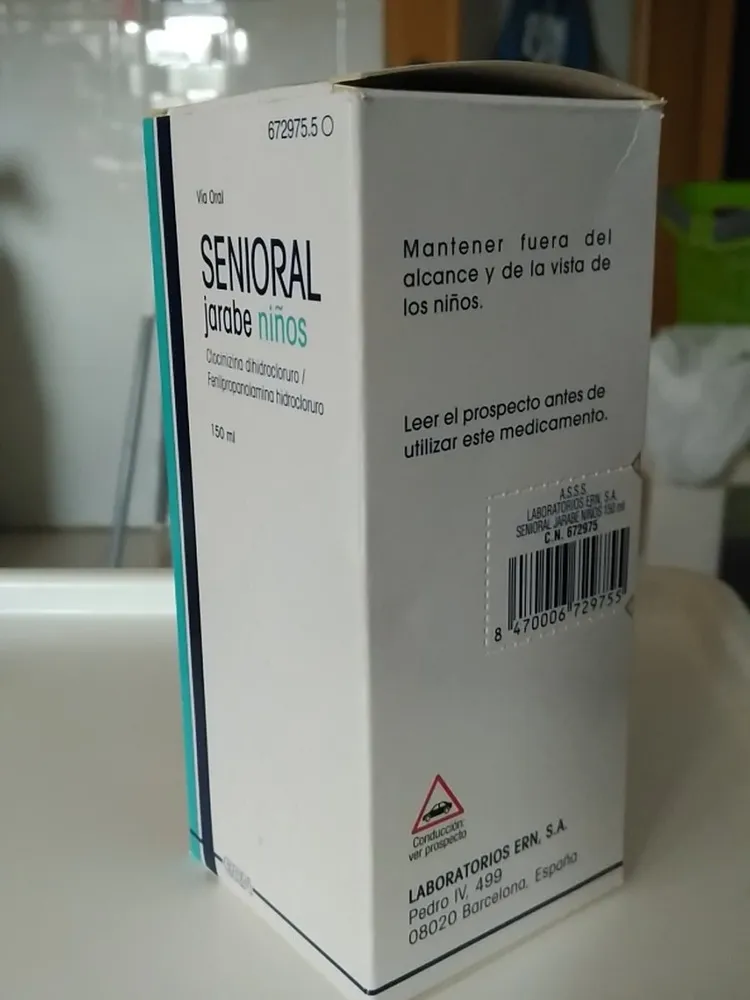
Table of Contents
- Patient Information Leaflet
- Introduction
- 1. What SENIORAL Children's Syrup is and what it is used for
- 2. What you need to know before taking SENIORAL children's syrup
- 3. How to take SENIORAL children's syrup
- 4. Possible adverse effects
- 5. Storage of SENIORAL children's syrup
- 6. Contents of the container and other information
Patient Information Leaflet
Introduction
Patient Information Leaflet
SENIORAL children's syrup
Clocinizine dihydrochloride/Phenylpropanolamine hydrochloride
Read the entire leaflet carefully before you start taking this medicine, because it contains important information for you.
- Keep this leaflet as you may need to read it again.
- If you have any questions, ask your doctor or pharmacist.
- This medicine has been prescribed for you and should not be given to other people, even if they have the same symptoms as you, because it could harm them.
- If you consider any of the side effects you experience to be serious, or if you notice any side effects not listed in this leaflet, please inform your doctor or pharmacist.
Leaflet contents
- What SENIORAL children's syrup is and what it is used for
- What you need to know before taking SENIORAL children's syrup
- How to take SENIORAL children's syrup
- Possible side effects
- How to store SENIORAL children's syrup
- Contents of the pack and other information
1. What SENIORAL Children's Syrup is and what it is used for
SENIORAL Children's Syrup contains two active substances: clocinizine and phenylpropanolamine.
Clocinizine belongs to the group of antihistamines, medicines used to relieve allergic reactions.
Phenylpropanolamine belongs to the group of adrenergic agonists, which are used to relieve nasal congestion.
SENIORAL Children's Syrup is used only for the temporary relief of nasal congestion due to colds, rhinitis, and nasal congestion associated with sinusitis.
2. What you need to know before taking SENIORAL children's syrup
Do not take SENIORAL children's syrup
- If you are allergic (hypersensitive) to phenylpropanolamine or clocinizine or to any of the other components of SENIORAL children's syrup
- If you have high blood pressure (arterial hypertension), thyroid disease (hyperthyroidism), or heart problems (severe coronary heart disease or angina pectoris)
- If you are taking any medication for depression or Parkinson's disease that inhibits monoamine oxidase (MAOI) (see below: Use of other medicines)
- In children under 2 years of age.
Take special care with SENIORAL children's syrup
- Do not exceed the maximum recommended dose (see 3. How to take SENIORAL children's syrup), as serious adverse effects may occur (see If you take more SENIORAL children's syrup than you should).
- If you have diabetes mellitus, increased intraocular pressure (glaucoma), prostate disorders (prostatic hypertrophy), or urinary retention, as these conditions may worsen.
Use of other medicines
Inform your doctor or pharmacist if you are taking, or have recently taken, any other medicines, including those obtained without a prescription.
- If administered together with drugs that inhibit the enzyme monoamine oxidase (MAOI), used for depression (tranilcypramine, moclobemide) or for Parkinson's disease (selegiline), serious adverse effects may occur, such as severe headache and sudden increase in body temperature. If you have taken any of these medicines, wait at least 15 days before taking SENIORAL children's syrup. If you are unsure whether your medication contains an MAOI drug, consult your doctor or pharmacist before taking SENIORAL children's syrup.
- If you are undergoing treatment with other medicines, consult your doctor or pharmacist before taking SENIORAL children's syrup.
Pregnancy and breastfeeding
Consult your doctor or pharmacist before using any medicine.
Women who are breastfeeding should not take this medicine, as it passes into breast milk and may affect the infant.
Driving and use of machines
Do not drive or operate tools or machinery, as SENIORAL may reduce your concentration and reflexes.
Use in athletes
Athletes are advised that this medicine contains a component that may lead to a positive analytical result in doping controls.
SENIORAL children's syrup contains alcohol (ethanol), methyl parahydroxybenzoate (E-218), and sucrose.
This medicine contains 103 mg of alcohol (ethanol) per 15 ml, equivalent to 0.87% v/v. The amount of alcohol in 15 ml of this medicine is equivalent to less than 3 ml of beer or 1 ml of wine.
The small amount of alcohol in this medicine has no perceptible effects.
This medicine contains methyl parahydroxybenzoate (E-218). It may cause allergic reactions (possibly delayed).
This medicine contains 12.3 g of sucrose per 15 ml. This should be taken into account by patients with diabetes mellitus. If your doctor has advised you that you have an intolerance to certain sugars, consult him before taking this medicine.
3. How to take SENIORAL children's syrup
Follow exactly the administration instructions for SENIORAL children's syrup provided by your doctor. Consult your doctor or pharmacist if you have any doubts.
The usual dose is:
In children aged 2 to 5 years: The maximum dose is 7.5 ml three times a day (22.5 ml/day), to be taken before meals, with a minimum interval of 6 hours between doses.
In children aged 5 to 12 years: The maximum dose is 15 ml three times a day (45 ml/day), to be taken before meals, with a minimum interval of 6 hours between doses.
If symptoms do not improve within 5 days or are accompanied by high fever, consult your doctor before continuing treatment.
SENIORAL children's syrup is administered orally, using the provided dosing cup.
The syrup should be taken before meals. A minimum interval of 6 hours must be maintained between doses.
Remember to take your medicine.
Use in children
Do not use in children under 2 years of age.
If you take more SENIORAL children's syrup than you should
If you have taken more than the recommended dose, cardiac and neurological disturbances may occur. In such cases, gastric lavage should be performed and symptoms treated. Consult your doctor or pharmacist.
Taking higher than recommended doses may cause nervousness, dizziness, palpitations, tremors, agitation, and very rarely, hallucinations, seizures, and cerebral hemorrhage. If you experience any of these symptoms, immediately discontinue use of this medicine and consult your doctor.
In case of accidental or excessive ingestion of SENIORAL children's syrup, go immediately to your doctor or the nearest hospital Emergency Department, or contact the Toxicology Information Service (telephone: 91 562 04 20), indicating the medicine and the amount ingested. Bring this leaflet with you if possible.
If you forget to take SENIORAL children's syrup
Do not take a double dose to make up for missed doses. Take the missed dose as soon as possible. If less than 6 hours remain until the next scheduled dose, wait until that time to take your syrup.
If you stop treatment with SENIORAL children's syrup
Your doctor will advise you on the duration of treatment with SENIORAL children's syrup. If treatment is stopped before completing the period indicated by your doctor, symptoms of your condition may recur.
If you have any further questions about the use of this product, ask your doctor or pharmacist.
4. Possible adverse effects
Like all medicines, SENIORAL syrup for children may cause adverse effects, although not everyone experiences them.
Cardiovascular effects: Changes in pulse (frequency not known: strong heartbeat that may be fast or irregular (palpitations), tachycardia), increased blood pressure (hypertension), which may sometimes be severe (hypertensive crises).
Effects on the nervous system: Restlessness, dizziness, insomnia, headache, unusual behaviour. Occasionally, drowsiness and somnolence may occur.
Other adverse effects include gastrointestinal discomfort (nausea and vomiting), constipation, confusion, euphoria, visual disturbances, dry mouth, and difficulty urinating.
If you consider any of the adverse effects you experience to be severe, or if you notice any adverse effects not listed in this leaflet, inform your doctor or pharmacist.
Reporting of adverse effects
If you experience any type of adverse effect, consult your doctor or pharmacist, even if it is a possible adverse effect not listed in this leaflet. You may also report them directly through the Spanish Pharmacovigilance System for Human Medicinal Products: https://www.notificaram.es. By reporting adverse effects, you can help provide more information on the safety of this medicine.
5. Storage of SENIORAL children's syrup
Keep out of the reach and sight of children.
Do not use SENIORAL children's syrup after the expiry date stated on the container. The expiry date refers to the last day of the month indicated.
Store in the original packaging.
Medicines must not be disposed of via wastewater drains or household waste. Dispose of unused medicines and their containers at the SIGRE collection point at your pharmacy. If in doubt, ask your pharmacist how to properly dispose of unused medicines and their packaging. This will help protect the environment.
6. Contents of the container and other information
Composition of SENIORAL children's syrup
- The active substances are: Clocinizine dihydrochloride and phenylpropanolamine hydrochloride. Each 100 ml of syrup contains 15 mg of clocinizine dihydrochloride and 130 mg of phenylpropanolamine hydrochloride. Each 15 ml (one dose) of syrup contains: clocinizine dihydrochloride, 2.25 mg and phenylpropanolamine hydrochloride, 19.50 mg.
- The other components are: Sucrose, ethanol, methyl 4-hydroxybenzoate (E-218), cassis extract 30 GS 750, concentrated hydrochloric acid and purified water.
Appearance of the product and contents of the container
SENIORAL children's syrup is a reddish-colored syrup supplied in cartons containing one bottle with 150 ml and a dosing cup with multiple measurement markings.
Marketing Authorization Holder
Laboratorios ERN, S.A.
C/Perú, 228
08020 Barcelona, Spain
Manufacturers responsible
Laboratorios ERN, S.A.
C/Gorchs Lladó, 188
Pol. Ind. Can Salvatella
08210 Barberá del Vallés (Barcelona), Spain.
This leaflet was approved in May 2025.
Detailed and up-to-date information on this medicinal product is available on the website of the Spanish Agency of Medicines and Health Products (AEMPS) http://www.aemps.gob.es/.