Rennie 680 mg/80 mg chewable tablets with saccharin
Spain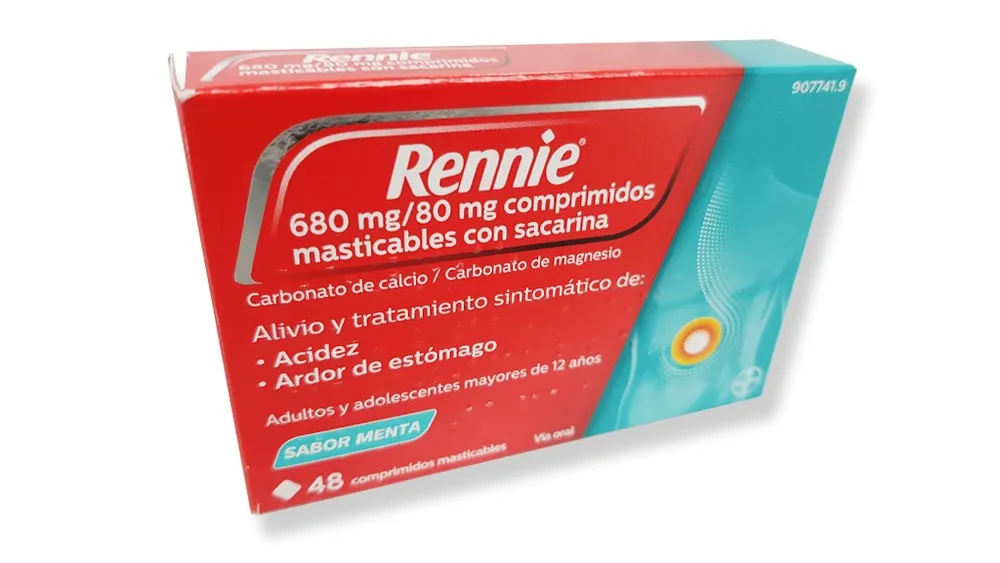
Table of Contents
Package leaflet: Information for the user
Introduction
PACKAGE LEAFLET: INFORMATION FOR THE USER
Rennie 680 mg/80 mg chewable tablets with saccharin
Calcium carbonate/Magnesium carbonate
Read the entire leaflet carefully before you start taking this medicine because it contains important information for you.
Always follow exactly the instructions for use of this medicine as described in this leaflet or as directed by your doctor, pharmacist, or nurse.
- Keep this leaflet, as you may need to read it again.
- If you need advice or more information, consult your pharmacist.
- If you experience any side effects, consult your doctor, pharmacist, or nurse, even if they are side effects not listed in this leaflet. See section 4.
- You should consult a doctor if you get worse or if you do not improve after 7 days.
Leaflet contents:
- What Rennie is and what it is used for.
- What you need to know before taking Rennie.
- How to take Rennie.
- Possible side effects.
- How to store Rennie.
- Contents of the pack and other information.
1. What Rennie is and what it is used for
Rennie belongs to the group of medicines known as aluminium, calcium and magnesium combinations and complexes.
It contains as active ingredients calcium carbonate and magnesium carbonate, which act by neutralising excess stomach acid.
Rennie is indicated for the symptomatic relief and treatment of acid reflux and heartburn in adults and adolescents over 12 years of age.
You should consult a doctor if symptoms worsen or do not improve after 7 days.
2. What you need to know before taking Rennie
Do not take Rennie:
- If you are allergic to any of the active substances or to any of the other components of this medicine (listed in section 6).
- If you have severe renal insufficiency, hypercalcemia (high levels of calcium in the blood), or hypophosphatemia (low phosphate levels in the blood).
- If you have a history of calcium kidney stones.
- If you have hypercalciuria (high levels of calcium in the urine).
Warnings and Precautions
Consult your doctor, pharmacist, or nurse before starting to take Rennie:
- Avoid prolonged use.
- Do not exceed the recommended dose (see section 3).
- Consult your doctor or pharmacist before taking Rennie if you have kidney problems, as administration of this medicine in patients with impaired renal function may cause hypercalcemia (elevated calcium levels in the blood) and metabolic alkalosis (milk-alkali syndrome).
- If symptoms worsen or persist for more than 7 days, you must consult your doctor.
- This medicine should not be taken with large amounts of milk or dairy products.
Children and adolescents
Do not administer to children under 12 years of age without consulting a doctor.
Taking Rennie with other medicines
Inform your doctor or pharmacist if you are taking, have recently taken, or might need to take any other medicines.
Before taking Rennie, inform your doctor or pharmacist if you are taking any of the following medicines, as Rennie may affect their efficacy:
- calcitonin,
- sodium phosphate and other phosphates,
- oral contraceptives,
- thiazide diuretics (medicines used to increase the rate of urine excretion),
- fluorides (medicines for the prevention of dental caries),
- amphetamines or quinidine,
- salicylates (medicines with anti-inflammatory, analgesic, and antipyretic properties),
- vitamin D,
- heart medications such as glycosides (digoxin), bisphosphonates, or dolutegravir,
- levothyroxine (a thyroid hormone),
- eltrombopag (a medicine used to increase platelet count),
- other medicines prescribed by a doctor (e.g. etidronate, iron-containing products, antidyskinetics, antimuscarinics, phenothiazines, benzodiazepines, ketoconazole, diflunisal, H2 antihistamines, sucralfate, oral anticoagulants derived from coumarin or indandione, antibiotics such as tetracyclines or quinolones), as it may interfere with their absorption.
It is recommended to separate the administration of antacids and other medicines by 1 or 2 hours.
Interference with diagnostic tests
If you are scheduled to undergo any diagnostic tests (including blood or urine tests, skin tests using allergens, etc.), inform your doctor that you are taking this medicine, as it may alter test results.
Taking Rennie with food and drinks
Like all calcium-containing antacids, Rennie should not be taken with large amounts of milk or dairy products, as this may lead to increased levels of calcium or magnesium in the blood and to milk-alkali syndrome.
Pregnancy, breastfeeding, and fertility
If you are pregnant or breastfeeding, think you may be pregnant, or are planning to become pregnant, consult your doctor or pharmacist before using this medicine.
Rennie chewable tablets with saccharin may be used during pregnancy and breastfeeding if taken according to these recommendations and not for longer than 2 weeks.
Pregnant or breastfeeding women must not take more than the amount of medicine indicated in section 3 (How to take Rennie), and must not simultaneously consume large amounts of dairy products and milk (1 liter of milk contains 1.2 grams of elemental calcium), because this medicine provides a significant amount of calcium in addition to daily dietary intake.
There is no evidence indicating that Rennie has adverse effects on human fertility.
Driving and using machines
No effects on the ability to drive or operate machinery have been reported.
Rennie chewable tablets with saccharin contain isomalt
This medicine contains 500 mg of isomalt per tablet.
If your doctor has informed you that you have an intolerance to certain sugars, consult your doctor before taking this medicine.
3. How to take Rennie
Follow exactly the instructions for use provided in this leaflet or those given by your doctor, pharmacist, or nurse. If in doubt, consult your doctor, pharmacist, or nurse.
Dosage
The recommended dose is:
Adults and adolescents over 12 years of age: 1 or 2 tablets, preferably taken 1 hour after meals and before going to bed. Additionally, if necessary, an extra dose may be taken. Do not take more than 6 tablets in 24 hours. Do not take for longer than 2 weeks.
Method of administration
Oral use
Remove the tablets from the packaging. Rennie tablets should be chewed or allowed to dissolve slowly in the mouth. They must not be swallowed whole.
Use in children and adolescents
Do not administer to children under 12 years of age.
If symptoms persist after 7 days of treatment, consult your doctor to rule out more serious diseases.
If you take more Rennie than you should:
Symptoms of overdose include nausea, vomiting, constipation, fatigue, difficulty and pain when urinating, and kidney stones. In such cases, stop treatment, drink plenty of water, and consult your doctor or pharmacist.
In case of overdose or accidental ingestion, consult your doctor or pharmacist, go to a medical center, or call the Toxicology Information Service at telephone number: 91 562.04.20, stating the name of the medicine and the amount ingested.
It is recommended to bring the medicine package and leaflet to the healthcare professional.
If you forget to take Rennie
If you forget to take a dose, wait until the next scheduled dose. Do not take a double dose to make up for missed doses.
If you have any questions about the use of this medicine, ask your doctor, pharmacist, or nurse.
4. Possible adverse effects
Like all medicines, Rennie may cause adverse effects, although not everyone experiences them.
When used normally, at the recommended doses, the occurrence of adverse effects is not expected.
The adverse reactions listed below are based on spontaneous reports, and their frequency has not been accurately established:
Immune system disorders
Very rarely, allergic reactions have been reported, such as skin rashes, itching, difficulty breathing, swelling of the face, mouth or throat, and anaphylaxis. If you experience these reactions, stop taking this medicine immediately and consult your doctor without delay.
Metabolism and nutrition disorders
Prolonged use of high doses may lead to hypermagnesemia (elevated magnesium levels in the blood) or hypercalcemia (elevated calcium levels in the blood) and milk-alkali syndrome, especially in patients with impaired renal function.
Gastrointestinal disorders
Prolonged use of high doses may lead to nausea, vomiting, stomach discomfort, constipation and diarrhea, particularly in patients with impaired renal function.
Constipation has occurred in some cases. Flatulence (gas), belching, and stomach bloating may also occur.
Musculoskeletal and connective tissue disorders
Abnormal muscle weakness, especially in patients with impaired renal function.
Specific symptoms of milk-alkali syndrome may include taste disturbances, headache, kidney problems, fatigue, and lumps under the skin.
If you notice any of these or any other adverse reactions not described above, consult your doctor or pharmacist.
Reporting of adverse effects:
If you experience any type of adverse effect, consult your doctor, pharmacist, or nurse, even if it is a possible adverse effect not listed in this leaflet. You can also report them directly via the Spanish Pharmacovigilance System for Human Medicines: http://www.notificaram.es. By reporting adverse effects, you can help provide more information on the safety of this medicine.
5. Storage of Rennie
Keep this medicine out of sight and reach of children.
Do not use Rennie after the expiry date stated on the packaging, following the abbreviation CAD. The expiry date refers to the last day of the month indicated.
No special storage conditions are required.
Medicines must not be disposed of via wastewater drains or household waste. Dispose of unused medicines and their packaging at the SIGRE collection point at your pharmacy. If you are unsure, ask your pharmacist how to properly dispose of unused medicines and their packaging. This will help protect the environment.
6. Contents of the pack and other information
Composition of Rennie chewable tablets with saccharin:
- The active substances are: calcium carbonate 680 mg and magnesium carbonate 80 mg.
- The other components (excipients) are: isomalt (E-953), talc, magnesium stearate, peppermint flavour, saccharin.
Appearance of the product and contents of the pack
Rennie are white-cream, square-shaped tablets with a mint odour.
Rennie is available in packs containing 36 or 48 chewable tablets each. It is presented in aluminium/PVC blisters.
Only certain pack sizes may be marketed.
Marketing Authorisation Holder and Manufacturer
Marketing Authorisation Holder
BAYER HISPANIA, S.L.
Av. Baix Llobregat, 3-5
08970 Sant Joan Despí (Barcelona)
Spain
Manufacturer
Bayer Bitterfeld GmbH
OT Greppin
Salegaster Chaussee 1
06803 Bitterfeld-Wolfen
Germany
Date of the most recent revision of this leaflet: December 2024
Detailed and up-to-date information on this medicinal product is available on the website of the Spanish Agency of Medicines and Medical Devices (AEMPS) http://www.aemps.gob.es/