Rasilez 150 mg film-coated tablets
Spain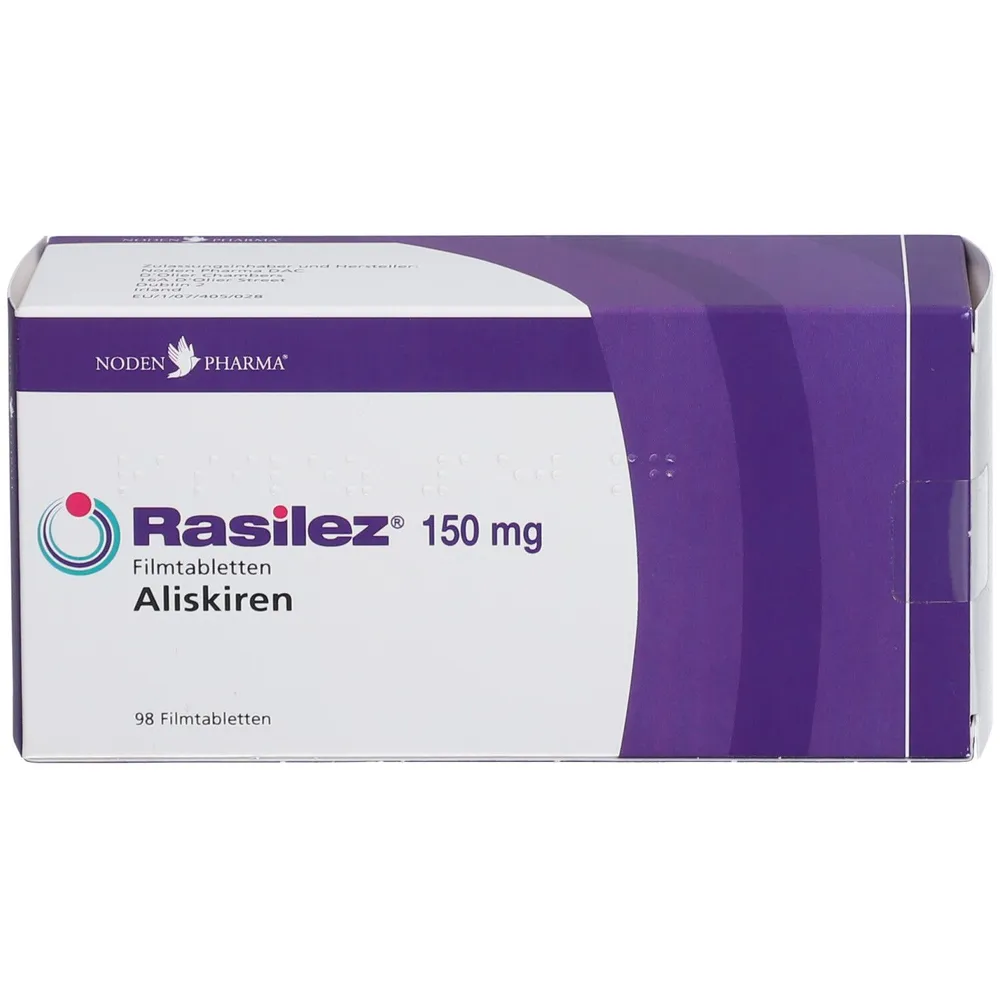
Table of Contents
Package leaflet: Information for the user
Introduction
Package leaflet: information for the user
Rasilez 150 mg film-coated tablets
Rasilez 300 mg film-coated tablets
aliskiren
Read the entire leaflet carefully before you start taking this medicine because it contains important information for you.
- Keep this leaflet. You may need to read it again.
- If you have any questions, ask your doctor or pharmacist.
- This medicine has been prescribed for you only. Do not pass it on to other people, even if they have the same symptoms as you, because it may harm them.
- If you experience any adverse effects, talk to your doctor or pharmacist, even if the effects are not listed in this leaflet. See section 4.
Contents of the leaflet
- What Rasilez is and what it is used for
- What you need to know before taking Rasilez
- How to take Rasilez
- Possible adverse effects
- How to store Rasilez
- Contents of the pack and other information
1. What Rasilez is and what it is used for
This medicine contains an active substance called aliskiren. Aliskiren belongs to a class of medicines known as renin inhibitors. Renin inhibitors reduce the amount of angiotensin II that the body can produce. Angiotensin II causes narrowing of blood vessels, which increases blood pressure. By reducing levels of angiotensin II, blood vessels are able to relax, thereby lowering blood pressure.
This helps lower high blood pressure in adult patients. Hypertension increases the workload on the heart and arteries. If this continues for a long time, the blood vessels in the brain, heart, and kidneys may become damaged, leading to stroke, heart failure, myocardial infarction, or kidney failure. Lowering blood pressure to normal levels reduces the risk of developing these conditions.
2. What you need to know before taking Rasilez
Do not take Rasilez
-
if you are allergic to aliskiren or any of the other components of this medicine (listed in section 6). If you think you may be allergic, consult your doctor.
-
if you have ever experienced the following types of angioedema (difficulty breathing or swallowing, or swelling of the face, hands and feet, eyes, lips and/or tongue):
-
angioedema while taking aliskiren.
-
hereditary angioedema.
-
angioedema of unknown cause.
-
during the last 6 months of pregnancy or if you are breastfeeding; see section “Pregnancy and breastfeeding”.
-
if you are taking cyclosporine (a medicine used in organ transplantation to prevent organ rejection or for other conditions, e.g. rheumatoid arthritis or atopic dermatitis), itraconazole (a medicine used to treat fungal infections), or quinidine (a medicine used to correct heart rhythm).
-
if you have diabetes or kidney failure and are being treated with one of the following classes of medicines used to treat hypertension (high blood pressure):
-
an angiotensin-converting enzyme (ACE) inhibitor such as enalapril, lisinopril, ramipril
or
- an angiotensin II receptor antagonist such as valsartan, telmisartan, irbesartan.
- if the patient is under 2 years of age.
Warnings and precautions
Consult your doctor before taking Rasilez:
- if you are taking a diuretic (a type of medicine to increase urine output).
- if you are taking any of the following classes of medicines used to treat hypertension (high blood pressure):
- an angiotensin-converting enzyme (ACE) inhibitor such as enalapril, lisinopril, ramipril
or
-
an angiotensin II receptor antagonist such as valsartan, telmisartan, irbesartan.
-
if you have kidney failure, your doctor will carefully consider whether this medicine is suitable for you and may wish to monitor you closely.
-
if you have previously experienced angioedema (difficulty breathing or swallowing, or swelling of the face, hands and feet, eyes, lips and/or tongue). If this occurs, stop taking this medicine and contact your doctor.
-
if you have renal artery stenosis (narrowing of the blood vessels to one or both kidneys).
-
if you have severe congestive heart failure (a type of heart disease in which the heart cannot pump enough blood to the body).
If you develop severe and persistent diarrhoea, you must stop taking Rasilez.
Your doctor may monitor your kidney function, blood pressure, and blood levels of electrolytes (e.g. potassium) at regular intervals.
See also section “Do not take Rasilez”.
Children and adolescents
This medicine must not be used in infants from birth up to less than 2 years of age. It must not be used in children from 2 years up to less than 6 years of age, and is not recommended for use in children and adolescents from 6 years up to less than 18 years of age. This is because the safety and risks in this population are not known.
Elderly people
The normal starting dose of aliskiren in elderly patients aged 65 years or older is 150 mg. In most patients aged 65 years or older, the 300 mg dose of Rasilez does not provide any additional benefit in lowering blood pressure compared to the 150 mg dose.
Other medicines and Rasilez
Tell your doctor or pharmacist if you are taking, have recently taken, or might need to take any other medicines.
Your doctor may need to adjust your dose and/or take other precautions if you are taking any of the following medicines:
- medicines that increase potassium levels in your blood, including potassium-sparing diuretics and potassium supplements.
- furosemide or torasemide, medicines belonging to a group known as diuretics used to increase urine output.
- an angiotensin II receptor antagonist or an angiotensin-converting enzyme (ACE) inhibitor (see sections “Do not take Rasilez” and “Warnings and precautions”).
- ketoconazole, a medicine used to treat fungal infections.
- verapamil, a medicine used to lower blood pressure, correct heart rhythm, or treat angina.
- certain types of pain medicines called non-steroidal anti-inflammatory drugs (NSAIDs).
Taking Rasilez with food and drink
Take this medicine either with a light meal or without food, once daily, preferably at the same time each day. Avoid taking this medicine with fruit juice and/or drinks containing herbal extracts (including infusions), as this could reduce the effectiveness of this medicine.
Pregnancy and breastfeeding
Pregnancy
Do not take this medicine if you are pregnant (see section Do not take Rasilez). If you become pregnant while taking this medicine, stop taking it immediately and consult your doctor. If you think you may be pregnant or plan to become pregnant, consult your doctor or pharmacist before using this medicine. Your doctor will usually advise you to stop taking this medicine before becoming pregnant and will recommend an alternative antihypertensive medicine. Its use is not recommended during early pregnancy and it must not be administered from the third month of pregnancy onwards, as it may cause serious harm to your baby when used from that time.
Breastfeeding
Inform your doctor if you are planning to start or are currently breastfeeding, as this medicine is not recommended for women during this period. Your doctor may decide to prescribe an alternative treatment if you wish to breastfeed.
Driving and using machines
This medicine may make you feel dizzy, which could affect your ability to concentrate. Before driving a vehicle, operating machinery, or performing other activities requiring a certain level of concentration, ensure you are aware of how this medicine affects you.
3. How to take Rasilez
Follow exactly the instructions for taking this medicine as given by your doctor. If you are unsure, consult your doctor or pharmacist again.
People with high blood pressure often do not notice any symptoms of their condition. Many may feel perfectly normal. It is very important that you take this medicine exactly as prescribed by your doctor in order to achieve the best results and reduce the risk of adverse effects. Keep your appointments with your doctor even if you feel well.
The usual starting dose is one 150 mg tablet once daily. The blood pressure-lowering effects appear within two weeks after starting treatment.
Elderly patients
The usual starting dose of aliskiren is 150 mg. In most patients aged 65 years or older, the 300 mg dose of aliskiren is not more beneficial for lowering blood pressure than the 150 mg dose.
Depending on your response to treatment, your doctor may increase your dose to 300 mg once daily. Your doctor may prescribe this medicine together with other medicines to treat high blood pressure.
Method of administration
Swallow the tablet whole with some water. You should take this medicine once daily, always either with food or always without food, preferably at the same time each day. You should establish a consistent schedule for taking the medicine in relation to your mealtimes. You should avoid taking this medicine with fruit juice and/or drinks containing plant extracts (including herbal infusions). During your treatment, your doctor may adjust your dose depending on your blood pressure response.
If you take more Rasilez than you should
If you have accidentally taken too many tablets of this medicine, consult your doctor immediately. You may require medical attention.
If you forget to take Rasilez
If you forget to take a dose of this medicine, take it as soon as you remember, and then take your next dose at the usual time. However, if it is almost time for your next dose, take only the next tablet at the usual time. Do not take a double dose to make up for forgotten doses.
4. Possible adverse effects
Like all medicines, this medicine can cause adverse effects, although not everyone will experience them.
Some adverse effects can be serious (frequency not known):
Some patients have experienced these serious adverse effects. If you notice any of the following adverse effects, inform your doctor immediately:
- Severe allergic reaction with symptoms such as rash, itching, swelling of the face, lips, or tongue, difficulty breathing, dizziness.
Possible adverse effects:
Frequent (may affect up to 1 in 10 people): Diarrhea, joint pain (arthralgia), elevated blood potassium levels, dizziness.
Uncommon (may affect up to 1 in 100 people): Skin rash (this may also be a sign of an allergic reaction or angioedema – see below for “Rare” adverse effects), kidney problems including acute renal failure (markedly reduced urine production), swelling of hands, ankles or feet (peripheral edema), severe skin reactions (toxic epidermal necrolysis and/or mucosal reactions – skin redness, blistering of lips, eyes or mouth, skin peeling, fever), hypotension, palpitations, cough, itching, itchy rash (urticaria), increased liver enzymes.
Rare (may affect up to 1 in 1,000 people): increased blood creatinine levels, decreased blood hemoglobin levels (anemia), decreased red blood cell count, skin redness (erythema).
Frequency not known (frequency cannot be estimated from available data): sensation of spinning (vertigo), low blood sodium levels, difficulty breathing, nausea, vomiting, signs of liver problems (nausea, loss of appetite, dark urine, or yellowing of the skin and eyes).
If any of these affect you severely, inform your doctor. You may need to stop taking Rasilez.
Reporting of adverse effects
If you experience any adverse effect, consult your doctor or pharmacist, even if it is a possible adverse effect not listed in this leaflet. You can also report them directly through the national reporting system detailed in Appendix V. By reporting adverse effects, you can help provide more information on the safety of this medicine.
5. Storage of Rasilez
Keep this medicine out of the sight and reach of children.
Do not use this medicine after the expiry date stated on the packaging and blister. The expiry date refers to the last day of the month indicated.
Do not store above 25°C.
Keep in the original packaging to protect from moisture.
Medicines must not be disposed of via wastewater or household waste. Ask your pharmacist how to dispose of medicines and packaging you no longer need. This will help protect the environment.
6. Package contents and other information
Composition of Rasilez
- The active substance is aliskiren (as hemifumarate).
Rasilez 150 mg film-coated tablets
- Each tablet contains 150 mg of aliskiren (as hemifumarate). The other components are crospovidone type A, hypromellose type 2910 (3 mPa·s), magnesium stearate, macrogol 4000, microcrystalline cellulose, povidone K-30, colloidal anhydrous silica, talc, titanium dioxide (E 171), black iron oxide (E 172), red iron oxide (E 172).
Rasilez 300 mg film-coated tablets
- Each tablet contains 300 mg of aliskiren (as hemifumarate). The other components are crospovidone type A, hypromellose type 2910 (3 mPa·s), magnesium stearate, macrogol 4000, microcrystalline cellulose, povidone K-30, colloidal anhydrous silica, talc, titanium dioxide (E 171), black iron oxide (E 172), red iron oxide (E 172).
Appearance of the product and contents of the pack
Rasilez 150 mg film-coated tablets are light pink, biconvex, round tablets, marked with “IL” on one side and “NVR” on the other.
Rasilez 300 mg film-coated tablets are light red, biconvex, oval tablets, marked with “IU” on one side and “NVR” on the other.
Rasilez 150 mg film-coated tablets are available in the following pack sizes:
- Unit packs containing 14, 28, 30, 50, 56, 90 or 98 tablets
- Unit packs containing 56x1 tablets in perforated unit-dose blisters
- Multiple packs containing 280 (20x14) tablets
- Multiple packs containing 98 (2x49x1) tablets in perforated unit-dose blisters
Rasilez 300 mg film-coated tablets are available in the following pack sizes:
- Unit packs containing 14, 28, 30, 50, 56, 90 or 98 tablets
- Unit packs containing 56x1 tablets in perforated unit-dose blisters
- Multiple packs containing 280 (20x14) tablets
- Multiple packs containing 98 (2x49x1) tablets in perforated unit-dose blisters
Not all pack sizes may be marketed.
Marketing Authorization Holder
Noden Pharma DAC
D'Olier Chambers
16A D'Olier Street
Dublin 2
Ireland
Manufacturer
Delpharm Milano S.R.L.,
Via Carnevale, 1,
Segrate (MI),
20054,
Italy
Date of the most recent revision of this leaflet: 02/2023
Other sources of information
Detailed information on this medicine is available on the European Medicines Agency website: http://www.ema.europa.eu