Phesgo 600 mg/600 mg solution for injection
Spain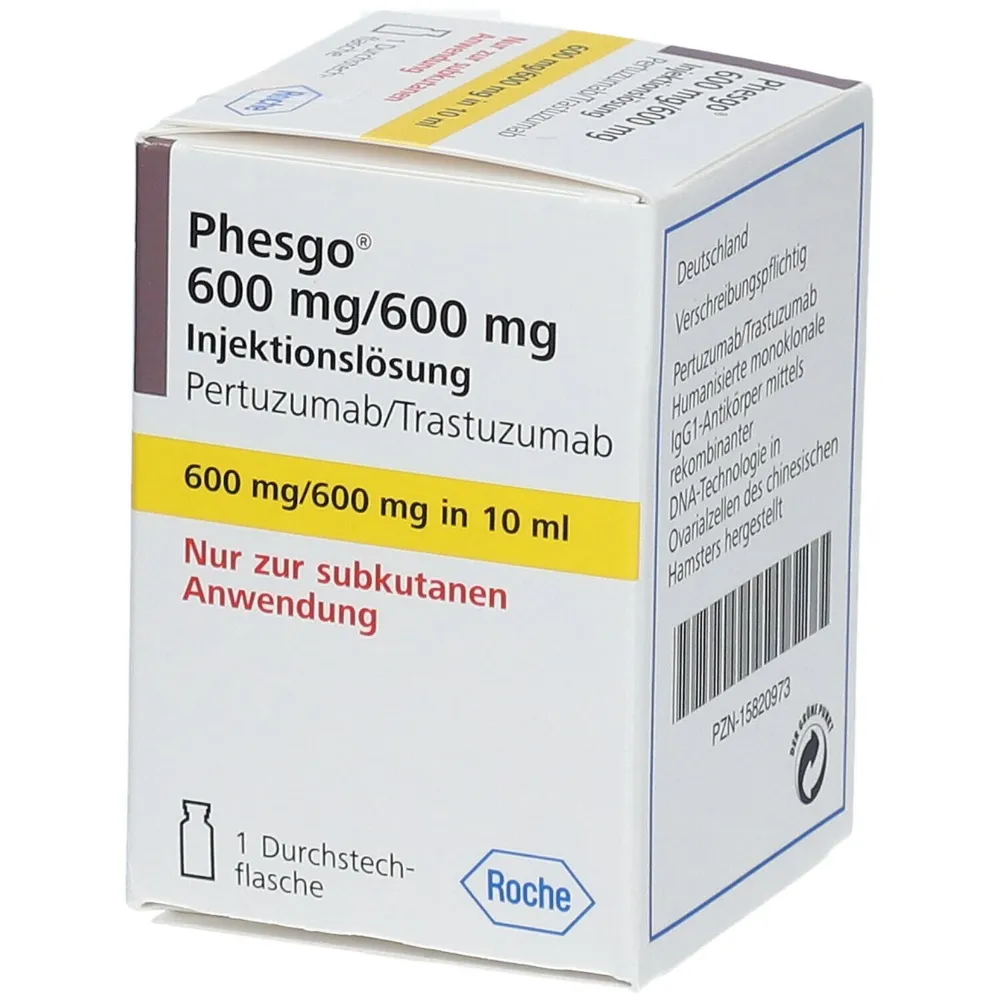
Table of Contents
Package leaflet: Information for the user
Introduction
Package leaflet: information for the user
Phesgo 600mg/600mg solution for injection
Phesgo 1,200mg/600mg solution for injection
pertuzumab/trastuzumab
Read all of this leaflet carefully before you start using this medicine, because it contains important information for you.
- Keep this leaflet, as you may need to read it again.
- If you have any questions, ask your doctor, pharmacist or nurse.
- If you experience any side effects, talk to your doctor, pharmacist or nurse, even if it is a side effect not listed in this leaflet. See section 4.
Contents of this leaflet
- What Phesgo is and what it is used for
- What you need to know before using Phesgo
- How to use Phesgo
- Possible side effects
- How to store Phesgo
- Contents of the pack and other information
1. What Phesgo is and what it is used for
Phesgo is a cancer medicine that contains two active substances: pertuzumab and trastuzumab.
- Pertuzumab and trastuzumab are “monoclonal antibodies”. They are designed to bind to a specific target on cells called “human epidermal growth factor receptor 2” (HER2).
- HER2 is found in large amounts on the surface of certain cancer cells and stimulates their growth.
- By binding to HER2 on cancer cells, pertuzumab and trastuzumab slow down their growth or destroy them.
Phesgo is available in two different doses. For more information, see section 6.
Phesgo is a medicine used to treat adult patients with breast cancer that is of the “HER2-positive” type – your doctor will perform tests to determine if this is the case. It can be used when:
- the cancer has spread to other parts of the body (has metastasized), such as the lungs or liver, or the cancer has recurred in the breast and the area around the breast, but cannot be surgically removed and no prior treatment with cancer medicines (chemotherapy) or other medicines designed to target HER2 has been administered.
- the cancer has not spread to other parts of the body and treatment is to be carried out before surgery (neoadjuvant therapy) or after surgery (adjuvant therapy).
In addition to Phesgo, you will receive other medicines called chemotherapeutic agents. Information about these medicines is described in separate package leaflets. Ask your doctor, pharmacist, or nurse for information about these other medicines.
2. What you need to know before using Phesgo
Do not use Phesgo
- If you are allergic to pertuzumab, trastuzumab, or any of the other components of this medicine (listed in section 6).
If you are unsure, speak with your doctor, pharmacist, or nurse before being administered Phesgo.
Warnings and precautions
Heart problems
Treatment with Phesgo may affect the heart. Consult your doctor, pharmacist, or nurse before being administered Phesgo if:
- You have ever had heart problems (such as heart failure, treatment for severe irregular heartbeat, uncontrolled hypertension, or recent heart attack). Your doctor will perform tests to check that your heart is functioning properly before and during treatment with Phesgo.
- You have ever had heart problems during previous treatment with a medicine containing trastuzumab.
- You have ever received chemotherapy medicines from the group of anticancer drugs known as anthracyclines, such as doxorubicin or epirubicin; these medicines can damage the heart muscle and increase the risk of heart problems with Phesgo.
- You have ever received radiotherapy to the chest area, as this may increase the risk of heart problems.
If any of the above applies to you (or if you are unsure), consult your doctor or nurse before being administered Phesgo. See section 4, “Serious side effects,” for more details about signs of heart problems to watch for.
Reactions to the injection
Reactions to the injection may occur. These are allergic reactions and can be serious.
If you experience any serious adverse reaction, your doctor may discontinue treatment with Phesgo. See section 4, “Serious side effects,” for more details about injection-related reactions to monitor during and after the injection.
Your doctor or nurse will monitor you for adverse effects during the injection and for:
- 30 minutes after the first injection of Phesgo.
- 15 minutes after subsequent injections of Phesgo.
If you experience any serious reaction, your doctor will discontinue treatment with Phesgo.
Low white blood cell counts and fever (Febrile neutropenia)
When Phesgo is administered with chemotherapy medicines, the number of white blood cells in the blood may decrease and fever may occur. If you have inflammation of the digestive tract (e.g., mouth pain or diarrhea), you may be more likely to experience this adverse effect. If fever persists for several days, this may be a sign of worsening condition and you should contact your doctor.
Diarrhea
Treatment with Phesgo may cause severe diarrhea. Patients over 65 years of age have a higher risk of developing diarrhea compared to patients under 65 years of age. If you experience severe diarrhea while receiving your cancer treatment, your doctor may give you medications to control it. Your doctor may also interrupt your treatment with Phesgo until the diarrhea is under control.
Children and adolescents
Phesgo must not be given to patients under 18 years of age because there is no information available on its efficacy in this age group.
Elderly patients over 65 years of age
Patients over 65 years of age are more likely to experience adverse effects such as decreased appetite, reduced number of red blood cells in the blood, weight loss, fatigue, loss or alteration of taste, weakness, numbness, tingling, or itching, primarily in the feet and legs, and diarrhea, compared to patients under 65 years of age.
Other medicines and Phesgo
Inform your doctor, pharmacist, or nurse if you are taking, have recently taken, or might need to take any other medicines.
Pregnancy, breastfeeding, and fertility
Before starting treatment, inform your doctor, pharmacist, or nurse if you are pregnant or breastfeeding, or if you think you may be pregnant or intend to become pregnant. You will be informed of the benefits and risks to you and your baby of receiving Phesgo during pregnancy.
- Inform your doctor immediately if you become pregnant during treatment with Phesgo or within 7 months after stopping treatment. Phesgo may harm the unborn baby. You must use an effective method of contraception during treatment with Phesgo and for 7 months after stopping treatment.
- Ask your doctor if you can breastfeed during or after treatment with Phesgo.
Driving and use of machines
Phesgo may affect your ability to drive or operate machinery. If during treatment you experience symptoms such as dizziness, chills, fever, injection reactions, or allergic reactions as described in section 4, you should not drive or use machines until these symptoms have resolved.
Phesgo contains sodium
Phesgo contains less than 1 mmol of sodium (23 mg) per dose; this is essentially “sodium-free.”
Phesgo contains polysorbate 20 (E 432)
Phesgo contains polysorbate 20. Each 15 ml vial of solution contains 6 mg of polysorbate 20. Each 10 ml vial of solution contains 4 mg of polysorbate 20. Polysorbates may cause allergic reactions. Inform your doctor if you have any known allergy.
3. How to use Phesgo
A doctor or nurse will administer Phesgo as an injection under your skin (subcutaneous injection). Treatment will begin in a hospital or clinic. If you tolerate the treatment well, your doctor may decide that you can receive Phesgo outside the hospital or clinic, for example, at your home.
- Injections are given every three weeks.
- You will receive the injection first in one thigh, then in the other. You will continue to alternate between thighs for each injection.
- Your doctor or nurse will ensure that each injection is given at a new site (at least 2.5 cm away from the previous injection site), and where the skin is not red, bruised, tender, or hard.
- Different injection sites should be used for other medications.
Starting treatment (initial dose)
- 1,200 mg / 600 mg of Phesgo will be administered under the skin over 8 minutes. Your doctor or nurse will monitor you for side effects during the injection and for 30 minutes afterward.
- You will also receive chemotherapy.
Subsequent injections (maintenance dose), which will be administered if the first injection did not cause you any serious adverse reactions:
-
600 mg / 600 mg of Phesgo will be administered under the skin over 5 minutes. Your doctor or nurse will monitor you for side effects during the injection and for 15 minutes afterward.
-
Depending on your doctor's prescription, you will also receive chemotherapy.
-
The number of injections you will receive depends on:
-
how you respond to treatment
-
whether you are receiving treatment before surgery, after surgery, or if the disease has spread.
For more information on initial and maintenance doses, see section 6.
For more information on the dose of chemotherapy (which may also cause side effects), please read the package leaflet of those medicines. If you have any questions about these medicines, consult your doctor, pharmacist, or nurse.
Administration outside the clinical setting
At the end of this leaflet, information for healthcare professionals on how to prepare and administer Phesgo is provided.
If you forget to use Phesgo
If you miss your appointment to receive Phesgo, schedule another appointment as soon as possible. Depending on how much time has passed between visits, your doctor will decide which dose of Phesgo to give you.
If you interrupt treatment with Phesgo
Do not stop your treatment with this medicine without first talking to your doctor. It is important that you receive all injections of the treatment cycle at the correct time every three weeks. This helps ensure the medicine works as effectively as possible.
If you have any further questions about the use of this medicine, ask your doctor, pharmacist, or nurse.
4. Possible adverse effects
Like all medicines, this medicine can cause adverse effects, although not everyone experiences them.
Serious adverse effects
Tell your doctor or nurse immediately if you notice any of the following adverse effects:
- Heart problems: slower or faster heartbeat than normal, or fluttering in the chest, and symptoms that may include cough, shortness of breath, and swelling (fluid retention) in your legs or arms.
- Reactions to the injection: these may be mild or more severe and may include feeling unwell, fever, chills, tiredness, headache, loss of appetite, muscle and joint pain, and hot flushes.
- Diarrhea: may be mild or moderate, but can be very severe or persistent, with 7 or more bowel movements per day.
- Low white blood cell count shown in a blood test. This may occur with or without fever.
- Allergic reactions: swelling of the face and throat, with difficulty breathing, which may be symptoms of a severe allergic reaction.
Tell your doctor or nurse immediately if you notice any of the above adverse effects.
Other adverse effects
Very common (may affect more than 1 in 10 people):
- Hair loss
- Rash
- Inflammation of the digestive tract (e.g. mouth pain)
- Decrease in red and white blood cells, shown in a blood test
- Muscle weakness
- Constipation
- Loss or change in taste
- Difficulty sleeping
- Sensation of weakness, numbness, tingling, or prickling, mainly affecting feet, legs, and hands
- Nosebleeds
- Acid reflux
- Dry, itchy skin or acne
- Pain at the injection site, redness of the skin (erythema), and bruising at the injection site
- Nail problems, such as discoloration with white or dark streaks or change in nail color
- Sore throat, redness, pain, or runny nose, flu-like symptoms, and fever, which may lead to ear, nose, or throat infection
- Increased tear production
- Body pain, in arms, legs, and abdomen
- Sharp, stabbing pain, with sensation of cold or heat
- Feeling pain from something that should not be painful, such as light touch
- Loss of balance or coordination
Common (may affect up to 1 in 10 people):
- Difficulty breathing
- Reduced ability to feel changes in heat or cold
- Inflammation of the nail bed at its junction with the skin
- A condition in which the left side of the heart does not function properly, with or without symptoms
- A condition in which the heart muscle becomes weaker, which may result in difficulty breathing
- Allergic reaction causing a range of symptoms from mild to severe, such as fever, chills, headache, and difficulty breathing
Uncommon (may affect up to 1 in 100 people):
- Chest symptoms such as dry cough or difficulty breathing (possible signs of interstitial lung disease, a condition involving damage to the tissues around the air sacs in the lungs)
- Fluid around the lungs causing difficulty breathing
Rare adverse effects such as tumor lysis syndrome (where cancer cells die rapidly) have been observed with intravenous pertuzumab but not with Phesgo. Tumor lysis syndrome may include kidney problems (signs include weakness, shortness of breath, fatigue, and confusion), heart problems (signs include fluttering in the chest, irregular heartbeat from fast to slow, seizures, vomiting or diarrhea, and tingling in the mouth, hands, or feet).
If you experience any of the above side effects, speak to your doctor, nurse, or pharmacist.
If you develop any of the above symptoms after treatment with Phesgo has been stopped, consult your doctor immediately and inform them that you have previously been treated with Phesgo.
Some of the adverse effects you experience may be due to your breast cancer. If Phesgo is administered at the same time as chemotherapy, some adverse effects may also be due to these other medicines.
Reporting of adverse effects
If you experience any adverse effect, talk to your doctor, pharmacist, or nurse. This includes any possible adverse effects not listed in this leaflet. You can also report them directly through the national reporting system listed in Appendix V. By reporting adverse effects, you can help provide more information on the safety of this medicine.
5. Storage of Phesgo
Phesgo will be stored by healthcare professionals at the hospital or clinic. The storage details are as follows:
- Keep this medicine out of the sight and reach of children.
- Do not use this medicine after the expiry date stated on the packaging and vial after EXP. The expiry date refers to the last day of the month indicated.
- Store in a refrigerator (2 °C–8 °C).
- Do not freeze.
- Keep the vial in the outer packaging to protect it from light.
- Once the vial has been opened, administer the solution immediately. Do not use this medicine if you notice particles in the liquid or if it has an unusual colour (see section 6).
- Medicines must not be disposed of via wastewater or household waste. Ask your pharmacist how to dispose of any unused containers and medicines. This will help protect the environment.
6. Contents of the container and other information
Composition of Phesgo
The active substances are pertuzumab and trastuzumab.
- A 10 ml vial of solution contains 600 mg of pertuzumab and 600 mg of trastuzumab. Each ml contains 60 mg of pertuzumab and 60 mg of trastuzumab.
- A 15 ml vial of solution contains 1,200 mg of pertuzumab and 600 mg of trastuzumab. Each ml contains 80 mg of pertuzumab and 40 mg of trastuzumab.
The other components are: hyaluronidase alfa, L-histidine, L-histidine monohydrochloride monohydrate, α,α-trehalose dihydrate, sucrose, L-methionine, polysorbate 20, and water for injections (see section 2 “Phesgo contains sodium”, “Phesgo contains polysorbate”).
Appearance of Phesgo and contents of the container
Phesgo is an injectable solution. It is a solution ranging from transparent to slightly opalescent, colourless to pale brown, contained in a glass vial. Each package contains one vial with either a 10 ml or 15 ml solution.
Marketing Authorization Holder
Roche Registration GmbH
Emil-Barell-Strasse 1
79639 Grenzach-Wyhlen
Germany
Manufacturer responsible
Roche Pharma AG
Emil-Barell-Strasse 1
79639 Grenzach-Wyhlen
Germany
For further information about this medicinal product, please contact the local representative of the Marketing Authorization Holder:
Belgium/Belgium/Belgium Luxembourg/Luxembourg N.V. Roche S.A. Belgium/Belgium/Belgium Tel/Tel: +32 (0) 2 525 82 11 | Lithuania UAB “Roche Lietuva” Tel.: +370 5 2546799 |
| Luxembourg/Luxembourg (See Belgique/Belgien) |
Czech Republic Roche s. r. o. Tel.: +420 - 2 20382111 | Hungary Roche (Magyarország) Kft. Tel.: +36 - 1 279 4500 |
Denmark Roche Pharmaceuticals A/S Tel.: +45 - 36 39 99 99 | Malta (See Ireland) |
Germany Roche Pharma AG Tel.: +49 (0) 7624 140 | Netherlands Roche Nederland B.V. Tel.: +31 (0) 348 438050 |
Estonia Roche Eesti OÜ Tel.: + 372 - 6 177 380 | Norway Roche Norge AS Tel.: +47 - 22 78 90 00 |
Greece/Cyprus Roche (Hellas) A.E. Greece Tel.: +30 210 61 66 100 | Austria Roche Austria GmbH Tel.: +43 (0) 1 27739 |
Spain Roche Farma S.A. Tel: +34 - 91 324 81 00 | Poland Roche Polska Sp.z o.o. Tel.: +48 - 22 345 18 88 |
France Roche Tel: +33 (0) 1 47 61 40 00 | Portugal Roche Farmacêutica Química, Lda Tel.: +351 - 21 425 70 00 |
Croatia Roche d.o.o. Tel.: +385 1 4722 333 | Romania Roche România S.R.L. Tel.: +40 21 206 47 01 |
Ireland, Malta Roche Products (Ireland) Ltd. Ireland/Ireland Tel.: +353 (0) 1 469 0700 | Slovenia Roche farmacevtska družba d.o.o. Tel.: +386 - 1 360 26 00 |
Iceland Roche Pharmaceuticals A/S c/o Icepharma hf Tel: +354 540 8000 | Slovakia Roche Slovensko, s.r.o. Tel.: +421 - 2 52638201 |
Italy Roche S.p.A. Tel.: +39 - 039 2471 | Finland/Finland Roche Oy Tel/Tel: +358 (0) 10 554 500 |
Cyprus G.A. Stamatēs & Sia Ltd. Tel.: +357 - 22 76 62 76 | Sweden Roche AB Tel.: +46 (0) 8 726 1200 |
Latvia Roche Latvija SIA Tel.: +371 - 6 7039831 | United Kingdom (Northern Ireland) Roche Products (Ireland) Ltd. Tel: +44 (0) 1707 366000 |
Date of the most recent review of this leaflet
Other sources of information
Detailed information on this medicine is available on the website of the European Medicines Agency: http://www.ema.europa.eu.
The following information is intended exclusively for healthcare professionals:
Administration of Phesgo 600/600 mg injectable solution outside the clinical setting
Any healthcare professional treating patients outside the clinical setting must be fully informed about both the administration method and the potential risks associated with Phesgo.
Healthcare professionals must ensure that appropriate medications for managing hypersensitivity reactions, in accordance with local standard clinical practice (depending on the severity and type of reaction, e.g., epinephrine, beta agonists, antihistamines, and corticosteroids), are readily available for immediate use.
Phesgo must be stored at 2°C–8°C in its original carton until the time of use.
Instructions for use
Phesgo must be administered only as a subcutaneous injection. Phesgo is not intended for intravenous administration.
To prevent medication errors, it is important to check the vial label to ensure that the medicine being prepared and administered is Phesgo 600/600 mg (15 ml vial containing 10 ml of solution).
Before administration, Phesgo should be visually inspected to ensure there are no particles or discoloration. If particles or discoloration are observed, the vial must be discarded according to local disposal guidelines. Do not shake the vial.
Prior to use, allow the Phesgo vial to reach room temperature by leaving it out for approximately 15 minutes before preparing the injection.
A syringe, a transfer needle, and a subcutaneous injection needle are required to withdraw the Phesgo solution from the vial and administer it subcutaneously. Phesgo can be injected using hypodermic injection needles with gauges between 25 G and 27 G, and lengths between 3/8" (10 mm) and 5/8" (16 mm). Phesgo is compatible with stainless steel, polypropylene, polycarbonate, polyethylene, polyurethane, polyvinyl chloride, and fluorinated ethylene propylene.
Since Phesgo does not contain any antimicrobial preservative, the medicine must be used immediately. The hypodermic injection needle should be attached to the syringe immediately before administration, and the volume should then be adjusted to 10 ml.
The injection site should alternate only between the left and right thigh. New injections should be administered at least 2.5 cm away from the previous injection site on healthy skin, and never in areas where the skin is red, bruised, tender, or hard. The dose must not be divided between two syringes or administered at two different injection sites.
The dose should be administered over a period of 5 minutes. The injection may be slowed or stopped if the patient experiences injection-related symptoms.
A 15-minute observation period is recommended after completion of the injection, during which patients should be monitored for injection-related reactions and hypersensitivity reactions.
Patients should be advised to recognize the symptoms of hypersensitivity reactions and other potentially serious adverse effects (as described in section 4 of this leaflet), and should be encouraged to contact a healthcare professional if symptoms occur after the healthcare professional has left the patient.
Phesgo is for single use only. Any unused medicine and all materials that have come into contact with it must be disposed of in accordance with local regulations. The name and batch number of the administered product must be clearly recorded.