Paidoterin descongestive syrup
Spain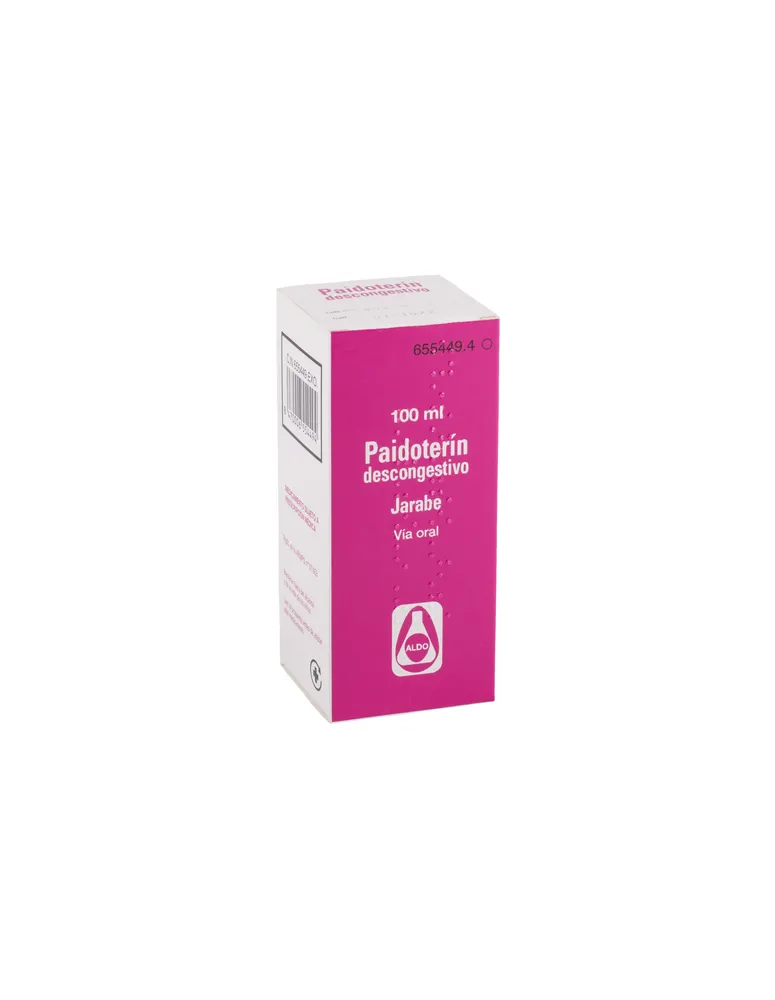
Table of Contents
- Package leaflet: Information for the user
- Introduction
- 1. What PAIDOTERÍN DECONGESTANT syrup is and what it is used for
- 2. BEFORE TAKING PAIDOTERÍN DECONGESTANT syrup
- 3. How to take PAIDOTERÍN DESCONGESTIVO syrup
- 4. Possible adverse effects
- 5. Storage of PAIDOTERÍN DECONGESTANT syrup
- 6. ADDITIONAL INFORMATION
Package leaflet: Information for the user
Introduction
Package leaflet: information for the user
PAIDOTERIN DECONGESTANT
Syrup
Read the entire leaflet carefully before you start taking this medicine, because it contains important information for you.
- Keep this leaflet, as you may need to read it again. If you have any questions, consult your doctor or pharmacist.
- This medicine has been prescribed for you only, and you should not give it to others, even if they have the same symptoms as you, because it could harm them.
- If you experience any adverse effects, consult your doctor or pharmacist, even if they are adverse effects not listed in this leaflet. See section 4.
Leaflet contents
- What PAIDOTERIN DECONGESTANT syrup is and what it is used for
- What you need to know before taking PAIDOTERIN DECONGESTANT syrup
- How to take PAIDOTERIN DECONGESTANT syrup
- Possible adverse effects
- How to store PAIDOTERIN DECONGESTANT syrup
- Contents of the pack and other information
1. What PAIDOTERÍN DECONGESTANT syrup is and what it is used for
PAIDOTERÍN DECONGESTANT syrup is a combination of phenylephrine, diphenhydramine, and chlorpheniramine. Phenylephrine is a sympathomimetic amine that acts on the alpha-adrenergic receptors in the respiratory tract mucosa to produce vasoconstriction, thereby temporarily reducing swelling associated with inflammation of the mucous membranes lining the nasal passages, acting as a decongestant.
Diphenhydramine and chlorpheniramine are two antihistamines that prevent, but do not reverse, responses mediated by histamine. The antimuscarinic actions of antihistamines provide a sedative effect on the nasal mucosa.
It relieves symptoms of congestion of the mucous membranes of the upper respiratory tract associated with perennial or seasonal allergic rhinitis.
2. BEFORE TAKING PAIDOTERÍN DECONGESTANT syrup
Do not take PAIDOTERÍN DECONGESTANT syrup:
- If you have hypersensitivity to any of the components of the medicine.
- In children under 2 years of age.
Take special care with PAIDOTERÍN DECONGESTANT syrup:
Administer with great caution in patients with hypertension, severe cardiovascular disease, glaucoma, prostatic hypertrophy, bladder neck obstruction, and urinary retention.
Patients sensitive to one antihistamine may also be sensitive to others.
Use with other medicines:
Antihistamines may potentiate central nervous system (CNS) depressant effects when administered concomitantly with CNS depressants, tricyclic antidepressants, maprotiline, MAO inhibitors, and alcohol. They may also enhance the anticholinergic effects of drugs with anticholinergic activity.
Pressor effects may be enhanced when phenylephrine is administered concomitantly with doxapram, methyldopa, or trimethaphan. Phenylephrine, when used together with digitalis glycosides, may increase the risk of cardiac arrhythmias and exacerbate vasoconstriction induced by ergot alkaloids or methysergide. It may also prolong and intensify the cardiac stimulant and vasopressor effects of sympathomimetic amines. The pressor response to phenylephrine may be blocked by prior administration of alpha-adrenergic blockers, and phenylephrine may inhibit the therapeutic effects of beta-adrenergic blockers. The risk of severe ventricular arrhythmias may increase when phenylephrine is administered simultaneously with inhaled halogenated hydrocarbon anesthetics.
PAIDOTERÍN DECONGESTANT syrup is compatible with sulfonamide therapy or any antibiotic treatment.
Inform your doctor or pharmacist if you are taking or have recently taken any other medicines, including those obtained without a prescription.
Use in children:
Do not administer to children under 2 years of age.
Use in elderly:
In elderly patients, anticholinergic and CNS stimulant effects are more likely to occur, and there is a risk of precipitating undiagnosed glaucoma.
Pregnancy and breastfeeding:
The safety of PAIDOTERÍN DECONGESTANT syrup during pregnancy has not been established. Its use is not recommended in women who are breastfeeding due to the risk of adverse effects in the infant, such as unusual excitability or irritability, since small amounts of antihistamines are excreted in breast milk.
Driving and use of machines:
Since this medicine may cause drowsiness, the ability to drive or operate machinery may be impaired, potentially posing a danger.
Use in athletes:
This medicine contains phenylephrine, which may lead to a positive result in doping control tests.
Important information about some components of PAIDOTERÍN DECONGESTANT syrup:
- This medicine contains sucrose. If your doctor has informed you of an intolerance to certain sugars, consult with him before taking this medicine.
- May cause dental caries.
- May cause allergic reactions (possibly delayed) because it contains methylparaben sodium salt (E-219).
- This medicine may cause allergic reactions because it contains amaranth (E-123). It may provoke asthma, especially in patients allergic to acetylsalicylic acid.
3. How to take PAIDOTERÍN DESCONGESTIVO syrup
Instructions for proper use
Follow exactly the administration instructions for PAIDOTERÍN DESCONGESTIVO syrup provided by your doctor.
Consult your doctor or pharmacist if you have any doubts.
Recommended doses are:
Children 2 to 6 years of age: 5 ml every 6 or 8 hours.
Children 6 to 12 years of age: 10-15 ml every 6 or 8 hours.
Adults: 15-20 ml every 6 or 8 hours.
Administration is preferably done after meals.
The dose may be measured using the graduated 5 ml dosing syringe included in the package, or with a small spoon (equivalent to 5 ml).
The maximum dose should not exceed double the recommended amount for each individual dose.
If you take more PAIDOTERÍN DESCONGESTIVO syrup than you should:
In case of acute intoxication due to overdose, treatment consists of administration of an emetic or gastric lavage with 5% sodium bicarbonate solution, activated charcoal, and catharsis. If ventricular tachycardia occurs, lidocaine should be administered; if there is no response, propranolol. For seizures, diazepam. In cases of severe hypertension, nitroprusside or phentolamine. If anticholinergic effects are intractable, physostigmine should be administered. Electrocardiographic and vital signs monitoring should be performed, and in symptomatic patients, urine and blood electrolytes should be monitored.
In case of overdose or accidental ingestion, contact your doctor or pharmacist immediately or call the Toxicology Information Service at telephone number: 91562 04 20, indicating the medication and the amount ingested.
If you forget to take PAIDOTERÍN DESCONGESTIVO syrup:
Do not take a double dose to make up for missed doses.
If you have any further questions about the use of this medicine, ask your doctor or pharmacist.
4. Possible adverse effects
Like all medicines, PAIDOTERÍN DESCONGESTIVO syrup may have adverse effects, although not everybody gets them.
Somnolence may exceptionally occur. Rarely, blood dyscrasias, increased sensitivity of the skin to sunlight, increased sweating, and loss of appetite may appear. Also, with rare incidence, a paradoxical reaction (nightmares, excitement, nervousness, etc.) may occur, which is more likely in children and elderly patients. In these patients, confusion, difficulty or pain during urination, and somnolence are more likely to occur.
If you consider that any of the adverse effects you experience is severe, or if you notice any adverse effects not listed in this leaflet, inform your doctor or pharmacist.
5. Storage of PAIDOTERÍN DECONGESTANT syrup
Keep out of the reach and sight of children.
The bottle must be stored in its original packaging, protected from light and excessively low temperatures.
Do not use PAIDOTERÍN DECONGESTANT syrup after the expiry date stated on the packaging following Exp:. The expiry date refers to the last day of the month indicated.
Medicines must not be disposed of via wastewater or household waste. Dispose of unused containers and medicines at the SIGRE collection point at your pharmacy. If in doubt, ask your pharmacist how to properly dispose of unused containers and medicines. This will help protect the environment.
6. ADDITIONAL INFORMATION
Composition of PAIDOTERÍN DECONGESTANT syrup
- The active substances are Phenylephrine hydrochloride, Diphenhydramine hydrochloride, and Chlorpheniramine maleate. The other components are sodium saccharin, sucrose, amaranth (E-123), methyl parahydroxybenzoate, sodium salt (E-219), glycerol, sodium citrate, citric acid, strawberry flavor, and purified water.
Appearance of the product and contents of the container
PAIDOTERÍN DECONGESTANT syrup is a red liquid with a strawberry flavor, supplied in a 100 ml bottle, provided with a 5 ml dosing syringe.
Marketing Authorization Holder and Manufacturer
Laboratorio ALDO-UNIÓN, S.L.
Calle Baronesa de Maldà, 73
08950 Esplugues de Llobregat (Barcelona)
SPAIN
This leaflet was approved: March 2012
Detailed and up-to-date information on this medicine is available on the website of the Spanish Agency of Medicines and Health Products (AEMPS): http://www.aemps.gob.es