Olmetec 20 mg film-coated tablets
Spain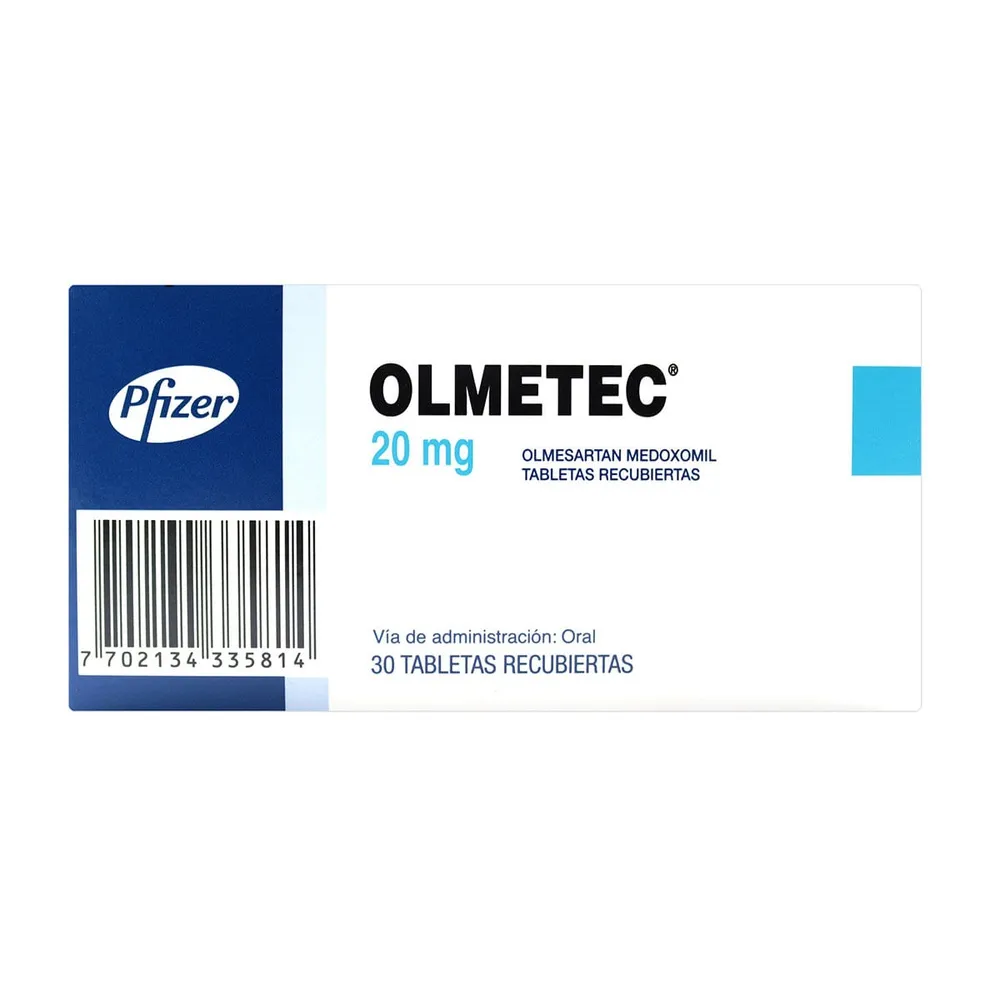
Table of Contents
Package leaflet: Information for the user
Introduction
Package leaflet: information for the user
Olmetec 20 mg film-coated tablets
Olmesartan medoxomil
Read all of this leaflet carefully before you start taking this medicine because it contains important information for you.
- Keep this leaflet. You may need to read it again.
- If you have any further questions, ask your doctor or pharmacist.
- This medicine has been prescribed for you only. Do not pass it on to others. It may harm them, even if their symptoms are the same as yours.
- If you get any side effects, talk to your doctor or pharmacist. This includes any side effects not listed in this leaflet. See section 4.
What is in this leaflet
- What Olmetec is and what it is used for
- What you need to know before you take Olmetec
- How to take Olmetec
- Possible side effects
- How to store Olmetec
- Contents of the pack and other information
1. What Olmetec is and what it is used for
Olmetec belongs to a group of medicines known as angiotensin II receptor antagonists. It lowers blood pressure by relaxing blood vessels.
Olmetec is used to treat high blood pressure (also known as hypertension) in adults, and in children and adolescents aged 6 to less than 18 years. High blood pressure can damage blood vessels in organs such as the heart, kidneys, brain, and eyes. In some cases, this may lead to heart attack, heart or kidney failure, stroke, or blindness. High blood pressure usually produces no symptoms. It is important to control your blood pressure to prevent organ damage.
High blood pressure can be controlled with medicines such as Olmetec tablets. Your doctor has likely also advised you to make certain lifestyle changes to help lower your blood pressure (for example, losing weight, quitting smoking, reducing the amount of alcohol you drink, and reducing salt in your diet). Your doctor may also recommend that you exercise regularly, such as walking or swimming. It is important to follow your doctor's advice.
2. What you need to know before taking Olmetec
Do not take Olmetec
- If you are allergic to olmesartan medoxomil or to any of the other ingredients of this medicine (listed in section 6).
- If you are more than 3 months pregnant. (It is also advisable to avoid Olmetec tablets at the beginning of pregnancy – see Pregnancy section).
- If you have yellowing of the skin and eyes (jaundice), or problems with bile drainage from the gallbladder (biliary obstruction, for example, due to gallstones).
- If you have diabetes or kidney failure and are being treated with a blood pressure-lowering medicine containing aliskiren.
Warnings and precautions
Talk to your doctor before starting to take Olmetec.
Tell your doctor if you are taking any of the following medicines used to treat high blood pressure (hypertension):
- An angiotensin-converting enzyme (ACE) inhibitor (for example enalapril, lisinopril, ramipril), particularly if you have kidney problems related to diabetes.
- Aliskiren.
Your doctor may monitor your kidney function, blood pressure, and blood levels of electrolytes (for example, potassium) at regular intervals.
See also the information under the heading “Do not take Olmetec”.
Tell your doctor if you have any of the following health problems:
- Kidney problems.
- Liver disease.
- Heart failure or problems with heart valves or heart muscle.
- Severe vomiting, diarrhoea, treatment with high doses of medicines that increase urine output (diuretics), or if you are on a low-salt diet.
- High levels of potassium in the blood.
- Problems with the adrenal glands.
Contact your doctor if you experience severe, persistent diarrhoea that causes significant weight loss. Your doctor will assess your symptoms and decide how to proceed with your blood pressure treatment.
Consult your doctor if you develop abdominal pain, nausea, vomiting, or diarrhoea after taking Olmetec. Your doctor will decide whether to continue treatment. Do not stop taking Olmetec on your own.
As with any other medicine that lowers blood pressure, excessive lowering of blood pressure in patients with impaired blood flow to the heart or brain may lead to a heart attack or stroke. Therefore, your doctor will carefully monitor your blood pressure.
You must inform your doctor if you are pregnant or think you might be pregnant. The use of Olmetec is not recommended at the beginning of pregnancy, and it must not be taken if you are more than 3 months pregnant, as it may cause serious harm to your baby if taken during this stage (see Pregnancy section).
Black patients
As with other similar medicines, the blood pressure-lowering effect of Olmetec is somewhat reduced in black patients.
Elderly patients
If you are 65 years of age or older and your doctor decides to increase the dose of olmesartan medoxomil to 40 mg daily, you will need regular monitoring of your blood pressure by your doctor to ensure it does not drop too low.
Children and adolescents
Olmetec has been studied in children and adolescents. For further information, consult your doctor. Olmetec is not recommended for children aged 1 year to less than 6 years, and must not be used in children under 1 year of age, as there is no experience available.
Taking Olmetec with other medicines
Tell your doctor or pharmacist if you are taking, have recently taken, or might need to take any other medicines.
In particular, inform your doctor or pharmacist about any of the following medicines:
- Other blood pressure-lowering medicines, as they may increase the effect of Olmetec.
Your doctor may need to adjust your dose and/or take other precautions:
If you are taking an angiotensin-converting enzyme (ACE) inhibitor or aliskiren (see also information under the headings “Do not take Olmetec” and “Warnings and precautions”).
- Potassium supplements, salt substitutes containing potassium, medicines that increase urine output (diuretics), or heparin (a blood thinner). Taking these medicines together with Olmetec may increase potassium levels in the blood.
- Lithium (a medicine used to treat mood disorders and certain types of depression), as taking it together with Olmetec may increase its toxicity. If you need to take lithium, your doctor will monitor lithium levels in your blood.
- Non-steroidal anti-inflammatory drugs (NSAIDs) (medicines to relieve pain, swelling, and other symptoms of inflammation, including arthritis), as taking them together with Olmetec may increase the risk of kidney failure and reduce the effect of Olmetec.
- Colesevelam hydrochloride, a medicine that lowers cholesterol levels in the blood, as it may reduce the effect of Olmetec. Your doctor may advise you to take Olmetec at least 4 hours before colesevelam hydrochloride.
- Certain antacids (remedies for indigestion), as they may slightly reduce the effect of Olmetec.
Taking Olmetec with food and drink
Olmetec can be taken with or without food.
Pregnancy and breastfeeding
Pregnancy
Inform your doctor if you are pregnant, think you might be pregnant, or plan to become pregnant. Your doctor will advise you to stop taking Olmetec before becoming pregnant or as soon as you know you are pregnant, and will recommend an alternative medicine instead of Olmetec. The use of Olmetec is not recommended at the beginning of pregnancy, and must not be taken after the third month of pregnancy, as it may cause serious harm to your baby if used from the third month of pregnancy onwards.
Breastfeeding
Inform your doctor if you are breastfeeding or about to start breastfeeding. Olmetec is not recommended for breastfeeding mothers, and your doctor may choose an alternative treatment if you wish to breastfeed, especially if your baby is a newborn or premature.
If you are pregnant or breastfeeding, think you may be pregnant, or plan to become pregnant, consult your doctor or pharmacist before using this medicine.
Driving and using machines
You may feel drowsy or dizzy during treatment for high blood pressure. If this occurs, do not drive or operate machinery until symptoms have resolved. Consult your doctor.
Olmetec contains lactose
This medicine contains lactose. If your doctor has informed you that you have an intolerance to certain sugars, consult with him before taking this medicine.
3. How to take Olmetec
Follow exactly the instructions given by your doctor for taking this medicine. If you are unsure, please consult your doctor or pharmacist again.
The recommended initial dose is 1 Olmetec 10 mg tablet once daily. If blood pressure is not adequately controlled, your doctor may increase the dose to 20 mg or 40 mg per day or prescribe additional treatment.
In patients with mild to moderate renal impairment, the maximum dose is 20 mg once daily.
The tablets can be taken with or without food. Take the tablets with a sufficient amount of liquid (for example, a glass of water). If possible, take your dose at the same time each day, for example, with breakfast.
Children and adolescents aged 6 to less than 18 years:
The recommended initial dose is 10 mg once daily. If the patient's blood pressure is not adequately controlled, the doctor may decide to adjust the dose up to 20 mg or 40 mg once daily. In children weighing less than 35 kg, the dose must not exceed 20 mg once daily.
If you take more Olmetec than you should
If you take more tablets than prescribed or if a child has accidentally ingested tablets, contact your doctor or the nearest hospital emergency department immediately and bring the medicine packaging with you.
In case of overdose or accidental ingestion, contact the Toxicology Information Service. Telephone: 91 562 04 20.
If you forget to take Olmetec
If you miss a dose, take your usual dose the next day. Do not take a double dose to make up for forgotten doses.
If you stop taking Olmetec
It is important to continue taking Olmetec unless your doctor tells you to stop treatment.
If you have any further questions about the use of this medicine, ask your doctor or pharmacist.
4. Possible adverse effects
Like all medicines, this medicine can cause adverse effects, although not everyone experiences them. If they do occur, they are often mild and do not require discontinuation of treatment.
The following adverse effects may be serious, although they affect only a small number of people.
Rare cases (may affect up to 1 in 1,000 people) of the following systemic allergic reactions have been reported: swelling of the face, mouth and/or larynx, together with itching and skin rash. If this happens to you, stop taking Olmetec and consult your doctor immediately.
Rarely (but slightly more frequently in elderly patients), Olmetec may cause a marked drop in blood pressure in susceptible patients, or as a result of an allergic reaction. This may lead to fainting or severe dizziness. If this happens to you, stop taking Olmetec, consult your doctor immediately, and remain lying down in a horizontal position.
Frequency not known: If you experience yellowing of the whites of the eyes, dark urine, or skin itching—even if you started treatment with Olmetec some time ago—contact your doctor immediately. Your doctor will assess your symptoms and decide how to proceed with your blood pressure treatment.
The following are other adverse effects known so far with Olmetec:
Frequent adverse effects (may affect up to 1 in 10 people):
Dizziness, headache, nausea, indigestion, diarrhoea, stomach pain, gastroenteritis, fatigue, sore throat, nasal congestion and discharge, bronchitis, flu-like symptoms, cough, pain, chest pain, back pain, bone pain, joint pain, urinary tract infection, swelling of ankles, feet, legs, hands, arms, blood in urine.
Some changes in certain blood test results have also been observed:
increase in fat levels (hypertriglyceridaemia), increase in uric acid levels (hyperuricaemia), increase in blood urea, increases in liver and muscle function test values.
Uncommon adverse effects (may affect up to 1 in 100 people):
Rapid allergic reactions that may affect the whole body and may cause breathing difficulties, as well as a rapid drop in blood pressure that may even lead to fainting (anaphylactic reactions), facial swelling, vertigo, vomiting, weakness, feeling unwell, muscle pain, skin rash, allergic skin rash, itching, exanthema (skin eruption), skin swelling (hives), angina pectoris (chest pain or discomfort).
In blood tests, a decrease in the number of a type of blood cells called platelets (thrombocytopenia) has been observed.
Rare adverse effects (may affect up to 1 in 1,000 people):
Lack of energy, muscle cramps, worsening of kidney function, kidney failure, intestinal angioedema: swelling in the intestine accompanied by symptoms such as abdominal pain, nausea, vomiting and diarrhoea.
Some changes in certain blood test results have been observed. These include an increase in blood potassium levels (hyperkalaemia) and an increase in components related to kidney function.
Other adverse effects in children and adolescents:
Adverse effects observed in children are similar to those reported in adults. However, dizziness and headache have been observed more frequently in children, and nosebleeds are a frequent adverse effect observed only in children.
Reporting of adverse effects
If you experience any type of adverse effect, consult your doctor or pharmacist, even if it is a possible adverse effect not listed in this leaflet. You may also report them directly via the Spanish Pharmacovigilance System for Human Medicinal Products: www.notificaram.es. By reporting adverse effects, you can help provide more information on the safety of this medicine.
5. Olmetec Storage
Keep this medicine out of the sight and reach of children.
Do not use this medicine after the expiry date stated on the packaging and blister after "EXP". The expiry date is the last day of the month indicated.
No special storage conditions are required.
Medicines must not be disposed of via wastewater or household waste. Dispose of unused medicines and their containers at the SIGRE point at your pharmacy. If you have any doubts, ask your pharmacist how to properly dispose of unused medicines and their packaging. This will help protect the environment.
6. Contents of the pack and other information
Composition of Olmetec
The active substance is olmesartan medoxomilo.
Each film-coated tablet contains 20 mg of olmesartan medoxomil.
The other components are microcrystalline cellulose, monohydrate lactose, hydroxypropylcellulose, low-substituted hydroxypropylcellulose, magnesium stearate, titanium dioxide (E171), talc and hypromellose (see section 2, "Olmetec contains lactose").
Appearance of the product and contents of the pack
Olmetec 20 mg film-coated tablets are white, round tablets with the imprint C14 on one side.
Olmetec film-coated tablets are available in packs of 14, 28, 30, 56, 84, 90, 98 and 10 x 28 tablets, and in packs with single-dose perforated blisters containing 10, 50 and 500 tablets.
Not all pack sizes are marketed.
Marketing Authorization Holder
Daiichi Sankyo España, S.A.
Paseo del Club Deportivo nº1,
Edificio 14, Planta baja izquierda
28223 Pozuelo de Alarcón – Madrid
Spain
Manufacturer
Daiichi Sankyo Europe GmbH
Luitpoldstrasse 1
85276 Pfaffenhofen
Germany
or
Qualiphar N.V.
Rijksweg, 9
2880 Bornem
Belgium
This medicinal product is authorized in the Member States of the European Economic Area under the following names:
Austria: Olmetec
Belgium: Olmetec
Denmark: Olmetec
Germany: Olmetec
Greece: Olmetec
Finland: Olmetec
France: Olmetec
Iceland: Olmetec
Ireland: Benetor
Italy: Olmetec
Luxembourg: Olmetec
Netherlands: Olmetec
Norway: Olmetec
Portugal: Olmetec
Spain: Olmetec
United Kingdom: Olmetec
Date of the most recent review of this summary: January 2025.
Other sources of information
Detailed and up-to-date information on this medicinal product is available on the website of the Spanish Agency for Medicines and Health Products (AEMPS): http://www.aemps.gob.es/.