Olmesartan/amlodipine/hydrochlorothiazide Cinfa 40 mg/10 mg/25 mg film-coated tablets EFG
Spain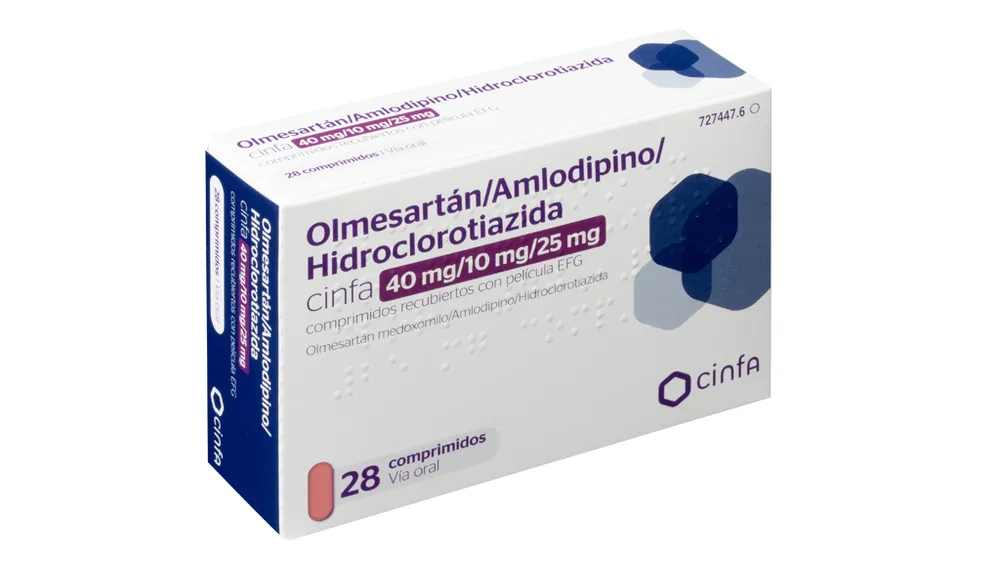
Table of Contents
- Patient Information Leaflet
- Introduction
- 1. What Olmesartan/Amlodipine/Hydrochlorothiazide Cinfa is and what it is used for
- 2. What you need to know before taking olmesartan/amlodipine/hydrochlorothiazide cinfa
- 3. How to take/use Olmesartan / Amlodipine / Hydrochlorothiazide Cinfa
- Follow exactly the instructions for using this medicine as indicated by your doctor or pharmacist. If in doubt, consult your doctor or pharmacist again.
- 4. Possible adverse effects
- 5. Storage of olmesartan/amlodipine/hydrochlorothiazide cinfa
- 6. Contents of the pack and other information
Patient Information Leaflet
Introduction
Patient Information Leaflet
olmesartan/amlodipine/hydrochlorothiazide cinfa 40 mg/10 mg/25 mg film-coated tablets EFG
olmesartan medoxomil / amlodipine / hydrochlorothiazide
Read the entire leaflet carefully before you start taking this medicine, as it contains important information for you.
- Keep this leaflet, as you may need to read it again.
- If you have any questions, ask your doctor or pharmacist.
- This medicine has been prescribed for you only, and you should not give it to other people, even if they have the same symptoms as you, because it may harm them.
- If you experience any adverse effects, consult your doctor or pharmacist, even if they are adverse effects not listed in this leaflet. See section 4.
Leaflet Contents
- What olmesartan/amlodipine/hydrochlorothiazide cinfa is and what it is used for
- What you need to know before taking olmesartan/amlodipine/hydrochlorothiazide cinfa
- How to take olmesartan/amlodipine/hydrochlorothiazide cinfa
- Possible side effects
- How to store olmesartan/amlodipine/hydrochlorothiazide cinfa
- Contents of the pack and other information
1. What Olmesartan/Amlodipine/Hydrochlorothiazide Cinfa is and what it is used for
This medicine contains three active substances: olmesartan medoxomil, amlodipine (as amlodipine besilate), and hydrochlorothiazide. These three substances help control high blood pressure.
- Olmesartan medoxomil belongs to a group of medicines called “angiotensin II receptor antagonists”, which lower blood pressure by relaxing blood vessels.
- Amlodipine belongs to a group of medicines called “calcium channel blockers”. Amlodipine also lowers blood pressure by relaxing blood vessels.
- Hydrochlorothiazide belongs to a group of medicines called thiazide diuretics. It lowers blood pressure by helping remove excess fluid from the body, increasing urine production by the kidneys.
The combined action of these substances helps reduce your blood pressure. Olmesartan/hydrochlorothiazide/amlodipine is used to treat high blood pressure:
- in adult patients whose blood pressure is not adequately controlled with the combination of olmesartan medoxomil and amlodipine taken as a fixed-dose combination, or
- in patients who are already taking a fixed-dose combination of olmesartan medoxomil and hydrochlorothiazide, together with tablets containing only amlodipine, or a fixed-dose combination of olmesartan medoxomil and amlodipine, together with tablets containing only hydrochlorothiazide.
2. What you need to know before taking olmesartan/amlodipine/hydrochlorothiazide cinfa
Do not take olmesartan/amlodipine/hydrochlorothiazide cinfa
- If you are allergic to olmesartan medoxomil, amlodipine, or a specific group of calcium channel blockers (dihydropyridines), hydrochlorothiazide, or substances similar to hydrochlorothiazide (sulfonamides), or to any of the other components of this medicine (listed in section 6).
- If you think you may be allergic, inform your doctor before taking olmesartan/amlodipine/hydrochlorothiazide.
- If you have severe kidney problems.
- If you have diabetes or renal failure and are being treated with a blood pressure-lowering medicine containing aliskiren.
- If you have low levels of potassium or sodium in the blood, high levels of calcium or uric acid (with symptoms of gout or kidney stones) in the blood, which do not improve with treatment.
- If you are more than 3 months pregnant. (It is also advisable to avoid olmesartan/amlodipine/hydrochlorothiazide in early pregnancy – see section “Pregnancy and breastfeeding”).
- If you have severe liver problems, biliary secretion disorders, or obstruction of bile drainage from the gallbladder (e.g., due to gallstones), or have jaundice (yellowing of the skin and eyes).
- If you have inadequate blood supply to your tissues, with symptoms such as low blood pressure, weak pulse, rapid heartbeat, or shock (including cardiogenic shock, meaning shock due to serious heart problems).
- If you have very low blood pressure.
- If blood flow from your heart is slow or blocked. This may occur if blood vessels or valves carrying blood away from the heart are narrowed (aortic stenosis).
- If you have low cardiac output following a heart attack (acute myocardial infarction). Low cardiac output may cause shortness of breath or swelling in your feet and ankles.
Do not take olmesartan/amlodipine/hydrochlorothiazide if any of these apply to you.
Warnings and precautions
Talk to your doctor or pharmacist before taking olmesartan/amlodipine/hydrochlorothiazide.
Tell your doctor if you are taking any of the following medicines used to treat high blood pressure (hypertension):
- An angiotensin-converting enzyme (ACE) inhibitor (e.g., enalapril, lisinopril, ramipril), particularly if you have kidney problems related to diabetes.
- Aliskiren.
Your doctor may monitor your kidney function, blood pressure, and blood electrolyte levels (e.g., potassium) at regular intervals.
See also the information under the heading “Do not take olmesartan/amlodipine/hydrochlorothiazide cinfa”.
Tell your doctor if you have any of the following health conditions:
- Kidney problems or a kidney transplant.
- Liver disease.
- Heart failure or problems with heart valves or heart muscle.
- Severe vomiting, diarrhea, treatment with high doses of medicines that increase urine output (diuretics), or if you are on a low-salt diet.
- High levels of potassium in the blood.
- Problems with the adrenal glands (hormone-producing glands located above the kidneys).
- Diabetes.
- If you experience vision loss or eye pain, these could be symptoms of fluid accumulation in the vascular layer of the eye (choroidal effusion) or increased eye pressure, which may occur within hours to a week after taking olmesartan/amlodipine/hydrochlorothiazide.
- Lupus erythematosus (an autoimmune disease).
- Allergy or asthma.
- Skin reactions such as sunburn or rash after sun exposure or use of tanning beds.
- If you have had skin cancer or develop an unexpected skin lesion during treatment. Treatment with hydrochlorothiazide, particularly long-term use at high doses, may increase the risk of certain types of non-melanoma skin and lip cancer. Protect your skin from sun exposure and UV rays while taking olmesartan/amlodipine/hydrochlorothiazide.
- If you have had breathing or lung problems (such as inflammation or fluid in the lungs) after taking hydrochlorothiazide in the past. If you develop shortness of breath or severe difficulty breathing after taking olmesartan/amlodipine/hydrochlorothiazide cinfalab, seek medical attention immediately.
Consult your doctor if you experience abdominal pain, nausea, vomiting, or diarrhea after taking olmesartan/amlodipine/hydrochlorothiazide. Your doctor will decide whether to continue treatment. Do not stop taking olmesartan/amlodipine/hydrochlorothiazide on your own.
Contact your doctor if you experience any of the following symptoms:
- Severe, persistent diarrhea leading to significant weight loss. Your doctor will evaluate your symptoms and decide how to proceed with your blood pressure treatment.
- Vision loss or eye pain. These could be symptoms of increased eye pressure and may occur from hours to weeks after taking olmesartan/amlodipine/hydrochlorothiazide. This may lead to permanent vision deterioration if untreated.
As with any other medicine that lowers blood pressure, excessive reduction in blood pressure in patients with impaired blood flow to the heart or brain may lead to a heart attack or stroke. Therefore, your doctor will carefully monitor your blood pressure.
Olmesartan/amlodipine/hydrochlorothiazide may increase blood lipid and uric acid levels (which causes gout – painful joint swelling). Your doctor may want to perform blood tests periodically to monitor these potential changes.
Changes in blood levels of certain chemicals called electrolytes may occur. Your doctor may want to perform blood tests periodically to monitor this possible change. Some signs of electrolyte imbalances include: thirst, dry mouth, muscle pain or cramps, tired muscles, low blood pressure (hypotension), feeling weak, slow, tired, drowsy, or restless, nausea, vomiting, reduced need to urinate, rapid heartbeat. Inform your doctor if you notice any of these symptoms.
If you are scheduled for parathyroid function tests, you must stop taking olmesartan/amlodipine/hydrochlorothiazide before undergoing these tests.
Athletes should be aware that this medicine contains a component that may result in a positive analytical finding in doping controls.
Inform your doctor if you are pregnant (or think you might be). The use of olmesartan/amlodipine/hydrochlorothiazide is not recommended in early pregnancy, and it must not be taken if you are more than 3 months pregnant, as it may cause serious harm to your baby if taken during this stage (see section “Pregnancy and breastfeeding”).
Children and adolescents (under 18 years of age)
The use of olmesartan/amlodipine/hydrochlorothiazide is not recommended in children and adolescents under 18 years of age.
Taking olmesartan/amlodipine/hydrochlorothiazide cinfa with other medicines
Inform your doctor or pharmacist if you are taking, have recently taken, or might need to take any of the following medicines:
- Other blood pressure-lowering medicines, as they may enhance the effect of olmesartan/amlodipine/hydrochlorothiazide.
Your doctor may need to adjust your dose and/or take other precautions:
- If you are taking an angiotensin-converting enzyme (ACE) inhibitor or aliskiren (see also information under the headings “Do not take olmesartan/amlodipine/hydrochlorothiazide cinfa” and “Warnings and precautions”).
- Lithium (a medicine used to treat mood disorders and certain types of depression) may have increased toxicity when used together with olmesartan/amlodipine/hydrochlorothiazide. If you need to take lithium, your doctor will monitor lithium levels in your blood.
- Diltiazem, verapamil, used for heart rhythm disorders and high blood pressure.
- Rifampicin, erythromycin, clarithromycin, tetracyclines, or sparfloxacin, antibiotics used for tuberculosis and other infections.
- St. John’s wort (Hypericum perforatum), a herbal remedy for depression.
- Cisapride, used to increase gastrointestinal motility.
- Difemanil, used to treat slow heart rate or reduce sweating.
- Halofantrine, used for malaria.
- Vincamine IV, used to improve blood circulation in the nervous system.
- Amantadine, used for Parkinson’s disease.
- Potassium supplements, potassium-containing salt substitutes, diuretics (medicines that increase urine output), heparin (to thin blood and prevent clots), angiotensin-converting enzyme (ACE) inhibitors (to lower blood pressure), laxatives, steroids, adrenocorticotropic hormone (ACTH), carbenoxolone (a medicine for mouth and stomach ulcers), sodium G penicillin (an antibiotic also known as sodium benzylpenicillin), some painkillers such as acetylsalicylic acid (“aspirin”) or salicylates. Using these medicines together with olmesartan/amlodipine/hydrochlorothiazide may alter blood potassium levels.
- Non-steroidal anti-inflammatory drugs (NSAIDs) (medicines used to relieve pain, swelling, and other inflammatory symptoms, including arthritis), when used together with olmesartan/amlodipine/hydrochlorothiazide, may increase the risk of kidney failure. The effect of olmesartan/amlodipine/hydrochlorothiazide may be reduced by NSAIDs. High doses of salicylates may increase central nervous system toxicity.
- Sleep-inducing medicines, sedatives, and antidepressants, when used with olmesartan/amlodipine/hydrochlorothiazide, may cause a sudden drop in blood pressure upon standing.
- Colesevelam hydrochloride, a medicine that lowers blood cholesterol levels, may reduce the effect of olmesartan/amlodipine/hydrochlorothiazide. Your doctor may advise you to take olmesartan/amlodipine/hydrochlorothiazide at least 4 hours before colesevelam hydrochloride.
- Certain antacids (remedies for indigestion and heartburn), as they may slightly reduce the effect of olmesartan/amlodipine/hydrochlorothiazide.
- Certain muscle relaxants, such as baclofen and tubocurarine.
- Anticholinergic medicines, such as atropine and biperiden.
- Calcium supplements.
- Dantrolene (administered intravenously for severe body temperature abnormalities).
- Simvastatin, used to lower cholesterol and fat (triglyceride) levels in the blood.
- Medicines used to control the body’s immune response (e.g., tacrolimus, cyclosporine), which help the body accept transplanted organs.
Inform your doctor or pharmacist if you are taking, have recently taken, or might need to take any of the following medicines for:
- Treating certain mental disorders, such as thioridazine, chlorpromazine, levomepromazine, trifluoperazine, cyamemazine, sulpiride, amisulpride, pimozide, sultopride, tiapride, droperidol, or haloperidol.
- Treating low blood sugar (e.g., diazoxide) or high blood pressure (e.g., beta-blockers, methyldopa), since olmesartan/amlodipine/hydrochlorothiazide may affect the mechanism of action of these medicines.
- Treating heart rhythm disorders, such as mizolastine, pentamidine, terfenadine, dofetilide, ibutilide, or erythromycin injections.
- Treating HIV/AIDS (e.g., ritonavir, indinavir, nelfinavir).
- Treating fungal infections (e.g., ketoconazole, itraconazole, amphotericin).
- Treating heart problems, such as quinidine, hydroquinidine, disopyramide, amiodarone, sotalol, bepridil, or digitalis.
- Treating cancer, such as amifostine, cyclophosphamide, or methotrexate.
- Increasing blood pressure and decreasing heart rate, such as noradrenaline.
- Treating gout, such as probenecid, sulfinpyrazone, and allopurinol.
- Lowering blood fat levels, such as colestyramine and colestipol.
- Lowering blood sugar levels, such as metformin or insulin.
Inform your doctor or pharmacist if you are taking, have recently taken, or might need to take any other medicine.
Taking olmesartan/amlodipine/hydrochlorothiazide cinfa with food, drinks, and alcohol
Olmesartan/amlodipine/hydrochlorothiazide can be taken with or without food.
People taking olmesartan/amlodipine/hydrochlorothiazide should not consume grapefruit or grapefruit juice. This is because grapefruit and grapefruit juice may increase blood levels of the active ingredient amlodipine, which could unpredictably enhance the blood pressure-lowering effect of olmesartan/amlodipine/hydrochlorothiazide.
Be cautious when drinking alcohol while taking olmesartan/amlodipine/hydrochlorothiazide, as some people may feel faint or dizzy. If this happens, avoid alcohol.
Elderly patients
If you are over 65 years old, your doctor will regularly monitor your blood pressure each time your dose is increased, to ensure your blood pressure does not drop too low.
Pregnancy and breastfeeding
Pregnancy
If you are pregnant or breastfeeding, think you might be pregnant, or plan to become pregnant, consult your doctor or pharmacist before using this medicine.
Inform your doctor if you are pregnant or think you might be. Your doctor will advise you to stop taking olmesartan/amlodipine/hydrochlorothiazide before becoming pregnant or as soon as you know you are pregnant, and will recommend an alternative medicine. The use of olmesartan/amlodipine/hydrochlorothiazide is not recommended during pregnancy, and it must not be taken after 3 months of pregnancy, as it may cause serious harm to your baby if used from the third month of pregnancy onward.
If you become pregnant while being treated with olmesartan/amlodipine/hydrochlorothiazide, inform and see your doctor immediately.
Breastfeeding
Inform your doctor if you are breastfeeding or planning to start breastfeeding. It has been shown that amlodipine and hydrochlorothiazide pass into breast milk in small amounts. Olmesartan/amlodipine/hydrochlorothiazide is not recommended for breastfeeding mothers, and your doctor may choose an alternative treatment if you wish to breastfeed.
If you are pregnant or breastfeeding, think you might be pregnant, or plan to become pregnant, consult your doctor or pharmacist before using this medicine.
Driving and using machines
You may feel drowsy, unwell, dizzy, or have a headache while being treated for high blood pressure. If this occurs, do not drive or operate machinery until symptoms have resolved. Consult your doctor.
olmesartan/amlodipine/hydrochlorothiazide cinfa contains sodium.
This medicine contains less than 23 mg of sodium (1 mmol) per tablet; hence, it is essentially “sodium-free”.
3. How to take/use Olmesartan / Amlodipine / Hydrochlorothiazide Cinfa
Follow exactly the instructions for using this medicine as indicated by your doctor or pharmacist. If in doubt, consult your doctor or pharmacist again.
-
The recommended dose is one tablet per day.
-
The tablets can be taken with or without food. Swallow the tablets with some liquid (such as a glass of water). Do not chew the tablet. Do not take the tablets with grapefruit juice.
-
If possible, take your daily dose at the same time each day, for example at breakfast time.
-
If you take more Olmesartan/Amlodipine/Hydrochlorothiazide Cinfa than you should
-
If you take more tablets than prescribed, you may experience a drop in blood pressure, accompanied by symptoms such as dizziness, or a fast or slow heartbeat.
-
If you take more tablets than you should, or if a child accidentally swallows any tablets, contact your doctor immediately or go to the nearest emergency department, and bring the medicine packaging or this leaflet with you.
-
Excess fluid may accumulate in the lungs (pulmonary edema), causing breathing difficulties, which may develop within 24–48 hours after ingestion.
-
In case of overdose or accidental ingestion, contact your doctor or pharmacist immediately or call the Toxicology Information Service at telephone number 91 562 04 20.
-
If you forget to take Olmesartan/Amlodipine/Hydrochlorothiazide Cinfa
-
If you forget to take a dose, take your usual dose the next day. Do not take a double dose to make up for forgotten doses.
-
If you stop taking Olmesartan/Amlodipine/Hydrochlorothiazide Cinfa
-
It is important to continue taking this medicine unless your doctor tells you to stop.
-
If you have any further questions about the use of this medicine, ask your doctor or pharmacist.
4. Possible adverse effects
Like all medicines, this medicine may cause adverse effects, although not everyone experiences them. If they do occur, they are often mild and do not require discontinuation of treatment.
The following adverse effects may be serious, although they affect only a small number of people:
During treatment with olmesartan/amlodipine/hydrochlorothiazide, allergic reactions may occur, with swelling of the face, mouth and/or larynx (vocal cords), together with itching and skin rash. If this happens to you, stop taking this medicine immediately and consult your doctor without delay.
Olmesartan/amlodipine/hydrochlorothiazide may cause a marked drop in blood pressure in susceptible patients. This may lead to fainting or severe dizziness. If this happens to you, stop taking this medicine, consult your doctor immediately, and remain lying down in a horizontal position.
Frequency not known: If you experience yellowing of the whites of the eyes, dark urine, or skin itching, even if you started treatment with olmesartan/amlodipine/hydrochlorothiazide some time ago, contact your doctor immediately. Your doctor will assess your symptoms and decide how to proceed with your blood pressure treatment.
Olmesartan/amlodipine/hydrochlorothiazide is a combination of three active substances. The following information first describes the adverse effects reported so far with the combination olmesartan/amlodipine/hydrochlorothiazide (in addition to those already mentioned), and secondly, the known adverse effects of each of the individual active substances separately, or when two of the substances are taken together.
To give you an idea of how many patients may experience adverse effects, they have been classified as common, uncommon, rare, and very rare.
These are other known adverse effects with olmesartan/amlodipine/hydrochlorothiazide:
If these effects occur, they are often mild and it is not necessary to stop treatment.
Common (may affect up to 1 in 10 people)
Upper respiratory tract infection, sore throat and nose, urinary tract infection, dizziness, headache, awareness of heartbeat, low blood pressure, nausea, diarrhea, constipation, cramps, joint swelling, feeling of urgency to urinate, weakness, ankle swelling, fatigue, abnormal laboratory test results.
Uncommon (may affect up to 1 in 100 people)
Dizziness upon standing, vertigo, rapid heartbeat, feeling faint, flushing and sensation of warmth in the face, cough, dry mouth, muscle weakness, inability to achieve or maintain an erection.
These are the known adverse effects for each of the active substances separately or when two of the substances are taken together:
These may be adverse effects due to olmesartan/amlodipine/hydrochlorothiazide, even if they have not yet been observed with olmesartan/amlodipine/hydrochlorothiazide.
Very common (may affect more than 1 in 10 people)
Edema (fluid retention).
Common (may affect up to 1 in 10 people)
Bronchitis, stomach and intestinal infection, vomiting, increased blood sugar, sugar in urine, confusion, drowsiness, visual disturbances (including double vision and blurred vision), nasal discharge or congestion, sore throat, difficulty breathing, cough, abdominal pain, heartburn, stomach discomfort, flatulence, joint or bone pain, back pain, bone pain, blood in urine, flu-like symptoms, chest pain, pain.
Uncommon (may affect up to 1 in 100 people)
Reduction in the number of a type of blood cells called platelets, which may lead to easy bruising or prolonged bleeding time, anaphylactic reactions, abnormally decreased appetite (anorexia), sleep problems, irritability, mood changes including anxiety, feeling of depression, chills, sleep disorders, altered sense of taste, loss of consciousness, reduced sense of touch, tingling sensation, worsening of myopia, ringing in the ears (tinnitus), angina (pain or discomfort in the chest, known as angina pectoris), irregular heartbeat, rash, hair loss, allergic skin inflammation, skin redness, purple spots or patches on the skin due to small hemorrhages (purpura), skin discoloration, itchy red welts (urticaria), increased sweating, pruritus, skin rash, skin reactions to light such as sunburn or skin eruption, muscle pain, problems urinating, feeling of needing to urinate at night, enlargement of the breasts in men, decreased sexual desire, facial swelling, feeling of malaise, weight gain or loss, exhaustion.
Rare (may affect up to 1 in 1,000 people)
Inflammation and pain of the salivary glands, decreased number of white blood cells in the blood, which could increase the risk of infections, decreased number of red blood cells (anemia), bone marrow damage, restlessness, feeling of loss of interest (apathy), attacks (seizures), yellowish perception of objects when looking at them, dry eyes, blood clots (thrombosis, embolism), fluid accumulation in the lungs, pneumonia, inflammation of blood vessels and small blood vessels in the skin, inflammation of the pancreas, yellowing of the skin and eyes, acute inflammation of the gallbladder, symptoms of lupus erythematosus such as skin rash, joint pains, and coldness in hands and fingers, severe skin reactions including intense skin rash, urticaria, redness of the skin of the body, severe itching, blisters, peeling and inflammation of the skin, inflammation of mucous membranes (Stevens-Johnson syndrome, toxic epidermal necrolysis), sometimes very severe, deterioration of movement, acute kidney failure, non-infectious inflammation of the kidney, decreased kidney function, fever, intestinal angioedema: swelling in the intestine presenting symptoms such as abdominal pain, nausea, vomiting, and diarrhea.
Very rare (may affect up to 1 in 10,000 people)
High muscle tension, numbness of hands or feet, heart attack, inflammation of the stomach, gum overgrowth, intestinal obstruction, liver inflammation.
Acute breathing difficulty (signs include severe shortness of breath, fever, weakness, and confusion).
Adverse effects of unknown frequency (cannot be estimated from available data)
Decreased vision or eye pain due to elevated pressure [possible signs of fluid accumulation in the vascular layer of the eye (choroidal effusion) or acute angle-closure glaucoma], tremors, rigid posture, mask-like face, slow movements, and unbalanced gait with shuffling steps.
Skin and lip cancer (non-melanoma skin cancer).
Reporting of adverse effects
If you experience any type of adverse effect, talk to your doctor or pharmacist, even if they are possible adverse effects not listed in this leaflet. You can also report them directly via the Spanish Pharmacovigilance System for Human Medicines: www.notificaram.es. By reporting adverse effects, you can help provide more information on the safety of this medicine.
5. Storage of olmesartan/amlodipine/hydrochlorothiazide cinfa
Keep this medicine out of the sight and reach of children.
Do not use this medicine after the expiry date stated on the packaging after EXP. The expiry date is the last day of the month indicated.
No special storage conditions are required.
Medicines must not be disposed of via wastewater or household waste. Dispose of empty containers and unused medicines at the SIGRE collection point at your pharmacy. If you are unsure, ask your pharmacist how to properly dispose of unused medicines and their packaging. This will help protect the environment.
6. Contents of the pack and other information
Composition of olmesartan/amlodipine/hydrochlorothiazide cinfa
-
The active substances are olmesartan medoxomil, amlodipine (as amlodipine besilate) and hydrochlorothiazide. Each film-coated tablet contains 40 mg of olmesartan medoxomil, 10 mg of amlodipine (as amlodipine besilate) and 25 mg of hydrochlorothiazide.
-
The other components are:
Tablet core: Pregelatinized corn starch, microcrystalline cellulose, sodium croscarmellose and magnesium stearate.
Tablet coating: Red iron oxide and Opadry White (polyvinyl alcohol, polyethylene glycol, titanium dioxide and talc).
Appearance of the product and pack contents
olmesartan/amlodipine/hydrochlorothiazide cinfa 40 mg/10 mg/25 mg: film-coated tablets, oblong, biconvex, pink in colour, with a score line on one side and the logo “t1” on the other side.
The score line is intended solely for ease of breaking and swallowing, and does not allow division into equal doses.
Presented in blister packs containing 28 tablets.
Marketing Authorization Holder and Manufacturer
Laboratorios Cinfa, S.A.
Carretera Olaz Chipi, 10. Polígono Industrial Areta
31620 Huarte (Navarra) – Spain
Date of the most recent review of this leaflet: February 2025
Detailed information on this medicinal product is available on the website of the Spanish Agency of Medicines and Health Products (AEMPS) (http://www.aemps.gob.es/)
You can access detailed and up-to-date information about this medicine by scanning with your mobile phone (smartphone) the QR code included in the package leaflet and outer packaging. You can also access this information at the following internet address: https://cima.aemps.es/cima/dochtml/p/84678/P_84678.html
QR code to: https://cima.aemps.es/cima/dochtml/p/84678/P_84678.html