Mepivacaine Physan 20 mg/ml solution for injection
Spain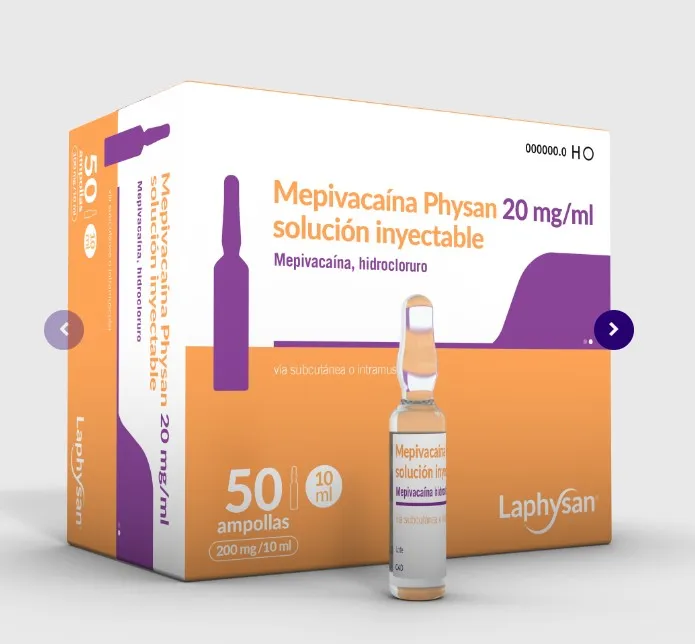
Table of Contents
Package leaflet: Information for the user
Introduction
Package leaflet: information for the user
Mepivacaine Physan 20 mg/ml solution for injection
mepivacaine hydrochloride
Read the entire leaflet carefully before you start using this medicine, because it contains important information for you.
- Keep this leaflet as you may need to read it again.
- If you have any questions, ask your doctor or pharmacist.
- This medicine has been prescribed for you only and must not be given to other people, even if they have the same symptoms, as it may harm them.
- If you experience any adverse reactions, consult your doctor or pharmacist, even if they are adverse reactions not listed in this leaflet. See section 4.
Contents of the leaflet:
- What Mepivacaine Physan is and what it is used for
- What you need to know before using Mepivacaine Physan
- How to use Mepivacaine Physan
- Possible adverse effects
- How to store Mepivacaine Physan
- Contents of the pack and other information
1. What Mepivacaína Physan is and what it is used for
Mepivacaína Physan is a local anaesthetic (an agent that reduces or eliminates sensations, affecting a particular region) belonging to the amide subgroup.
Mepivacaína Physan has been prescribed to provide you with anaesthetic effect.
2. What you need to know before using Mepivacaine Physan
Do not use Mepivacaine Physan
- if you are allergic to mepivacaine hydrochloride or to any of the other ingredients of this medicine (listed in section 6).
- if you are allergic to any other local anaesthetic of the same group (e.g. bupivacaine, lidocaine).
- if you have heart rhythm disorders. Consult your doctor, as Mepivacaine Physan may not be advisable for you.
- if you have uncontrolled epilepsy.
- if you have acute intermittent porphyria (a hereditary metabolic disorder affecting the nervous system that may cause mental disturbances).
Warnings and precautions
Talk to your doctor or pharmacist before using Mepivacaine Physan
- if you have any heart problems.
- if you have severe liver disease.
- if you have any kidney problems.
- if you are a debilitated or elderly patient.
- For athletes, there is a possibility of positive results in anti-doping controls.
Other medicines and Mepivacaine Physan
Tell your doctor or pharmacist if you are taking, have recently taken, or might need to take any other medicines.
Mepivacaine Physan should be used with caution if you are receiving treatment with medicines structurally similar to local anaesthetics, such as those used for heart rhythm disorders (so-called class Ib antiarrhythmics like lidocaine), as this increases the risk of side effects.
Prolonged treatment with antiarrhythmics (medicines to control heart rhythm), psychotropic agents (medicines acting on mental function), or anticonvulsants (medicines for seizures) may reduce sensitivity to anaesthetics.
Caution is advised if you are taking central nervous system depressants at the same time, as they may enhance the depressant effects.
Local irritation, swelling, or oedema may occur when used simultaneously with certain disinfectants.
Anticoagulants (medicines to prevent blood clots) and anti-inflammatory medicines may increase the risk of bleeding.
Alcohol consumption and Mepivacaine Physan
Excessive alcohol consumption may reduce sensitivity to anaesthetics.
Pregnancy and breastfeeding
Consult your doctor or pharmacist before using any medicine.
Your doctor will prescribe Mepivacaine Physan weighing the potential benefit against any possible risk to your baby.
Mepivacaine Physan is excreted in breast milk, but the risk of adverse reactions in the infant appears unlikely if recommended doses are respected.
Driving and using machines
The use of Mepivacaine Physan may have a slight effect on mental function and may temporarily impair movement and coordination.
Mepivacaine Physan contains sodium
2 ml vials:
This medicine contains less than 23 mg of sodium (1 mmol) per dose; therefore, it is essentially "sodium-free".
10 ml vials:
This medicine contains 28 mg of sodium (main component of table/cooking salt) in each dose. This corresponds to 1.4% of the maximum daily sodium intake recommended for an adult.
3. How to use Mepivacaína Physan
Follow exactly the instructions for the administration of Mepivacaína Physan provided by your doctor. If in doubt, consult your doctor or pharmacist again.
Mepivacaína Physan will be administered by your doctor as an injection.
The dose, rate of administration, and duration of treatment will vary depending on the anesthetic procedure being performed, the area to be anesthetized, and the patient's weight, clinical condition, and response.
If you use more Mepivacaína Physan than you should
In case of overdose, adverse reactions may occur at the level of the heart and blood vessels: drop in blood pressure and disturbances in heart rhythm. Adverse effects may also occur at the central nervous system level: agitation, numbness of the lips, tongue, and around the mouth, dizziness, visual and auditory discomfort, and tinnitus. Difficulty speaking, muscle stiffness, or spasms are more severe symptoms that precede generalized seizures.
If these signs of toxicity appear, the anesthetic injection must be stopped immediately.
In case of overdose or accidental ingestion, contact the Toxicology Information Service. Telephone: 91 562 04 20.
If you have any further questions about the use of this product, ask your doctor or pharmacist.
4. Possible adverse effects
Like all medicines, Mepivacaína Physan may produce adverse effects, although not everyone will experience them.
Rare adverse effects (observed in between 1 and 10 out of every 10,000 patients/individuals)
Allergic reactions, including severe reactions (so-called anaphylactic shock), which may involve skin rash, breathing difficulties, and swelling of the tongue and throat.
Heart disorders and heart attack (in cases of overdose).
Loss of consciousness and seizures (in cases of overdose).
Neurological reactions associated with the anesthetic techniques used, regardless of the anesthetic administered.
Reporting of adverse effects
If you experience any type of adverse effect, consult your doctor or pharmacist, even if it is a possible adverse effect not listed in this leaflet. You may also report them directly through the Spanish Pharmacovigilance System for Human Medicines: www.notificaram.es. By reporting adverse effects, you can help provide more information on the safety of this medicine.
5. Storage of Mepivacaína Physan
Keep this medicine out of the sight and reach of children.
No special storage conditions are required.
Do not use Mepivacaína Physan after the expiry date stated on the ampoule and the product carton. The expiry date refers to the last day of the month indicated.
Any unused solution must be disposed of in accordance with local regulations.
Medicines must not be disposed of via wastewater or household waste. Ask your pharmacist how to dispose of medicines and packaging you no longer need. This will help protect the environment.
6. ADDITIONAL INFORMATION
Composition of Mepivacaína Physan
- The active substance is Mepivacaine Hydrochloride 20.0 mg/ml.
- The other components are: Sodium chloride, Sodium hydroxide (for pH adjustment), and Water for injections.
Appearance of the medicinal product and contents of the container
Mepivacaína Physan 20 mg/ml solution for injection is supplied in glass ampoules.
The commercial presentation consists of a pack containing 1 ampoule, or clinical packs containing 50 or 100 glass ampoules of 2 ml or 10 ml.
Marketing Authorization Holder
LAPHYSAN S.A.U.
Anabel Segura, 11, Building A, 4th Floor, Door D,
28108 Alcobendas (Madrid)
Spain
Manufacturer:
LABORATORIOS BASI – INDUSTRIA FARMACÉUTICA, S.A.
Parque Industrial Manuel Lourenço Ferreira,
Nos. 8, 15 and 16
3450-232 Mortágua – Portugal
Date of latest revision of this leaflet: July 2008
Detailed information on this medicinal product is available on the website of the Spanish Agency of Medicines and Medical Devices (AEMPS) http://www.aemps.gob.es/
This information is intended exclusively for doctors or healthcare professionals
Local and regional anaesthetic procedures, except for the most trivial ones, should always be performed by properly trained professionals and in areas with immediate access to resuscitation equipment and medications. Specialists must receive appropriate training in these procedures and be familiar with the diagnosis and treatment of adverse effects, systemic toxicity, and other complications.
When performing major blocks, a catheter should be inserted before injecting the anaesthetic.
In addition, taking into account the anaesthetic technique and the patient's condition, administration of the product must follow the guidelines and recommendations described in the different sections of the Summary of Product Characteristics (“Dosage and method of administration”; “Special warnings and precautions for use”). Therefore, reference to the full text is necessary to ensure correct use of the product.
Solutions should be used immediately after opening. Any remaining portion of the solution used must be discarded.
Incompatibilities
At pH >6.5, there is a risk of precipitation. This characteristic must be taken into account when adding alkaline solutions, such as carbonates.