Lynparza 150 mg film-coated tablets
Spain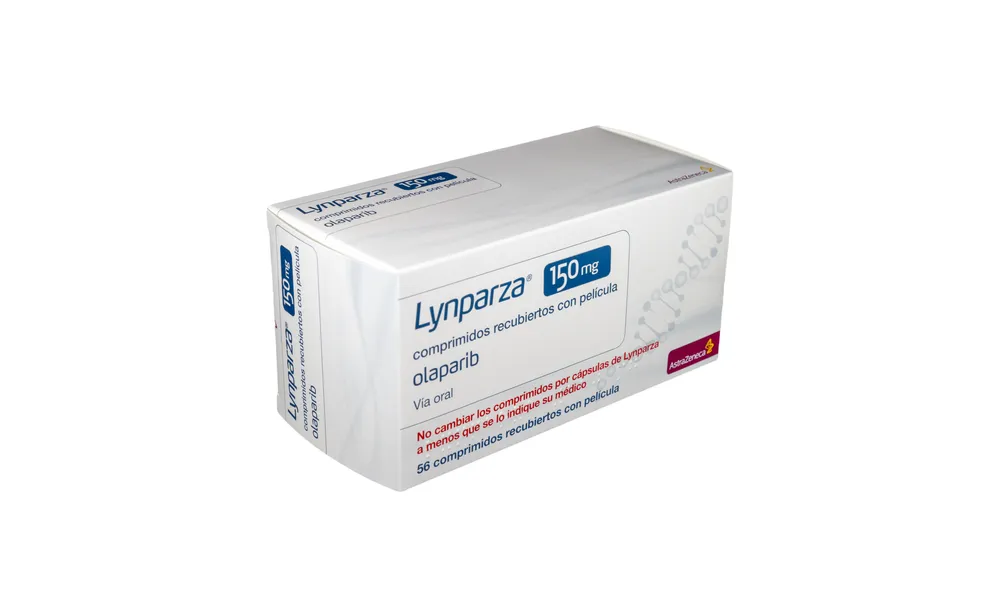
Table of Contents
Package Leaflet: Information for the User
Introduction
Package leaflet: information for the patient
Lynparza 100 mg film-coated tablets
Lynparza 150 mg film-coated tablets
olaparib
Read the entire leaflet carefully before you start taking this medicine because it contains important information for you.
- Keep this leaflet. You may need to read it again.
- If you have any questions, ask your doctor, pharmacist, or nurse.
- This medicine has been prescribed for you only. Do not give it to others, even if they have the same symptoms as you, as it may harm them.
- If you experience any side effects, talk to your doctor, pharmacist, or nurse, even if the side effects are not listed in this leaflet. See section 4.
Contents of the leaflet
- What Lynparza is and what it is used for
- What you need to know before taking Lynparza
- How to take Lynparza
- Possible side effects
- How to store Lynparza
- Contents of the pack and other information
1. What Lynparza is and what it is used for
What Lynparza is and how it works
Lynparza contains the active substance olaparib. Olaparib is a type of anticancer medicine known as a PARP inhibitor (poly [adenosine diphosphate-ribose] polymerase inhibitor).
PARP inhibitors can destroy cancer cells that are poor at repairing DNA damage. These specific cancer cells can be identified:
- by their response to platinum-based chemotherapy, or
- by testing for defective DNA repair genes, such as BRCA (BReast CAncer) genes.
When Lynparza is used in combination with abiraterone (an androgen receptor signaling inhibitor), the combination may enhance the anticancer effect in prostate cancer cells, with or without defective DNA repair genes (e.g., BRCA genes).
What Lynparza is used for
Lynparza is used to treat:
-
A type of ovarian cancer (BRCA-mutated) that has responded to initial standard platinum-based chemotherapy.
A test is used to determine whether you have BRCA-mutated ovarian cancer.
-
Recurrent ovarian cancer (cancer that has returned). It may be used after the tumor has responded to prior platinum-based standard chemotherapy.
-
A type of ovarian cancer (HRD-positive, defined by a BRCA mutation or genomic instability) that has responded to initial standard platinum-based chemotherapy combined with bevacizumab. Lynparza is used in combination with bevacizumab.
-
A type of breast cancer (BRCA-mutated, HER2-negative) that has not spread to other parts of the body, and when treatment is to be given after surgery (treatment after surgery is called adjuvant therapy). You should have received chemotherapy either before or after surgery. If your cancer is hormone receptor-positive, your doctor may also prescribe hormonal therapy.
A test is used to determine whether you have BRCA-mutated breast cancer.
-
A type of breast cancer (BRCA-mutated, HER2-negative) that has spread beyond the original tumor. You should have received chemotherapy either before or after the cancer spread.
A test is used to determine whether you have BRCA-mutated cancer.
-
A type of pancreatic cancer (BRCA-mutated) that has responded to initial standard platinum-based chemotherapy.
A test is used to determine whether you have BRCA-mutated pancreatic cancer.
-
A type of prostate cancer (with BRCA mutations) that has spread beyond the original tumor and no longer responds to medical or surgical treatments to lower testosterone levels. You should have previously received certain hormonal treatments, such as enzalutamide or abiraterone acetate.
A test is used to determine whether you have BRCA-mutated prostate cancer.
-
A type of prostate cancer that has spread to other parts of the body (metastatic) beyond the original tumor and no longer responds to medical or surgical treatments that reduce testosterone. Lynparza is used in combination with another anticancer medicine called abiraterone, together with the steroid medicine prednisone or prednisolone.
-
A type of endometrial cancer (MMR-proficient endometrial cancer) that has spread beyond the original tumor or has recurred. Lynparza is used in combination with durvalumab if the cancer has not progressed after initial treatment with chemotherapy (carboplatin and paclitaxel) in combination with durvalumab.
- A test is used to determine whether you have MMR-proficient endometrial cancer.
When Lynparza is administered in combination with other anticancer medicines, it is important that you also read the package leaflets for these other medicines. If you have any questions about these medicines, consult your doctor.
2. What you need to know before taking Lynparza
Do not take Lynparza
- if you are allergic to olaparib or to any of the other ingredients of this medicine (listed in section 6)
- if you are breastfeeding (see section 2 of this leaflet for more information)
Do not take Lynparza if either of the above applies to you. If you are unsure, consult your doctor, pharmacist, or nurse before taking Lynparza.
Warnings and precautions
Talk to your doctor, pharmacist, or nurse before starting or during treatment with Lynparza
-
if you have low blood counts in your blood tests. These may include low red blood cell counts, low white blood cell counts, or low platelet counts. See section 4 for more information about these side effects, including signs and symptoms you should watch for (e.g., fever or infection, bruising or bleeding). In a small number of patients, these may be signs of a more serious bone marrow problem such as “Myelodysplastic Syndrome” (MDS) or “Acute Myeloid Leukemia” (AML). When Lynparza is used in combination with another cancer medicine (durvalumab), low blood counts may indicate “Pure Red Cell Aplasia” (PRCA), a condition in which red blood cells are not produced, or “Autoimmune Hemolytic Anemia” (AIHA), excessive destruction of red blood cells.
-
if you notice any new symptoms or worsening of shortness of breath, cough, or wheezing (a whistling sound when breathing). A small number of patients treated with Lynparza have reported lung inflammation (pneumonitis). Pneumonitis is a serious condition that often requires hospital treatment.
-
if you experience any new or worsening symptoms of pain or swelling in a limb, difficulty breathing, chest pain, faster-than-normal breathing, or rapid heartbeat. A small number of patients treated with Lynparza have been reported to develop a blood clot in a deep vein, usually in the leg (venous thrombosis), or a clot in the lungs (pulmonary embolism).
-
if you notice yellowing of the skin or whites of the eyes, abnormally dark urine (brown-colored), pain in the right side of the stomach area (abdomen), fatigue, loss of appetite, or unexplained nausea and vomiting, contact your doctor immediately, as these may indicate liver problems.
If you think any of the above may apply to you, consult your doctor, pharmacist, or nurse during treatment with Lynparza.
Tests and monitoring
Your doctor will perform blood tests before and during treatment with Lynparza.
You will have a blood test
- before starting treatment
- every month during the first year of treatment
- at regular intervals, as determined by your doctor, after the first year of treatment.
If your blood counts drop to a low level, you may require a blood transfusion (in which you are given new blood or blood products from a donor).
Other medicines and Lynparza
Tell your doctor, pharmacist, or nurse if you are taking, have recently taken, or might need to take any other medicines, including those obtained without a prescription and herbal medicines. This is because Lynparza may affect how some medicines work, and some medicines may affect Lynparza.
Tell your doctor, pharmacist, or nurse if you are taking or may need to take any of the following medicines:
-
any other cancer medicine
-
a vaccine or a medicine that suppresses the immune system, as you may need to be closely monitored
-
itraconazole, fluconazole – used for fungal infections
-
telithromycin, clarithromycin, erythromycin – used for bacterial infections
-
ritonavir- or cobicistat-boosted protease inhibitors, boceprevir, telaprevir, nevirapine, efavirenz – used for viral infections, including HIV
-
rifampicin, rifapentine, rifabutin – used for bacterial infections, including tuberculosis (TB)
-
phenytoin, carbamazepine, phenobarbital – used as sedatives or to treat seizures (convulsions) and epilepsy
-
herbal remedies containing St. John’s wort (Hypericum perforatum) – mainly used for depression
-
digoxin, diltiazem, furosemide, verapamil, valsartan – used to treat heart conditions or high blood pressure
-
bosentan – used to treat pulmonary arterial hypertension
-
statins, for example simvastatin, pravastatin, rosuvastatin – used to lower cholesterol levels in the blood
-
dabigatran – used to thin the blood
-
glibenclamide, metformin, repaglinide – used to treat diabetes
-
ergot alkaloids – used to treat migraines and headaches
-
fentanyl – used to treat cancer-related pain
-
pimozide, quetiapine – used to treat mental health conditions
-
cisapride – used to treat stomach problems
-
colchicine – used to treat gout
-
cyclosporine, sirolimus, tacrolimus – used to suppress the immune system
-
methotrexate – used to treat cancer, rheumatoid arthritis, and psoriasis
Inform your doctor, pharmacist, or nurse if you are taking any of the above medicines or any other medicine. The medicines listed above may not be the only ones that could affect Lynparza.
Taking Lynparza with drinks
Do not drink grapefruit juice while being treated with Lynparza. This may affect how the medicine works.
Contraception, pregnancy, and breastfeeding
Female patients
- You must not take Lynparza if you are pregnant or think you may become pregnant, as it could harm the unborn baby.
- You must not become pregnant while taking this medicine. If you have sexual intercourse, you must use two effective contraceptive methods while taking this medicine and for 6 months after taking the last dose of Lynparza. It is unknown whether Lynparza may affect the effectiveness of some hormonal contraceptives. Inform your doctor if you are using a hormonal contraceptive, as your doctor may recommend also using a non-hormonal contraceptive method.
- A pregnancy test must be performed before starting Lynparza and at regular intervals during treatment and for 6 months after the last dose of Lynparza. If you become pregnant during this time, you must consult your doctor immediately.
- It is unknown whether Lynparza passes into breast milk. You must not breastfeed while taking Lynparza or for 1 month after taking the last dose of this medicine. If you plan to breastfeed, inform your doctor.
Male patients
- You must use a condom when having sexual intercourse with a female partner, even if she is pregnant, while taking Lynparza and for three months after taking the last dose. It is not known whether Lynparza passes into semen.
- Your female partner must also use an effective contraceptive method.
- You must not donate sperm while taking Lynparza or for three months after taking the last dose.
Driving and using machines
Lynparza may affect your ability to drive and use machines. If you feel dizzy, weak, or tired while taking Lynparza, do not drive or operate tools or machinery.
Information about other ingredients in this medicine
This medicine contains less than 1 mmol of sodium (23 mg) per 100 mg or 150 mg tablet; this is essentially “sodium-free”.
3. How to take Lynparza
Follow exactly the instructions given by your doctor, pharmacist, or nurse for taking this medicine. If in doubt, consult your doctor, pharmacist, or nurse again.
How to take
- Swallow the Lynparza tablets whole, with or without food.
- Take Lynparza once in the morning and once in the evening.
- Do not chew, crush, dissolve, or split the tablets, as this may affect how quickly the medicine enters your body.
What dose to take
- Your doctor will tell you how many Lynparza tablets to take. It is important that you take the recommended total daily dose. Continue taking it as long as your doctor, pharmacist, or nurse instructs you to do so.
- The usual recommended dose is 300 mg (2 tablets of 150 mg) twice daily – a total of 4 tablets each day.
Your doctor may prescribe you a different dose if
- you have kidney problems. You will be instructed to take 200 mg (2 tablets of 100 mg) twice daily – a total of 4 tablets per day.
- you are taking certain medicines that may interact with Lynparza (see section 2).
- you experience certain adverse effects while taking Lynparza (see section 4). Your doctor may reduce your dose or interrupt treatment, either temporarily or permanently.
If you take more Lynparza than you should
If you take more Lynparza than your prescribed dose, consult a doctor or go to a hospital immediately.
If you forget to take Lynparza
If you forget to take Lynparza, take your next dose at the usual time. Do not take a double dose (two doses at the same time) to make up for a missed dose.
If you have any further questions about the use of this medicine, ask your doctor, pharmacist, or nurse.
4. Possible adverse effects
Like all medicines, this medicine can cause adverse effects, although not everyone experiences them.
Tell your doctor immediately if you notice any of the following
Adverse effects reported in clinical trials in patients receiving Lynparza alone:
Very common (may affect more than 1 in 10 people)
- shortness of breath, feeling very tired, pale skin, or rapid heartbeat – these may be symptoms of a reduced number of red blood cells (anaemia).
Uncommon (may affect up to 1 in 100 people)
- allergic reactions (e.g., hives, difficulty breathing or swallowing, dizziness, which are signs and symptoms of hypersensitivity reactions).
- itchy rash on swollen and red skin (dermatitis).
- serious bone marrow problems (myelodysplastic syndrome or acute myeloid leukaemia). See section 2 (may affect more than 1 in 100 people over a lifetime).
- inflammation of the lungs, which may cause cough with fever and difficulty breathing (pneumonitis).
Other adverse effects include
Very common (may affect more than 1 in 10 people)
- nausea
- vomiting
- feeling tired or weak (fatigue)
- indigestion or heartburn (dyspepsia)
- loss of appetite
- headache
- changes in the taste of food (dysgeusia)
- feeling dizzy
- cough
- difficulty breathing (dyspnoea)
- diarrhoea – if this becomes severe, tell your doctor immediately.
Very common adverse effects that may be found in blood test results
- low white blood cell count (leucopenia or neutropenia), which may reduce your ability to fight infections and may be accompanied by fever.
Common (may affect up to 1 in 10 people)
- rash
- mouth pain (stomatitis)
- pain in the area under the ribs (upper abdominal pain)
- blood clot in a deep vein, usually in the leg (venous thrombosis), which may cause symptoms such as leg pain or swelling, or a clot in the lungs (pulmonary embolism), which may cause symptoms such as difficulty breathing, chest pain, abnormally rapid breathing, or abnormally rapid heartbeat.
Common adverse effects that may be found in blood test results
- low white blood cell count (lymphopenia), which may reduce your ability to fight infections and may be accompanied by fever
- decrease in the number of platelets in the blood (thrombocytopenia) – you may notice the following symptoms:
- bruising or bleeding for longer than normal if injured
- increased blood creatinine – this test is used to check kidney function
- abnormal liver function tests
Uncommon adverse effects that may be found in blood test results
- increase in the size of red blood cells (not associated with any symptoms)
Rare (may affect up to 1 in 1,000 people)
- facial swelling (angioedema)
- painful inflammation of the fatty tissue beneath the skin (erythema nodosum)
Frequency not known (cannot be estimated from available data)
- signs of liver problems, such as yellowing of the skin or the whites of the eyes (jaundice), nausea or vomiting, pain on the right side of the stomach area (abdomen), dark (brown) urine, feeling less hungry than usual, tiredness
Adverse effects reported in a clinical trial in patients who received Lynparza and durvalumab after initial chemotherapy treatment (carboplatin and paclitaxel) with durvalumab, occurring more frequently than in patients receiving Lynparza alone:
Very common (may affect more than 1 in 10 people)
- decrease in the number of platelets in the blood (thrombocytopenia) – you may notice the following symptoms:
- bruising or bleeding for longer than normal if injured
- rash
Common adverse effects (may affect up to 1 in 10 people) when using Lynparza with durvalumab
- allergic reactions (e.g., hives, difficulty breathing or swallowing, dizziness, which are signs and symptoms of hypersensitivity reactions)
In addition, the following adverse effects were reported in patients who received Lynparza with durvalumab:
Common (may affect up to 1 in 10 people):
- failure to produce red blood cells (pure red cell aplasia), which may be associated with symptoms such as difficulty breathing, fatigue, pale skin, or rapid heartbeat.
Your doctor will perform a blood test every month during the first year of treatment and at regular intervals thereafter. Your doctor will inform you if any changes in your blood tests may require treatment.
If you notice any adverse effects not mentioned in this leaflet, contact your doctor immediately.
Reporting of adverse effects
If you experience any type of adverse effect, talk to your doctor, pharmacist, or nurse, even if it is a possible adverse effect not listed in this leaflet. You can also report them directly through the national reporting system listed in Appendix V. By reporting adverse effects, you can help provide more information on the safety of this medicine.
5. Storage of Lynparza
Keep this medicine out of the sight and reach of children.
Do not use this medicine after the expiry date which is stated on the pack and blister after EXP/CAD. The expiry date refers to the last day of the month indicated.
This medicine does not require any special storage temperature conditions.
Store in the original packaging to protect from moisture.
Medicines should not be disposed of via wastewater or household waste. Ask your pharmacist how to dispose of medicines and packaging that you no longer need. This will help protect the environment.
6. Contents of the pack and other information
Composition of Lynparza
The active substance is olaparib.
- Each Lynparza 100 mg film-coated tablet contains 100 mg of olaparib.
- Each Lynparza 150 mg film-coated tablet contains 150 mg of olaparib.
The other components (excipients) are:
- Tablet core: copovidone, colloidal anhydrous silica, mannitol, sodium stearyl fumarate.
- Film coating: hypromellose, macrogol 400, titanium dioxide (E171), yellow iron oxide (E172), black iron oxide (E172) (only in the 150 mg tablets).
See Section 2 “Information on other ingredients present in this medicinal product”.
Nature of the product and pack contents
Lynparza 100 mg tablets are film-coated, yellow to dark yellow, oval, biconvex tablets, marked with "OP100" on one side and plain on the other.
Lynparza 150 mg tablets are film-coated, green to greenish-grey, oval, biconvex tablets, marked with "OP150" on one side and plain on the other.
Lynparza is available in packs containing 56 film-coated tablets (7 blisters of 8 tablets each) or multiple packs containing 112 film-coated tablets (2 packs of 56 tablets).
Not all pack sizes may be marketed.
Marketing Authorization Holder
AstraZeneca AB
SE-151 85 Södertälje
Sweden
Manufacturer responsible for batch release
AstraZeneca AB
Gärtunavägen
SE-152 57 Södertälje
Sweden
For further information about this medicinal product, please contact the local representative of the Marketing Authorization Holder:
Belgium/Belgium/Belgium AstraZeneca S.A./N.V. Tel: +32 2 370 48 11 | Lithuania UAB AstraZeneca Lietuva Tel: +370 5 2660550 |
| Luxembourg/Luxembourg AstraZeneca S.A./N.V. Tél/Tel: +32 2 370 48 11 |
Czech Republic AstraZeneca Czech Republic s.r.o. Tel: +420 222 807 111 | Hungary AstraZeneca Kft. Tel.: +36 1 883 6500 |
Denmark AstraZeneca A/S Tlf.: +45 43 66 64 62 | Malta Associated Drug Co. Ltd Tel: +356 2277 8000 |
Germany AstraZeneca GmbH Tel: +49 40 809034100 | Netherlands AstraZeneca BV Tel: +31 85 808 9900 |
Estonia AstraZeneca Tel: +372 6549 600 | Norway AstraZeneca AS Tlf: +47 21 00 64 00 |
Greece AstraZeneca A.E. Tel: +30 210 6871500 | Austria AstraZeneca Österreich GmbH Tel: +43 1 711 31 0 |
Spain AstraZeneca Farmacéutica Spain, S.A. Tel: +34 91 301 91 00 | Poland AstraZeneca Pharma Poland Sp. z o.o. Tel.: +48 22 245 73 00 |
France AstraZeneca Tel: +33 1 41 29 40 00 | Portugal AstraZeneca Produtos Farmacêuticos, Lda. Tel: +351 21 434 61 00 |
Croatia AstraZeneca d.o.o. Tel: +385 1 4628 000 | Romania AstraZeneca Pharma SRL Tel: +40 21 317 60 41 |
Ireland AstraZeneca Pharmaceuticals (Ireland) DAC Tel: +353 1609 7100 | Slovenia AstraZeneca UK Limited Tel: +386 1 51 35 600 |
Iceland Vistor hf. Tel: +354 535 7000 | Slovakia AstraZeneca AB, o.z. Tel: +421 2 5737 7777 |
Italy AstraZeneca S.p.A. Tel: +39 02 00704500 | Finland AstraZeneca Oy Puh/Tel: +358 10 23 010 |
Cyprus Aléktor Pharmaceuticals Ltd Tel: +357 22490305 | Sweden AstraZeneca AB Tel: +46 8 553 26 000 |
Latvia SIA AstraZeneca Latvija Tel: +371 67377100 |

Date of the most recent review of this leaflet:
Other sources of information
Detailed information on this medicine is available on the European Medicines Agency website: http://www.ema.europa.eu.