Lundeos 20,000 IU soft capsules
Spain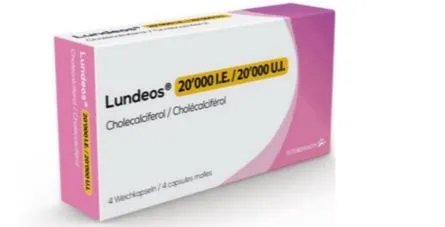
Table of Contents
Package leaflet: Information for the user
Introduction
Package leaflet: information for the patient
Lundeos 20,000 IU soft capsules
Colecalciferol
Read the entire leaflet carefully before you start taking this medicine, because it contains important information for you.
- Keep this leaflet, as you may need to read it again.
- If you have any questions, ask your doctor or pharmacist.
- This medicine has been prescribed for you only, and you should not give it to others, even if they have the same symptoms as you, because it may harm them.
- If you experience any adverse effects, consult your doctor or pharmacist, even if such effects are not listed in this leaflet. See section 4.
Leaflet contents
-
What Lundeos is and what it is used for
-
What you need to know before taking Lundeos
-
How to take Lundeos
-
Possible side effects
-
How to store Lundeos
-
Contents of the pack and other information
1. What Lundeos is and what it is used for
Lundeos contains vitamin D3, which regulates the absorption and metabolism of calcium as well as the incorporation of calcium into bone tissue.
Lundeos is indicated for the treatment of vitamin D deficiency in adults.
2. What you need to know before taking Lundeos
Do not take Lundeos:
- if you are allergic to colecalciferol or to any of the other components of this medicine (listed in section 6);
- if you have high levels of calcium in your blood or urine;
- if you have kidney stones;
- if you have severe kidney problems.
Warnings and precautions
When you take Lundeos, your doctor will check your blood and/or urine calcium levels to ensure they are not too high.
Consult your doctor or pharmacist before starting to take Lundeos if you:
- are at a much higher risk of developing kidney stones;
- have a condition affecting your bones;
- have a hormonal disorder affecting the parathyroid gland (pseudohypoparathyroidism);
- suffer from "sarcoidosis", an immune system disorder that may affect your liver, lungs, skin, or lymph nodes;
- have heart problems;
- are already taking additional doses of calcium or vitamin D.
Children and adolescents
The use of this medicine is not recommended in children and adolescents under 18 years of age.
Other medicines and Vitamin D3
Inform your doctor if you are taking or have recently taken other medicines such as:
- products containing high doses of calcium, as they increase the risk of high calcium levels in the blood;
- medicines used to treat heart conditions (cardiac glycosides, such as digoxin). Your doctor may monitor your heart with an electrocardiogram (ECG) and measure calcium levels in your blood;
- thiazide diuretics, as they may increase the risk of hypercalcemia;
- medicines used to treat epilepsy (such as phenytoin) or to aid sleep (barbiturates, such as phenobarbital), as these may reduce the effect of vitamin D;
- antibiotics used to treat bacterial infections such as rifampicin and isoniazid;
- laxatives (such as liquid paraffin), orlistat, a medicine used to treat obesity, or a cholesterol-lowering medicine called colestyramine, as they may reduce vitamin D absorption;
- products containing magnesium (e.g., antacids) – these should not be taken during vitamin D treatment due to the risk of high magnesium levels;
- products containing high amounts of phosphorus. These agents increase the risk of high phosphate levels in the blood;
- actinomycin (a medicine used in the treatment of certain types of cancer) and imidazole antifungals (e.g., clotrimazole and ketoconazole, medicines used to treat fungal diseases). These medicines may interfere with vitamin D metabolism;
- glucocorticoids (steroid hormones such as hydrocortisone or prednisolone), as they may reduce the effect of vitamin D.
Pregnancy and breastfeeding
Pregnancy
This medicine contains a high dose that is not recommended for use in pregnant women.
Breastfeeding
Lundeos may be used during breastfeeding. Vitamin D passes into breast milk. This should be taken into account when administering additional vitamin D to a breastfed infant.
Driving and using machines
This medicine has no known effects on the ability to drive or operate machinery.
This medicine contains 4.8 mg of sorbitol in each soft capsule.
3. How to take Lundeos
Follow exactly the instructions for administering the medicine given by your doctor or pharmacist. If in doubt, ask your doctor or pharmacist.
The dose of Lundeos will depend on your vitamin D levels and your response to treatment.
Treatment of vitamin D deficiency (loading dose) in adults: 20,000 IU once weekly (1 capsule)
After the first month, a dose reduction may be considered. Your doctor will decide on any additional treatment with Lundeos that may be necessary.
Swallow the capsule whole (not chewed) with water, preferably with a substantial meal.
Use in children and adolescents
This medicine is not recommended for use in children and adolescents.
If you take more Lundeos than you should
If you have taken more Lundeos capsules than you should, speak immediately with your doctor or pharmacist. Take the medicine with you.
An overdose may lead to increased levels of calcium in the blood and urine as shown by laboratory tests.
Signs and symptoms of an overdose may include loss of appetite, thirst, nausea, vomiting, diarrhea followed by constipation, abdominal pain, headache, muscle and joint pain, muscle weakness, fatigue, confusion, more frequent urination than normal with calcium in the urine, kidney problems, and in severe cases, irregular heartbeat, coma, or even death.
In case of overdose or accidental ingestion, go to a medical center or call the Toxicology Information Service at telephone number: 91 562 04 20, indicating the medicine and the amount used.
If you forget to take Lundeos
Do not take a double dose to make up for forgotten doses. If you forget to take your capsules, take them as soon as possible. Afterwards, take the next dose at the usual time, following your doctor's instructions. However, if it is almost time for the next dose, do not take the missed dose and instead take the next dose at the usual time.
If you stop taking Lundeos
If you have any questions about using this medicine, consult your doctor or pharmacist.
4. Possible adverse effects
Like all medicines, this medicine may cause adverse effects, although not everyone will experience them.
Uncommon (affects up to 1 in 100 people)
- Excess calcium in the blood (hypercalcaemia). You may feel unwell or become sick, lose your appetite, constipation, stomach pain, excessive thirst, muscle weakness, drowsiness.
- confusion.
- Excess calcium in the urine (hypercalciuria).
Rare (affects up to 1 in 1,000 people)
- Skin rash
- pruritus
- itchy raised rash (urticaria)
Reporting of adverse effects
If you experience any type of adverse effect, consult your doctor or pharmacist, even if it is a possible adverse effect not listed in this leaflet. You may also report them directly through the Spanish Pharmacovigilance System for Human Medicines: https://www.notificaram.es. By reporting adverse effects, you can help provide more information on the safety of this medicine.
5. Storage of Lundeos
Keep this medicine out of the sight and reach of children.
Do not use this medicine after the expiry date stated on the packaging after EXP. The expiry date refers to the last day of the month indicated.
Do not use this medicine if you notice any visible signs of deterioration.
Medicines must not be disposed of via wastewater or household waste. Dispose of unused medicines and their packaging at the SIGRE Point at your pharmacy. If you are in doubt, ask your pharmacist how to dispose of medicines and packaging that you no longer need. This will help protect the environment.
6. Contents of the container and other information
Composition of Lundeos
- The active substance is colecalciferol.
- The other excipients are: medium-chain triglycerides, all-rac-alpha-tocopherol acetate, gelatin (E441), glycerol (E422), liquid sorbitol (E420) (partially dehydrated) and purified water.
Appearance of the product and contents of the container
Lundeos 20,000 IU are soft, round, light yellow transparent gelatin capsules containing a clear, colourless liquid.
It is supplied in blisters containing 4, 5, 10 or 14 capsules.
Only certain pack sizes may be marketed.
Marketing Authorization Holder
Theramex Ireland Limited
3rd Floor, Kilmore House,
Park Lane, Spencer Dock,
Dublin 1
D01 YE64
Ireland
Manufacturer
NetPharma Lab Consulting Services
Carretera de Fuencarral, 22
28051 – Alcobendas
Madrid
Spain
For more information about this medicinal product, you may contact the local representative of the Marketing Authorization Holder:
Theramex Healthcare Spain, S.L.
Calle Martínez Villergas 52, Edificio C, planta 2ª izquierda.
28027 Madrid
Spain
This medicinal product is authorized in the member states of the European Economic Area under the following names:
Member State | Name of the medicinal product |
Netherlands: | Fedivelle 20000 IU |
Italy: | Fedivelle 20000 IU soft capsules |
Date of the last revision of this leaflet: July 2020
Detailed and up-to-date information on this medicinal product is available on the website of the Spanish Agency of Medicines and Health Products (AEMPS) (http://www.aemps.gob.es/))