Lampit 120 mg tablets
Spain
Table of Contents
Package leaflet: Information for the user
Introduction
Package leaflet: information for the patient
Lampit 120 mg tablets
nifurtimox
This medicine is subject to additional monitoring, which will enable rapid identification of new safety information. You can help by reporting any side effects you may experience. Information on how to report side effects is included at the end of section 4.
Read all of this leaflet carefully before you or your child start taking this medicine, because it contains important information for you.
- Keep this leaflet, as you may need to read it again.
- If you have any questions, ask your doctor or pharmacist.
- This medicine has been prescribed for you or your child only; do not pass it on to other people, even if they have the same symptoms as you, because it may harm them.
- If you or your child experience any side effects, consult your doctor or pharmacist, even if they are side effects not listed in this leaflet. See section 4.
Contents of this leaflet
- What Lampit is and what it is used for
- What you need to know before taking Lampit
- How to take Lampit
- Possible side effects
- How to store Lampit
- Contents of the pack and other information
1. What Lampit is and what it is used for
Lampit contains the active substance nifurtimox, which belongs to a class of medicines known as nitrofuran derivatives.
Lampit is used to treat Chagas disease (American trypanosomiasis) caused by the parasite Trypanosoma cruzi in adults, children, and adolescents.
2. What you need to know before starting Lampit
Do not take Lampit
- if you are allergic to nifurtimox or to any of the other ingredients of this medicine (listed in section 6).
- if you plan to drink alcohol during treatment, as alcohol may worsen the adverse effects caused by Lampit. Therefore, you must not drink alcohol while taking Lampit.
Warnings and precautions
Talk to your doctor or pharmacist before starting Lampit if:
- you have a history of brain damage, epileptic seizures (convulsions), mental health problems, or behavioral changes.
- you have a genetic condition called porphyria (a group of disorders resulting from the accumulation of naturally occurring body chemicals called porphyrins). Taking Lampit may worsen your porphyria symptoms, including dark urine, severe stomach pain, muscle pain, tingling, numbness, mental changes, or skin sensitivity to light.
- you have severe kidney problems or are on dialysis.
- you have liver problems.
- you are pregnant or could become pregnant. Lampit may harm the unborn baby. A pregnancy test is recommended before starting Lampit. If you could become pregnant, you must use an effective method of contraception during treatment and for 6 months after treatment (see section 2 “Pregnancy and breastfeeding”).
- you are breastfeeding. Lampit is excreted in human breast milk (see section 2 “Pregnancy and breastfeeding”).
- you are a man and have a partner who could become pregnant. You must use condoms during treatment and for 3 months after treatment.
Talk to your doctor or pharmacist during treatment with Lampit if:
- you experience allergic reactions. If you have symptoms such as low blood pressure, rapid swelling of the skin or other tissues (including swelling of the face, tongue, and/or throat), difficulty breathing, severe itching, rash, or other serious skin reactions, stop taking Lampit and contact your doctor immediately.
- you develop brain or nerve disorders such as epileptic seizures (convulsions) or mental disorders (changes in thinking or behavior). Inform your doctor or pharmacist immediately if you experience any of these symptoms during treatment.
- you lose weight or experience loss of appetite. During treatment with Lampit, your weight should be monitored every 14 days. If you lose weight, your doctor will decide whether a dose adjustment is needed (see section 3 “How to take Lampit”).
- you become pregnant or suspect you may be pregnant. Lampit may harm the unborn baby. Do not use Lampit during pregnancy unless your doctor has carefully considered the benefit to you and the risk to the unborn baby (see section 2 “Pregnancy and breastfeeding”).
Children and adolescents
Lampit can be used in all age groups, from newborns to adolescents (see section 1 “What Lampit is and what it is used for”).
It is unknown whether Lampit is safe and effective in premature newborns and in children weighing less than 2.5 kg.
Other medicines and Lampit
Tell your doctor or pharmacist if you are taking, have recently taken, or might need to take any other medicines.
Taking Lampit with alcohol
You must not drink alcohol during treatment with Lampit (see section 2 “Do not take Lampit”).
Pregnancy and breastfeeding
If you are pregnant or breastfeeding, think you might be pregnant, or plan to have a baby, consult your doctor or pharmacist before taking this medicine.
Pregnancy and contraception in women
Lampit may harm the unborn baby. Do not use Lampit during pregnancy unless your doctor has carefully considered the benefit to you and the risk to the unborn baby.
A pregnancy test is recommended before starting Lampit. If you could become pregnant, you must use effective contraception during treatment and for 6 months after treatment.
Contraception in men
Male patients whose partners could become pregnant must use condoms during treatment and for 3 months after treatment.
Breastfeeding
Lampit is excreted in human breast milk.
Talk to your doctor if you are breastfeeding a baby. Your doctor will carefully evaluate the benefits and risks of breastfeeding and taking Lampit.
Driving and using machines
Lampit may cause muscle weakness, tremors, dizziness, drowsiness, loss of balance, or agitation (see section 4 “Possible side effects”). If this occurs, do not drive, ride a bicycle, or operate any tools or machinery.
Lampit contains sodium
This medicine contains less than 1 mmol of sodium (23 mg) per maximum daily dose; hence, it is essentially “sodium-free”.
3. How to take Lampit
Follow exactly the instructions given by your doctor for taking this medicine. If you are unsure, consult your doctor or pharmacist again.
The recommended dose depends on your body weight and age. Your doctor will advise you on your individual dose and treatment plan. Your doctor may adjust your dose if your body weight changes (see section 2 “Warnings and precautions”).
Lampit must be taken 3 times a day with food.
Duration of treatment
The recommended duration of treatment for adult patients (18 years of age or older) is 60 to 120 days.
The recommended duration of treatment for children and adolescents (under 18 years of age) is 60 days.
To prevent the infection from recurring, it is important that you or your child complete the entire course of treatment.
Instructions for splitting tablets
The tablets have a score line. The tablet can be divided into equal doses.
Do not break the tablets mechanically using a tablet-splitting device.
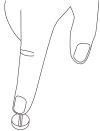
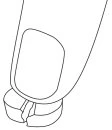
The score line is intended for splitting the tablet by hand as follows:
- To split the tablet, place it on a flat surface with the score line facing upwards (Step 1).
- With the tablet resting on the flat surface, apply sufficient downward pressure with the index finger centered on the top of the tablet to break it along the score line (Step 2).
Step 1 | Step 2 | Two equal doses |
|
|
|


Preparation of a suspension
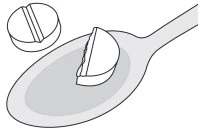
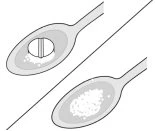
- If you or your child have difficulty swallowing tablets, a suspension can be prepared from whole tablets or halves.
- The tablet should be mixed with water (Step 1), approximately one teaspoon (5 ml), until a suspension is formed (usually takes less than 30 seconds; Step 2). The suspension should be taken immediately with food.
Step 1 | Step 2 | Suspension |
|
|
|

If you take more Lampit than you should
If you or your child have taken more Lampit than the usual dose, contact your doctor immediately.
In case of overdose, consult your doctor or pharmacist immediately or call the Toxicology Information Service at: 91 562 04 20, indicating the medication and the amount ingested.
If you forget to take Lampit
If you forget to take a dose, take it as soon as possible with food. If less than 3 hours remain until the next dose, skip the missed dose and continue treatment as prescribed with the next scheduled dose.
Do not take a double dose to make up for the missed dose.
If you stop taking Lampit
Do not stop taking this medicine without first consulting your doctor. It is important to take Lampit for the entire duration prescribed by your doctor (see section 3, "Duration of treatment"). If you are unable to take the medicine as prescribed, contact your doctor immediately, as your condition may worsen.
If you have any further questions about the use of this medicine, consult your doctor or pharmacist.
4. Possible adverse effects
Like all medicines, this medicine can cause adverse effects, although not everyone experiences them.
The adverse effects listed below may occur in adults, children, and adolescents during treatment with Lampit. However, the frequency of these adverse effects is unknown (the frequency cannot be estimated from the available data):
- Allergic reactions (hypersensitivity reactions)
- Sensation of spinning (vertigo)
- Abdominal pain
- Feeling of needing to vomit (nausea)
- Vomiting
- Diarrhea
- Indigestion (dyspepsia)
- Rapid swelling under the skin in areas such as the face, tongue, throat, arms, and legs, which can be life-threatening if swelling in the throat blocks the airways (angioedema)
- Rash
- Intense itching
- Skin inflammation (dermatitis)
- Itchy rash (urticaria)
- Abnormal weight loss
- Decreased appetite
- Muscle weakness
- Joint pain
- Muscle pain
- Memory loss
- Nerve damage causing pain or numbness, burning, tingling, and/or muscle weakness in different parts of the body (peripheral neuropathies, including polyneuropathy)
- Abnormal sensation in the skin such as burning, prickling, itching, or tingling (paresthesia)
- Tremor
- Headache
- Dizziness
- Seizures (convulsions)
- Drowsiness
- Lack of interest in activities, motivation, or energy (apathy)
- Feeling of inner tension or restlessness (agitation)
- Anxiety
- Tendency to become angry and react to minor provocations and disagreements (irritability)
- Nervousness
- Confusion (disorientation)
- Disturbances in thoughts and perceptions making it difficult for a person to recognize what is real and what is not (psychotic behaviour)
- Mood changes (altered mood)
- Sleep disorders, including inability to sleep (insomnia)
- Lack or loss of strength and energy (asthenia)
- Excessive tiredness (fatigue)
- General malaise
- Fever
- Low levels of white blood cells (leucopenia)
Additional adverse effects in children and adolescents
The adverse effects listed below have been observed in a study with children and adolescents (under 18 years of age):
Very common (may affect more than 1 in 10 people)
- Headache
- Vomiting
- Decreased appetite
Common (may affect up to 1 in 10 people)
- Abdominal pain
- Dizziness
- Diarrhea
- Feeling of needing to vomit (nausea)
- Itchy rash (urticaria)
- Rash
- Lack or loss of strength and energy (asthenia)
- Excessive tiredness (fatigue)
- Fever
- Weight loss
Uncommon (may affect up to 1 in 100 people)
- Tendency to become angry and react to minor provocations and disagreements (irritability)
- Anxiety
- Seizures (convulsions)
- Abnormal sensation in the skin such as burning, prickling, itching, or tingling (paresthesia)
- Tremor
- Drowsiness
- Sensation of spinning, dizziness, or loss of balance (vertigo)
- Indigestion (dyspepsia)
- Intense itching
- Joint pain
- Muscle pain
- Low levels of white blood cells (leucopenia)
- Low levels of neutrophils, a type of white blood cells (neutropenia)
Reporting of adverse effects
If you experience any type of adverse effect, consult your doctor, pharmacist, or nurse, even if they are possible adverse effects not listed in this leaflet. You may also report them directly via the Spanish Pharmacovigilance System for Human Medicines: www.notificaRAM.es. By reporting adverse effects, you can help provide more information on the safety of this medicine.
5. Storage of Lampit
Keep this medicine out of the sight and reach of children.
Do not use this medicine after the expiry date stated on the carton and on the label of the bottle after EXP. The expiry date refers to the last day of the month indicated.
After first opening the bottle, use this medicine within 67 days.
Keep the bottle tightly closed. Store it in the original packaging to protect it from moisture. Do not remove the sachet that helps keep the medicine dry (desiccant).
Medicines must not be disposed of via wastewater or household waste. Dispose of empty containers and unused medicines at the SIGRE collection point at your pharmacy. Ask your pharmacist how to dispose of containers and medicines you no longer need. This will help protect the environment.
6. Contents of the pack and further information
Composition of Lampit
- The active substance is nifurtimox. Each tablet contains 120 mg of nifurtimox.
- The other components are corn starch, calcium hydrogen phosphate dihydrate, magnesium stearate, anhydrous colloidal silica, and sodium lauryl sulfate.
Nature of the product and pack contents
Lampit 120 mg tablets are yellow, round, biconvex tablets with a score line on one side and marked '120' on the other side.
Lampit is available in 90 ml bottles containing 100 tablets with a child-resistant cap, a sealed liner, and a desiccant. The desiccant is a moisture-absorbing material placed in a small container to protect the tablets from moisture.
Marketing Authorization Holder
Bayer Hispania, S.L.
Av. Baix Llobregat, 3-5
08970 Sant Joan Despí (Barcelona)
Spain
Manufacturer
Bayer AG
Kaiser-Wilhelm-Allee
51368 Leverkusen
Germany
This medicinal product is authorized in the Member States of the European Economic Area under the following names:
Germany, Spain: Lampit
Date of the latest revision of this leaflet: February 2024
Detailed information on this medicinal product is available on the website of the Spanish Agency of Medicines and Health Products (AEMPS) (http://www.aemps.gob.es/).