Fragmin 7.500 IU/0.3 ml solution for injection in pre-filled syringes
Spain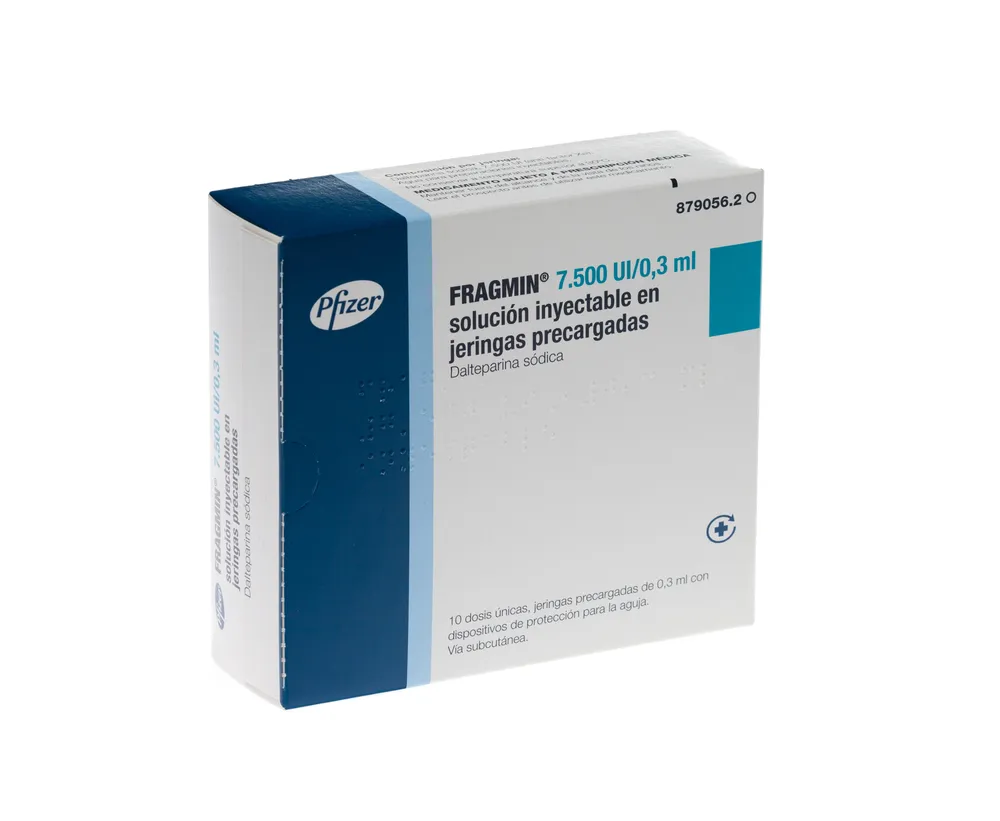
Table of Contents
Package leaflet: Information for the user
Introduction
Package leaflet: Information for the user
FRAGMIN 7,500 IU/0.3 ml solution for injection in pre-filled syringes
dalteparin sodium
Read all of this leaflet carefully before you start using this medicine because it contains important information for you.
- Keep this leaflet. You may need to read it again.
- If you have any questions, ask your doctor, pharmacist, or nurse.
- This medicine has been prescribed for you only and must not be given to other people, even if they have the same symptoms as you, because it may harm them.
- If you experience any adverse effects, talk to your doctor, pharmacist, or nurse, even if they are effects not listed in this leaflet. See section 4.
Contents of this leaflet:
- What Fragmin is and what it is used for
- What you need to know before using Fragmin
- How to use Fragmin
- Possible side effects
- How to store Fragmin
- Contents of the pack and other information
1. What Fragmin is and what it is used for
Fragmin belongs to a group of medicines called low molecular weight heparins.
Fragmin 7,500 IU/0.3 ml is used in adults aged 18 years and older for:
- Treatment of deep vein thrombosis with or without pulmonary embolism (to treat existing blood clots in the deep veins—a type of blood vessel)—and for the treatment of unstable angina and non-Q-wave myocardial infarction (a type of heart attack).
- Prophylaxis of thromboembolic disease in patients with cancer.
2. What you need to know before using Fragmin
Do not use Fragmin:
- if you are allergic (hypersensitive) to dalteparin sodium, to any of the other ingredients of this medicine (listed in section 6), to any other type of heparin (medicines that prevent blood clotting) other than dalteparin sodium, or to products derived from pork
- if you have acute gastroduodenal ulcer, cerebral hemorrhage, or any other significant bleeding
- if you have severe coagulation disorders
- if you have a disease called acute or subacute infective endocarditis (inflammation of one of the membranes of the heart due to infection)
- if you have recently undergone surgery on the central nervous system, eyes, or ears, or if you have trauma to these organs or systems
- if you have a low platelet count (blood cells involved in blood clotting) and when tested for aggregation in the presence of dalteparin sodium, the result is positive.
If you are being treated with Fragmin, you must not receive epidural or spinal anesthesia.
Warnings and precautions:
Talk to your doctor, pharmacist, or nurse before using Fragmin if:
-
You are due to receive intramuscular injections of other medicines, due to the risk of bruising.
-
You have a low platelet count or platelet dysfunction. Your doctor may carry out specific tests to determine the cause of this problem.
-
You have severe renal impairment (reduced kidney function) or severe hepatic impairment (reduced liver function).
-
You have uncontrolled high blood pressure.
-
You have retinal disorders (a part of the eye) due to diabetes or high blood pressure.
-
You have recently undergone surgery or are at high risk of bleeding.
-
You have suffered an acute myocardial infarction and are being treated with this medicine.
-
You are at risk of increased potassium levels in the blood due to a medical condition or taking certain medicines. Your doctor may perform blood tests to monitor your potassium levels.
-
If you undergo epidural anesthesia (in one of the membranes surrounding the brain and spinal cord), spinal anesthesia (in the spinal cord), or lumbar puncture, and heparin is administered for prophylaxis, hematomas in these areas may very rarely occur. If you experience lower back pain, numbness, weakness in the lower limbs, or any bowel or bladder dysfunction, inform your doctor immediately.
- If you have a cardiac valve prosthesis, preventive doses of Fragmin may not be sufficient to prevent valve thrombosis.
- If you are receiving prolonged treatment for unstable coronary disease, prior to revascularization, your doctor may reduce your Fragmin dose.
- If you are allergic or suspect you may have an allergy to latex (natural rubber), or if the needle cap of the pre-filled syringes of Fragmin will be handled by someone with a known or possible latex allergy (natural rubber). The needle cap of the pre-filled syringes of Fragmin is made of latex (natural rubber) which may cause severe allergic reactions in people allergic to latex (natural rubber).
Depending on your condition and/or age, your doctor may perform tests to monitor anticoagulant activity and prevent the risk of bleeding or recurrence of thrombosis.
Fragmin must not be interchanged with unfractionated heparins, low molecular weight heparins, or synthetic polysaccharides, as their effects may not be equivalent.
Children and adolescents:
Fragmin is not used in newborns under 1 month of age.
Using Fragmin with other medicines:
Tell your doctor, pharmacist, or nurse if you are taking, have recently taken, or might take any other medicines, including those obtained without a prescription.
Certain medicines may interact with Fragmin 7,500 IU/0.3 ml; in such cases, it may be necessary to adjust the dose or discontinue treatment with one of the medicines.
Thrombolytic therapy (which dissolves clots) or certain medicines affecting blood clotting may increase the risk of bleeding when used with Fragmin:
- Aspirin (acetylsalicylic acid).
- Platelet inhibitors (used to reduce platelet aggregation and lower the risk of blood clots).
- Thrombolytics (used to dissolve blood clots).
- Non-steroidal anti-inflammatory drugs (NSAIDs) (medicines used to treat inflammation).
- Vitamin K antagonists and other types of anticoagulants.
- Dextran (used in some artificial tears).
Medicines that may reduce the effect of Fragmin include:
- Andexanet alfa (a medicine used to reverse the effects of certain anticoagulants such as apixaban or rivaroxaban).
Pregnancy and breastfeeding:
Consult your doctor or pharmacist before taking or using any medicine, including Fragmin.
If you are pregnant, you should only use this medicine when clearly necessary, although Fragmin does not cross the placenta.
Its use together with epidural anesthesia is not recommended. Inform your doctor if you have an artificial heart valve.
If you are breastfeeding, inform your doctor; they will decide whether treatment with this medicine is appropriate, as Fragmin passes into breast milk in small amounts.
Driving and using machines:
This medicine does not affect the ability to drive or operate machinery.
Fragmin contains sodium
This medicine contains less than 23 mg (1 mmol) of sodium per pre-filled syringe; hence, it is essentially “sodium-free”.
3. How to use Fragmin
Follow exactly the administration instructions for Fragmin 7,500 IU/0.3 ml provided by your doctor. If you have any doubts, consult your doctor, pharmacist, or nursing staff.
Remember to take or use your medicine.
Your doctor will determine the dose, method of administration, and duration of your treatment with Fragmin.
Fragmin is administered by subcutaneous route (injection under the skin).
If you are being given Fragmin to treat existing blood clots in deep veins, treatment will begin as soon as possible and will continue for at least 5 days or until levels of the prothrombin complex (factors involved in blood clotting) return to their appropriate levels. You may receive one or two doses per day.
If you are given a single daily dose, it will be 200 IU per kg of body weight per day, administered by subcutaneous injection. The daily dose will not exceed 18,000 IU.
If you are given two doses per day, each dose will be 100 IU per kg of body weight per day.
If necessary, your doctor will perform blood tests to monitor your treatment.
If you are being administered Fragmin 7,500 IU/0.3 ml for the treatment of unstable angina and non-Q-wave myocardial infarction, the dose will be 120 IU per kg of body weight twice daily, administered by subcutaneous injection. The maximum dose will be 10,000 IU every 12 hours, and the treatment duration will be 6–8 days. Your doctor may consider that you should also take low-dose acetylsalicylic acid.
Fragmin injections are normally administered by a healthcare professional and injected under the skin in the front or back of the abdominal area, alternating between the right and left sides.
Use in children and adolescents
Treatment of blood clots in veins (symptomatic venous thromboembolism [VTE])
The recommended doses depend on the child's body weight and age group. Your doctor will perform the necessary calculations and advise you on the individualized dose of Fragmin according to these criteria. Do not change the dose or dosing schedule without first consulting your doctor.
This medicine is not suitable for use in the pediatric population because the pre-filled syringes do not allow dose adjustment based on the child's body weight. It is recommended to use the 2,500 IU/mL solution for injection in 4 mL vials.
The effect of Fragmin will be monitored after the initial dose and subsequent dose adjustments through a blood test.
How to inject Fragmin
Fragmin is administered by injection under the skin (subcutaneously). This section of the leaflet explains how to administer Fragmin. You must follow these instructions only after being trained by your doctor. If you are unsure what to do, speak to your doctor immediately. The dose of Fragmin must be injected (or administered) at the times recommended by your doctor.
If dilution is required before administering Fragmin, it must be performed by a healthcare professional. Follow your doctor’s instructions on how and when to inject the diluted medication provided to you.
Please follow the steps outlined below.
Step 1: How to prepare the syringe for injection depends on the specific presentation of Fragmin being used.
The Needle-Trap safety system is specifically designed to help prevent needlestick injuries after proper use of Fragmin. It consists of a plastic safety device attached to the syringe label. It is used to prevent accidental needlesticks after correct injection of Fragmin. The needle protection device (Needle-Trap) consists of a plastic tab (clamp) aligned parallel to the needle, firmly attached to the syringe barrel label.
The following actions are required to activate the safety system: Lift the syringe, grasp the tip of the plastic needle shield, and bend it away from the protective cap (see Figure 1).
Figure 1

Remove the grey rubber cap by pulling it outward (see Figure 2).
Figure 2

You will notice an air bubble in the syringe. This is expected and can be ignored. It is important not to press the plunger yet, as some of the medicine may be lost. The air bubble in disposable syringes should not be expelled before injection, as this may result in loss of medication and therefore a reduced dose.
You are now ready to administer the injection. Proceed to Step 2.
Step 2: Choosing and preparing the subcutaneous injection site
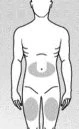
Choose one of the recommended injection sites shown below (see shaded areas in Figure 3):
- A "U"-shaped area around the navel.
- The central part of the thighs.
Figure 3
- Use a different injection site each time you administer a dose.
- Do not administer the injection in areas where the skin is painful, bruised, red, or hard. Avoid areas with scars.
- If you or the child has psoriasis, do not administer the injection directly into any raised, thick, red, or scaly skin plaques (“psoriatic skin lesions”).
- Wash and dry your hands.
- Clean the injection site with a new alcohol-impregnated wipe using circular motions. Allow the skin to dry completely. Do not touch this area again before administering the injection.
Step 3: Adopting the correct posture
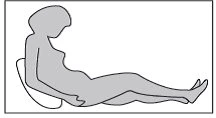
You or your child should be sitting or lying down during subcutaneous injection. If you are self-injecting, sit in a comfortable position where you can see your abdomen (see Figure 4).
Figure 4
Step 4:
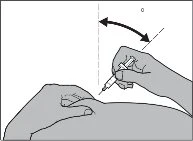
With your thumb and index finger, pinch a fold of skin with one hand. With the other hand, hold the syringe like a pencil. This will be the injection site.
Step 5:
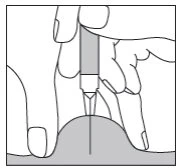
If injecting Fragmin to an adult or to yourself, hold the syringe over the skin fold at a right angle (i.e., vertically, as shown in the diagram, not at an angle). Insert the needle into the skin until it is fully inside (see Figure 5).
Figure 5
If injecting Fragmin to a child, insert the needle quickly and completely into the skin at an angle between 45° and 90° (see Figure 6).
Figure 6
Step 6:
Push the plunger down completely at a slow and steady pace to administer the correct dose. Continue pinching the skin fold while administering the injection, then release the skin fold and withdraw the needle.
If there is any bleeding at the injection site, apply gentle pressure. Do not rub the injection site, as this may cause bruising.
Press the injection site with a cotton swab for 10 seconds. Minor bleeding may occur. Do not rub the injection site. You may apply a bandage over the injection site.
Step 7: If your syringe has a Needle-Trap safety device, activate it
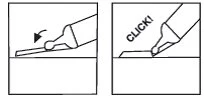
Place the plastic shield against a firm, stable surface and, with one hand, rotate the syringe barrel upward against the needle, forcing the needle into the shield until it locks (see Figure 7).
Continue bending the needle until the syringe exceeds a 45-degree angle with the flat surface to permanently disable it (see Figure 8).
(see Figure 7) (see Figure 8)
Step 8:
Dispose of the syringe and needle in a sharps container. Keep your sharps container out of reach of others. When the sharps container is nearly full, dispose of it according to instructions or consult your doctor or nurse.
If you use more Fragmin than you should
If you have used more Fragmin than prescribed, contact your doctor or pharmacist immediately, go to the nearest hospital, or contact the Toxicology Information Service at telephone number 91 562 04 20.
If you forget to use Fragmin
Contact your doctor or pharmacist immediately.
Do not administer a double dose to make up for a missed dose.
4. Possible adverse effects
Like all medicines, Fragmin may cause adverse effects, although not everyone experiences them.
Adverse effects observed frequently (may affect up to 1 in 10 patients):
- Pain and bruising at the injection site
- Reversible decrease in blood platelet count not mediated by immune mechanisms (type 1)
- Elevated potassium levels in blood (hyperkalemia), especially in patients with chronic renal failure and diabetes mellitus (see section 2 “Warnings and precautions”)
- Bleeding at any site, which has sometimes been fatal
- Temporary increase in liver enzymes
Rare adverse effects (may affect up to 1 in 1,000 patients):
- Hair loss, death of skin cells
Adverse effects with unknown frequency (cannot be estimated from available data):
- Decrease in blood platelet count mediated by immune mechanisms induced by heparin (type 2)
- Severe allergic reactions
- Localized bleeding inside the skull, abdomen, or other sites, sometimes fatal
- Rash
- Accumulation of blood inside the skull or spinal column (epidural or spinal hematoma)
- Increased potassium levels in blood
- Osteoporosis (porous bones)
Adverse effects in children are expected to be the same as in adults. However, there is limited information on possible adverse effects with long-term use in children.
Reporting of adverse effects:
If you experience any type of adverse effect, consult your doctor or pharmacist, even if it is a possible adverse effect not listed in this leaflet. You may also report them directly via the Spanish Pharmacovigilance System for Human Medicinal Products: www.notificaram.es. By reporting adverse effects, you can help provide more information on the safety of this medicine.
5. Storage of Fragmin
Keep out of the sight and reach of children.
Do not store above 30°C.
Do not use Fragmin after the expiry date (EXP) stated on the packaging and outer carton. The expiry date refers to the last day of the month indicated.
Do not use Fragmin if particles are present or if discoloration occurs.
Medicines should not be disposed of via wastewater or household waste. Dispose of unused containers and medicines at the SIGRE collection point at your pharmacy. If you are unsure, ask your pharmacist how to properly dispose of unused containers and medicines. This will help protect the environment.
6. Contents of the pack and other information
Composition of Fragmin 7,500 IU/0.3 ml:
The active substance in Fragmin 7,500 IU/0.3 ml is dalteparin sodium. Each millilitre of solution contains 25,000 IU (anti-Xa) of dalteparin sodium. The total content per container is 7,500 IU (anti-Xa).
The other components are: sodium hydroxide, hydrochloric acid and water for injections.
Appearance of Fragmin 7,500 IU/0.3 ml and contents of the pack:
Prefilled syringes with needle protection device: injectable solution for subcutaneous administration in prefilled syringes containing 7,500 IU (anti-Xa)/0.3 ml, in packs of 10 prefilled syringes.
Marketing Authorization Holder:
Pfizer, S.L.
Avda. de Europa 20-B. Parque Empresarial La Moraleja.
28108 Alcobendas (Madrid)
Spain
Manufacturer:
Pfizer Manufacturing Belgium NV
Rijksweg 12
2870 Puurs-Sint-Amands
Belgium
or
CATALENT FRANCE LIMOGES SAS
Z.I. Nord.
53 Rue de Dion Bouton
87280 Limoges
France
Additional information for healthcare professional/user:
Fragmin 7,500 IU/0.3 ml is compatible with isotonic sodium chloride solutions (9 mg/ml) or glucose solutions (50 mg/ml), both in glass vials and plastic containers.
Compatibility with other medicinal products has not been investigated.
Date of the most recent revision of this package leaflet: October 2025
Detailed and up-to-date information on this medicinal product is available on the website of the Spanish Agency for Medicines and Health Products (AEMPS) http://www.aemps.gob.es