Diclofenac Abamed 1 mg/ml eye drops solution in single-dose container
Spain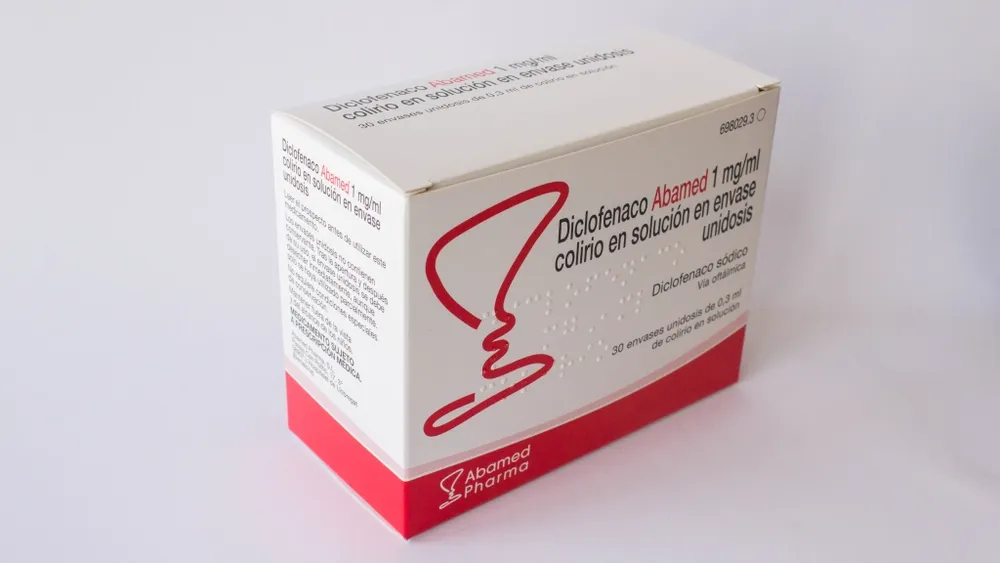
Table of Contents
- Package leaflet: Information for the user
- Introduction
- 1. What Diclofenac Abamed is and what it is used for
- 2. What you need to know before starting to use Diclofenac Abamed
- 3. How to use Diclofenaco Abamed
- 4. Possible adverse effects
- 5. Storage of Diclofenac Abamed
- 6. Contents of the pack and other information
Package leaflet: Information for the user
Introduction
Package leaflet: information for the user
Diclofenaco Abamed 1 mg/ml eye drops, solution in single-dose container
sodium diclofenac
Read all of this leaflet carefully before you start using this medicine, because it contains important information for you.
- Keep this leaflet. You may need to read it again.
- If you have any questions, ask your doctor, pharmacist or nurse.
- This medicine has been prescribed for you only and must not be given to other people, even if they have the same symptoms as you. It may harm them.
- If you experience any adverse effects, consult your doctor, pharmacist or nurse, even if they are adverse effects not listed in this leaflet. See section 4.
Contents of this leaflet:
- What Diclofenaco Abamed is and what it is used for
- What you need to know before using Diclofenaco Abamed
- How to use Diclofenaco Abamed
- Possible side effects
- How to store Diclofenaco Abamed
- Contents of the pack and other information
1. What Diclofenac Abamed is and what it is used for
This medicine belongs to the group of topical ophthalmic medications. It contains sodium diclofenac as the active substance, which is a non-steroidal anti-inflammatory drug (NSAID).
Diclofenac Abamed is used for:
- Postoperative treatment of inflammation of the anterior segment of the eye.
- Treatment to inhibit miosis (pupil contraction) before and after cataract surgery.
- Symptomatic treatment of chronic non-infectious conjunctivitis.
- Treatment of ocular inflammation, ocular pain, and photophobia following refractive surgery (performed to correct myopia, astigmatism, and hyperopia).
2. What you need to know before starting to use Diclofenac Abamed
Do not use Diclofenac Abamed
- if you are allergic to the active substance or to any of the other components of this medicine (listed in section 6).
Warnings and precautions
Consult your doctor or pharmacist before starting to use Diclofenac Abamed.
Take special care with Diclofenac Abamed:
- In case of infection or when there is a risk of infection, your doctor may prescribe Diclofenac Abamed together with another appropriate treatment (e.g., antibiotics).
- Non-steroidal anti-inflammatory drugs (NSAIDs) may mask an acute infectious process.
Other medicines and Diclofenac Abamed
Inform your doctor or pharmacist if you are taking, have recently taken, or might need to take any other medicines.
No interactions with other drugs have been reported to date with ocular administration.
Pregnancy, breastfeeding and fertility
If you are pregnant or breastfeeding, think you may be pregnant, or are planning to become pregnant, consult your doctor or pharmacist before using this medicine.
Diclofenac Abamed must not be used during the last three months of pregnancy. Diclofenac Abamed should not be used during the first six months of pregnancy unless strictly necessary and recommended by your doctor. If treatment is required during this period, the lowest possible dose for the shortest possible time should be used.
Oral formulations (e.g., tablets) of Diclofenac Abamed may cause adverse effects on the fetus. It is unknown whether this same risk applies to Diclofenac Abamed when used in the eyes.
Driving and use of machines
It is advisable to avoid using the eye drops before driving or operating machinery.
Diclofenac Abamed contains boric acid
Do not administer to children under 2 years of age, as this medicine contains boron and may affect future fertility.
3. How to use Diclofenaco Abamed
Follow exactly the administration instructions for this medicine given by your doctor or pharmacist. If in doubt, consult your doctor or pharmacist again.
Your doctor will indicate the duration of your treatment with Diclofenaco Abamed. Do not stop the treatment before instructed to do so.
The recommended dose for the conditions listed below is as follows:
-
Before surgery: 1 drop of the eye drops 3 to 5 times within the 3 hours prior to the operation, administered at regular intervals, meaning a maximum of 5 drops.
-
After surgery: 3 drops of the eye drops administered at regular intervals, starting immediately after the operation. Afterwards, for the required period, 1 to 2 drops of the eye drops 3 to 5 times a day, meaning a maximum daily dose of 10 drops.
-
Other indications: 1 to 2 drops of the eye drops 3 to 4 times a day, depending on the severity of the case, meaning a maximum daily dose of 8 drops.
If you think that the effect of Diclofenaco Abamed is too strong or too weak, tell your doctor or pharmacist.
Instructions for the correct use of Diclofenaco Abamed
- Separate a single-dose container by pulling it downwards with a gentle motion.
- Tap the base of the single-dose container lightly with your fingertip so that the eye drops move down towards the opening.
- Gently twist the cap to open the container.
- Apply the eye drops to the eye by repeatedly pressing the base of the container to help the liquid flow out, which may be hindered by air bubbles.
If you use more Diclofenaco Abamed than you should
In case of overdose or accidental ingestion, consult your doctor or pharmacist immediately, or call the Toxicology Information Service at telephone number: 91 562 04 20.
If you forget to use Diclofenaco Abamed
Do not apply a double dose to make up for missed doses.
If you have any further questions about the use of this product, ask your doctor or pharmacist.
4. Possible adverse effects
Like all medicines, this medicine can cause adverse effects, although not everyone experiences them.
Occasionally, as occurs with other eye drop solutions of the same therapeutic class, a mild to moderate transient stinging sensation may be felt immediately after instillation of the eye drops. Rarely, hypersensitivity reactions may occur, such as pruritus (itching), redness, and photosensitivity (sensitivity to light). Likewise, with unknown frequency, a burning sensation in the eye may occur.
Reporting of adverse effects
If you experience any type of adverse effect, consult your doctor or pharmacist, even if it is a possible adverse effect not listed in this leaflet. You may also report them directly through the Spanish Pharmacovigilance System for Human Medicines: www.notificaRAM.es. By reporting adverse effects, you can help provide more information on the safety of this medicine.
5. Storage of Diclofenac Abamed
Keep this medicine out of the sight and reach of children.
No special storage conditions are required.
This medicine does not contain preservatives. After opening and use, the single-dose container must be discarded, even if only partially used.
Do not use this medicine after the expiry date stated on the packaging after EXP. The expiry date refers to the last day of the month indicated.
Medicines must not be disposed of via wastewater or household waste. Dispose of unused containers and medicines at the SIGRE collection point at your pharmacy. If you have any doubts, ask your pharmacist how to dispose of containers and medicines you no longer need. This will help protect the environment.
6. Contents of the pack and other information
Composition of Diclofenac Abamed:
- The active substance is sodium diclofenac.
- The other components are polyoxyl 40 hydrogenated castor oil, boric acid (E-284), tromethamine, and purified water.
Appearance of the product and contents of the pack
Diclofenac Abamed is presented as an eye drop solution in single-dose containers. Carton pack containing 30 single-dose units, arranged in plastic blocks of 5 units, packed in a pouch.
Marketing Authorization Holder
Qualix Pharma, S.L.
c/ Botánica, 137-139
08908 L’Hospitalet de Llobregat (Barcelona)
Spain
Manufacturer
Qualix Pharma, S.L.
c/ Botánica, 137-139
08908 L’Hospitalet de Llobregat (Barcelona)
Spain
Date of the most recent review of this leaflet: August 2024.
Detailed and up-to-date information on this medicinal product is available on the website of the Spanish Agency of Medicines and Medical Devices (AEMPS) http://www.aemps.gob.es/