Deratin 5 mg lozenges for sucking
Spain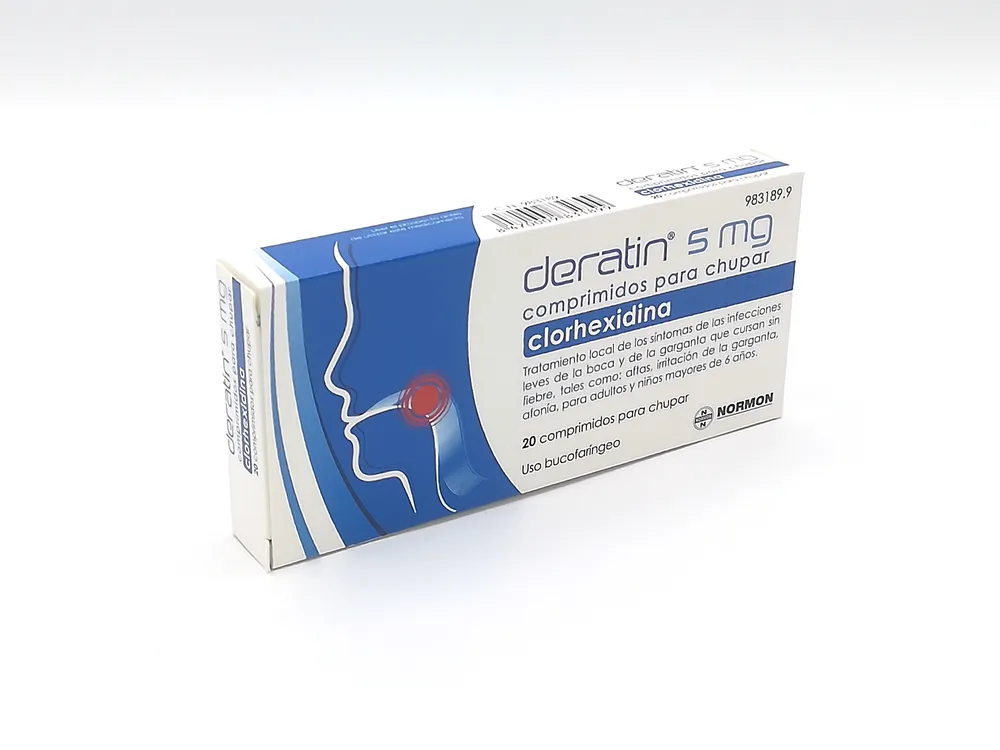
Table of Contents
Patient Information Leaflet
Introduction
Patient Information Leaflet
Deratin 5 mg lozenges
clorhexidina dihidrocloruro
Read the entire leaflet carefully before you start using this medicine , because it contains important information for you.
Follow exactly the instructions for taking this medicine as described in this leaflet or as directed by your doctor, pharmacist, or nurse.
- Keep this leaflet, as you may need to read it again.
- If you need advice or more information, consult your pharmacist.
- If you experience any adverse effects, consult your doctor or pharmacist, even if they are effects not listed in this leaflet. See section 4.
- You should consult a doctor if your condition worsens or if you do not improve after 2 days.
Leaflet contents :
- What Deratin is and what it is used for
- What you need to know before using Deratin
- How to use Deratin
- Possible side effects
- How to store Deratin
- Contents of the pack and other information
1. What Deratin is and what it is used for
Deratin is an oral and pharyngeal antiseptic.
Deratin is indicated for the local treatment of symptoms of mild infections of the mouth and throat that occur without fever, such as: aphthous ulcers, sore throat, hoarseness, in adults and children over 6 years of age.
You should consult a doctor if symptoms worsen or do not improve after 2 days of treatment.
2. What you need to know before using Deratin
Do not use Deratin:
- if you are allergic to chlorhexidine or to any of the other ingredients of this medicine (listed in section 6).
Warnings and precautions
Talk to your doctor or pharmacist before starting to use Deratin.
- If you have periodontitis (gum disease), because chlorhexidine may increase supragingival calculus formation.
- It is recommended to maintain proper oral hygiene to reduce tartar buildup and possible tooth staining that chlorhexidine may cause.
- Do not use doses higher than those recommended in section 3.
Children and adolescents
Do not use Deratin in children under 6 years of age without first consulting a doctor.
Using Deratin with other medicines
Tell your doctor or pharmacist if you are taking, have recently taken, or might need to take any other medicines.
Do not use together with other medicines containing antiseptics.
Taking Deratin tablets with food and drinks
The action of chlorhexidine is reduced by the presence of food residues.
Pregnancy and breastfeeding
If you are pregnant or breastfeeding, think you may be pregnant, or are planning to become pregnant, consult your doctor or pharmacist before using this medicine.
Do not use during pregnancy or breastfeeding unless instructed by your doctor.
Driving and using machines
The influence of Deratin on the ability to drive and use machines is none or negligible.
Deratin contains sorbitol (E-420) and sodium.
Sorbitol
This medicine contains 1000 mg of sorbitol per tablet. Sorbitol is a source of fructose. If your doctor has told you (or your child) that you have a sugar intolerance, or if you have been diagnosed with hereditary fructose intolerance (HFI), a rare genetic disorder in which the patient cannot break down fructose, consult your doctor (or your child’s doctor) before taking this medicine.
Sodium
This medicine contains less than 23 mg of sodium (1 mmol) per tablet, which means it is essentially “sodium-free”.
3. How to use Deratin
Follow exactly the administration instructions provided in this leaflet or those indicated by your doctor or pharmacist. If in doubt, ask your doctor or pharmacist.
The recommended dose is:
Children over 6 years of age:
1 lozenge every 4–5 hours, slowly dissolving it in the mouth, up to a maximum of 6 lozenges per day.
Adults and adolescents aged 12 years and older:
1 lozenge every 2–3 hours, slowly dissolving it in the mouth, up to a maximum of 8 lozenges per day.
Always use the lowest effective dose.
Allow the lozenge to dissolve slowly in the mouth. The lozenges must not be chewed or swallowed, as their action is entirely local and their activity is only evident when the product is in direct contact with the affected area.
If your condition worsens, or if symptoms persist for more than 2 days of treatment, or if fever, headache, nausea, or vomiting occur, consult your doctor as soon as possible.
If you use more Deratin than you should
Contact your doctor or pharmacist immediately. Chlorhexidine poisoning is unlikely due to its poor absorption through the gastrointestinal membrane. In case of overdose, it is recommended to take milk, egg white, or gelatin. Especially in children, chlorhexidine overdose may produce symptoms resembling alcohol intoxication (slurred speech, drowsiness, or unsteady gait).
In case of overdose or accidental ingestion, contact your doctor or pharmacist immediately or call the Toxicology Information Service at Tel. 91 562 04 20, indicating the product and the amount ingested.
4. Possible adverse effects
Like all medicines, Deratin may cause adverse effects, although not everyone will experience them.
During the period of use of chlorhexidine, the following adverse effects have been reported, although their frequency cannot be precisely established:
More frequent incidence: alteration in taste sensation, increased dental plaque, staining of teeth, mouth, dental fillings, dentures, or other oral prostheses, which becomes visible within one week of starting treatment. Staining of fillings may be permanent.
Less frequent or rare incidence: irritation at the tip of the tongue; oral irritation has been described in children aged 10 to 18 years; the lesions are transient and may not be painful.
Rare incidence: local irritant reactions and, rarely, severe allergic reactions, including nasal congestion, sensation of breathlessness or difficulty breathing, skin rash, itching, swelling of the face. If any of these occur, treatment must be discontinued and a doctor consulted immediately.
Reporting of adverse effects
If you experience any type of adverse effect, consult your doctor, pharmacist, or nurse, even if it is a possible adverse effect not listed in this leaflet. You may also report them directly via the Spanish Pharmacovigilance System for Human Medicines: www.notificaRAM.es. By reporting adverse effects, you can help provide more information on the safety of this medicine.
5. Storage of Deratin
Keep this medicine out of sight and reach of children.
Store below 25 °C.
Do not use this medicine after the expiry date stated on the carton after EXP. The expiry date refers to the last day of the month indicated.
Medicines must not be disposed of via wastewater or household waste. Instead, return unused medicines and their packaging to the SIGRE collection point at your pharmacy. If you are unsure, ask your pharmacist how to properly dispose of unused medicines and their packaging. This will help protect the environment.
6. Contents of the pack and other information
Composition of Deratin
- The active substance is: chlorhexidine dihydrochloride, each tablet contains 5 mg of chlorhexidine dihydrochloride.
- The other components (excipients) are: Sorbitol (E-420), povidone, sodium saccharin (E-954), magnesium stearate and peppermint flavour.
Appearance of the product and contents of the pack
Deratin are white or almost white, round tablets, with a "D" marked on one side.
They are presented in packs containing 20 tablets, packaged in aluminum/PVC blisters.
Marketing Authorization Holder and Manufacturer
LABORATORIOS NORMON, S.A.
Ronda de Valdecarrizo, 6 – 28760 Tres Cantos – Madrid (Spain)
Date of the most recent review of this leaflet: December 2021
Detailed and up-to-date information on this medicinal product is available on the website of the Spanish Agency for Medicines and Health Products (AEMPS): http://www.aemps.gob.es/