Darzalex 20 mg/ml concentrate for solution for infusion
Spain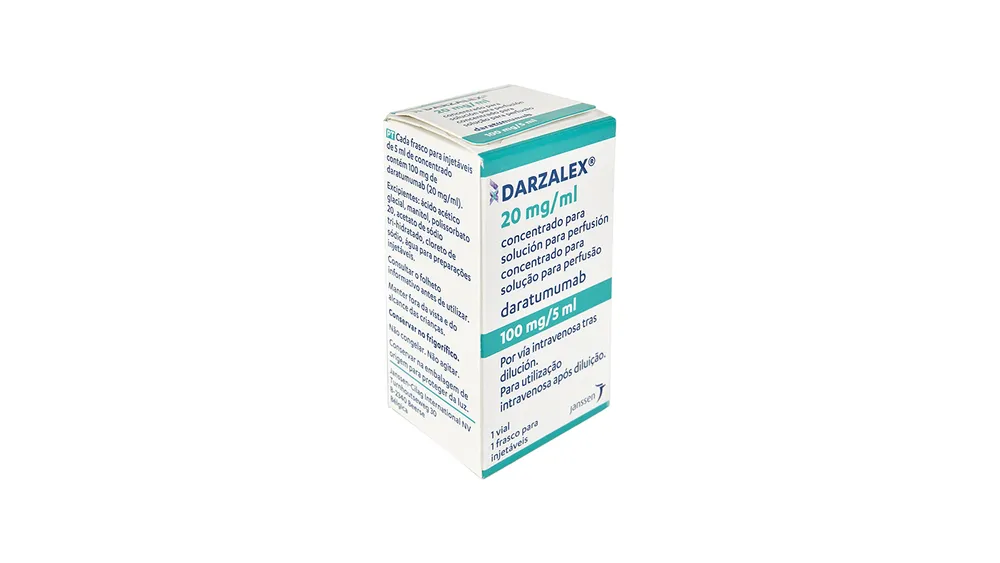
Table of Contents
Package leaflet: Information for the user
Introduction
Package leaflet: information for the patient
DARZALEX 20 mg/ml concentrate for solution for infusion
daratumumab
Read the entire leaflet carefully before you start receiving this medicine, because it contains important information for you.
- Keep this leaflet, as you may need to read it again.
- If you have any questions, consult your doctor or nurse.
- If you experience any adverse reactions, consult your doctor or nurse, even if they are not listed in this leaflet. See section 4.
Contents of the leaflet
- What DARZALEX is and what it is used for
- What you need to know before receiving DARZALEX
- How DARZALEX is administered
- Possible side effects
- How to store DARZALEX
- Contents of the pack and other information
1. What DARZALEX is and what it is used for
What DARZALEX is
DARZALEX is a cancer treatment medicine that contains the active substance daratumumab. It belongs to a group of medicines called "monoclonal antibodies". Monoclonal antibodies are proteins that are designed to recognize and bind to specific targets in the body. Daratumumab is designed to bind to specific cancer cells in the body, enabling the immune system to destroy them.
What DARZALEX is used for
DARZALEX is used in adults aged 18 years and older who have a type of cancer called "multiple myeloma". This is a cancer of the bone marrow.
2. What you need to know before you start receiving DARZALEX
Do not receive DARZALEX
- if you are allergic to daratumumab or to any of the other ingredients of this medicine (listed in section 6).
You must not receive DARZALEX if you meet the above criterion. If you are unsure, consult your doctor or nurse before starting DARZALEX.
Warnings and precautions
Talk to your doctor or nurse before starting DARZALEX.
Infusion-related reactions
DARZALEX is administered as an intravenous infusion (drip). Medicines will be given before and after each DARZALEX infusion to help reduce the likelihood of infusion-related reactions (see section 3, “Medicines administered during treatment with DARZALEX”). These reactions may occur during the infusion or within 3 days after the infusion.
In some cases, you may experience a severe allergic reaction, which may include swelling of the face, lips, mouth, tongue or throat, difficulty swallowing or breathing, or an itchy rash (urticaria). Some severe allergic reactions and other serious infusion-related reactions have resulted in death.
Immediately inform your doctor or nurse if you experience any of the infusion-related reactions or related symptoms listed at the beginning of section 4.
If you experience infusion-related reactions, you may need additional medicines or the infusion may need to be slowed or stopped. The infusion may be resumed once these reactions have subsided or improved.
These reactions occur mostly with the first infusion. If you have already experienced an infusion-related reaction, it is less likely to occur again. If you experience a severe infusion-related reaction, your doctor may decide not to continue DARZALEX.
Reduction in blood cell counts
DARZALEX may reduce the number of white blood cells, which are cells that help fight infections, and of other blood cells called platelets, which help blood to clot. Inform your healthcare provider if you experience any signs of infection such as fever, or any signs of low platelet counts such as bruising or bleeding.
Blood transfusions
If you need a blood transfusion, a blood test will first be performed to determine your blood group. DARZALEX may affect the results of this blood test. Inform the person performing the test that you are receiving DARZALEX.
Hepatitis B
Inform your doctor if you have ever had or may currently have a Hepatitis B virus infection. This is because DARZALEX could cause reactivation of the Hepatitis B virus. Your doctor will monitor you for signs of this infection before, during, and for some time after treatment with DARZALEX. Immediately inform your doctor if you experience worsening fatigue or develop yellowing of the skin or the whites of the eyes.
Children and adolescents
Do not give DARZALEX to children or adolescents under 18 years of age, as it is unknown how the medicine will affect them.
Other medicines and DARZALEX
Inform your doctor or nurse if you are taking, have recently taken, or might need to take any other medicines. This includes medicines obtained without a prescription and herbal medicines.
Pregnancy
If you are pregnant, think you may be pregnant, or plan to become pregnant, consult your doctor before receiving this medicine.
If you become pregnant during treatment with this medicine, inform your doctor or nurse immediately. You and your doctor will decide whether the benefit of receiving the medicine outweighs the risk to the fetus.
Contraception
Women receiving DARZALEX should use an effective method of contraception during treatment and for 3 months after treatment ends.
Breast-feeding
You and your doctor will decide whether the benefit of breast-feeding outweighs the risk to your baby, as this medicine may pass into breast milk and it is unknown how it may affect the baby.
Driving and using machines
You may feel tired after receiving DARZALEX, which may affect your ability to drive or operate machinery.
DARZALEX contains sorbitol
Sorbitol is a source of fructose. If you have hereditary fructose intolerance (HFI), a rare genetic disorder, you must not receive this medicine. Patients with HFI cannot break down fructose, which may lead to serious adverse effects.
Consult your doctor before receiving this medicine if you have HFI.
3. How DARZALEX is administered
Dose administered
Your doctor will calculate the dose and dosing schedule of DARZALEX. The dose of DARZALEX will depend on your body weight.
The usual initial dose of DARZALEX is 16 mg per kg of body weight. DARZALEX may be given alone or together with other medicines used to treat multiple myeloma.
When given alone, DARZALEX is administered as follows:
- once a week for the first 8 weeks
- then once every 2 weeks for 16 weeks
- after this, once every 4 weeks as long as the disease does not worsen.
When DARZALEX is administered together with other medicines, your doctor may modify the time between doses as well as the number of treatments you receive.
In the first week, your doctor may administer your DARZALEX dose divided over two consecutive days.
How the medicine is administered
A doctor or nurse will administer DARZALEX to you. It is given as an intravenous infusion (a “drip”) into a vein over several hours.
Medicines administered during treatment with DARZALEX
You may be given medicines to reduce the likelihood of developing herpes zoster.
Before each DARZALEX infusion, you will be given medicines to help reduce the risk of infusion-related reactions. These may include:
- medicines to treat allergic reactions (antihistamines)
- medicines to treat inflammation (corticosteroids)
- medicines to treat fever (such as paracetamol).
After each DARZALEX infusion, you will be given medicines (such as corticosteroids) to reduce the risk of infusion-related reactions.
Patients with respiratory problems
If you have breathing problems, such as asthma or chronic obstructive pulmonary disease (COPD), you will be given inhaled medicines to help treat breathing difficulties:
- medicines to keep the airways of the lungs open (bronchodilators)
- medicines to reduce inflammation and irritation in the lungs (corticosteroids).
If you receive more DARZALEX than you should
A doctor or nurse will administer this medicine to you. In the unlikely event that you receive an excessive amount (overdose), your doctor will monitor you for adverse effects.
If you miss your appointment to receive DARZALEX
It is very important that you attend all your appointments to ensure that the treatment works. If you miss an appointment, schedule another one as soon as possible.
If you have any further questions about the use of this medicine, ask your doctor or nurse.
4. Possible adverse effects
Like all medicines, this medicine can cause adverse effects, although not everyone will experience them.
Infusion-related reactions
Immediately inform your doctor or nurse if you experience any of the following signs of an infusion-related reaction during or within 3 days after the infusion. You may need additional medicines, or it may be necessary to slow down or stop the infusion.
These reactions include the following symptoms:
Very common (may affect more than 1 in 10 people):
- chills
- sore throat, cough
- feeling sick (nausea)
- vomiting
- itching, runny or stuffy nose
- difficulty breathing or other breathing problems.
Common (may affect up to 1 in 10 people):
- chest discomfort
- dizziness or vertigo (hypotension)
- itching
- wheezing.
Rare (may affect up to 1 in 1,000 people):
- severe allergic reaction, which may include swelling of the face, lips, mouth, tongue, or throat, difficulty swallowing or breathing, or an itchy rash (urticaria). See section 2.
- eye pain
- blurred vision.
If you experience any of the infusion-related reactions listed above, inform your doctor or nurse immediately.
Other adverse effects
Very common (may affect more than 1 in 10 people):
- fever
- feeling very tired
- diarrhoea
- constipation
- decreased appetite
- headache
- nerve damage that may cause tingling, numbness, or pain
- high blood pressure
- muscle spasms
- swollen hands, ankles, or feet
- weakness
- back pain
- chills
- lung infection (pneumonia)
- bronchitis
- respiratory tract infection, such as in the nose, sinuses, or throat
- low red blood cell count, which carry oxygen in the blood (anaemia)
- low white blood cell count, which help fight infections (neutropenia, lymphopenia, leucopenia)
- low count of a type of blood cell called platelets, which help blood to clot (thrombocytopenia)
- unusual skin sensations (such as tingling or prickling).
Common (may affect up to 1 in 10 people):
- irregular heartbeat (atrial fibrillation)
- fluid buildup in the lungs, leading to difficulty breathing
- flu
- urinary tract infection
- serious body-wide infection (sepsis)
- dehydration
- fainting
- high blood sugar level
- low calcium level in the blood
- low level of antibodies called 'immunoglobulins' in the blood, which help fight infections (hypogammaglobulinaemia)
- inflammation of the pancreas
- infection with a type of herpes virus (cytomegalovirus infection)
- COVID-19.
Uncommon (may affect up to 1 in 100 people):
- inflammation of the liver (hepatitis).
Reporting of adverse effects
If you experience any adverse effect, consult your doctor or nurse, even if it is a possible adverse effect not listed in this leaflet. You can also report them directly through the national reporting system included in Appendix V. By reporting adverse effects, you can help provide more information on the safety of this medicine.
5. Storage of DARZALEX
DARZALEX will be stored in the hospital or clinic.
Keep this medicine out of the sight and reach of children.
Do not use this medicine after the expiry date stated on the carton and label of the vial following "EXP". The expiry date refers to the last day of the month indicated.
Store in a refrigerator (between 2 °C and 8 °C). Do not freeze.
Keep in the original packaging to protect from light.
Medicines should not be disposed of via wastewater or household waste. Your healthcare professional will dispose of unused medicines. This helps protect the environment.
6. Contents of the pack and other information
Composition of DARZALEX
- The active substance is daratumumab. One ml of concentrate contains 20 mg of daratumumab. Each 5 ml vial of concentrate contains 100 mg of daratumumab. Each 20 ml vial of concentrate contains 400 mg of daratumumab.
- The other components are L-histidine, L-histidine monohydrochloride monohydrate, L-methionine, polysorbate 20, sorbitol (E420) and water for injections (see section 2, «DARZALEX contains sorbitol»).
Nature of the product and pack contents
DARZALEX is a concentrate for solution for infusion and is a liquid that ranges from colourless to yellow.
DARZALEX is supplied in a carton containing 1 glass vial.
DARZALEX is also available as a starter pack containing 11 vials: (6 vials of 5 ml + 5 vials of 20 ml).
Marketing Authorisation Holder
Janssen-Cilag International NV
Turnhoutseweg 30
B-2340 Beerse
Belgium
Manufacturer
Janssen Biologics B.V.
Einsteinweg 101
NL-2333 CB Leiden
The Netherlands
Further information on this medicine is available upon request by contacting the local representative of the Marketing Authorisation Holder:
Belgium/Belgium/Belgium Janssen-Cilag NV Tel/Tel: +32 14 64 94 11 | Lithuania UAB "JOHNSON & JOHNSON" Tel: +370 5 278 68 88 |
Bulgaria „JOHNSON & JOHNSON“ EOOD Tel: +359 2 489 94 00 | Luxembourg/Luxembourg Janssen-Cilag NV Tél/Tel: +32 14 64 94 11 |
Czech Republic Janssen-Cilag s.r.o. Tel: +420 227 012 227 | Hungary Janssen-Cilag Kft. Tel.: +36 1 884 2858 |
Denmark Janssen-Cilag A/S Tlf: +45 4594 8282 | Malta AM MANGION LTD Tel: +356 2397 6000 |
Germany Janssen-Cilag GmbH Tel: +49 2137 955 955 | Netherlands Janssen-Cilag B.V. Tel: +31 76 711 1111 |
Estonia UAB "JOHNSON & JOHNSON" Estonia branch Tel: +372 617 7410 | Norway Janssen-Cilag AS Tlf: +47 24 12 65 00 |
Greece Janssen-Cilag Pharmaceutical S.A.E. Tel: +30 210 80 90 000 | Austria Janssen-Cilag Pharma GmbH Tel: +43 1 610 300 |
Spain Janssen-Cilag, S.A. Tel: +34 91 722 81 00 | Poland Janssen-Cilag Polska Sp. z o.o. Tel.: +48 22 237 60 00 |
France Janssen-Cilag Tél: 0 800 25 50 75 / +33 1 55 00 40 03 | Portugal Janssen-Cilag Farmacêutica, Lda. Tel: +351 214 368 600 |
Croatia Johnson & Johnson S.E. d.o.o. Tel: +385 1 6610 700 | Romania Johnson & Johnson România SRL Tel: +40 21 207 1800 |
Ireland Janssen Sciences Ireland UC Tel: 1 800 709 122 | Slovenia Johnson & Johnson d.o.o. Tel: +386 1 401 18 00 |
Iceland Janssen-Cilag AB c/o Vistor hf. Tel: +354 535 7000 | Slovakia Johnson & Johnson, s.r.o. Tel: +421 232 408 400 |
Italy Janssen-Cilag SpA Tel: 800.688.777 / +39 02 2510 1 | Finland Janssen-Cilag Oy Puh/Tel: +358 207 531 300 |
Cyprus Varnavas Hadjipanagis Ltd Tel: +357 22 207 700 | Sweden Janssen-Cilag AB Tfn: +46 8 626 50 00 |
Latvia UAB "JOHNSON & JOHNSON" Latvia branch Tel: +371 678 93561 | United Kingdom (Northern Ireland) Janssen Sciences Ireland UC Tel: +44 1 494 567 444 |
Date of the most recent review of this summary:
Other sources of information
Detailed information on this medicine is available on the European Medicines Agency website: http://www.ema.europa.eu.
This information is intended for healthcare professionals only:
This medicine is for single use only.
Prepare the infusion solution using an aseptic technique as described below:
- Calculate the required dose (mg) and total volume (ml) of DARZALEX solution, and the number of DARZALEX vials needed based on the patient's body weight.
- Check that the DARZALEX solution is colorless to yellow. Do not use if visible particulate matter, discoloration, or other foreign particles are present.
- Using an aseptic technique, withdraw a volume of sodium chloride 9 mg/ml (0.9%) for injection from the infusion bag/container equal to the volume of DARZALEX solution to be added.
- Withdraw the required amount of DARZALEX solution and dilute it to the appropriate volume by adding it to an infusion bag/container containing sodium chloride 9 mg/ml (0.9%) for injection. The infusion bags/containers must be made of polyvinyl chloride (PVC), polypropylene (PP), polyethylene (PE), or polyolefin blend (PP + PE). Dilute under appropriate aseptic conditions. Discard any unused portion remaining in the vial.
- Gently invert the bag/container to mix the solution. Do not shake.
- Prior to administration, visually inspect parenteral medicines for the presence of particulate matter and discoloration. The diluted solution may contain very small, translucent to white, proteinaceous particles, as daratumumab is a protein. Do not use if visible opaque particles, discoloration, or foreign particles are observed.
- Since DARZALEX does not contain any preservative, the diluted solution must be administered within 15 hours (including infusion time) at room temperature (15 °C to 25 °C) and under normal light conditions.
- If not used immediately, the diluted solution may be stored prior to administration for up to 24 hours under refrigerated conditions (2 °C to 8 °C), protected from light. Do not freeze.
- Administer the diluted solution as an intravenous infusion using an infusion set with a flow regulator and an integrated sterile, non-pyrogenic, low protein-binding polyethersulfone (PES) filter (pore size, 0.22 or 0.2 µm). Administration sets made of polyurethane (PU), polybutadiene (PBD), PVC, PP, or PE should be used.
- DARZALEX must not be administered simultaneously with other medicinal products through the same intravenous line.
- Do not store and reuse any unused portion of the infusion solution. Any unused medicinal product and waste materials that have come into contact with the product must be disposed of in accordance with local requirements.
Traceability
In order to improve traceability of biological medicines, the name and batch number of the administered product should be clearly recorded.