Cystagon 50 mg hard capsules
Spain
Table of Contents
- Patient Information Leaflet
- Introduction
- 1. What Cystagon is and what it is used for
- 2. What you need to know before using Cystagon
- 3. How to use Cystagon
- 4. Possible adverse effects
- 5. Storage of Cystagon
- Keep this medicine out of the sight and reach of children.
- 6. Contents of the pack and other information
Patient Information Leaflet
Introduction
Patient Information Leaflet
CYSTAGON 50 mg Hard Capsules
CYSTAGON 150 mg Hard Capsules
cysteamine bitartrate (mercaptamine bitartrate)
Read all of this leaflet carefully before you start taking this medicine, because it contains important information for you.
- Keep this leaflet, as you may need to read it again.
- If you have any questions, ask your doctor or pharmacist.
- This medicine has been prescribed for you only, and you should not give it to other people, even if they have the same symptoms as you, because it may harm them.
- If you experience any side effects, talk to your doctor or pharmacist, even if they are side effects not listed in this leaflet. See section 4.
Contents of this leaflet
-
What CYSTAGON is and what it is used for
-
What you need to know before taking CYSTAGON
-
How to take CYSTAGON
-
Possible side effects
-
How to store CYSTAGON
-
Contents of the pack and other information
1. What Cystagon is and what it is used for
Cystinosis is a metabolic disease called 'nephropathic cystinosis' which is characterized by abnormal accumulation of the amino acid cystine in various organs of the body such as the kidneys, eyes, muscles, pancreas, and brain. The accumulation of cystine causes kidney damage and excessive loss of sugar (glucose), proteins, and electrolytes. Different organs may become affected at different ages.
CYSTAGON is prescribed to treat this rare inherited disorder. CYSTAGON is a medicine that reacts with cystine, thereby reducing cystine levels within cells.
2. What you need to know before using Cystagon
Do not take CYSTAGON:
- if you or your child are allergic to cysteamine bitartrate or penicillamine or to any of the other ingredients of this medicine (listed in section 6).
- if you are pregnant, especially during the first trimester.
- if you are breastfeeding.
Warnings and precautions:
- Once your or your child's disease has been confirmed by leukocyte cystine measurements, treatment with CYSTAGON should be started as soon as possible.
- Cases of skin lesions in the form of small, hard nodules, mainly on the elbows, have been reported in children treated with high doses of various cysteamine preparations. These lesions were associated with skin striae, bone abnormalities such as fractures and bone deformities, and loose joints.
Your doctor may periodically request physical skin examinations and radiographic bone evaluations to monitor the effects of the medication. Patient or parental self-examination of the skin is recommended. If any skin or bone abnormalities appear, you must inform your doctor immediately.
-
Your doctor may periodically request blood tests to monitor blood cell counts.
-
CYSTAGON does not prevent cystine crystal accumulation in the eyes. If ophthalmic cysteamine solutions are being used for this purpose, you should continue using them.
-
Unlike phosphocysteamine, another active substance similar to cysteamine bitartrate, CYSTAGON does not contain phosphate. You may be taking phosphate supplements, and their dosage may need to be adjusted if your treatment is changed from CYSTAGON to phosphocysteamine.
-
Capsules should not be administered to children under approximately 6 years of age to avoid the risk of pulmonary aspiration.
-
Do not ingest the desiccant container present in the bottle.
Other medicines and CYSTAGON
Inform your doctor or pharmacist if you are taking, have recently taken, or might need to take any other medicines.
CYSTAGON with food and drinks:
For children under six years of age, the hard capsule may be opened and its contents sprinkled onto food (e.g., milk, potatoes, or starchy foods such as flour-based foods) or mixed with a bottle-feed. It should not be mixed with acidic drinks such as orange juice. For complete instructions, consult your doctor.
Pregnancy
CYSTAGON must not be used during pregnancy. You should consult your doctor if you are planning to become pregnant.
Breast-feeding
CYSTAGON must not be used during breast-feeding.
Driving and use of machines:
CYSTAGON may cause drowsiness. When starting treatment, you or your child should avoid potentially hazardous activities until the effects of the medicine are well known.
3. How to use Cystagon
Follow exactly the administration instructions for this medicine given by your doctor or your child's doctor. If you have any doubts, consult your doctor again.
The dose of CYSTAGON prescribed for you or your child will depend on your or your child's weight and age.
For children up to 12 years of age, the dose will be based on body size (surface area), with the usual dose being 1.30 g/m2 of body surface area per day.
For patients older than 12 years and weighing more than 50 kg, the usual dose is 2 g/day.
In any case, the usual dose should not exceed 1.95 g/m2/day.
CYSTAGON must always be taken orally and exactly as directed by your doctor or your child's doctor. To ensure that CYSTAGON works properly, it is necessary to:
-
Follow your doctor's instructions exactly. Do not increase or decrease the amount of medication without your doctor's approval.
-
Do not administer the hard capsules to children under six years of age, as they may be unable to swallow them and could choke. For children under six years of age, the hard capsule may be opened and its contents sprinkled on food (for example, milk, potatoes, or starchy foods such as flours), or mixed with a bottle-feed. Do not mix with acidic drinks, such as orange juice. Consult your doctor for appropriate recommendations.
-
The medical treatment prescribed for you or your child will include, in addition to CYSTAGON, one or more supplements to replace important electrolytes lost through the kidneys. It is important to take or administer these supplements exactly as instructed. If you miss several doses of one of the supplements, or if you notice weakness or drowsiness, you must consult your doctor immediately.
-
To determine the correct dose of CYSTAGON, periodic blood tests are required to measure the amount of cystine within the leukocytes. Your doctor or your child's doctor will determine when these blood tests should be performed. Periodic blood and urine tests are also necessary to measure the concentrations of important electrolytes in the body, so that your doctor can adjust the doses of the electrolyte supplements you need.
CYSTAGON should be taken 4 times a day, every 6 hours, preferably with meals or immediately after meals. It is important to adhere as strictly as possible to the rule of taking the dose every six hours.
CYSTAGON treatment should be continued indefinitely, as directed by your doctor.
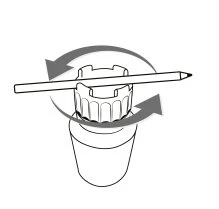
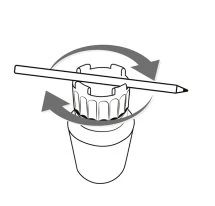
To easily open and close the Cystagon bottle, follow the instructions included below:
Instructions for opening and closing the container
OPEN
| CLOSE
|
To open the container Place a pen or similar object between the raised parts of the cap and turn it in the indicated direction (counterclockwise) | To close the container Place a pen or similar object between the raised parts of the cap and turn it in the indicated direction (clockwise) |
If you take more CYSTAGON than you should
If you have ingested more medicine than prescribed, or if drowsiness occurs, consult your doctor or your child's doctor immediately, or go to a hospital emergency department.
If you forget to take CYSTAGON
If you forget to take a dose of the medicine, take it as soon as possible. However, if less than 2 hours remain before the next dose, the missed dose should be skipped and you should return to your regular dosing schedule. Do not take a double dose to make up for missed doses.
4. Possible adverse effects
Like all medicines, this medicine can cause adverse effects, although not everyone will experience them.
CYSTAGON may cause drowsiness or reduced alertness in some people compared to their normal state. Make sure you know how you or your child reacts to this medicine before undertaking any activity that could be dangerous if you are not fully alert.
The following adverse effects have been reported in the following frequency categories: very common (occurs in at least 1 in 10 patients), common (occurs in at least 1 in 100 patients), uncommon (occurs in at least 1 in 1,000 patients), rare (occurs in at least 1 in 10,000 patients), very rare (occurs in at least 1 in 100,000 patients).
-
Very common: vomiting, nausea, diarrhoea, loss of appetite, fever, and drowsiness.
-
Common: abdominal pain or discomfort, bad breath and unpleasant body odour, skin rash, gastroenteritis, fatigue, headache, encephalopathy (brain disorder), and abnormal liver function tests.
-
Uncommon: skin striae, skin lesions (small hard lumps at the elbows), loose joints, leg pain, bone fractures, scoliosis (spinal curvature), bone deformities and fragility, hair depigmentation, severe allergic reaction, drowsiness, seizures, nervousness, hallucinations, decreased number of white blood cells, gastrointestinal ulcer with secondary gastrointestinal bleeding, and kidney disorders manifested by swelling of the limbs and weight gain.
As some of these adverse effects are serious, please ask your doctor or paediatrician to explain the warning signs to you.
Reporting of adverse effects
If you experience any type of adverse effect, consult your doctor or pharmacist, even if it is a possible adverse effect not listed in this leaflet. You can also report them directly through the national reporting system included in Appendix V. By reporting adverse effects, you can help provide more information on the safety of this medicine.
5. Storage of Cystagon
Keep this medicine out of the sight and reach of children.
Do not use this medicine after the expiry date stated on the label after EXP. The expiry date is the last day of the month indicated.
Do not store above 25°C.
Keep the container tightly closed to protect it from light and moisture.
Medicines must not be disposed of via wastewater or household waste. Ask your pharmacist how to dispose of containers and medicines you no longer require. This will help protect the environment.
6. Contents of the pack and other information
Composition of CYSTAGON
-
The active substance is cysteamine bitartrate (mercaptamine bitartrate). Each CYSTAGON 50 mg hard capsule contains 50 mg of cysteamine (as mercaptamine bitartrate). Each CYSTAGON 150 mg hard capsule contains 150 mg of cysteamine (as mercaptamine bitartrate).
-
The other components are microcrystalline cellulose, pregelatinized starch, magnesium stearate/sodium lauryl sulfate, colloidal anhydrous silica, sodium croscarmellose. Capsule shell: gelatin, titanium dioxide, black ink on hard capsules (E172).
Nature and contents of the container
Hard capsules
- Cystagon 50 mg: Opaque white hard capsules with the inscriptions "CYSTA 50" on the body and "RECORDATI RARE DISEASES" on the cap.
Bottles of 100 or 500 hard capsules. Only certain pack sizes may be marketed.
- Cystagon 150 mg: Opaque white hard capsules with the inscriptions "CYSTAGON 150" on the body and "RECORDATI RARE DISEASES" on the cap.
Bottles of 100 or 500 hard capsules. Only certain pack sizes may be marketed.
Marketing Authorization Holder
Recordati Rare Diseases
Tour Hekla
52, Avenue du Général de Gaulle
F-92800 Puteaux
France
Manufacturer
Recordati Rare Diseases
Tour Hekla
52, Avenue du Général de Gaulle
F-92800 Puteaux
France
or
Recordati Rare Diseases
Eco River Parc
30, rue des Peupliers
F-92000 Nanterre
France
For further information regarding this medicinal product, please contact the local representative of the Marketing Authorization Holder.
Belgium/Belgium/Belgium Recordati Tél/Tel: +32 2 46101 36 | Lithuania Recordati AB. Tel: +46 8 545 80 230 Sweden |
| Luxembourg/Luxembourg Recordati Tél/Tel: +32 2 46101 36 Belgium/Belgium |
Czech Republic Recordati Rare Diseases Tel: +33 (0)1 47 73 64 58 France | Hungary Recordati Rare Diseases Tel: +33 (0)1 47 73 64 58 France |
Denmark Recordati AB. Tlf: +46 8 545 80 230 Sweden | Malta Recordati Rare Diseases Tel: +33 1 47 73 64 58 France |
Germany Recordati Rare Diseases Germany GmbH Tel: +49 731 140 554 0 | Netherlands Recordati Tel: +32 2 46101 36 Belgium |
Estonia Recordati AB. Tel: +46 8 545 80 230 Sweden | Norway Recordati AB. Tlf: +46 8 545 80 230 Sweden |
Greece Recordati Rare Diseases Tel: +33 1 47 73 64 58 France | Austria Recordati Rare Diseases Germany GmbH Tel: +49 731 140 554 0 Germany |
Spain Recordati Rare Diseases Spain S.L.U. Tel: +34 91 659 28 90 | Poland Recordati Rare Diseases Tel: +33 (0)1 47 73 64 58 France |
France Recordati Rare Diseases Tél: +33 (0)1 47 73 64 58 | Portugal Recordati Rare Diseases SARL |
Croatia Recordati Rare Diseases Tél: +33 (0)1 47 73 64 58 France | Romania Recordati Rare Diseases Tel: +33 (0)1 47 73 64 58 France |
Ireland Recordati Rare Diseases Tel: +33 (0)1 47 73 64 58 France | Slovenia Recordati Rare Diseases Tel: +33 (0)1 47 73 64 58 France |
Iceland Recordati AB. Simi: +46 8 545 80 230 Iceland | Slovak Republic Recordati Rare Diseases Tel: +33 (0)1 47 73 64 58 France |
Italy Recordati Rare Diseases Italy Srl Tel: +39 02 487 87 173 | Finland Recordati AB. Puh/Tel: +46 8 545 80 230 Sweden |
Cyprus Recordati Rare Diseases Tel: +33 1 47 73 64 58 France | Sweden Recordati AB. Tel: +46 8 545 80 230 |
Latvia Recordati AB. Tel: +46 8 545 80 230 Sweden |
Date of the most recent review of this leaflet:
Detailed information on this medicine is available on the website of the European Medicines Agency: https://www.ema.europa.eu/. There are also links to other websites on rare diseases and orphan medicinal products.