Cyramza 10 mg/ml concentrate for infusion solution
Spain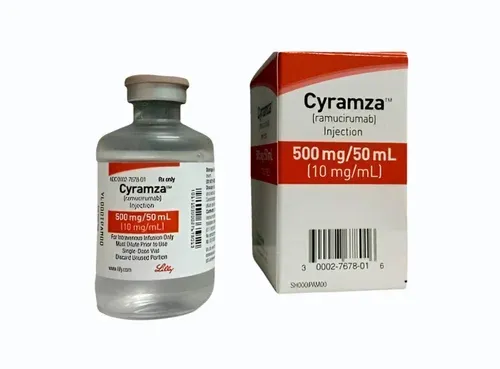
Table of Contents
- Package leaflet: Information for the user
- Introduction
- 1. What Cyramza is and what it is used for
- 2. What you need to know before using Cyramza
- 3. How to use Cyramza
- This cancer treatment will be administered by your doctor or nurse.
- 4. Possible adverse effects
- 5. Conservation of Cyramza
- **Keep this medicine out of the sight and reach of children.**
- 6. Contents of the pack and other information
Package leaflet: Information for the user
Introduction
Package leaflet: information for the patient
Cyramza 10 mg/ml concentrate for solution for infusion
ramucirumab
Read the entire leaflet carefully before you start using this medicine, because it contains important information for you.
-
Keep this leaflet, as you may need to read it again.
-
If you have any questions, ask your doctor.
-
If you experience any adverse reactions, consult your doctor, even if they are adverse reactions not listed in this leaflet. See section 4.
Leaflet contents
-
What Cyramza is and what it is used for
-
What you need to know before receiving Cyramza
-
How to use Cyramza
-
Possible side effects
-
How to store Cyramza
-
Contents of the pack and other information
1. What Cyramza is and what it is used for
Cyramza is a cancer medicine that contains ramucirumab as the active substance, which is a monoclonal antibody. It is a specialised protein that can recognise and bind to another protein found on blood vessels called "VEGFR-2" (Vascular Endothelial Growth Factor Receptor type 2). This receptor is required for the development of new blood vessels. Since cancer needs to develop new blood vessels in order to grow, by binding to and blocking "VEGFR-2", Cyramza disrupts the blood supply to cancer cells.
Cyramza is also used in combination with paclitaxel, another anticancer medicine, for the treatment of advanced gastric cancer (or cancer of the gastroesophageal junction) in adults whose disease has worsened after treatment with anticancer medicines.
Cyramza is used for the treatment of advanced gastric cancer (or cancer of the gastroesophageal junction) in adults whose disease has progressed after prior treatment with anticancer medicines and for whom treatment with Cyramza in combination with paclitaxel is not suitable.
Cyramza is used for the treatment of colorectal cancer (cancer of the colon or rectum, parts of the large intestine) in adults. It is administered in combination with another medicine called "FOLFIRI", which includes "5-fluorouracil", "folinic acid", and "irinotecan".
Cyramza is administered in combination with erlotinib, another anticancer medicine, as first-line therapy for the treatment of adult patients with advanced non-small cell lung cancer whose tumour cells have specific genetic changes (mutations) in the epidermal growth factor receptor (EGFR) gene.
Cyramza is administered in combination with docetaxel, another anticancer medicine, for the treatment of adult patients with advanced non-small cell lung cancer whose disease has progressed after prior treatment with anticancer medicines.
Cyramza is used to treat advanced or surgically unresectable liver cancer in adults who have previously been treated with another anticancer medicine (sorafenib) and who have high levels of a specific protein in the blood (alpha-fetoprotein).
2. What you need to know before using Cyramza
Do not use Cyramza:
- if you are allergic to ramucirumab or to any of the other components of this medicine (listed in section 6).
- if X-rays show signs that the lung cancer has a cavity or hole, or if the lung cancer is attached to major blood vessels.
Warnings and precautions
Talk to your doctor or nurse before starting Cyramza if:
-
you have a condition that increases the risk of bleeding. Also consult your doctor if you are taking other medicines that increase the risk of bleeding or affect blood clotting. In such cases, your doctor will perform regular blood tests to monitor your risk of bleeding.
-
you have liver cancer and have previously had bleeding from varices in your digestive tract (esophagus), or if you have portal hypertension (increased blood pressure in the portal vein that carries blood from the intestines and spleen to the liver).
-
you have lung cancer and have recently experienced lung bleeding (coughing up bright red blood), or if you are continuously taking non-steroidal anti-inflammatory drugs (NSAIDs) or medications that affect blood clotting.
-
you have high blood pressure. Cyramza may increase the risk of high blood pressure. Your doctor will ensure that any pre-existing high blood pressure is under control before starting treatment with Cyramza. During treatment, your doctor will monitor your blood pressure and adjust your antihypertensive medication as needed. Treatment with Cyramza may be temporarily interrupted until high blood pressure is controlled with medication, or permanently discontinued if it cannot be adequately controlled.
-
you have or have had an aneurysm (a bulge and weakening in the wall of a blood vessel) or a tear in the wall of a blood vessel.
-
you are scheduled for surgery, have recently undergone surgery, or your surgical wound is not healing properly. Cyramza may increase the risk of impaired wound healing. You must not receive Cyramza for at least 4 weeks before a planned surgery, and your doctor will decide when to resume treatment. If during treatment you develop a wound that is not healing well, the dose of Cyramza will be interrupted until the wound is fully healed.
-
you have severe liver disease (“cirrhosis”) and associated conditions such as excessive fluid accumulation in the abdomen (“ascites”). Your doctor will assess whether the potential benefits of treatment outweigh the possible risks for you. If you have liver cancer, your doctor will monitor you for signs and symptoms of confusion and/or disorientation associated with chronic liver problems and will discontinue Cyramza treatment if such signs or symptoms develop.
-
you have severe kidney problems. Available data on the use of Cyramza in patients with severe renal impairment are limited.
Contact your doctor or nurse immediately if any of the following apply to you (or if you are unsure) during treatment with Cyramza or at any time thereafter:
- Blockage of arteries by a blood clot (“arterial thromboembolic disease”):
Cyramza may cause blood clots in your arteries. Arterial clots can lead to serious conditions, including heart attack or stroke. Symptoms of a heart attack may include chest pain or tightness. Symptoms of a stroke may include sudden numbness or weakness in the arm, leg, or face, confusion, difficulty speaking or understanding others, sudden difficulty walking, loss of balance or coordination, or sudden dizziness. If you develop an arterial clot, treatment with Cyramza will be permanently discontinued.
-
Perforation in the wall of the intestine (“gastrointestinal perforation”): Cyramza may increase the risk of developing a perforation in the wall of your intestine. Symptoms include severe abdominal pain, vomiting, fever, or chills. If an intestinal perforation occurs, treatment with Cyramza will be permanently discontinued.
-
Severe bleeding: Cyramza may increase the risk of severe bleeding. Symptoms may include: extreme fatigue, weakness, dizziness, or changes in the color of your stools. If you experience severe bleeding, treatment with Cyramza will be permanently discontinued.
-
Infusion-related reactions: reactions related to the infusion may occur during treatment, as Cyramza is administered by intravenous infusion (see section 3). Your doctor or nurse will monitor you for adverse effects during the infusion. Symptoms may include: increased muscle tension, back pain, pain and/or tightness in the chest, chills, flushing, difficulty breathing, wheezing, and tingling or numbness in the hands or feet. In severe cases, symptoms may include difficulty breathing due to narrowing of the airways, rapid pulse, and feeling faint. If you experience a severe infusion-related reaction, treatment with Cyramza will be permanently discontinued.
-
A rare but serious brain condition called "posterior reversible encephalopathy syndrome" or "PRES": Cyramza may increase the risk of developing this brain condition. Symptoms may include seizures, headache, feeling sick (nausea), vomiting, blindness or decreased level of consciousness, with or without high blood pressure. Stop Cyramza treatment if you experience this brain condition.
-
Heart failure: Cyramza, when given in combination with chemotherapy or erlotinib, may increase the risk of heart failure. Symptoms may include weakness and fatigue, swelling, and fluid accumulation in the lungs, which may cause difficulty breathing. Your symptoms will be evaluated and discontinuation of Cyramza treatment may be considered.
-
Abnormal passages inside the body (“fistula”): Cyramza may increase the risk of developing abnormal passages between internal organs and the skin or other tissues. If you develop a fistula, treatment with Cyramza will be permanently discontinued.
-
Abnormal urine test (“proteinuria”): Cyramza may increase the risk of developing or worsening abnormal levels of protein in the urine. Treatment with Cyramza may need to be temporarily interrupted until protein levels in the urine decrease, after which treatment may be resumed at a lower dose, or permanently discontinued if protein levels do not sufficiently decrease.
-
Inflammation of the mouth (“stomatitis”): Cyramza, when administered in combination with chemotherapy, may increase the risk of developing inflammation of the mouth. Symptoms may include a burning sensation in the mouth, ulcers, blisters, or swelling. Your doctor may prescribe treatment to help manage these symptoms.
-
Fever or infection: During treatment, you may develop a temperature of 38°C or higher (due to having fewer than normal white blood cells, which is very common). Symptoms may include sweating or other signs of infection, such as headache, limb pain, or loss of appetite. Infection (sepsis) could be severe and potentially fatal.
-
Elderly patients with lung cancer: Your doctor will carefully consider the most appropriate treatment for you.
Children and adolescents
Cyramza must not be given to patients under 18 years of age due to lack of information on its use in this age group.
Using Cyramza with other medicines
Tell your doctor if you are taking, have recently taken, or might need to take any other medicines. This includes medicines obtained without a prescription and herbal preparations.
Pregnancy, breastfeeding, and fertility
If you are pregnant, breastfeeding, think you might be pregnant, or plan to become pregnant, consult your doctor before using this medicine. You must avoid becoming pregnant while receiving this medicine and for at least 3 months after receiving the last dose of Cyramza. Discuss with your doctor the most appropriate contraceptive method for you.
Since Cyramza inhibits the development of new blood vessels, it may reduce the likelihood of becoming pregnant or maintaining a pregnancy. It may also harm the fetus. You must not use this medicine during pregnancy. If you become pregnant while being treated with Cyramza, your doctor will discuss with you whether the benefits of treatment outweigh any possible risks to you or your baby.
It is not known whether the medicine passes into breast milk and could affect the infant. Therefore, you must not breastfeed during treatment with Cyramza and for at least 3 months after receiving the last dose.
Driving and using machines
The effect of Cyramza on the ability to drive and use machines is negligible or minor. If you experience any symptoms that affect your ability to concentrate or react, do not drive or use machines until the symptoms have resolved.
Cyramza contains sodium
This medicine contains less than 1 mmol of sodium (23 mg) per 10 ml vial; this is essentially “sodium-free”.
This medicine contains approximately 85 mg of sodium (main component of table/cooking salt) per 50 ml vial. This is approximately 4% of the maximum daily recommended sodium intake for an adult.
Cyramza contains polysorbate
This medicine contains approximately 1 mg of polysorbate 80 per 10 ml vial, and 5 mg of polysorbate 80 per 50 ml vial. Polysorbates may cause allergic reactions. Inform your doctor if you have any known allergies.
3. How to use Cyramza
This cancer treatment will be administered by your doctor or nurse.
Dosage and frequency of administration
The appropriate amount of Cyramza needed to treat your condition will be calculated by your doctor or hospital pharmacist based on your body weight.
The recommended dose of Cyramza for the treatment of gastric cancer, advanced colorectal cancer, and liver cancer is 8 mg per kilogram of body weight once every 2 weeks.
The recommended dose of Cyramza for the treatment of lung cancer is 10 mg per kilogram of body weight once every 2 weeks when administered in combination with erlotinib, or once every 3 weeks when administered in combination with docetaxel.
The number of infusions you will receive depends on how you respond to treatment. Your doctor will discuss this with you.
Premedication
You may receive another medication prior to Cyramza infusion to reduce the risk of infusion-related reactions. If you experience an infusion-related reaction during treatment with Cyramza, premedication must be given before all subsequent infusions.
Dose adjustments
Before each infusion, your doctor or nurse will check for any adverse effects.
If you experience an infusion-related reaction during treatment, the duration of the infusion will be extended for that infusion and for all future infusions.
The level of protein in your urine will be monitored regularly during treatment. Cyramza may be temporarily interrupted depending on the level of protein detected. Once urinary protein levels have decreased to certain thresholds, treatment may be resumed at a reduced dose.
Route and method of administration
Cyramza is a concentrate for solution for infusion (also referred to as a "sterile concentrate"). A hospital pharmacist, nurse, or doctor will dilute the contents of the vial in a 9 mg/mL (0.9%) sodium chloride solution before use. This medicine is administered by intravenous infusion over approximately 60 minutes.
Cyramza treatment will be temporarily interrupted if:
- you develop high blood pressure, until it is controlled with antihypertensive medications
- you experience impaired wound healing, until the wound has healed
- you have scheduled surgery, starting 4 weeks prior to the procedure
Cyramza treatment will be permanently discontinued if:
- you develop an arterial thromboembolic event
- you develop a perforation in the wall of the intestine
- you experience severe bleeding
- you experience a severe infusion-related reaction
- you develop high blood pressure that cannot be controlled with medication
- you excrete an increased amount of protein in your urine or develop a serious kidney disease (nephrotic syndrome)
- you develop an abnormal connection within your body between internal organs and the skin or other tissues (fistula)
- you develop confusion and/or disorientation associated with chronic liver problems
- you develop decreased kidney function (in the context of hepatic failure)
When receiving Cyramza in combination with paclitaxel or docetaxel
Paclitaxel and docetaxel are administered by intravenous infusion over approximately 60 minutes. If you receive Cyramza in combination with paclitaxel or docetaxel on the same day, Cyramza will be administered first.
The required dose of paclitaxel or docetaxel depends on your body surface area. Your doctor or hospital pharmacist will calculate your body surface area by measuring your height and weight, and then determine the appropriate dose for you.
The recommended dose of paclitaxel is 80 mg per square meter (m²) of body surface area, administered once weekly for 3 weeks followed by 1 week without treatment.
The recommended dose of docetaxel is 75 mg per square meter (m²) of body surface area once every 3 weeks. If you are of East Asian origin, you may receive a reduced starting dose of docetaxel of 60 mg per m² of body surface area once every 3 weeks.
Before starting any paclitaxel infusion, blood tests will be performed to ensure your blood cell counts are sufficiently high and that your liver is functioning properly.
Please read the package leaflet for paclitaxel or docetaxel for more information.
When receiving Cyramza in combination with FOLFIRI
FOLFIRI chemotherapy is administered by intravenous infusion after completion of the Cyramza infusion. Please read the package leaflet of the other medicines that are part of your treatment regimen to confirm whether they are suitable for you. If you are unsure, consult your doctor, pharmacist, or nurse about any reason why you should not use these medicines.
When receiving Cyramza in combination with erlotinib
Please read the package leaflet for erlotinib for more information about erlotinib and to confirm whether it is suitable for you. If you are unsure, ask your doctor, pharmacist, or nurse whether there is any reason why you should not take erlotinib.
4. Possible adverse effects
Like all medicines, this medicine can cause adverse effects, although not everyone will experience them.
Consult your doctor immediately if you experience any of the following serious adverse effects that have been observed during treatment with Cyramza (see also What you need to know before you start using Cyramza):
Common adverse effects (may affect up to 1 in 10 people):
- perforation in the intestinal wall: Perforation developing in the stomach or intestine. Symptoms include severe abdominal pain, vomiting, fever, or chills.
- severe gastrointestinal bleeding: symptoms may include extreme tiredness, weakness, dizziness, or changes in the color of your stools.
- arterial blood clots: arterial clots may cause a heart attack or stroke. Symptoms of a heart attack may include chest pain or tightness. Symptoms of a stroke may include sudden numbness or weakness in the arm, legs, or face, confusion, difficulty speaking or understanding others, sudden difficulty walking or loss of balance or coordination, or sudden dizziness.
Rare adverse effects (may affect up to 1 in 1,000 people):
- a brain disorder called reversible posterior encephalopathy syndrome: symptoms may include seizures, headache, feeling sick (nausea), vomiting, blindness or decreased level of consciousness, with or without high blood pressure.
Consult your doctor if you experience any of the following adverse effects:
Very common adverse effects (may affect more than 1 in 10 people):
- tiredness or weakness
- low white blood cell count (may increase the risk of infection)
- infections
- diarrhea
- hair loss
- nosebleeds
- inflammation of the lining of the mouth
- high blood pressure
- reduction in the number of red blood cells which may cause paleness of the skin
- swelling of hands, feet, and legs due to fluid retention
- low platelet count (blood cells that help blood to clot)
- abdominal pain
- protein in the urine (abnormal urine test)
- headache
- inflammation of mucous membranes, such as in the digestive and respiratory tracts
Common adverse effects (may affect up to 1 in 10 people):
- fever accompanied by low white blood cell count
- low blood levels of a protein called albumin
- infusion site-related reactions
- rash
- erythema, swelling, numbness/tingling or pain and/or peeling of the skin on the hands and/or feet (called hand-foot syndrome)
- hoarseness
- bleeding in your lungs
- low blood sodium levels (hyponatremia) which may cause tiredness, confusion, or muscle spasms
- bleeding from the gums
- confusion and/or disorientation in patients with chronic liver problems
- intestinal obstruction; symptoms may include constipation and abdominal pain
- underactive thyroid gland which may cause tiredness or weight gain (hypothyroidism)
- abnormal growth of blood vessels
- serious infections (sepsis)
- low blood potassium levels (hypokalemia) which may cause muscle weakness, spasms, or irregular heartbeat
Uncommon adverse effects (may affect up to 1 in 100 people):
- heart condition in which the heart muscle does not pump blood as well as it should, causing difficulty breathing and swelling of the legs and feet
Rare adverse effects (may affect up to 1 in 1,000 people):
- abnormal blood clotting in small blood vessels
Frequency not known (frequency cannot be estimated from the available data):
- enlargement and weakening of the wall of a blood vessel or tear in the wall of a blood vessel (aneurysms and arterial dissections)
Cyramza may cause changes in laboratory tests. These changes may include, among the adverse effects listed above: low white blood cell count, low platelet count, low blood levels of albumin, potassium, or sodium, and presence of protein in the urine.
Reporting of adverse effects
If you experience any adverse effect, talk to your doctor, even if it is a possible adverse effect not listed in this leaflet. You can also report them directly through the national reporting system listed in Appendix V. By reporting adverse effects, you can help provide more information on the safety of this medicine.
5. Conservation of Cyramza
Keep this medicine out of the sight and reach of children.
Do not use this medicine after the expiry date which is stated on the carton and on the vial after EXP. The expiry date refers to the last day of that month.
This medicine does not require any special storage conditions.
After reconstitution and dilution, chemical and physical in-use stability has been demonstrated for 24 hours at 2°C - 8°C and 3 hours at room temperature (including infusion time).
From a microbiological point of view, the product should be used immediately. If not used immediately, in-use storage times and conditions prior to use are the responsibility of the user and would normally not be longer than 24 hours at 2°C - 8°C, unless dilution has taken place in controlled and validated aseptic conditions.
Keep the vial in the outer carton in order to protect from light.
For single use only. Any unused product should be discarded.
Any unused medicinal product and waste material should be disposed of in accordance with local requirements.
Keep this medicine out of the sight and reach of children.
Do not use this medicine after the expiry date stated on the carton and on the label of the vial after EXP. The expiry date refers to the last day of the month indicated.
Store in a refrigerator (between 2°C and 8°C).
Do not freeze.
Keep the vial in the outer packaging to protect it from light.
Do not freeze or shake the infusion solution. Do not administer the solution if you notice any particles or an unusual colour.
Medicines should not be disposed of via wastewater or household waste. Ask your pharmacist how to dispose of medicines and packaging that you no longer need. This will help protect the environment.
6. Contents of the pack and other information
Composition of Cyramza
- The active substance is ramucirumab. One ml of concentrate for solution for infusion contains 10 mg of ramucirumab.
- Each 10 ml vial contains 100 mg of ramucirumab.
- Each 50 ml vial contains 500 mg of ramucirumab.
- The other components are histidine, histidine monohydrochloride, sodium chloride, glycine (E 640), polysorbate 80 (E 433), and water for injections (see section 2 “Cyramza contains sodium” and “Cyramza contains polysorbate”).
Appearance of the product and contents of the pack
The concentrate for solution for infusion (or sterile concentrate) is a transparent to slightly opalescent, colourless to slightly yellow solution supplied in a glass vial with a rubber stopper.
Cyramza is available in packs containing:
-
1 vial of 10 ml
-
2 vials of 10 ml
-
1 vial of 50 ml
Only some pack sizes may be marketed.
Marketing Authorisation Holder
Eli Lilly Nederland B.V.
Papendorpseweg 83
3528 BJ Utrecht
The Netherlands
Manufacturer
Lilly, S.A.
Avda de la Industria, 30
Alcobendas
28108 Madrid
Spain
Lilly France Fegersheim
2 rue du Colonel Lilly
67640 Fegersheim
France
For further information about this medicinal product, please contact the local representative of the Marketing Authorisation Holder:
Belgique/België/BelgienLietuva
Eli Lilly Benelux S.A./N.V. Eli Lilly Lietuva
Tél/Tel: + 32-(0)2 548 84 84 Tel. +370 (5) 2649600
 Luxembourg/Luxemburg
Eli Lilly Benelux S.A./N.V.
Tél/Tel: + 32-(0)2 548 84 84
Ceská republikaMagyarország
ELI LILLY CR, s.r.o. Lilly Hungária Kft.
Tel: + 420 234 664 111 Tel: + 36 1 328 5100
DanmarkMalta
Eli Lilly Danmark A/S Charles de Giorgio Ltd.
Tlf: +45 45 26 60 00 Tel: + 356 25600 500
DeutschlandNederland
Lilly Deutschland GmbH Eli Lilly Nederland B.V.
Tel. + 49-(0) 6172 273 2222 Tel: + 31-(0) 30 60 25 800
EestiNorge
Eli Lilly Nederland B.V. Eli Lilly Norge A.S.
Tel: +372 6 817 280 Tlf: + 47 22 88 18 00
Ελλ?δαÖsterreich
ΦΑΡΜΑΣΕΡΒ-ΛΙΛΛΥ Α.Ε.Β.Ε. Eli Lilly Ges.m.b.H.
Τηλ: +30 210 629 4600 Tel: + 43-(0) 1 711 780
EspañaPolska
Lilly S.A. Eli Lilly Polska Sp. z o.o.
Tel: + 34-91 663 50 00 Tel: +48 22 440 33 00
FrancePortugal
Lilly France Lilly Portugal Produtos Farmacêuticos, Lda
Tél: +33-(0) 1 55 49 34 34 Tel: + 351-21-4126600
HrvatskaRomânia
Eli Lilly Hrvatska d.o.o. Eli Lilly România S.R.L.
Tel: +385 1 2350 999 Tel: + 40 21 4023000
IrelandSlovenija
Eli Lilly and Company (Ireland) Limited Eli Lilly farmacevtska družba, d.o.o.
Tel: + 353-(0) 1 661 4377 Tel: +386 (0)1 580 00 10
ÍslandSlovenská republika
Icepharma hf. Eli Lilly Slovakia s.r.o.
Sími + 354 540 8000 Tel: + 421 220 663 111
ItaliaSuomi/Finland
Eli Lilly Italia S.p.A. Oy Eli Lilly Finland Ab
Tel: + 39- 055 42571 Puh/Tel: + 358-(0) 9 85 45 250
Κ?προςSverige
Phadisco Ltd Eli Lilly Sweden AB
Τηλ: +357 22 715000 Tel: + 46-(0) 8 7378800
LatvijaUnited Kingdom(Northern Ireland)
Eli Lilly (Suisse) S.A Parstavnieciba Latvija Eli Lilly and Company (Ireland) Limited
Tel: +371 67364000 Tel: + 353-(0) 1661 4377
Date of the most recent review of this leaflet:
Other sources of information
Detailed information on this medicinal product is available on the European Medicines Agency website: https://www.ema.europa.eu.
This information is intended for healthcare professionals only:
Do not shake the vial.
Prepare the solution for infusion using aseptic techniques to ensure sterility of the prepared solution.
Each vial is for single use only. Before dilution, inspect the vial contents for the presence of particles or discoloration (the concentrate for solution for infusion should be transparent to slightly opalescent, colourless to slightly yellow, without visible particles). If particles or discoloration are observed, discard the vial.
Calculate the required dose and volume of ramucirumab needed to prepare the infusion solution. The vials contain 100 mg or 500 mg of ramucirumab in a solution at 10 mg/ml. Use only sodium chloride 9 mg/ml (0.9%) solution for injection as diluent.
When using a pre-filled intravenous infusion bag
Depending on the calculated volume of ramucirumab, withdraw the corresponding volume of sodium chloride 9 mg/ml (0.9%) solution for injection from the 250 ml pre-filled intravenous infusion bag.
Aseptically transfer the calculated volume of ramucirumab into the intravenous infusion bag. The final total volume in the bag must be 250 ml. Gently invert the bag to ensure adequate mixing. DO NOT FREEZE OR SHAKE the infusion solution. DO NOT dilute with other solutions or co-infuse with other drugs or electrolytes.
When using an empty intravenous infusion bag
Aseptically transfer the calculated volume of ramucirumab into an empty intravenous infusion bag. Add sufficient sodium chloride 9 mg/ml (0.9%) solution for injection to achieve a total volume of 250 ml. Gently invert the bag to ensure adequate mixing. DO NOT FREEZE OR SHAKE. DO NOT dilute with other solutions or co-infuse with other drugs or electrolytes.
After dilution and preparation, the medicinal product should be used immediately. If not used immediately, the storage time and conditions prior to use are the responsibility of the user and normally should not exceed 24 hours between 2°C and 8°C.
Parenteral medicinal products should be inspected visually for particulate matter before administration. If particles are observed, discard the vial.
Discard any unused portion of ramucirumab remaining in the vial, as the product contains no antimicrobial preservatives.
Administer using an infusion pump. Use a separate infusion line with a low protein-binding 0.22 micron in-line filter for infusion. At the end of the infusion, flush the line with sodium chloride 9 mg/ml (0.9%) solution for injection.
Disposal of unused medicinal product and all materials that have come into contact with it must be carried out in accordance with local regulations.