Coronur 40 mg tablets
Spain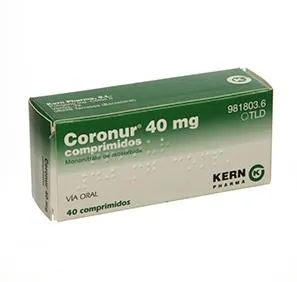
Table of Contents
Package leaflet: Information for the user
Introduction
Package leaflet: Information for the user
Coronur 40mg tablets
Isosorbide mononitrate
Read the entire leaflet carefully before you start taking this medicine, because it contains important information for you.
- Keep this leaflet, as you may need to read it again.
- If you have any questions, ask your doctor or pharmacist.
- This medicine has been prescribed for you and you should not give it to others, even if they have the same symptoms as you, because it could harm them.
- If you experience any adverse effects, consult your doctor or pharmacist, even if they are adverse effects not listed in this leaflet. See section 4.
Leaflet contents:
- What Coronur is and what it is used for
- What you need to know before taking Coronur
- How to take Coronur
- Possible adverse effects
- How to store Coronur
- Contents of the pack and other information
1. What Coronur is and what it is used for
CORONUR contains isosorbide mononitrate as the active substance, which belongs to a group of medicines known as nitrates that have vasodilating properties on the coronary arteries of the heart.
This medicine is indicated for the treatment and prevention of angina pectoris.
2. What you need to know before starting to take Coronur
Do not take Coronur
- if you are allergic (hypersensitive) to isosorbide mononitrate, isosorbide dinitrate, or any of the other components of this medicine,
- in case of shock (a potentially life-threatening condition occurring when the body does not receive enough blood flow, which may damage multiple organs), cardiocirculatory collapse (cessation of blood circulation), very low blood pressure (systolic pressure below 90 mm Hg), or acute myocardial infarction (heart attack),
- if you suffer from severe anemia, cerebral trauma (brain injury), or cerebral hemorrhage,
- if you are taking any medicine containing a 5-phosphodiesterase inhibitor such as sildenafil (a medicine used for penile erectile dysfunction).
Warnings and precautions
Consult your doctor if you have any of the following conditions: obstructive hypertrophic cardiomyopathy (a heart disease characterized by thickening of the heart walls), constrictive pericarditis (inflammation of the sac covering the heart), cardiac tamponade (compression of the heart due to accumulation of blood or fluid), stenosis (narrowing) of the mitral and/or aortic heart valves, orthostatic disturbances in circulatory regulation (dizziness upon standing), or increased intracranial pressure.
This medicine is not suitable for the treatment of sudden angina attacks; your doctor has likely prescribed another medicine for such episodes.
Taking Coronur with other medicines
Inform your doctor or pharmacist if you are taking, have recently taken, or might need to take any other medicines.
Due to the possibility of enhanced hypotensive action (lowering of blood pressure), caution should be exercised when administering this medicine concomitantly with antihypertensive medicines (medicines that reduce high blood pressure, for example: calcium antagonists, beta-blockers, diuretics, Angiotensin Converting Enzyme inhibitors), vasodilators, neuroleptic drugs (medicines for mental disorders), or tricyclic antidepressants (medicines for depression).
Nitrates may produce false negatives (results that should be positive but incorrectly appear negative) in blood cholesterol determination using the Zlatkis-Zak method.
This medicine may increase the hypertensive effect of dihydroergotamine (a medicine used for headache).
Concomitant administration of this medicine with 5-phosphodiesterase inhibitors such as sildenafil (a medicine used for penile erectile dysfunction) may lead to heart complications that could be life-threatening in sensitive individuals.
Taking Coronur with food, drinks, and alcohol
Do not take this medicine with alcohol, as alcohol enhances the vasodilatory effect of isosorbide mononitrate, potentially causing a rapid drop in blood pressure. In addition to hypotension, alcohol may further impair reaction capacity.
The tablets should be taken after meals, without chewing, and with a sufficient amount of liquid (a glass of water).
Pregnancy and breastfeeding
If you are pregnant or breastfeeding, think you might be pregnant, or are planning to become pregnant, consult your doctor or pharmacist before using this medicine.
This medicine should not be taken during pregnancy unless, in the strict judgment of a physician, the benefit justifies the potential risks.
This medicine should not be used during breastfeeding, as it is unknown whether it passes into breast milk.
Children and adolescents
The use of this medicine is not recommended in children, as safety and efficacy have not been established in this population group.
Driving and using machines
Observe your response to the medication, as in some cases your ability to drive or operate machinery may be reduced due to decreased reflexes, especially at the beginning of treatment, when the dose is changed, or if you consume alcohol simultaneously. Therefore, avoid driving or operating potentially dangerous machinery until you know how you tolerate the medicine.
Coronur contains lactose
If your doctor has informed you that you have an intolerance to certain sugars, consult with him before taking this medicine.
3. How to take Coronur
Follow exactly the instructions given by your doctor for administering this medicine. If in doubt, consult your doctor or pharmacist again.
The recommended dose of isosorbide mononitrate is one 40 mg tablet two to three times daily.
The tablets should be taken after meals, without chewing, and with a sufficient amount of liquid (a glass of water).
The tablets are scored and can be easily split into two halves to allow dose adjustment.
In patients not previously treated with nitrates, and to prevent or minimize possible headache, your doctor will recommend starting with a low dose (for example, half a tablet of Coronur 20 mg twice daily), which will then be gradually increased.
If you feel that the effect of this medicine is too strong or too weak, inform your doctor or pharmacist.
During treatment with this medicine, tolerance (reduced effect) may develop. It is recommended to keep the dose as low as possible and to allow the longest possible interval between doses to restore sensitivity (first dose in the morning, last dose in the late afternoon).
It is advisable to take this medicine while sitting down, especially at the beginning of treatment, if you are taking high doses or if you are over 65 years of age.
It is important that treatment with isosorbide mononitrate is started and stopped gradually and never abruptly. Your doctor will advise you on how to gradually increase and reduce the dose.
Your doctor will determine the duration of your treatment with this medicine. Do not stop treatment early, as this could lead to a sudden increase in blood pressure.
If you take more Coronur than you should
If you have taken more isosorbide mononitrate than you should, contact your doctor or pharmacist immediately.
The main symptoms in case of overdose are: headache, decreased blood pressure with dizziness upon standing, tachycardia (increased heart rate), and cyanosis (bluish discoloration of the skin due to inadequate blood oxygenation).
The patient should be kept lying down with legs elevated to correct the drop in blood pressure.
In case of overdose or accidental ingestion, contact your doctor or pharmacist immediately or call the Toxicology Information Service at 91 562 04 20, indicating the medicine and the amount ingested.
If you forget to take Coronur
Do not take a double dose to make up for missed doses.
Take the tablet as soon as you remember on the same day and then continue with your usual dose.
4. Possible adverse effects
Like all medicines, this medicine can cause adverse effects, although not everyone experiences them.
During the period of use of isosorbide mononitrate, the following adverse effects have been observed, the frequency of which could not be established accurately.
In certain cases, especially with high doses or at the beginning of treatment, orthostatic hypotension (dizziness upon standing) may occur. In particularly sensitive patients, hypotension may lead to syncope (fainting), which could be mistaken, due to symptoms, for acute myocardial infarction.
Occasionally, and especially when used for the first time, gastrointestinal disturbances such as nausea and/or vomiting may occur.
In patients with a history of coronary artery disease (narrowing of the arteries supplying the heart), ischemia (temporary or permanent reduction in blood supply) may occur.
In patients with methemoglobin reductase deficiency or abnormal hemoglobin structure, a blood disorder (formation of methemoglobin) may occur, resulting in reduced oxygen content in the blood, which may cause bluish discoloration of the skin and mucous membranes, headache, fatigue, difficulty breathing, and lack of energy.
Rarely, it may cause skin rashes and/or exfoliative dermatitis (skin peeling).
Other adverse effects include: headache, facial flushing or sensation of warmth, dizziness, palpitations, and fatigue. Generally, all these effects, including hypotension, disappear during continued treatment or, at least, upon dose reduction.
Reporting of adverse effects
If you experience any type of adverse effect, consult your doctor or pharmacist, even if it is a possible adverse effect not listed in this leaflet. You may also report them directly via the Spanish Pharmacovigilance System for Human Medicines: www.notificaRAM.es. By reporting adverse effects, you can help provide more information on the safety of this medicine.
5. Storage of Coronur
Keep out of the sight and reach of children.
No special storage conditions are required.
Do not use this medicine after the expiry date stated on the container after "EXP.". The expiry date refers to the last day of the month indicated.
Medicines must not be disposed of via wastewater or household waste. Dispose of unused medicines and their containers at the SIGRE Point located in your pharmacy. If you are unsure, ask your pharmacist how to properly dispose of unused medicines and their packaging. This will help protect the environment.
6. Package contents and other information
Composition of Coronur
-
The active substance in Coronur is isosorbide mononitrate.
-
The other components are: anhydrous lactose, anhydrous colloidal silica and magnesium stearate.
Appearance of the medicine and contents of the pack
Coronur is presented as white, scored tablets.
Coronur is available in packs containing 40 tablets.
Other presentations
Coronur 20 mg tablets
Coronur retard 40 mg prolonged-release coated tablets
Marketing Authorization Holder and Manufacturer
Kern Pharma, S.L.
Venus, 72 - Pol. Ind. Colón II
08228 Terrassa - Barcelona
Spain
Date of the most recent review of this leaflet: March 2008
Detailed and up-to-date information on this medicine is available on the website of the Spanish Agency for Medicines and Health Products (AEMPS) http://www.aemps.gob.es/