Caverject 10 micrograms powder and solvent for solution for injection
Spain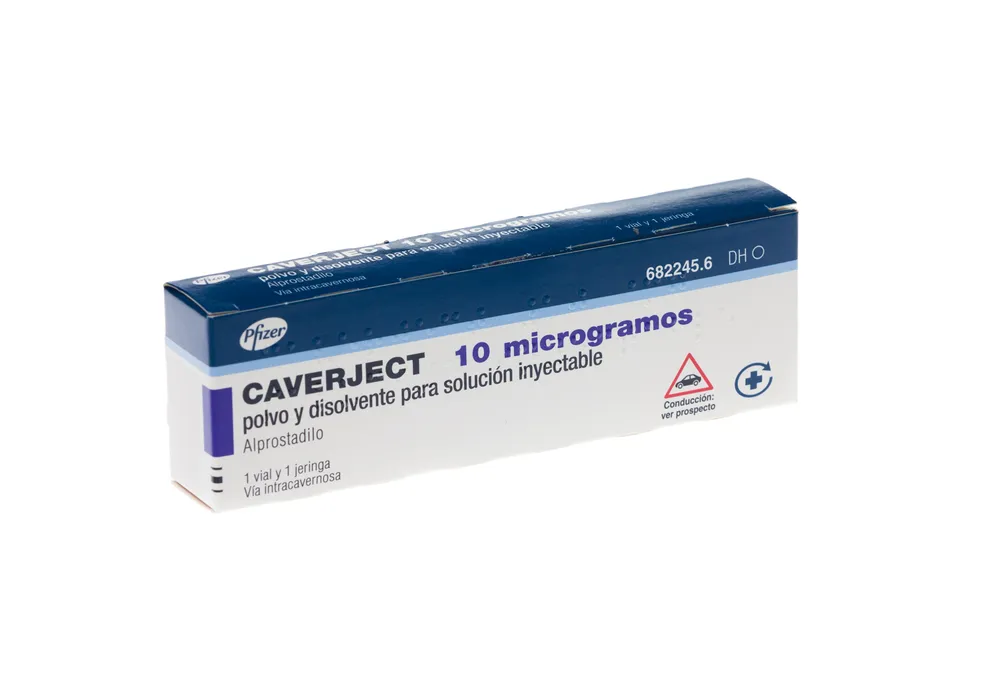
Instructions for Use
Table of Contents
- Introduction
- 1. What Caverject is and what it is used for
- 2. What you need to know before using Caverject
- **Warnings and precautions**
- Consult your doctor, pharmacist, or nurse before starting to use Caverject:
- **Use of Caverject with other medicines**
- 3. How to use Caverject
- *Dilution and Extraction of the Medication*
- *Self-injection*
- **If you use more Caverject than you should**
- 4. Possible adverse effects
- 5. Storage of Caverject
- 6. Contents of the pack and other information
Package leaflet: Information for the user
Introduction
Package leaflet: information for the patient
Caverject 10 micrograms powder and solvent for solution for injection
Caverject 20 micrograms powder and solvent for solution for injection
Alprostadil
Read the entire leaflet carefully before you start using this medicine, because it contains important information for you.
- Keep this leaflet, as you may need to read it again.
- If you have any questions, ask your doctor, pharmacist or nurse.
- This medicine has been prescribed for you only, and you must not pass it on to others, even if they have the same symptoms as you, because it may harm them.
- If you experience any adverse effects, consult your doctor, pharmacist or nurse, even if they are adverse effects not listed in this leaflet. See section 4.
Contents of the leaflet
-
What Caverject is and what it is used for
-
What you need to know before using Caverject
-
How to use Caverject
-
Possible side effects
-
How to store Caverject
-
Contents of the pack and other information
1. What Caverject is and what it is used for
Caverject is a prostaglandin (E1) with vasodilatory action.
Caverject is indicated for the treatment of erectile dysfunction in adult males, including insufficient erections or impotence. Your doctor may also use it, along with other tests, to help determine the exact cause of your erectile dysfunction.
2. What you need to know before using Caverject
Do not use Caverject
- if you are allergic to alprostadil or to any of the other components of this medicine (listed in section 6).
- if you have sickle cell anemia (a disease affecting red blood cells), multiple myeloma (a type of bone marrow cancer involving abnormal proliferation of plasma cells, which are blood cells that produce antibodies to defend against infections and foreign substances), leukemia (a bone marrow disease causing uncontrolled increase of white blood cells), sickle cell trait, sickle cell anemia (an inherited disease in which red blood cells have an abnormal sickle shape), thrombocytopenia (a condition characterized by abnormally low levels of platelets in the blood), polycythemia (a condition characterized by an increased hematocrit, the proportion of red blood cells in the blood), if you are predisposed to venous thrombosis, or any other disease that may favor the occurrence of priapism (prolonged erection).
- if you have an anatomical deformity of the penis, such as angulation, cavernous fibrosis, or Peyronie's disease.
- if you have a penile implant.
- if you suffer from a disease (such as severe heart disease) for which sexual activity is inadvisable or contraindicated.
Warnings and precautions
Consult your doctor, pharmacist, or nurse before starting to use Caverject:
- if you or your partner have a sexually transmitted disease, such as AIDS, herpes, or gonorrhea. Caverject injection may cause minor bleeding at the injection site, which could increase the risk of transmitting these diseases. The use of Caverject does not protect you from sexually transmitted diseases; therefore, you should seek information about necessary measures to prevent transmission of these sexually transmitted infections.
- if you are being treated with anticoagulants such as warfarin or heparin, as bleeding may occur after the injection.
- if priapism (prolonged erection lasting more than six hours) occurs during treatment, which must be reported to your doctor.
- if you have had a stroke or suffer from any heart, blood vessel, or lung disorder.
- if you have one or more cardiovascular risk factors (these may include
arterial hypertension, smoking, elevated blood glucose, elevated blood cholesterol, overweight, and obesity).
- if you have one or more risk factors for stroke (these may
include arterial hypertension, elevated blood cholesterol, coronary artery disease, irregular heartbeat, diabetes).
- if a hard area (plaque) develops in one part of the penis, causing the penis to bend toward the side where the hardened area is located (fibrosis, Peyronie's disease), which must be reported immediately to your doctor.
- if you have a history of psychiatric disorders or addiction.
Children and adolescents
Not applicable.
Use of Caverject with other medicines
Inform your doctor or pharmacist if you are taking, have recently taken, or might need to take any other medicines.
Do not use other medicines for erectile dysfunction at the same time as Caverject.
Certain medicines may interact with Caverject; in such cases it may be necessary to adjust the dose or discontinue treatment with one of them.
It is important that you inform your doctor if you are taking or have recently taken any of the following medicines:
- anticoagulants, such as warfarin or heparin, since you may experience increased bleeding at the injection site.
- antihypertensives, vasodilators, anticoagulants, and platelet aggregation inhibitors, since Caverject could enhance the effects of these medicines.
- sympathomimetics, as these medicines could reduce the effect of Caverject.
Use of Caverject with food, drink, and alcohol
Not applicable.
Pregnancy, breastfeeding, and fertility
Caverject is not intended for use in women.
Driving and use of machines
A decrease in blood pressure and syncope (fainting) have been reported in some patients treated with Caverject. Therefore, while undergoing treatment with this medicine, it is advisable to avoid situations in which injury could occur, including driving or operating dangerous machinery. No significant effect on the ability to drive or operate machines is expected as a direct result of alprostadil administration.
Caverject contains benzyl alcohol and sodium
After reconstitution, this medicine contains 8.4 mg of benzyl alcohol per ml. Benzyl alcohol may cause allergic reactions. Consult your doctor or pharmacist if you have liver or kidney disease, as large amounts of benzyl alcohol may accumulate in the body and cause adverse effects (metabolic acidosis).
This medicine contains less than 23 mg of sodium (1 mmol) per ml, meaning it is essentially "sodium-free."
3. How to use Caverject
Follow exactly the administration instructions for this medicine as given by your doctor. If in doubt, consult your doctor or pharmacist again.
Your doctor or nurse will teach you how to perform the injection. Do not attempt to do it yourself until you have learned the correct way to administer it. If you forget how to do it, consult your doctor again. These instructions are for reminder purposes only.
Each patient requires a different dose of Caverject for the treatment of erectile dysfunction.
Administer an injection of the dose prescribed by your physician (5 to 20 micrograms of alprostadil). If further dose adjustment is needed, you must consult your doctor. The maximum daily dose is 60 micrograms of alprostadil.
The frequency of administration should be no more than once a day and no more than three times per week. Do not use Caverject more often. Each time you use Caverject, change both the side of the penis and the exact injection site.
Caverject (sterile lyophilized powder) is supplied in 5 ml vials. For reconstitution, use the solvent provided in the accompanying syringe.
After reconstitution by adding 1 ml of solvent, the resulting solution contains 10 micrograms or 20 micrograms of alprostadil per ml. (See Storage of Caverject.)
Reconstituted alprostadil solutions are for single use only. The syringe and any remaining solution must be properly discarded.
An erection typically occurs between 5 and 15 minutes after injection. The duration of the erection depends on the dose administered. The selected dose should provide you with an erection sufficient for satisfactory sexual intercourse, lasting no more than 60 minutes. If the erection lasts longer than 60 minutes, a dose reduction will be necessary. Consult your doctor if you experience any prolonged erection lasting four hours or more.
The patient should visit the doctor every three months for follow-up of self-administration therapy. The reconstituted vial, syringe, and needles are intended for single use only and must be discarded after use.
Instructions for proper administration:
Dilution and Extraction of the Medication
- Wash your hands with water and soap.
- Remove the plastic cap from the vial.
- Clean the rubber stopper of the vial using one of the alcohol-impregnated wipes provided (the other will be needed later).
- Remove the protective covering from the larger needle (labeled 22G1½), keeping the plastic sheath in place. Twist the upper part of the white tamper-evident seal to break it. Attach the needle to the syringe by screwing it onto the neck of the syringe.
- Insert the needle through the center of the rubber stopper of the vial and inject all of the solvent into the vial.
- Carefully handle the syringe and vial as a single unit; gently agitate until the powder is completely dissolved.
- To withdraw the medication, invert the vial with the syringe still inserted. Slowly pull back the syringe plunger until the solution reaches the level recommended by your doctor.
- Tap the syringe to remove any possible air bubbles, or alternatively, re-inject the solution into the vial and withdraw it slowly again.
- Remove the syringe and needle from the vial.
- Replace the needle with the smaller one (labeled 30G½) for self-injection.
Self-injection
- Undress and get comfortable. If your doctor has recommended using alcohol wipes, open one.
- Make sure the needle is not bent. If it is bent, do not use it and discard it. Do not attempt to straighten it.
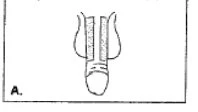
- The solution will be injected into either of the two areas of the penis called the corpora cavernosa. As shown in Diagram A, the corpora cavernosa run along the shaft (diaphysis) of the penis, one on each side.
Each time you use Caverject, alternate the injection sites: choose one side for this injection and the other side for the next. Within each site, the injection point should also be changed every time.
Hold the penis by placing your index and middle fingers underneath, near the testicles, and your thumb on top. Gently squeeze the penis between your thumb and fingers so that the injection site protrudes. If you have a foreskin, make sure it is retracted.

- Using the alcohol wipe, clean the skin in that area and allow it to dry completely.
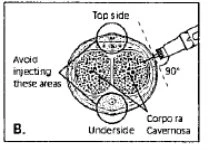
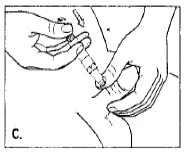
- While firmly holding the penis with one hand and holding the syringe with the other, insert the needle into the protruding area, piercing the skin with a steady motion. Avoid visible veins and other blood vessels. Diagrams B and C show the correct 90º angle. Firmly push the plunger. If the solution does not pass easily, gently move the needle and try again. Do not force the Caverject liquid through the needle.


- Remove the needle. Gently press the alcohol wipe with your thumb against the injection site for 3 minutes. If bleeding occurs, maintain pressure until it stops. Massage the penis to help distribute the alprostadil.
- Do not save any remaining solution in the cartridge for a second injection. After completing the injection, carefully dispose of the needle as instructed by your doctor, ensuring that no one else can see it, use it, or accidentally get pricked by it.
If you feel that the effect of Caverject is too strong or too weak, inform your doctor or pharmacist.
If you use more Caverject than you should
If you have used more Caverject than you should and experience an erection lasting longer than four hours, rapid breathing, weakness, dizziness, depression, loose stools or diarrhea, contact your doctor or pharmacist immediately, as you may require treatment.
In case of overdose or accidental administration, contact the Toxicology Information Service, Telephone 91 562 04 20, indicating the medication and the amount administered.
If you have any further questions about the use of this medicine, consult your doctor, pharmacist, or nurse.
4. Possible adverse effects
Like all medicines, this medicine can cause adverse effects, although not everyone experiences them.
The following adverse effects have been reported with the approximate frequencies indicated below:
Very common (may affect more than 1 in 10 people)
Common (may affect up to 1 in 10 people)
Uncommon (may affect up to 1 in 100 people)
Rare (may affect up to 1 in 1,000 people)
Frequency not known (cannot be estimated from available data)
Very common (may affect more than 1 in 10 people):
- pain in the penis.
Common (may affect up to 1 in 10 people):
- bruising (hematoma).
- erythema (redness of the skin).
- cramps.
- penile scarring and curvature (fibrosis, angulation, fibrous nodules, and Peyronie’s disease), penile disorder, prolonged erection; in most cases, this resolved spontaneously.
- red discoloration at the injection site due to blood leakage into surrounding tissues (ecchymosis), hematoma at the injection site, which have been related more to the injection technique than to the effect of Caverject.
Uncommon (may affect up to 1 in 100 people):
- fungal infection, symptoms of the common cold.
- sensation of lightheadedness without loss of consciousness (presyncope), reduced sense of touch (hypoesthesia), exaggerated sensation to touch (hyperesthesia).
- sensitivity of the eyes to bright light (photophobia).
- a disturbance in heart rhythm known as supraventricular extrasystole, increased heart rate.
- hypotension (including symptomatic hypotension), increased diameter of blood vessels (vasodilation), circulatory disturbances (peripheral vascular disorders), venous disorders.
- nausea, dry mouth.
- rash, increased sweating, itching.
- if Caverject is accidentally injected into the urethra (the tube through which urine exits the penis), blood may appear in the urine or at the tip of the penis.
- increased frequency of urination, even with urgency and pain, difficulties in urination.
- prolonged erection lasting more than six hours (priapism), pelvic pain, swelling felt in the scrotum (spermatocele), testicular disorders (pain, fluid accumulation, swelling), scrotal disorders (pain, fluid accumulation), redness of the scrotum, painful erection, inflammation of the glans (balanitis), phimosis, repeated inability to achieve or maintain an erection firm enough for satisfactory sexual intercourse (erectile dysfunction), abnormal ejaculation.
- bleeding, hemorrhage at injection site, swelling, inflammation at injection site, sensation of warmth at injection site, fluid accumulation (edema) at injection site, swelling at injection site, pain at injection site, irritation at injection site, generalized weakness (asthenia), loss of sensation at injection site (anesthesia), fluid accumulation (edema), venous fluid accumulation, itching at injection site.
- increased blood creatinine levels.
Frequency not known (cannot be estimated from available data):
- Headache
- Increased blood pressure (hypertension)
- Back pain
- Localized pain (buttocks, legs, genitals), weakness in the buttocks.
- Inadequate blood flow to the heart muscle through the coronary arteries
- Stroke
If an erection lasts longer than 4 hours, contact your prescribing doctor immediately. If you cannot reach your doctor, go to the nearest hospital emergency department.
Reporting of adverse effects
If you experience any type of adverse effect, consult your doctor, pharmacist, or nurse, even if it is a possible adverse effect not listed in this leaflet. You may also report them directly via the Spanish Pharmacovigilance System for Human Medicines: https://www.notificaram.es. By reporting adverse effects, you can help provide more information on the safety of this medicine.
5. Storage of Caverject
Keep this medicine out of the sight and reach of children.
This medicine does not require any special storage conditions.
Do not use Caverject after the expiry date stated on the packaging after EXP. The expiry date refers to the last day of the month indicated.
The reconstituted solution must be used immediately. Do not use the resulting solution if it is cloudy, discolored, or contains particles.
Medicines should not be disposed of via wastewater or household waste. Dispose of unused containers and medicines at the SIGRE collection point at your pharmacy. If you are unsure, ask your pharmacist how to properly dispose of unused containers and medicines. This will help protect the environment.
6. Contents of the pack and other information
Composition of Caverject
- The active substance is alprostadil.
- The other components are:
In the lyophilisate: lactose monohydrate, alpha-cyclodextrin (Alfadex), sodium citrate dihydrate, sodium hydroxide (for pH adjustment), hydrochloric acid (for pH adjustment).
In the solvent: water for injectable preparations in solution with benzyl alcohol (E1519) at 0.9%.
Appearance of the product and contents of the pack
Caverject 10 micrograms powder and solvent for injectable solution is supplied in a single presentation consisting of one 5 ml vial containing 10 micrograms of sterile lyophilized powder and a pre-filled syringe with a capacity of 2.5 ml containing 1 ml of solvent.
Caverject 20 micrograms powder and solvent for injectable solution is supplied in a single presentation consisting of one 5 ml vial containing 20 micrograms of sterile lyophilized powder and a pre-filled syringe with a capacity of 2.5 ml containing 1 ml of solvent.
In both cases, the pack also contains the following materials:
- One 30G gauge needle, 1/2 inch length (used for drug injection).
- One 22G gauge needle, 1 1/2 inch length (used for drug reconstitution).
- 2 alcohol-impregnated wipes.
Marketing Authorization Holder and Manufacturer
- Marketing Authorization Holder:
Pfizer, S.L.
Avda. de Europa 20-B
Parque Empresarial La Moraleja
28108 Alcobendas (Madrid)
SPAIN
- Manufacturer:
Pfizer Manufacturing Belgium NV
Rijksweg 12
2870 Puurs-Sint-Amands
Belgium
Date of the most recent review of this leaflet: June 2021
Detailed and up-to-date information on this medicine is available on the website of the Spanish Agency of Medicines and Health Products (AEMPS) http://www.aemps.gob.es/.
Similar Medications
-
Caverject 20 micrograms powder and solvent for solution for injection
Form: powder and solvent for solution for injection
Active substance Dosage ALPROSTADIL 20 µg Manufacturer: Pfizer S.L.
This page has been machine-translated and may contain inaccuracies. The original data is available in the manufacturing country's language.
Last data check: May 18, 2026 · Data source: CIMA — AEMPS