Casenlax 10 g oral solution in sachet
Spain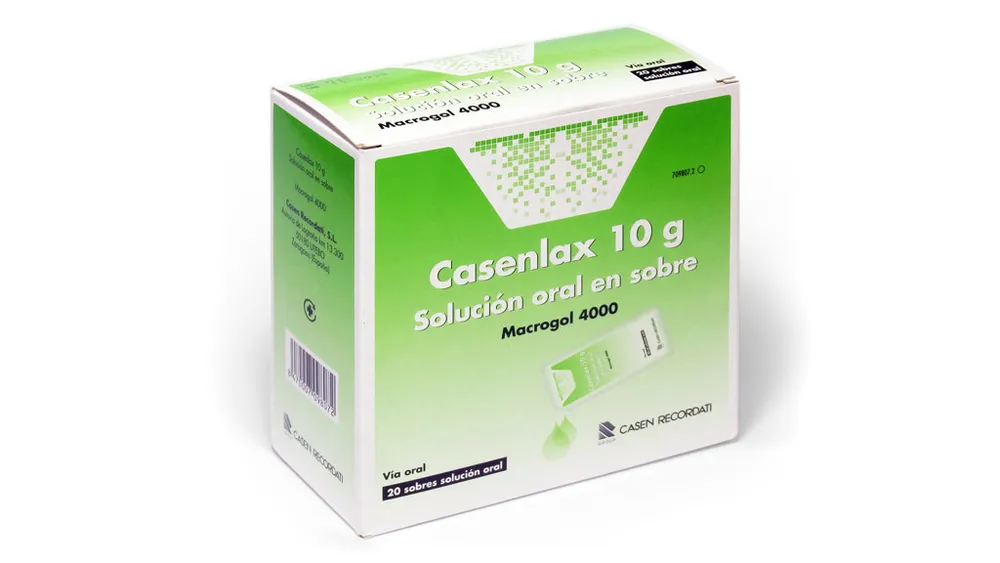
Table of Contents
Package leaflet: Information for the user
Introduction
PACKAGE LEAFLET: INFORMATION FOR THE USER
Casenlax 10g oral solution in sachet
Macrogol 4000
Read all of this leaflet carefully before you start taking this medicine, because it contains important information for you.
- Keep this leaflet. You may need to read it again.
- If you have any questions, ask your doctor, pharmacist or nurse.
- This medicine has been prescribed for you only, and you should not give it to others, even if they have the same symptoms as you, because it could harm them.
- If you experience any adverse effects, consult your doctor, pharmacist or nurse, even if they are adverse effects not listed in this leaflet. See section 4.
Contents of this leaflet:
- What Casenlax is and what it is used for
- What you need to know before taking Casenlax
- How to take Casenlax
- Possible side effects
- How to store Casenlax
- Contents of the pack and other information
1. What Casenlax is and what it is used for
The name of this medicine is Casenlax 10g oral solution in sachet.
Casenlax is considered an osmotic laxative.
Casenlax is used for the symptomatic treatment of constipation in adults and children over 8 years of age. It should be used together with appropriate lifestyle changes and a suitable diet (see section 2).
You should consult your doctor if your condition worsens or does not improve.
This medicine contains Macrogol (PEG = Polyethylene glycol).
In the case of constipation, the maximum treatment period in children is 3 months.
2. What you need to know before starting to take Casenlax
Occasional constipation:
Occasional constipation may be related to a recent change in lifestyle. There are medications that can be used for short-term treatment. Consult your doctor if you have recently developed constipation not due to changes in your lifestyle, or if constipation is associated with pain, fever, or abdominal swelling.
Chronic constipation (long-term constipation):
Chronic constipation may be caused by:
• Intestinal disease requiring medical consultation.
• Intestinal dysfunction (imbalance) due to dietary habits and lifestyle.
Treatment includes, among others:
• Increasing the proportion of fiber in the diet (vegetables, wholemeal bread, fruit).
- Increased fluid and fruit juice intake.
- Increased physical activity (exercise, walking, etc.).
• Rehabilitation of the defecation reflex.
Do not take Casenlax:
- If you are allergic to Macrogol (PEG = polyethylene glycol) or to any of the other components of this medicine (listed in section 6).
- If you have a disease affecting the intestine or colon (such as ulcerative colitis, Crohn's disease).
- If you have abdominal pain of unknown cause.
- If you have or suspect you may have gastrointestinal perforation.
- If you have or suspect you may have intestinal obstruction.
Warnings and precautions
Consult your doctor, pharmacist, or nurse before starting to take Casenlax.
If diarrhea occurs after treatment with Casenlax, you may be at risk of developing electrolyte disturbances (reduction in certain blood salts). This risk is higher if you are elderly, have liver or kidney problems, or are taking diuretics (medications that increase fluid elimination). If you belong to any of these groups and experience diarrhea, you should visit your doctor to check your electrolyte levels with a blood test.
Avoid mixing Casenlax with starch-based thickeners if you have swallowing difficulties. This may result in an aqueous liquid that could enter your lungs and cause pneumonia if you are unable to swallow properly.
If you need to thicken liquids to swallow safely, Casenlax may counteract the thickener's effect.
Children
Ask your doctor before giving this treatment to your child, to rule out constipation caused by an organic problem. After 3 months of treatment, your doctor should evaluate your child's clinical condition.
Use of Casenlax with other medicines
Casenlax may delay the absorption of other medicines, making them less effective or ineffective, especially those with a narrow therapeutic index (e.g., antiepileptics, digoxin, and immunosuppressive agents). Inform your doctor or pharmacist if you are taking, have recently taken, or might need to take any other medicine.
Pregnancy and breastfeeding
If you are pregnant or breastfeeding, think you might be pregnant, or plan to become pregnant, consult your doctor or pharmacist before using this medicine.
Pregnancy
Casenlax may be taken during pregnancy.
Breastfeeding
Casenlax may be taken during breastfeeding.
Driving and use of machines
Casenlax has no influence on the ability to drive or operate machinery.
Casenlax contains a negligible amount of sugar or polyols, and therefore can be prescribed to diabetic patients or patients on a galactose-free diet.
Casenlax contains sodium benzoate
This medicine contains 4 mg of sodium benzoate E 211 per sachet.
Casenlax contains sodium
This medicine contains less than 1 mmol of sodium (23 mg) per sachet; therefore, it is essentially “sodium-free”.
3. How to take Casenlax
Follow exactly the instructions for use of this medicine as given by your doctor or pharmacist. If in doubt, consult your doctor or pharmacist again.
Oral use.
The recommended dose is: 1 or 2 sachets per day, preferably taken as a single dose in the morning. It is recommended to drink 125 ml of liquid (e.g. water) after each dose.
1 sachet contains 20 ml of oral solution and 10 g of macrogol 4000.
The daily dose should be adjusted according to the clinical effects achieved, and may range from one sachet every two days (especially in children) up to a maximum of 2 sachets per day.
The effect of Casenlax occurs 24–48 hours after administration.
Improvement in intestinal transit after administration of Casenlax will be maintained by following a healthy lifestyle and diet.
Use in children and adolescents
In children, treatment should not exceed 3 months due to lack of clinical trial data for treatment periods longer than 3 months.
Treatment should be discontinued gradually and restarted if constipation recurs.
If you take more Casenlax than you should
You may develop diarrhea, abdominal pain, and vomiting, which disappear when treatment is temporarily interrupted or the dose is reduced.
If you experience severe diarrhea or vomiting, you should contact your doctor as soon as possible, as fluid loss may require treatment to prevent loss of salts (electrolytes).
In case of overdose or accidental ingestion, contact your doctor or pharmacist immediately or call the Toxicology Information Service, telephone: 91 562 04 20 (indicating the medicine and the amount ingested).
If you forget to take Casenlax
Do not take a double dose to make up for missed doses.
4. Possible adverse effects
Like all medicines, this medicine can cause adverse effects, although not everyone will experience them.
The most serious adverse effects are allergic reactions (hypersensitivity), including pruritus (rash), rash, facial edema (swelling of the face), angioedema (rapid swelling of the skin's inner layers), urticaria, and anaphylactic shock. The frequency of these adverse effects has been reported as very rare (may affect up to 1 in 10,000 people) in the adult population and as not known (cannot be estimated from available data) in the pediatric population. If you experience any of the reactions described above, please stop taking this medicine immediately and contact your doctor without delay.
Adults
Generally, adverse effects are mild and transient and mainly affect the gastrointestinal system. These adverse effects include:
Frequent (may affect up to 1 in 10 people)
- Abdominal pain.
- Abdominal distension.
- Diarrhea.
- Nausea.
Uncommon (may affect up to 1 in 100 people)
- Vomiting.
- Urgent need to defecate.
- Fecal incontinence.
Frequency not known (cannot be estimated from available data)
- Electrolyte disturbances (low levels of sodium and potassium in blood: hyponatremia and hypokalemia).
- Dehydration caused by severe diarrhea, especially in elderly patients.
- Erythema.
Children and adolescents
As in the adult population, adverse effects are generally mild and transient and mainly affect the gastrointestinal system. These adverse effects include:
Frequent (may affect up to 1 in 10 people)
- Abdominal pain.
- Diarrhea (may cause perianal pain).
Uncommon (may affect up to 1 in 100 people)
- Vomiting.
- Bloating.
- Nausea.
Excessive doses may cause diarrhea, abdominal pain, and vomiting, which usually resolve when the dose is reduced or treatment is temporarily discontinued.
Reporting of adverse effects
If you experience any adverse effect, talk to your doctor, pharmacist, or nurse, even if it is a possible adverse effect not listed in this leaflet. You can also report them directly via the Spanish Pharmacovigilance System for Human Medicinal Products (www.notificaRAM.es). By reporting adverse effects, you can help provide more information on the safety of this medicine.
5. Storage of Casenlax
Keep this medicine out of the sight and reach of children.
This medicine does not require special storage conditions.
Do not use this medicine after the expiry date stated on the packaging after EXP. The expiry date is the last day of the month indicated.
Do not use this medicine if you notice any visible signs of deterioration.
Medicines must not be disposed of via wastewater or household waste. Dispose of unused medicines and their containers at the SIGRE point in your pharmacy. If you have any doubts, ask your pharmacist how to dispose of medicines and their containers properly. This will help protect the environment.
6. Contents of the pack and other information
Composition of Casenlax
The active substance is: Macrogol 4000.
Each sachet contains 10 g of macrogol 4000.
The other components (excipients) are: Sodium benzoate (E 211), potassium sorbate, citric acid, sodium citrate, sucralose, and purified water.
Nature of the product and contents of the pack
Casenlax is a clear, colourless solution, odourless and tasteless.
It is available in packs of 10, 20, 30, 50 or 100 sachets.
Only certain pack sizes may be marketed.
Marketing Authorization Holder and Manufacturer
Casen Recordati, S.L.,
Autovía de Logroño, km 13.300
50180 UTEBO. Zaragoza (Spain)
This medicinal product is authorized in the European Economic Area member states under the following names:
Spain, Italy, Portugal: Casenlax
Date of the most recent review of this leaflet: 02/2026
Other sources of information
Detailed and up-to-date information on this medicinal product is available on the website of the Spanish Agency of Medicines and Health Products (AEMPS) http://www.aemps.gob.es/