Carbocal D 600 mg/400 IU chewable tablets orange flavour
Spain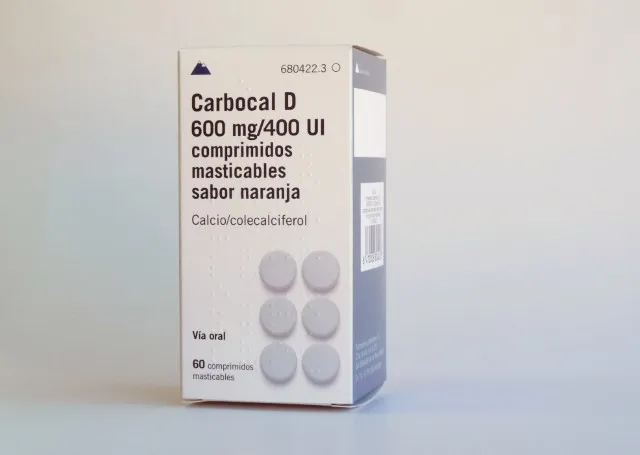
Table of Contents
Package leaflet: Information for the user
Introduction
Package leaflet: information for the user
CARBOCAL D 600 mg/400 IU chewable tablets, orange flavour
Calcium / colecalciferol
Read the entire leaflet carefully before you start taking this medicine.
- Keep this leaflet, as you may need to read it again.
- If you have any questions, ask your doctor or pharmacist.
- This medicine has been prescribed for you only and must not be given to other people, even if they have the same symptoms, as it may harm them.
- If you consider any of the side effects you experience to be severe, or if you notice any side effects not listed in this leaflet, inform your doctor or pharmacist.
Contents of the leaflet:
- What Carbocal D is and what it is used for.
- Before you take Carbocal D.
- How to take Carbocal D.
- Possible side effects.
- How to store Carbocal D.
- Further information.
1. What Carbocal D is and what it is used for
This medicine contains two active substances: calcium and vitamin D3. Calcium is an important component of bones, and vitamin D3 helps the absorption of calcium in the intestine and its deposition in bones.
It is indicated for:
- Correction of vitamin D and calcium deficiencies in the elderly.
- In combination with osteoporosis treatments, when calcium and vitamin D levels are too low, or there is a high risk of being too low.
2. Before taking Carbocal D
Do not take Carbocal D
- If you are allergic (hypersensitive) to calcium, vitamin D, or any of the other ingredients of Carbocal D (particularly soybean or peanut oil) (see section 6).
- If you have abnormally high levels of calcium in your blood (hypercalcemia) and/or excessive loss of calcium in the urine (hypercalciuria)
- If you have any condition that may lead to hypercalcemia and/or hypercalciuria (e.g. overactive parathyroid glands, a bone marrow disorder (myeloma), or malignant bone tumour (bone metastases))
- If you have renal failure
- If you have kidney stones (calcific lithiasis) or calcium deposits in your kidneys (nephrocalcinosis)
- If you have excessive intake of vitamin D (hypervitaminosis D)
Take special care with Carbocal D
During prolonged treatment with Carbocal D, the calcium level in your blood (calcemia) should be monitored regularly. This monitoring is particularly important in elderly patients and when treatment is administered simultaneously with cardiac glycosides (e.g. digoxin) or diuretics. Depending on the results, your doctor will decide whether to reduce or discontinue treatment.
Before taking Carbocal D, consult your doctor or pharmacist:
- If you have previously had kidney stones.
- If you suffer from an immune disorder (sarcoidosis), as calcium levels in blood and urine should be monitored.
- If you are immobile and have reduced bone mass (osteoporosis). This may excessively increase calcium levels in the blood, which could cause adverse effects.
- If you are taking other medicines containing vitamin D3 or calcium. This may excessively increase calcium levels in the blood, which could cause adverse effects.
Use of other medicines
Inform your doctor or pharmacist if you are using or have recently used any other medicines, including those obtained without a prescription.
In particular:
- Thiazide diuretics (medicines used to treat high blood pressure), as they may increase calcium levels in the blood,
- Oral steroids, as they may reduce calcium levels in the blood,
- Orlistat (a medicine used to treat obesity), cholestyramine, or laxatives such as mineral oil, as they may reduce the absorption of vitamin D3,
- Phenytoin (a medicine for epilepsy) and barbiturates (medicines that help sleep), as they may reduce the effectiveness of vitamin D3,
- Cardiac glycosides (medicines used to treat heart problems), as adverse effects may be increased if too much calcium is taken,
- Tetracycline antibiotics, as their absorption may be reduced. In this case, it is recommended to take them at least 2 hours before, or 4–6 hours after taking Carbocal D,
- Estramustine (a medicine used in chemotherapy), thyroid hormones, or medicines containing iron, zinc, or strontium, as their absorption may be reduced. These should be administered at least 2 hours before or after Carbocal D,
- Bisphosphonates (a treatment for certain bone conditions), fluoride, or fluoroquinolones (a type of antibiotic), as their absorption may be reduced. These medicines should be taken at least 3 hours before or after Carbocal D,
- Other medicines containing calcium or vitamin D while taking Carbocal D. This may excessively increase calcium levels in the blood.
Taking Carbocal D with food and drink
During the two hours before taking Carbocal D, you should avoid eating foods containing oxalates (e.g. spinach and rhubarb) or phytic acid (e.g. whole-grain cereals), as they may reduce calcium absorption.
Pregnancy and breastfeeding
Consult your doctor or pharmacist before using any medicine.
This medicine may be used during pregnancy; however, the daily intake of calcium should not exceed 1500 mg and the daily intake of vitamin D should not exceed 600 IU. Therefore, during pregnancy, the daily dose of Carbocal D should not exceed one tablet per day. Higher amounts may have negative effects on the baby.
During breastfeeding, you may take Carbocal D. Since calcium and vitamin D3 pass into breast milk, you must consult your doctor first if your child is receiving any other product containing vitamin D3.
Driving and using machines
No effects on the ability to drive or use machines are known.
Important information about some of the ingredients of Carbocal D
This medicine contains sorbitol. If your doctor has informed you of an intolerance to certain sugars, consult him before taking/using this medicine.
This medicine may be harmful to people with phenylketonuria because it contains aspartame, a source of phenylalanine.
This medicine contains sucrose. If your doctor has informed you of an intolerance to certain sugars, consult him before taking this medicine.
Carbocal D also contains partially hydrogenated soybean oil. It should not be used if you are allergic to peanuts or soy.
3. How to take Carbocal D
Follow exactly the administration instructions for Carbocal D given by your doctor. Consult your doctor if you have any doubts.
The usual dose is 1 tablet twice daily for adults and elderly patients (e.g., one tablet in the morning and one tablet in the evening). Pregnant women should take only one tablet per day.
Chew the Carbocal D tablets and then, if desired, drink a little water.
If you take more Carbocal D than you should
If you take more Carbocal D than you should and experience any symptoms of overdose, stop taking Carbocal D and contact your doctor immediately.
Symptoms of overdose may include: anorexia, excessive thirst, nausea, vomiting, constipation, abdominal pain, muscle weakness, fatigue, mental health problems, increased urine production, bone pain, kidney stones.
In the case of prolonged overdose, calcium deposits may appear in blood vessels or other body tissues.
In the case of severe overdose, cardiac arrest could occur.
In case of overdose or accidental ingestion, call the Toxicology Information Service at telephone number: 91 562 04 20, indicating the medication and the amount ingested.
If you forget to take Carbocal D
Do not take a double dose to make up for missed doses.
If you have any further questions about the use of this product, ask your doctor or pharmacist.
4. Possible adverse effects
Like all medicines, Carbocal D may produce adverse effects, although not everyone experiences them.
Uncommon adverse effects (affects 1 to 10 patients in 1000): elevated levels of calcium in blood or urine.
Rare adverse effects (affects 1 to 10 patients in 10,000): constipation, flatulence, nausea, abdominal pain, diarrhoea, itching, rash, and urticaria.
If you consider any of the adverse effects you experience to be severe, or if you notice any adverse effects not listed in this leaflet, inform your doctor or pharmacist.
5. Storage of Carbocal D
Keep this medicine out of the sight and reach of children.
Do not store above 30°C.
Keep the bottle tightly closed to protect it from moisture.
Do not use this medicine after the expiry date stated on the carton and on the bottle after EXP. The expiry date refers to the last day of the month indicated.
Medicines must not be disposed of via wastewater or household waste. Dispose of containers and unused medicines at the SIGRE collection point at your pharmacy. If in doubt, ask your pharmacist how to dispose of containers and medicines you no longer need. This will help protect the environment.
6. Additional information
Composition of Carbocal D
- The active substances are calcium carbonate and colecalciferol (vitamin D3).
Each tablet contains 1500 mg of calcium carbonate (equivalent to 600 mg of calcium) and 400 IU of colecalciferol (equivalent to 10 micrograms of vitamin D3).
- The other components (excipients) are: Dl-alpha-tocopherol, partially hydrogenated soybean oil, gelatin, sucrose, corn starch, pregelatinized corn starch, polysorbate 80, sorbitol, orange flavor (natural flavoring preparations, flavoring substances, maltodextrin, and E-307), sodium croscarmellose, aspartame, magnesium stearate and xylitol.
Appearance of the product and contents of the pack
Carbocal D is available as white, orange-flavored chewable tablets.
Each pack contains 60 chewable tablets.
Marketing Authorization Holder and Manufacturer
The Marketing Authorization Holder is: Farmasierra Laboratorios S.L.
Ctra. de Irún 26,200
San Sebastián de los Reyes 28709
Madrid, Spain
The Manufacturer is:
Farmasierra Manufacturing S.L.
Carretera de Irún km 26,200
San Sebastián de los Reyes
28709 – Madrid – Spain
This leaflet was approved in May 2011.
Detailed and up-to-date information on this medicine is available on the website of the Spanish Agency of Medicines and Health Products (AEMPS): http://www.aemps.es/