Budena 64 micrograms nasal spray suspension
Spain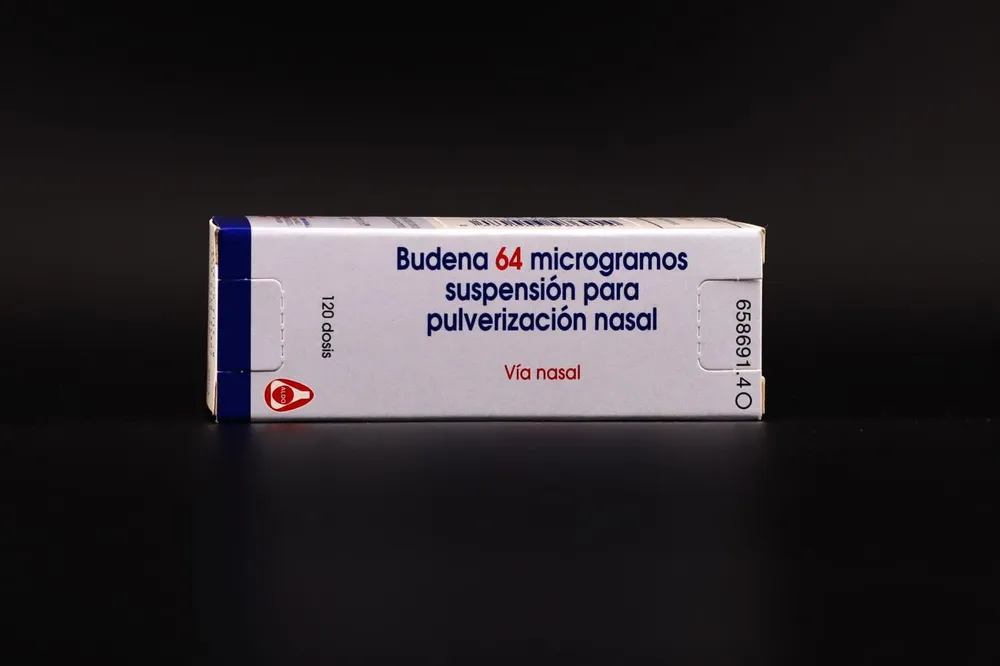
Table of Contents
- Patient Information Leaflet
- Introduction
- **Budena 64 micrograms nasal spray suspension**
- 1. What Budena 64 micrograms is and what it is used for
- 2. What you need to know before using Budena 64 micrograms.
- 3. How to use Budena 64 micrograms.
- 4. Possible adverse effects
- 5. Storage of Budena 64 micrograms
- 6. Contents of the pack and other information.
Patient Information Leaflet
Introduction
Patient Information Leaflet
Budena 64 micrograms nasal spray suspension
Budesonide
Read the entire leaflet carefully before you start using this medicine, as it contains important information for you.
- Keep this leaflet, as you may need to read it again. If you have any questions, consult your doctor or pharmacist.
- This medicine has been prescribed only for you; do not give it to other people, even if they have the same symptoms as you, as it may harm them.
- If you experience any adverse effects, consult your doctor or pharmacist, even if such effects are not listed in this leaflet. See section 4.
Leaflet contents
- What Budena 64 micrograms is and what it is used for
- What you need to know before using Budena 64 micrograms
- How to use Budena 64 micrograms
- Possible side effects
- How to store Budena 64 micrograms
- Contents of the pack and other information
1. What Budena 64 micrograms is and what it is used for
Budena 64 micrograms contains the active substance budesonide, which belongs to a group of medicines called glucocorticoids and is used to reduce inflammation of the nasal mucosa (the inside lining of the nose).
Budena 64 micrograms is used for the treatment of symptoms of seasonal allergic rhinitis ("hay fever"), as well as perennial (year-round) allergic and non-allergic rhinitis, in both adults and children aged 6 years and older.
Budena 64 micrograms may also be used in adult patients to treat symptoms of nasal polyps and/or to prevent the recurrence of new nasal polyps after surgical removal.
2. What you need to know before using Budena 64 micrograms.
Do not use Budena 64 micrograms:
- If you are allergic (hypersensitive) to budesonide or to any of the other ingredients of this medicine (listed in section 6).
- If you have symptoms or signs of a localized infection in the nasal passages.
Warnings and precautions
Consult your doctor or pharmacist before starting to use Budena 64 micrograms if:
- You suffer from severe or frequent nosebleeds.
- You have recently had nasal ulcers, nasal surgery, or a nasal injury that has not healed properly.
- You have tuberculosis, a chest infection, chickenpox, or measles, or have been in contact with someone who has tuberculosis, chickenpox, or measles.
- You have ever had glaucoma (increased pressure in the eye) or cataracts.
- You have an eye infection.
- You have diabetes.
- You have liver problems.
Consult your doctor or pharmacist if you develop any of the following conditions while using Budena 64 micrograms:
- Blurred vision or other visual disturbances.
- Any sign of infection, such as persistent fever.
If symptoms persist or worsen, or if new symptoms appear, you must stop using Budena 64 micrograms and consult your doctor.
Children and adolescents
The long-term effects in children are not known, but it may cause growth retardation. If slowed growth is observed, consult your doctor to reassess the treatment.
Use of Budena 64 microgramswith other medicines:
Inform your doctor or pharmacist if you are using, have recently used, or might need to use any other medicines. This includes medicines obtained without a prescription and herbal medicines. Some medicines may increase the effects of Budena 64 micrograms. In particular, inform your doctor or pharmacist if you are taking the following medicines:
-
For treating fungal infections (such as itraconazole or ketoconazole).
-
Taking antibiotics (such as clarithromycin).
-
Taking medicines for HIV (such as saquinavir, atazanavir, indinavir, nelfinavir, ritonavir, or medicines containing cobicistat).
-
Taking cimetidine (a medicine for stomach acidity).
-
Taking estrogens as hormone replacement therapy or oral contraceptives.
-
Taking another medicine containing corticosteroids (such as creams for eczema, asthma inhalers, tablets, injections, nasal sprays, eye or nose drops).
-
You have recently stopped taking corticosteroid tablets such as prednisolone or corticosteroid injections.
Pregnancy and breastfeeding
If you are pregnant or breastfeeding, think you may be pregnant, or are planning to become pregnant, consult your doctor or pharmacist before using this medicine. You should contact your doctor as soon as possible if you become pregnant during treatment with Budena 64 micrograms.
Driving and using machines
There is no indication that Budena 64 micrograms may affect your ability to drive or operate machinery.
Warning for athletes: Athletes are advised that this medicine contains a component that may result in a positive doping test.
3. How to use Budena 64 micrograms.
Follow exactly the instructions for administration of this medicine provided in this leaflet or those given by your doctor or pharmacist. If in doubt, consult your doctor or pharmacist again.
Your doctor's instructions may differ from the information contained in this leaflet. The dose should be individualized.
Your doctor will indicate the duration of treatment with Budena 64 micrograms; do not exceed the recommended treatment duration.
Do not share the spray with other people due to the risk of infection.
Seasonal and perennial allergic rhinitis, perennial non-allergic rhinitis:
Adults and children aged 6 years and older: the usual starting dose is two sprays into each nostril once daily in the morning. Alternatively, it may be administered as one spray into each nostril in the morning and evening. Once symptom improvement has been achieved, your doctor may reduce your dose.
If you suffer from seasonal allergic rhinitis ("hay fever"), you should start treatment with Budena 64 micrograms before the allergy season begins. Budena 64 micrograms does not provide immediate relief of symptoms. Several days of treatment with Budena 64 micrograms may be needed before you notice symptom relief (sometimes up to 2 weeks).
Budena 64 micrograms does not relieve ocular symptoms of allergy. If you experience eye discomfort, your doctor may prescribe another medication to relieve these symptoms.
Treatment of nasal polyposis/prevention after polypectomy:
The usual dose is two sprays into each nostril once daily in the morning. Alternatively, it may be administered as one spray into each nostril in the morning and evening. Once symptom improvement has been achieved, your doctor may reduce your dose.
Use in children
This medicine must not be used in children under 6 years of age.
If you use more Budena 64 micrograms than you should:
A single administration of more than the recommended dose usually does not cause harmful effects. However, if this occurs over a long period (months), adverse effects may occur, and you should consult your doctor or pharmacist. In case of overdose or accidental ingestion, go immediately to a medical center or call the Toxicology Information Service at telephone +34915620420, indicating the medicine and the amount ingested.
If you forget to use Budena 64 micrograms:
Do not take a double dose to make up for forgotten doses. Simply use the next dose as scheduled.
Instructions for correct administration of the preparation:
Read the following instructions carefully and follow them exactly.
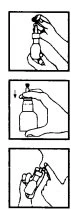
Before using Budena 64 micrograms for the first time, shake the container and press the pump several times (5–10 times) until a uniform spray of the product appears (see Figure 1).
If the spray is not used daily, the pump must be re-primed. In this case, one single press into the air is sufficient.
- Clean both nasal passages thoroughly. Shake the container and remove the cap.
- Hold the container in an upright position as shown in Figure 2.
- Insert the nasal applicator into one nostril and press the number of times indicated by your doctor (1 or 2). Repeat the procedure in the other nostril.
- Replace the cap. Do not use the product more often than prescribed.
 Cleaning:
After using the spray, clean the nozzle carefully with a tissue or clean cloth to keep it free from blockage.
If the spray does not work, the nozzle may be blocked. Never attempt to unblock it or enlarge the spray orifice with a pin or sharp object. This could damage the spray mechanism and prevent proper functioning.
The nasal applicator can be removed by gently pulling it upwards.
4. Possible adverse effects
Like all medicines, this medicine may cause adverse effects, although not everyone will experience them.
If you experience any of the following symptoms, stop using this nasal spray and consult a doctor immediately:
? sudden signs of an allergic reaction such as rash, itching, hives or redness of the skin, swelling of the face, lips, mouth, tongue or other body parts, difficulty breathing, wheezing or difficulty swallowing or breathing, or feeling faint.
Other adverse effects include:
Common (may affect up to 1 in 10 patients):
? Infections of the nose, throat or sinuses.
? Nosebleeds (epistaxis) or nasal irritation.
? Pain in the mouth and/or throat.
? Ear infections.
? Headache.
? Abdominal discomfort.
? Fever.
Uncommon (may affect up to 1 in 100 patients):
- Muscle cramps.
Rare (may affect up to 1 in 1,000 patients):
- Effects on the adrenal glands (small glands located above the kidneys).
- Nasal ulcers or perforation of the membrane separating the nasal passages (nasal septum).
- Voice changes.
- Bruising.
- Blurred vision.
Adverse effects with unknown frequency:
- Cataracts (loss of transparency of the eye lens).
- Glaucoma (increased intraocular pressure).
- Angioedema.
- Dermatitis.
- Erythema.
- Rash.
- Urticaria.
Other side effects in children
Slowed growth has been reported in children treated with nasal corticosteroids. The following adverse effects have also been frequently reported in children: stomach discomfort, headache, cough, fever or high temperature, inflammation and infections of the ears, tonsils, sinuses or lungs, or skin rash.
Mental or behavioural disorders, such as hyperactivity, sleep disorders, nervousness, depression or aggression, have been reported rarely (especially in children).
Reporting of adverse effects
If you experience any adverse effect, consult your doctor or pharmacist, even if it is a possible adverse effect not listed in this leaflet. You may also report them directly via the Spanish Pharmacovigilance System for Human Medicines: www.notificaRAM.es. By reporting adverse effects, you can help provide more information on the safety of this medicine.
5. Storage of Budena 64 micrograms
This medicine does not require any special storage conditions.
Do not freeze.
Keep this medicine out of the sight and reach of children.
Replace the protective cap after using Budena 64 micrograms.
Do not use this medicine after the expiry date stated on the packaging after “EXP”. The expiry date refers to the last day of the month indicated.
Medicines must not be disposed of via wastewater or household waste. Dispose of unused medicines and their packaging at the SIGRE point in your usual pharmacy. If in doubt, ask your pharmacist how to dispose of medicines and packaging you no longer need. This will help protect the environment.
6. Contents of the pack and other information.
Composition of Budena 64 micrograms:
- The active substance is budesonide.
- The other components are: disodium edetate, potassium sorbate (E-202), anhydrous glucose, microcrystalline cellulose (E-460), sodium carboxymethylcellulose (E-466), polysorbate 80 (E-433), hydrochloric acid and purified water.
Appearance of the product and contents of the pack:
Budena 64 micrograms nasal spray suspension is an aqueous white suspension supplied in a brown glass bottle containing 120 doses or 200 doses, equipped with a metering pump and a nasal adapter.
Only certain pack sizes may be marketed.
Marketing Authorization Holder and Manufacturer:
Laboratorio ALDO-UNIÓN, S.L.
Baronesa de Maldá, 73
08950 Esplugues de Llobregat
BARCELONA – SPAIN
Date of the most recent revision of this leaflet: December 2024.
Detailed and up-to-date information on this medicinal product is available on the website of the Spanish Agency for Medicines and Health Products (AEMPS) http://www.aemps.gob.es/