Benlysta 120 mg powder for concentrate for infusion solution
Spain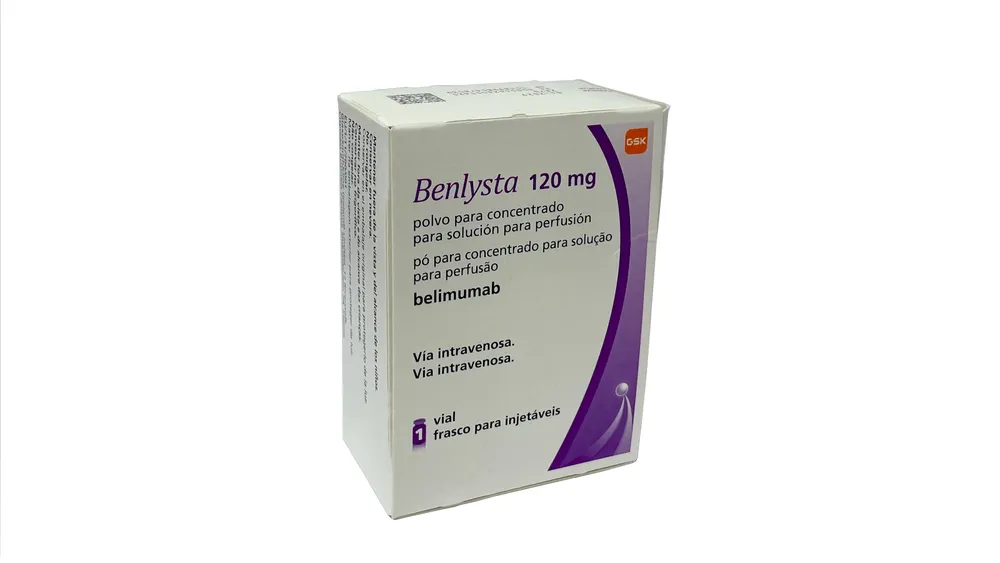
Table of Contents
Package leaflet: Information for the user
Introduction
Package leaflet: information for the user
Benlysta 120mg powder for concentrate for solution for infusion
Benlysta 400mg powder for concentrate for solution for infusion
belimumab
This medicinal product is subject to additional monitoring, which will allow for faster identification of new safety information. You can help by reporting any adverse reactions you may experience. Information on how to report adverse reactions is included at the end of section 4.
Read the entire leaflet carefully before starting to use this medicine, as it contains important information for you.
- Keep this leaflet, as you may need to read it again.
- If you have any questions, consult your doctor or pharmacist.
- If you experience any adverse reactions, consult your doctor, even if they are not listed in this leaflet. See section 4.
Contents of the leaflet
- What Benlysta is and what it is used for
- What you need to know before being given Benlysta
- How Benlysta is administered
- Possible side effects
- How to store Benlysta
- Contents of the pack and other information
1. What Benlysta is and what it is used for
Benlysta for infusion is a medicine used to treat lupus (systemic lupus erythematosus, SLE) in adults and children (from 5 years of age) whose disease remains highly active despite standard treatment. Benlysta is also used in combination with other medicines to treat adults (from 18 years of age) with active lupus nephritis (kidney inflammation associated with lupus).
Lupus is a disease in which the immune system (the system that fights infections) attacks your own cells and tissues, causing inflammation and organ damage. It can affect any organ in the body and is thought to involve a type of white blood cells called B cells.
Benlysta contains belimumab (a monoclonal antibody). It reduces the number of B cells in your blood by blocking the action of BLyS, a protein that helps prolong the survival of B cells and which is found at elevated levels in people with lupus.
Benlysta will be given to you in addition to your usual treatment for lupus.
2. What you need to know before you are given Benlysta
Do not administer Benlysta
-
if you are allergic to belimumab or to any of the other components of this medicine (listed in section 6).
-
Tell your doctor if you think this may apply to you.
Warnings and precautions
Talk to your doctor before you are given Benlysta:
-
if you currently have or have chronic infection, or if you get infections frequently (see section 4). Your doctor will decide whether Benlysta can be given to you.
-
if you are planning to be vaccinated or if you have been vaccinated within the last 30 days. Some vaccines should not be given shortly before or during treatment with Benlysta.
-
if lupus affects your nervous system.
-
if you have HIV or low levels of immunoglobulins.
-
if you have or have had hepatitis B or C.
-
if you have had an organ transplant or a bone marrow or stem cell transplant.
-
if you have had cancer.
-
if you have ever developed a severe skin rash, skin peeling, blistering, and/or mouth ulcers after using Benlysta.
-
Tell your doctor if you think any of these situations apply to you.
Depression and suicide
There have been reports of depression, suicidal ideation, and suicide attempts, including suicides, during treatment with Benlysta. Inform your doctor if you have a history of these conditions. If you develop new symptoms or your symptoms worsen at any time:
- Contact your doctor or go to the hospital immediately.
If you feel depressed or have thoughts of self-harm or suicide, it may be helpful to tell a close family member or friend and ask them to read this leaflet. You may ask them to inform you if they notice any changes in your mood or behaviour.
Severe skin reactions
Cases of Stevens-Johnson syndrome and toxic epidermal necrolysis have been reported in association with treatment with Benlysta.
- Stop using Benlysta and seek immediate medical attention if you notice any of the symptoms described in section 4.
Be alert to important symptoms
People taking medicines that affect their immune system may be at increased risk of developing infections, including a rare but serious brain infection called progressive multifocal leukoencephalopathy (PML).
-
Read the information “Increased risk of brain infection” in section 4 of this leaflet.
-
To improve traceability of this medicine, you and your healthcare professional should register the batch number of Benlysta. It is recommended that you record this information in case it is required in the future.
Children and adolescents
This medicine is not indicated for use in:
- children under 5 years of age (with SLE)
- children and adolescents (under 18 years of age) with active lupus nephritis
Other medicines and Benlysta
Tell your doctor if you are taking, have recently taken, or might need to take any other medicines.
In particular, inform your doctor if you are being treated with medicines that affect your immune system, including any medicine that affects your B-cells (used to treat cancer or inflammatory diseases).
Using these medicines together with Benlysta may make your immune system less effective. This could increase the risk of developing a serious infection.
Pregnancy and breastfeeding
Contraception for women who could become pregnant
- Use a reliable method of contraception while being treated with Benlysta and for at least 4 months after your last dose.
Pregnancy
Benlysta is generally not recommended during pregnancy.
- Tell your doctor if you are pregnant, think you might be pregnant, or plan to become pregnant. Your doctor will decide whether Benlysta can be given to you.
- If you become pregnant while being treated with Benlysta, inform your doctor.
Breastfeeding
Tell your doctor if you are breastfeeding. Benlysta may pass into breast milk. Your doctor will advise whether you should stop treatment with Benlysta while breastfeeding or whether you should stop breastfeeding.
Driving and using machines
Benlysta may have adverse effects that could impair your ability to drive or use machines.
Benlysta contains polysorbate 80
Benlysta 120mg powder for concentrate for solution for infusion: This medicine contains 0.6 mg of polysorbate 80 per vial.
Benlysta 400mg powder for concentrate for solution for infusion: This medicine contains 2.0 mg of polysorbate 80 per vial.
Polysorbates may cause allergic reactions. Inform your doctor if you or your child has any known allergies.
Benlysta contains sodium
This medicine contains less than 1 mmol of sodium (23 mg) per dose; hence, it is essentially “sodium-free”. However, before Benlysta is administered to you or your child, it is mixed with a solution containing sodium. Speak with your doctor if you or your child are on a low-salt diet.
3. How Benlysta is given
A nurse or doctor will give you Benlysta as an intravenous infusion (a drip into your vein) over a period of one hour.
Adults and children (from 5 years of age)
Your doctor will decide the correct dose based on your body weight. The recommended dose is 10 mg per kilogram (kg) of body weight.
Benlysta is given on the first day of treatment, and again on days 14 and 28. After this, Benlysta is given once every 4 weeks.
Medicines given before an infusion
Before receiving Benlysta, your doctor may give you other medicines to help reduce any infusion-related reactions. These may include a type of medicine called antihistamines and other medicines to prevent fever. You will be closely monitored, and if you have any reaction, it will be treated.
Interrupting treatment with Benlysta
Your doctor will decide whether it is necessary to interrupt the administration of Benlysta.
4. Possible adverse effects
Like all medicines, this medicine can cause adverse effects, although not everyone experiences them.
Stop using Benlysta and seek immediate medical attention if you notice any of the following symptoms of a serious skin reaction:
- Reddish spots on the trunk with a circular or target-like shape, often with blisters in the center, skin peeling, ulcers in the mouth, throat, nose, genitals, and eyes. These severe skin rashes may be preceded by fever and flu-like symptoms (Stevens-Johnson syndrome and toxic epidermal necrolysis). These adverse effects have been reported at an unknown frequency (cannot be estimated from available data).
Allergic reactions – seek immediate medical help
Benlysta may cause an infusion-related reaction or an allergic reaction (hypersensitivity). These are common adverse effects (may affect up to 1 in 10 people). They can occasionally be severe (uncommon, affecting up to 1 in 100 people) and may be life-threatening. These serious adverse reactions are more likely to occur on the first or second day of treatment with Benlysta, but may be delayed and occur several days later.
If you experience any of the following symptoms of an allergic reaction or infusion-related reaction, contact your doctor or nurse immediately or go to the nearest hospital emergency department:
- Swelling of the face, lips, mouth, or tongue
- Wheezing, difficulty breathing, or shortness of breath
- Skin rash
- Itchy rash or raised bumps (hives)
Rarely, less severe delayed reactions to Benlysta may also occur, usually 5 to 10 days after infusion.
These include symptoms such as skin rash, feeling unwell, fatigue, muscle aches, headache, or facial swelling.
If you experience these symptoms, especially if you notice two or more at the same time:
- Inform your doctor or nurse.
Infections
Benlysta may increase your likelihood of developing infections, including urinary tract and respiratory tract infections. Younger children may be at higher risk. These infections are very common and may affect more than 1 in 10 people. Some infections may be serious and, uncommonly, may lead to death.
If you have any of the following signs of infection:
-
Fever and/or chills
-
Cough, breathing problems
-
Diarrhea, vomiting
-
Burning sensation when urinating, frequent urination
-
Skin that is warm, red, or painful, or skin lesions on your body
-
Inform your doctor or nurse immediately.
Depression and suicide
There have been reports of depression, suicidal ideation, and suicide attempts during treatment with Benlysta. Depression may affect up to 1 in 10 people; suicidal ideation or suicide attempts may affect up to 1 in 100 people. If you feel depressed, have thoughts of self-harm or other troubling thoughts, or if you are depressed and notice worsening symptoms or develop new ones:
- Contact your doctor or go immediately to the hospital.
Increased risk of brain infection
Medicines that weaken your immune system, such as Benlysta, may increase the risk of a rare but serious and potentially fatal brain infection called progressive multifocal leukoencephalopathy (PML).
Symptoms of PML include:
-
Memory loss
-
Thinking problems
-
Difficulty speaking or walking
-
Vision loss
-
Inform your doctor immediately if you experience any of these symptoms or similar problems lasting several days.
If you already had these symptoms before starting treatment with Benlysta:
- Inform your doctor immediately if you notice any change in these symptoms.
Other possible adverse effects:
Very common adverse effects
May affect more than 1 in 10 people:
- Bacterial infections (see section “Infections” above).
Common adverse effects
May affect up to 1 in 10 people:
- High temperature or fever
- Itchy rash, raised bumps (hives), skin rash
- Low levels of white blood cells (can be seen in blood tests)
- Infection of nose, throat, or stomach
- Pain in hands or feet
- Migraine
- Feeling unwell, diarrhea
Reporting of adverse effects
If you experience any adverse effect, talk to your doctor or nurse, even if it is a possible adverse effect not listed in this leaflet. You can also report them directly through the national reporting system detailed in Appendix V. By reporting adverse effects, you can help provide more information on the safety of this medicine.
5. Storage of Benlysta
Keep this medicine out of the sight and reach of children.
Do not use this medicine after the expiry date which is stated on the container and label after EXP. The expiry date refers to the last day of the month indicated.
Store in a refrigerator (between 2°C and 8°C).
Do not freeze.
Keep in the original packaging to protect from light.
Disposal of unused medicine and of all materials that have come into contact with it must be carried out in accordance with local regulations.
6. Contents of the pack and other information
Composition of Benlysta
- The active substance is belimumab.
Each 5 ml vial contains 120 mg of belimumab.
Each 20 ml vial contains 400 mg of belimumab.
After reconstitution, the solution contains 80 mg of belimumab per ml.
- The other components are monohydrate citric acid (E 330), sodium citrate (E 331), sucrose and polysorbate 80 (E 433). See section 2 for more information about polysorbate 80 and sodium content.
Appearance of Benlysta and contents of the pack
Benlysta is presented as a white to off-white powder for solution for infusion, in a glass vial sealed with a butyl rubber stopper and an aluminium cap.
Each pack contains 1 vial.
Marketing Authorization Holder
GlaxoSmithKline (Ireland) Limited
12 Riverwalk
Citywest Business Campus
Dublin 24
Ireland
Manufacturer
GlaxoSmithKline Manufacturing S.P.A.
Strada Provinciale Asolana No. 90
I-43056 San Polo di Torrile
Parma
Italy
For further information on this medicine, please contact the local representative of the Marketing Authorization Holder:
Belgium/Belgium/Belgium GlaxoSmithKline Pharmaceuticals s.a./n.v. Tel/Tel: + 32 (0) 10 85 52 00
| Lithuania GlaxoSmithKline Trading Services Limited Tel: + 370 80000334 Luxembourg/Luxembourg GlaxoSmithKline Pharmaceuticals s.a./n.v. Belgium/Belgium Tel/Tel: + 32 (0) 10 85 52 00 |
Czech Republic GlaxoSmithKline s.r.o. Tel: + 420 222 001 111 | Hungary GlaxoSmithKline Trading Services Limited Tel.: + 36 80088309 |
Denmark GlaxoSmithKline Pharma A/S Tlf: + 45 36 35 91 00 | Malta GlaxoSmithKline Trading Services Limited Tel: + 356 80065004 |
Germany GlaxoSmithKline GmbH & Co. KG Tel.: + 49 (0)89 36044 8701 | Netherlands GlaxoSmithKline BV Tel: + 31 (0)33 2081100 |
Estonia GlaxoSmithKline Trading Services Limited Tel: + 372 8002640 | Norway GlaxoSmithKline AS Tlf: + 47 22 70 20 00 |
Greece GlaxoSmithKline Μονοπρóσωπη A.E.B.E. Tel: + 30 210 68 82 100 | Austria GlaxoSmithKline Pharma GmbH Tel: + 43 (0)1 97075 0 |
Spain GlaxoSmithKline, S.A. Tel: + 34 900 202 700 | Poland GSK Services Sp. z o.o. Tel.: + 48 (0)22 576 9000 |
France Laboratoire GlaxoSmithKline Tél.: + 33 (0)1 39 17 84 44 | Portugal GlaxoSmithKline – Produtos Farmacêuticos, Lda. Tel: + 351 21 412 95 00 |
Croatia GlaxoSmithKline Trading Services Limited Tel:+ 385 800787089 | Romania GlaxoSmithKline Trading Services Limited Tel: + 40 800672524 |
Ireland GlaxoSmithKline (Ireland) Limited Tel: + 353 (0)1 4955000 | Slovenia GlaxoSmithKline Trading Services Limited Tel: + 386 80688869 |
Iceland Vistor ehf. Tel: +354 535 7000 | Slovakia GlaxoSmithKline Trading Services Limited Tel: + 421 800500589 |
Italy GlaxoSmithKline S.p.A. Tel: + 39 (0)45 7741111 | Finland GlaxoSmithKline Oy Puh/Tel: + 358 (0)10 30 30 30 |
Cyprus GlaxoSmithKline Trading Services Limited Tel: + 357 80070017 | Sweden GlaxoSmithKline AB Tel: + 46 (0)8 638 93 00 |
Latvia GlaxoSmithKline Trading Services Limited Tel: + 371 80205045 |
Date of the most recent review of this leaflet:
Detailed information on this medicine is available on the website of the European Medicines Agency: https://www.ema.europa.eu/ , and on the website of the Spanish Agency of Medicines and Health Products (AEMPS) (http://www.aemps.gob.es/).
This information is intended for healthcare professionals only:
Instructions for use and handling – reconstitution, dilution, and administration
In order to improve the traceability of biological medicines, the name and batch number of the administered medicine should be clearly recorded.
- How to reconstitute Benlysta
Reconstitution and dilution must be performed under aseptic conditions.
Allow the vial to stand for 10 to 15 minutes until it reaches room temperature (between 15 °C and 25 °C).
For reconstitution and dilution, it is recommended to use a 21–25 gauge needle when piercing the vial stopper.
PRECAUTION: The 5 ml and 20 ml vials are reconstituted with different volumes of solvent; see below:
120 mg vial
The single-dose vial of 120 mg of Benlysta is reconstituted with 1.5 ml of water for injections to obtain a final concentration of 80 mg/ml of belimumab.
400 mg vial
The single-dose vial of 400 mg of Benlysta is reconstituted with 4.8 ml of water for injections to obtain a final concentration of 80 mg/ml of belimumab.
Amount of Benlysta | Vial size | Volume of solvent | Final concentration |
120mg | 5 ml | 1.5 ml | 80 mg/ml |
400mg | 20 ml | 4.8 ml | 80 mg/ml |
The water for injection flow should be directed against the vial wall to minimize foam formation. Gently swirl the vial for 60 seconds. Allow the vial to reach room temperature (between 15°C and 25°C) during reconstitution; gently swirl the vial for 60 seconds every 5 minutes until the powder dissolves. Do not shake. Reconstitution is usually complete within 10–15 minutes after adding water, but may take up to 30 minutes. Protect the reconstituted solution from direct sunlight.
If a mechanical reconstitution device is used for Benlysta, speeds must not exceed 500 rpm and the vial must not be agitated for more than 30 minutes.
- Before diluting Benlysta
Once reconstitution is complete, the solution should be opalescent, colorless to pale yellow, and free of particulate matter. However, small air bubbles are acceptable and expected.
120 mg vial
After reconstitution, a volume of 1.5 mL (corresponding to 120 mg of belimumab) can be withdrawn from each 5 mL vial.
400 mg vial
After reconstitution, a volume of 5 mL (corresponding to 400 mg of belimumab) can be withdrawn from each 20 mL vial.
- How to dilute the infusion solution
The reconstituted medicinal product must be diluted to 250 mL with sodium chloride 9 mg/mL (0.9%), sodium chloride 4.5 mg/mL (0.45%), or Ringer lactate solution for infusion. For patients with body weight less than or equal to 40 kg, infusion bags containing 100 mL of these diluents may be used, provided that the resulting belimumab concentration in the infusion bag does not exceed 4 mg/mL.
5% glucose intravenous solutions are incompatible with Benlysta and must not be used.
From a 250 mL (or 100 mL) infusion bag or bottle containing sodium chloride 9 mg/mL (0.9%), sodium chloride 4.5 mg/mL (0.45%), or Ringer lactate solution for infusion, withdraw and discard a volume equivalent to the volume of reconstituted Benlysta solution required for the patient's dose. Then, add the required volume of reconstituted Benlysta solution to the infusion bag or bottle. Gently invert the bag or bottle to mix the solution. Any unused solution remaining in the vials must be discarded.
Inspect the Benlysta solution visually before administration for foreign particles or discoloration. Discard the solution if any foreign particles or discoloration are observed.
The reconstituted solution, if not used immediately, must be protected from direct sunlight and stored refrigerated at 2°C to 8°C. Solutions diluted with sodium chloride 9 mg/mL (0.9%), sodium chloride 4.5 mg/mL (0.45%), or Ringer lactate solution for infusion must be stored at 2°C to 8°C or at room temperature (between 15°C and 25°C).
The total time from reconstitution of Benlysta to completion of the infusion must not exceed 8 hours.
- How to administer the diluted solution
Benlysta is administered by intravenous infusion over a period of 1 hour.
Benlysta must not be co-administered as a simultaneous infusion in the same intravenous line with other agents.
No incompatibilities have been observed between Benlysta and polyvinyl chloride or polyolefin infusion bags.