Auxina E-400 IU soft capsules
Spain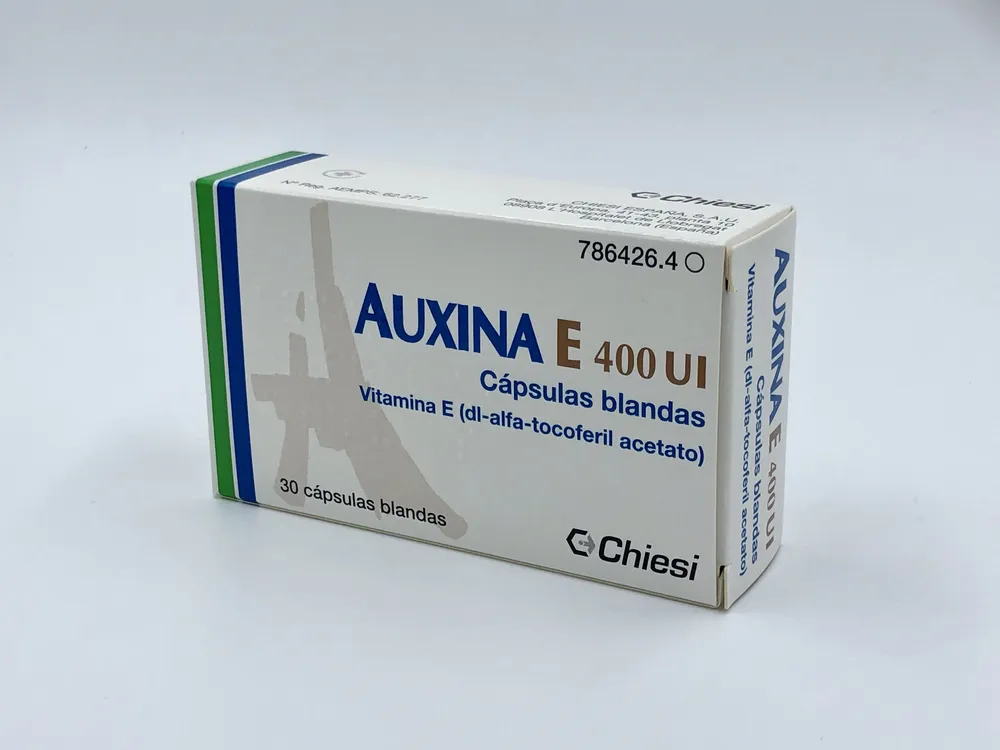
Table of Contents
Package leaflet: Information for the user
Introduction
Package leaflet: information for the patient
Auxina E 400 IU soft capsules
Vitamin E (dl-alpha tocopheryl acetate)
Read the entire leaflet carefully before you start taking this medicine, because it contains important information for you.
- Keep this leaflet, as you may need to read it again.
- If you have any questions, ask your doctor or pharmacist.
- This medicine has been prescribed for you only, and you should not give it to others, even if they have the same symptoms as you, because it could harm them.
- If you experience any adverse effects, consult your doctor or pharmacist, even if they are adverse effects not listed in this leaflet. See section 4.
Contents of the leaflet
- What Auxina E 400 is and what it is used for
- What you need to know before taking Auxina E 400
- How to take Auxina E 400
- Possible side effects
- How to store Auxina E 400
- Contents of the pack and other information
1. What Auxina E 400 is and what it is used for
Contains vitamin E (fat-soluble). The best-known function of vitamin E is its ability to act as an antioxidant for fats. It prevents the oxidation of essential cellular components and/or avoids the formation of toxic oxidation products.
Auxina E 400 is indicated for:
- Prevention and treatment of vitamin E deficiency in diseases with malabsorption syndrome (difficulty in absorbing nutrients) associated with steatorrhea (excessive amount of fat in feces), such as total or partial surgical removal of the gastrointestinal tract and celiac disease (gluten intolerance).
- Cystic fibrosis (hereditary disease characterized by the production and accumulation of thick mucus, primarily affecting the lungs, pancreas, and liver).
- Hepatobiliary tract disorders (such as bile retention, obstruction of the bile ducts).
- Abetalipoproteinemia (a genetic disorder causing inability to digest fats).
This medicine, with a dose of 400 IU of vitamin E, should be administered as indicated when a lower dose is not appropriate (see "Other presentations" in section 6).
2. What you need to know before starting to take Auxina E 400
Do not take Auxina E 400
- If you are allergic to vitamin E or to any of the other ingredients of this medicine (listed in section 6).
- If you have a blood clotting disorder, see the next section and “Taking Auxina E 400 with other medicines”.
Warnings and precautions
Consult your doctor or pharmacist before starting to take Auxina E 400.
- Do not take doses higher than those recommended.
- If you are at risk of thrombophlebitis (swelling of a vein caused by a blood clot), high doses of vitamin E may increase this risk, including in women taking estrogen-containing contraceptives (female sex hormones).
- If you have vitamin K deficiency (a vitamin involved in blood clotting), large doses of vitamin E may worsen blood clotting defects.
Children and adolescents
This medicine may be administered to children. However, the pharmaceutical form may not be suitable for young children, as they may have difficulty swallowing it.
Taking Auxina E 400 with other medicines
Inform your doctor or pharmacist if you are taking, have recently taken, or might need to take any other medicines.
The following medicines may interact with Auxina E 400 when used simultaneously:
- Oral anticoagulants (medicines to make the blood less thick), such as acenocoumarol, warfarin, dicoumarol, since vitamin E increases their effect.
- Tocofersolan (a form of vitamin E), which may increase the effect of this medicine.
- Estrogens, including oral contraceptives.
Medicines affecting gastrointestinal absorption of vitamin E:
- Cholestyramine and colestipol (used to reduce cholesterol levels)
- Orlistat (used to reduce fat absorption)
- Mineral oil or liquid paraffin (used to assist intestinal evacuation)
If taken together, doses should be spaced at least 2 hours apart.
Pregnancy, breastfeeding, and fertility
If you are pregnant or breastfeeding, think you might be pregnant, or are planning to become pregnant, consult your doctor before using this medicine.
As a precautionary measure, you should not take Auxina E 400 during pregnancy.
There is no information regarding the excretion of vitamin E in breast milk, so this medicine could have some effect on the newborn/child.
This medicine should not be used during breastfeeding.
Driving and using machines
The influence of Auxina E 400 on the ability to drive and use machines is negligible.
Auxina E 400 contains the colouring agent tartrazine (E-102)
This medicine may cause allergic reactions because it contains tartrazine. It may provoke asthma, especially in patients allergic to acetylsalicylic acid.
3. How to take Auxina E 400
Follow exactly the instructions given by your doctor for taking this medicine. If in doubt, consult your doctor or pharmacist again.
Auxina E 400 is taken orally. The recommended dose is:
Adults and children over 10 years of age:
- Vitamin E deficiency, when in the doctor's judgment the 400 IU dose is indicated: 1 capsule per day. (See “Other presentations” in section 6)
- Malabsorption syndromes: when the doctor indicates the 400 IU dose as necessary: 1 capsule per day or 15-25 mg per kg of body weight per day.
- Cystic fibrosis: when the doctor indicates the 400 IU dose as necessary: 1 capsule per day.
- Hepatobiliary tract disease: when the doctor indicates the 400 IU dose as necessary: 1 capsule per day. In chronic cholestasis, the daily dose of 400 IU (1 capsule) may be indicated in some cases.
- Abetalipoproteinemia: between 50 and 300 IU per kg of body weight per day is recommended.
The capsules should be swallowed whole with a small amount of water or another liquid, during or after meals.
Use in children
Auxina E 400 soft capsules may be administered to children. However, the pharmaceutical form of this medicine may not be suitable for young children, as they may have difficulty swallowing them.
If you take more Auxina E 400 than you should
Excessive doses of vitamin E (generally doses starting from 300 mg) may cause nausea, diarrhea, and other digestive disturbances, and in predisposed individuals may lead to thrombophlebitis and worsen coagulation problems; it may also cause gonadal dysfunction (sex glands), breast pain, increased cholesterol and triglycerides, and reduced thyroid hormones in the blood.
In case of overdose or accidental ingestion, contact your doctor or pharmacist immediately, go to a medical center, or call the Toxicology Information Service, Tel.: 91.562.04.20, indicating the medicine and the amount ingested.
If you forget to take Auxina E 400
Do not take a double dose to make up for missed doses.
If you have any further questions about the use of this medicine, ask your doctor or pharmacist.
4. Possible adverse effects
Like all medicines, this medicine may cause adverse effects, although not everyone will experience them.
Among these adverse effects, whose frequency is not exactly known, are included:
Digestive disorders (during prolonged treatment in general and with high doses), such as diarrhea, nausea, gastric discomfort, intestinal cramps, and bleeding gums.
Circulatory disorders, more likely in predisposed patients, such as thrombophlebitis (swelling of a vein caused by a blood clot) and tendency to bleeding (during prolonged treatment in general and with high doses).
During prolonged treatment in general and with high doses: fatigue, weakness, dizziness, headache; there have been some cases of cerebral infarction.
Rarely, emotional disturbances, fatigue.
Blurred vision, during prolonged treatment in general and with high doses.
Breast pain, alteration in gonadal function (sex glands).
Changes in clinical laboratory test results, such as measurements of creatine, creatine kinase, sex hormones, and thyroid hormones.
Reporting of adverse effects
If you experience any type of adverse effect, consult your doctor or pharmacist, even if it is a possible adverse effect not listed in this leaflet. You may also report them directly through the national reporting system, the Spanish Pharmacovigilance System for Human Medicines: https://www.notificaram.es. By reporting adverse effects, you can help provide more information on the safety of this medicine.
5. Storage of Auxina E 400
Do not store above 25°C.
Keep in the original packaging to protect from moisture.
Keep this medicine out of the sight and reach of children.
Do not use this medicine after the expiry date stated on the packaging after EXP. The expiry date refers to the last day of the month indicated.
Medicines must not be disposed of via wastewater or household waste. Dispose of empty containers and unused medicines at the SIGRE collection point at your pharmacy. If you are in doubt, ask your pharmacist how to dispose of containers and medicines you no longer need. This will help protect the environment.
6. Contents of the pack and other information
Composition of Auxina E 400
- The active substance is dl-alpha tocopheryl acetate (vitamin E). Each capsule contains 400 mg of dl-alpha tocopheryl acetate (equivalent to 400 IU of vitamin E).
- The other components (excipients) are: olive oil, gelatin, glycerol (E-422), purified water, tartrazine (E-102).
Appearance of the product and contents of the pack
Auxina E 400 consists of soft, oval, transparent yellow gelatin capsules containing a yellowish oily solution.
It is available in packs of 30 and 60 capsules.
- Other presentations:
Auxina E 50 IU
Auxina E 200 IU
Marketing Authorization Holder and Manufacturer
Marketing Authorization Holder
CHIESI ESPAÑA, S.A.U.
Plaça d'Europa, 41-43, planta 10
08908, L'Hospitalet de Llobregat
Barcelona (Spain)
Tel: 934948000
Manufacturer
Laboratorios Liconsa S.A.
Av. de Miralcampo 7 – Polígono Industrial Miralcampo
19200 Azuqueca de Henares
Guadalajara (Spain)
Date of the most recent revision of this leaflet: October 2025
Other sources of information
Detailed and up-to-date information on this medicinal product is available on the website of the Spanish Agency of Medicines and Health Products (AEMPS) http://www.aemps.gob.es/