Aerius 5 mg film-coated tablets
Spain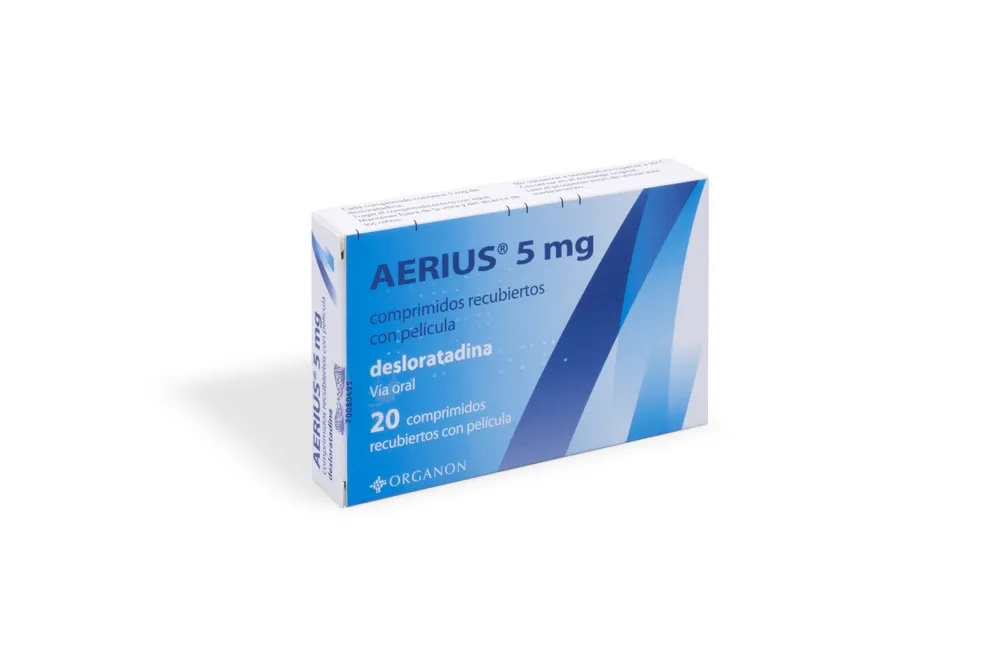
Table of Contents
- Package leaflet: Information for the user
- Introduction
- 1. What Aerius oral solution is and what it is used for
- 2. What you need to know before taking Aerius oral solution
- 3. How to take Aerius oral solution
- 4. Possible side effects
- 5. Storage of Aerius oral solution
- 6. Contents of the container and other information
Package leaflet: Information for the user
Introduction
Package leaflet: information for the patient
Aerius 0.5 mg/ml oral solution
desloratadine
Read the entire leaflet carefully before you start taking this medicine, because it contains important information for you.
- Keep this leaflet, as you may need to read it again.
- If you have any questions, consult your doctor, pharmacist, or nurse.
- This medicine has been prescribed for you only, and you should not give it to others, even if they have the same symptoms as you, because it may harm them.
- If you experience any adverse reactions, consult your doctor, pharmacist, or nurse, even if they are adverse reactions not listed in this leaflet. See section 4.
Leaflet contents
- What Aerius oral solution is and what it is used for
- What you need to know before taking Aerius oral solution
- How to take Aerius oral solution
- Possible side effects
- How to store Aerius oral solution
- Contents of the pack and other information
1. What Aerius oral solution is and what it is used for
What Aerius is
Aerius contains desloratadine, which is an antihistamine.
How Aerius works
Aerius oral solution is an antiallergic medicine. It helps control the allergic reaction and its symptoms.
When Aerius should be used
Aerius oral solution relieves symptoms associated with allergic rhinitis (inflammation of the nasal passages caused by an allergy, for example, hay fever or dust mite allergy) in adults, adolescents, and children from 1 year of age. These symptoms include sneezing, runny or itchy nose, itching of the palate, and itchy, red, or watery eyes.
Aerius oral solution is also used to relieve symptoms associated with urticaria (a skin condition caused by an allergy). These symptoms include itching and skin rashes.
Relief from these symptoms lasts for a full day, helping you carry on with your daily activities and maintain normal sleep periods.
2. What you need to know before taking Aerius oral solution
Do not take Aerius oral solution
- if you are allergic to desloratadine or to any of the other ingredients of this medicine (listed in section 6) or to loratadine.
Warnings and precautions
Consult your doctor, pharmacist, or nurse before taking Aerius:
- if you have impaired kidney function.
- if you have a personal or family history of seizures.
Children and adolescents
Do not give this medicine to children under 1 year of age.
Other medicines and Aerius
There are no known interactions between Aerius and other medicines.
Tell your doctor or pharmacist if you are taking, have recently taken, or might need to take any other medicines.
Taking Aerius oral solution with food, drinks, and alcohol
Aerius can be taken regardless of meals.
Be cautious when taking Aerius with alcohol.
Pregnancy, breastfeeding, and fertility
If you are pregnant or breastfeeding, think you may be pregnant, or are planning to become pregnant, consult your doctor or pharmacist before using this medicine.
It is not recommended to take Aerius oral solution if you are pregnant or breastfeeding.
There are no available data regarding male or female fertility.
Driving and using machines
At the recommended dose, this medicine is not expected to affect your ability to drive or operate machinery. Although most people do not experience drowsiness, it is recommended not to perform activities requiring mental alertness, such as driving a car or operating machinery, until you have determined how you personally respond to the medicine.
Aerius oral solution contains sorbitol (E-420)
This medicine contains 150 mg of sorbitol per ml of oral solution.
Sorbitol is a source of fructose. If your doctor has informed you (or your child) that you have an intolerance to certain sugars, or if you (or your child) have been diagnosed with hereditary fructose intolerance (HFI), a rare genetic disorder in which the body cannot break down fructose, consult your doctor before taking this medicine.
Aerius oral solution contains propylene glycol (E-1520)
This medicine contains 100.19 mg of propylene glycol per ml of oral solution.
Aerius oral solution contains sodium
This medicine contains less than 1 mmol of sodium (23 mg) per dose; therefore, it is essentially "sodium-free".
Aerius oral solution contains benzyl alcohol
This medicine contains 0.375 mg of benzyl alcohol per ml of oral solution.
Benzyl alcohol may cause allergic reactions.
This product should not be used for longer than one week in children under 3 years of age unless directed by your doctor or pharmacist.
Consult your doctor or pharmacist if you have liver or kidney disease. This is because large amounts of benzyl alcohol may accumulate in the body and cause adverse effects (metabolic acidosis).
Consult your doctor or pharmacist if you are pregnant or breastfeeding. This is because large amounts of benzyl alcohol may accumulate in your body and cause adverse effects (metabolic acidosis).
3. How to take Aerius oral solution
Follow exactly the instructions for use of this medicine as given by your doctor or pharmacist. If in doubt, consult your doctor or pharmacist again.
Use in children
Children 1 to 5 years of age:
The recommended dose is 2.5 ml (½ of a 5 ml spoonful) of oral solution once daily.
Children 6 to 11 years of age:
The recommended dose is 5 ml (one 5 ml spoonful) of oral solution once daily.
Use in adults and adolescents from 12 years of age
The recommended dose is 10 ml (two 5 ml spoonfuls) of oral solution once daily.
If the packaging containing the oral solution bottle includes a dosing syringe, it may alternatively be used to measure the appropriate amount of oral solution.
This medicine is for oral use.
Swallow the dose of oral solution, and then drink a little water. You may take this medicine with or without food.
Regarding the duration of treatment, your doctor will determine the type of allergic rhinitis you have and how long you should take Aerius oral solution.
If your allergic rhinitis is intermittent (symptoms present for fewer than 4 days per week or for fewer than 4 weeks), your doctor will recommend a treatment regimen based on an assessment of your medical history.
If your allergic rhinitis is persistent (symptoms present for 4 or more days per week and for more than 4 weeks), your doctor may recommend long-term treatment.
For urticaria, the duration of treatment may vary from patient to patient, and therefore you should follow your doctor's instructions.
If you take more Aerius oral solution than you should
Take Aerius oral solution only as directed by your doctor. An accidental overdose is not expected to cause serious problems. However, if you take more Aerius oral solution than prescribed, inform your doctor, pharmacist, or nurse immediately.
If you forget to take Aerius oral solution
If you forget to take your dose at the scheduled time, take it as soon as possible and then continue with your usual dosing schedule. Do not take a double dose to make up for forgotten doses.
If you stop taking Aerius
If you have any further questions about the use of this medicine, ask your doctor, pharmacist, or nurse.
4. Possible side effects
Like all medicines, this medicine can cause side effects, although not everybody gets them.
During the marketing of Aerius, very rare cases of serious allergic reactions (difficulty breathing, wheezing, itching, hives, and swelling) have been reported. If you experience any of these serious side effects, stop taking this medicine immediately and contact your doctor without delay.
In clinical trials involving most children and adults, side effects with Aerius were approximately the same as those with a solution or tablet containing no active ingredient. However, in children under 2 years of age, the most frequently reported side effects were diarrhoea, fever, and insomnia, whereas in adults, fatigue, dry mouth, and headache were reported more frequently than with a tablet containing no active ingredient.
In clinical trials with Aerius, the following side effects were reported as:
Frequent: the following may affect up to 1 in 10 people
- fatigue
- dry mouth
- headache
Children
Frequent in children under 2 years of age: the following may affect up to 1 in 10 children
- diarrhoea
- fever
- insomnia
During the marketing of Aerius, the following side effects have been reported as:
Very rare: the following may affect up to 1 in 10,000 people
- serious allergic reactions
- skin rash
- strong or irregular heartbeat
- rapid heartbeat
- stomach pain
- nausea
- vomiting
- upset stomach
- diarrhoea
- dizziness
- somnolence
- difficulty sleeping
- muscle pain
- hallucinations
- seizures
- agitation with increased body movement
- liver inflammation
- changes in liver function tests
Frequency not known: frequency cannot be estimated from the available data
- unusual weakness
- yellowing of the skin and/or eyes
- increased sensitivity of the skin to sunlight, even on cloudy days, and to ultraviolet light, for example ultraviolet light from a sunbed
- changes in heart rhythm
- abnormal behaviour
- aggression
- weight gain, increased appetite
- depressed mood
- dry eyes
Children
Frequency not known: frequency cannot be estimated from the available data
- slow heartbeat
- change in heart rhythm
- abnormal behaviour
- aggression
Reporting of side effects
If you experience any type of side effect, talk to your doctor, pharmacist, or nurse, even if it is a possible side effect not listed in this leaflet.
You can also report them directly through the national reporting system included in Appendix V. By reporting side effects, you can help provide more information on the safety of this medicine.
5. Storage of Aerius oral solution
Keep this medicine out of the sight and reach of children.
Do not use this medicine after the expiry date which is stated on the packaging after EXP. The expiry date refers to the last day of the month indicated.
Do not freeze. Store in the original packaging.
Do not use this medicine if you notice any change in the appearance of the oral solution.
Medicines must not be disposed of via wastewater or household waste. Ask your pharmacist how to dispose of medicines and packaging that you no longer need. This will help protect the environment.
6. Contents of the container and other information
Composition of Aerius oral solution
-
The active substance is desloratadine 0.5 mg/ml.
-
The other components of the oral solution are: sorbitol (E-420), propylene glycol (E-1520) (see section 2 “Aerius oral solution contains sorbitol (E-420) and propylene glycol (E-1520)”), sucralose (E-955), hypromellose 2910, sodium citrate dihydrate, natural and artificial flavour (chewing gum flavour, containing propylene glycol (E-1520) and benzyl alcohol (see section 2 “Aerius oral solution contains benzyl alcohol”) ), anhydrous citric acid, disodium edetate, and purified water.
Appearance of the product and contents of the container
Aerius oral solution is a clear, colourless solution.
Aerius oral solution is available in 30, 50, 60, 100, 120, 150, 225 and 300 ml bottles with a child-resistant cap. All pack sizes except the 150 ml bottle include a dosing spoon marked for 2.5 ml and 5 ml doses. The 150 ml pack includes either a dosing spoon or an oral dosing syringe marked for 2.5 ml and 5 ml doses.
Only certain container sizes may be marketed.
Marketing Authorization Holder and Manufacturer
Marketing Authorization Holder:
N.V. Organon
Kloosterstraat 6
5349 AB Oss
The Netherlands
Manufacturer: Organon Heist bv, Industriepark 30, 2220 Heist-op-den-Berg, Belgium.
For further information about this medicinal product, please contact the local representative of the Marketing Authorization Holder:
Belgium/Belgium/Belgium Organon Belgium Tel/Tel: 0080066550123 (+32 2 2418100) | Lithuania Organon Pharma B.V. Lithuania branch Tel.: +370 52041693 |
| Luxembourg/Luxembourg Organon Belgium Tel/Tel: 0080066550123 (+32 2 2418100) |
Czech Republic Organon Czech Republic s.r.o. Tel.: +420 277 051 010 | Hungary Organon Hungary Kft. Tel.: +36 1 766 1963 |
Denmark Organon Denmark ApS Tlf: +45 4484 6800 | Malta Organon Pharma B.V., Cyprus branch Tel: +356 2277 8116 |
Germany Organon Healthcare GmbH Tel: 0800 3384 726 (+49 (0) 89 2040022 10) | Netherlands N.V. Organon Tel.: 00800 66550123 (+32 2 2418100) |
Estonia Organon Pharma B.V. Estonian RO Tel: +372 66 61 300 | Norway Organon Norway AS Tlf: +47 24 14 56 60 |
Greece BIANEΞ Α.Ε. Tel: +30 210 80091 11 | Austria Organon Healthcare GmbH Tel: +49 (0) 89 2040022 10 |
Spain Organon Salud, S.L. Tel: +34 91 591 12 79 | Poland Organon Polska Sp. z o.o. Tel.: +48 22 306 57 64 |
France Organon France Tél: +33 (0) 1 57 77 32 00 | Portugal Organon Portugal, Sociedade Unipessoal Lda. Tel: +351 218705500 |
Croatia Organon Pharma d.o.o. Tel: +385 1 638 4530 | Romania Organon Biosciences S.R.L. Tel: +40 21 527 29 90 |
Ireland Organon Pharma (Ireland) Limited Tel: +353 15828260 | Slovenia Organon Pharma B.V., Oss, Ljubljana branch Tel: +386 1 300 10 80 |
Iceland Vistor ehf. Tel: +354 535 7000 | Slovakia Organon Slovakia s. r. o. Tel: +421 2 44 88 98 88 |
Italy Organon Italia S.r.l. Tel: +39 06 90259059 | Finland/Finland Organon Finland Oy Tel/Tel: +358 (0) 29 170 3520 |
Cyprus Organon Pharma B.V., Cyprus branch Tel: +357 22866730 | Sweden Organon Sweden AB Tel: +46 8 502 597 00 |
Latvia State commercial representative office “Organon Pharma B.V.” representative office Tel: +371 66968876 |
Date of the most recent review of this leaflet: MM/YYYY.
Detailed information on this medicine is available on the website of the European Medicines Agency: https://www.ema.europa.eu.