Adempas 2 mg film-coated tablets
Spain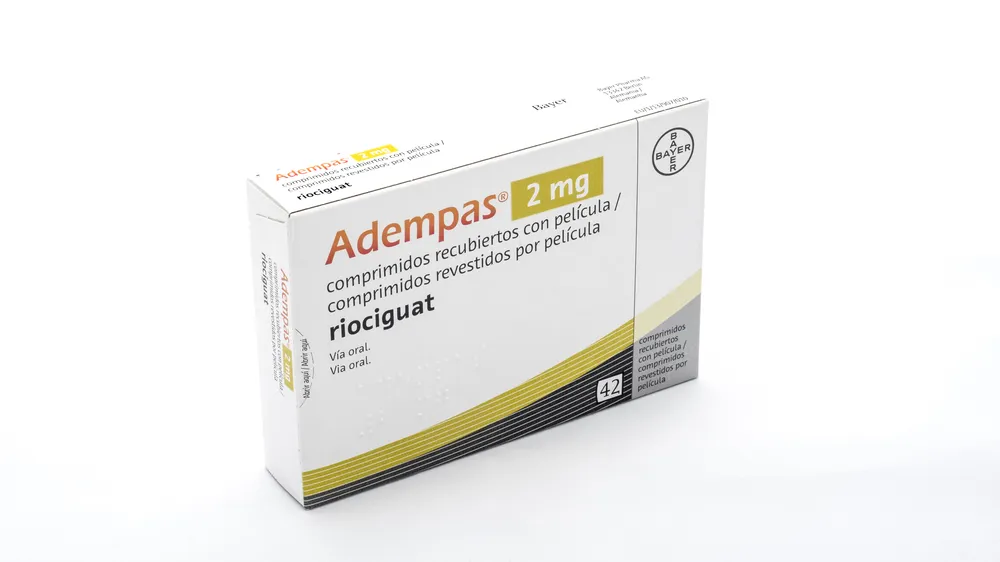
Table of Contents
- Package leaflet: Information for the user
- Introduction
- 1. What Adempas is and what it is used for
- 2. What you need to know before starting Adempas
- **Inform your doctor if**
- **While using Adempas, inform your doctor if**
- - **Pulmonary arterial hypertension (PAH)**
- - **Do not take medications used to treat**
- - **The following medicines may increase the level of Adempas in the blood, thereby increasing the risk of adverse reactions**
- 3. How to take Adempas
- 4. Possible adverse effects
- 5. Storage of Adempas
- 6. Contents of the pack and other information
Package leaflet: Information for the user
Introduction
Package leaflet: information for the user
Adempas 0.5 mg film-coated tablets
Adempas 1 mg film-coated tablets
Adempas 1.5 mg film-coated tablets
Adempas 2 mg film-coated tablets
Adempas 2.5 mg film-coated tablets
riociguat
Read all of this leaflet carefully before you start taking this medicine because it contains important information for you.
- Keep this leaflet. You may need to read it again.
- If you have any further questions, ask your doctor or pharmacist.
- This medicine has been prescribed for you only and must not be given to other people, even if they have the same symptoms as you. It may harm them.
- If you get any side effects, talk to your doctor or pharmacist, even if they are not listed in this leaflet. See section 4.
- This leaflet has been written as if the person taking the medicine is reading it. If you are administering this medicine to your child, please replace "you" with "your child" throughout the leaflet.
Contents of this leaflet
- What Adempas is and what it is used for
- What you need to know before you take Adempas
- How to take Adempas
- Possible side effects
- How to store Adempas
- Contents of the pack and other information
1. What Adempas is and what it is used for
Adempas contains the active substance riociguat, a stimulator of soluble guanylate cyclase (sGC).
It is used to treat adults and children aged 6 years and older with certain types of pulmonary hypertension:
- Chronic thromboembolic pulmonary hypertension (CTEPH)
Adempas is used to treat adult patients with CTEPH. In patients with CTEPH, the blood vessels in the lungs become blocked or narrowed due to blood clots. The medicine can be used in patients with CTEPH in whom surgery cannot be performed, or in those patients in whom pulmonary hypertension persists or recurs after surgery.
- Pulmonary arterial hypertension (PAH)
Adempas is used to treat adults and children aged 6 years and older with pulmonary arterial hypertension. In these patients, the walls of the blood vessels in the lungs are thickened and the vessels have narrowed. In patients with PAH, Adempas is taken together with other medicines (called endothelin receptor antagonists). In adults, the medicine may also be taken alone (monotherapy).
In patients with pulmonary hypertension, the blood vessels carrying blood from the heart to the lungs become narrowed, making it difficult for the heart to pump blood to the lungs and resulting in high blood pressure in these vessels. Because the heart must work harder than normal, people with pulmonary hypertension feel tired, dizzy, and short of breath. Adempas widens the blood vessels from the heart to the lungs, thereby reducing disease symptoms and enabling patients to perform physical activity more easily.
2. What you need to know before starting Adempas
Do not take Adempas if:
- you are taking PDE5 inhibitors such as sildenafil, tadalafil, vardenafil. These are medicines used to treat high blood pressure in the pulmonary arteries or erectile dysfunction;
- you have severely reduced liver function;
- you are allergic to riociguat or any of the other components of this medicine (listed in section 6);
- you are pregnant;
- you are taking nitrates or nitric oxide donors such as amyl nitrite. These medicines are frequently used to treat high blood pressure, chest pain, or heart diseases. This also includes recreational drugs known as "poppers";
- you are taking other medicines similar to Adempas called soluble guanylate cyclase stimulators, such as vericiguat. Consult your doctor if you are unsure;
- you have low blood pressure before taking Adempas for the first time. To start treatment with Adempas, your systolic blood pressure must be
- 90 mm Hg or higher if you are between 6 and 12 years of age,
- 95 mm Hg or higher if you are 12 years of age or older.
you have pulmonary hypertension associated with lung scarring of unknown cause, known as idiopathic pulmonary fibrosis.
If any of these situations apply to you, talk to your doctor first and do not take Adempas.
Warnings and precautions
Talk to your doctor or pharmacist before starting to use Adempas, if:
- you have pulmonary veno-occlusive disease, a condition that causes difficulty breathing due to fluid accumulation in the lungs. Your doctor may decide to prescribe an alternative medicine;
- you have recently had a serious bleeding episode in the lungs or airways;
- you have received treatment to stop coughing up blood (bronchial artery embolization);
- you are taking medicines that prevent blood clotting, as this may cause bleeding in the lungs. Your doctor will periodically perform blood tests and blood pressure measurements;
- your doctor may decide to monitor your blood pressure if you
- have symptoms of low blood pressure such as dizziness, lightheadedness, or fainting,
- are taking medicines to lower blood pressure or to increase urine output,
- have heart or circulation problems,
- are over 65 years of age, since low blood pressure is more likely in this age group.
Inform your doctor if
- you are on dialysis or if your kidneys are not functioning properly, as use of this medication is not recommended;
- your liver is not functioning properly.
While using Adempas, inform your doctor if
- you have difficulty breathing during treatment with this medicine. This may be caused by fluid accumulation in the lungs. If this is due to pulmonary veno-occlusive disease, your doctor may stop treatment with Adempas.
- you start or stop smoking during treatment with this medicine, as it may affect the level of riociguat in your blood.
Children and adolescents
- Chronic thromboembolic pulmonary hypertension (CTEPH)
- The use of Adempas is not recommended in CTEPH patients under 8 years of age.
- Pulmonary arterial hypertension (PAH)
-
You have been prescribed Adempas tablets. For patients with PAH aged 6 years and older who weigh less than 50 kg, Adempas is also available as granules for oral suspension. Patients may switch between tablets and oral suspension during treatment due to changes in body weight. The efficacy and safety have not been established in the following pediatric populations:
-
Children under 6 years of age, for safety reasons.
Other medicines and Adempas
Inform your doctor or pharmacist if you are taking, have recently taken, or might need to take any other medicines, particularly:
- Do not take medications used to treat
- High blood pressure or heart conditions such as nitrates, amyl nitrite, or other soluble guanylate cyclase stimulators like vericiguat. Do not take these medications together with Adempas.
- High blood pressure in the pulmonary arteries, because you should not take certain medications such as sildenafil, tadalafil together with Adempas. Other medications for high blood pressure in the pulmonary arteries, such as bosentan and iloprost, may be used with Adempas, but you must inform your doctor.
- Erectile dysfunction such as sildenafil, tadalafil, vardenafil. Do not take these medications together with Adempas.
- The following medicines may increase the level of Adempas in the blood, thereby increasing the risk of adverse reactions
- Fungal infections such as ketoconazole, posaconazole, itraconazole
- HIV infection such as abacavir, atazanavir, cobicistat, darunavir, dolutegravir, efavirenz, elvitegravir, emtricitabine, rilpivirine, ritonavir
- Epilepsy such as phenytoin, carbamazepine, phenobarbital
- Depression such as St. John's wort (hypericum perforatum)
- Prevention of rejection of transplanted organs such as cyclosporine
- Cancer such as erlotinib, gefitinib
- Nausea, vomiting (such as granisetron)
- For treating stomach discomfort or heartburn, known as antacids such as aluminium hydroxide/magnesium hydroxide. Take antacids at least 2 hours before or 1 hour after taking Adempas.
Adempas with food
In general, Adempas may be taken with or without food.
However, if your blood pressure tends to be low, take Adempas always with food or always without food.
Pregnancy and breastfeeding
- Pregnancy control: Women and adolescent girls of childbearing age must use effective contraceptive methods during treatment with Adempas. Speak with your doctor about suitable contraceptive methods you can use to prevent pregnancy. In addition, you should have a pregnancy test once a month.
- Pregnancy: Do not use Adempas during pregnancy.
- Breastfeeding: Breastfeeding is not recommended while taking this medicine, as it may harm the baby. Inform your doctor before using this medicine if you are breastfeeding or plan to breastfeed. Your doctor will decide whether to discontinue breastfeeding or discontinue treatment with Adempas.
Driving and use of machines
Adempas has a moderate influence on the ability to ride a bicycle, drive, and operate machinery. It may cause adverse effects such as dizziness. Before riding a bicycle, driving, or operating machinery, you should be aware of the adverse effects of this medicine (see section 4).
Adempas contains lactose
If a doctor has informed you that you have an intolerance to certain sugars, consult with him before taking this medicine.
Adempas contains sodium
This medicine contains less than 1 mmol of sodium (23 mg) per tablet; i.e., essentially “sodium-free”.
3. How to take Adempas
Follow exactly the instructions given by your doctor for taking this medicine. If you are unsure, consult your doctor or pharmacist again.
Adempas is available in the form of tablets or granules for oral suspension.
Tablets are available for adults and children weighing at least 50 kg. Granules for oral suspension are available for children weighing less than 50 kg.
Treatment should only be initiated by a physician experienced in the treatment of high blood pressure in the pulmonary arteries, who will monitor you during treatment. During the first weeks of treatment, your doctor will need to check your blood pressure at regular intervals. Adempas is available in different strengths, and by monitoring your blood pressure at the beginning of treatment, your doctor will ensure that you are taking the appropriate dose.
Starting treatment:
Your doctor will tell you what dose of Adempas you should take.
- Treatment is usually started at a low dose.
- Your doctor will gradually increase the dose depending on how you respond to treatment.
- During the first weeks of treatment, your doctor must measure your blood pressure at least every two weeks. This is necessary to determine the correct dose of the medicine.
How to take the medicine
Adempas is administered orally. Tablets should be taken 3 times a day, every 6–8 hours.
Crushed tablets:
If you have difficulty swallowing the whole tablet, consult your doctor about other ways of taking Adempas. The tablet may be crushed and mixed with water or a soft food immediately before taking.
What dose to take
The recommended starting dose is 1 tablet of 1 mg, 3 times a day for 2 weeks. Your doctor will increase the dose every 2 weeks up to a maximum of 2.5 mg 3 times a day (maximum daily dose of 7.5 mg), unless you experience low blood pressure. In that case, your doctor will prescribe the highest dose of Adempas that you tolerate well. Your doctor will determine the best dose for you. For some patients, lower doses taken 3 times a day may be sufficient.
If you are 65 years of age or older
You may be at higher risk of low blood pressure. Your doctor may adjust your dose.
If you smoke, it is recommended that you stop before starting treatment, as smoking may reduce the effectiveness of these tablets. Inform your doctor if you smoke or stop smoking during treatment. Your doctor may need to adjust your dose.
If you take more Adempas than you should
Inform your doctor if you have taken more Adempas than you should and if you experience any adverse effects (see section 4). If a sudden drop in blood pressure occurs (which may make you feel dizzy), you may require immediate medical attention.
If you forget to take Adempas
Do not take a double dose to make up for missed doses. If you forget to take a dose, continue with the next dose as scheduled.
If you stop taking Adempas
Do not stop taking this medicine without first discussing it with your doctor. If you stop taking this medicine, your condition may worsen. If you have not taken this medicine for 3 days or more, inform your doctor before starting again.
Switching treatment between Adempas and sildenafil or tadalafil
To avoid interactions, Adempas and PDE5 inhibitors (sildenafil, tadalafil) should not be taken at the same time.
- If switching to Adempas:
- Do not take Adempas for at least 24 hours after your last dose of sildenafil and for at least 48 hours after your last dose of tadalafil.
- If switching from Adempas:
- Stop taking Adempas at least 24 hours before starting sildenafil or tadalafil.
If you have any further questions about the use of this medicine, ask your doctor or pharmacist.
4. Possible adverse effects
Like all medicines, this medicine can cause adverse effects, although not everyone experiences them.
The most serious adverse effects in adults are:
- coughing up blood (haemoptysis) (common, may affect up to 1 in 10 people),
- acute pulmonary haemorrhage which may cause coughing up blood and may be fatal (uncommon, may affect up to 1 in 100 people).
If this occurs, contact your doctor immediately, as you may require urgent medical treatment.
General list of possible adverse effects (in adult patients):
Very common: may affect more than 1 in 10 people
- dizziness
- headache
- indigestion (dyspepsia)
- diarrhoea
- feeling unwell (nausea)
- vomiting
- swelling of the limbs (peripheral oedema)
Common: may affect up to 1 in 10 people
- inflammation of the digestive system (gastroenteritis)
- low red blood cell levels (anaemia). Symptoms include pale skin, weakness, or difficulty breathing
- irregular, strong, or rapid heartbeat (palpitations)
- low blood pressure (hypotension)
- nosebleeds (epistaxis)
- difficulty breathing through the nose (nasal congestion)
- inflammation of the stomach (gastritis)
- heartburn (gastro-oesophageal reflux disease)
- difficulty swallowing (dysphagia)
- stomach, intestinal, or abdominal pain (gastrointestinal and abdominal pain)
- constipation
- abdominal swelling (abdominal distension)
Adverse effects in children
In general, the adverse effects observed in children aged 6 to less than 18 years treated with Adempas were similar to those observed in adults. The most common adverse effects in children were:
- low blood pressure (hypotension) (very common: may affect more than 1 in 10 people)
- headache (common: may affect up to 1 in 10 people)
Reporting of adverse effects
If you experience any type of adverse effect, consult your doctor or pharmacist, even if it is a possible adverse effect not listed in this leaflet. You can also report them directly through the national reporting system included in Appendix V. By reporting adverse effects, you can help provide more information on the safety of this medicine.
5. Storage of Adempas
Keep this medicine out of the sight and reach of children.
This medicine does not require any special storage conditions.
Do not use this medicine after the expiry date stated on the blister and outer packaging following "EXP". The expiry date refers to the last day of the month indicated.
Medicines should not be disposed of via wastewater or household waste. Ask your pharmacist how to dispose of medicines and packaging that you no longer need. This will help protect the environment.
6. Contents of the pack and other information
Composition of Adempas
- The active substance is riociguat.
Adempas 0.5 mg film-coated tablets
Each tablet contains 0.5 mg of riociguat.
Adempas 1 mg film-coated tablets
Each tablet contains 1 mg of riociguat.
Adempas 1.5 mg film-coated tablets
Each tablet contains 1.5 mg of riociguat.
Adempas 2 mg film-coated tablets
Each tablet contains 2 mg of riociguat.
Adempas 2.5 mg film-coated tablets
Each tablet contains 2.5 mg of riociguat.
- The other components are:
Tablet core: microcrystalline cellulose, crospovidone (type B), hypromellose 5 cP, lactose monohydrate, magnesium stearate and sodium lauryl sulfate (see the end of section 2 for more information on lactose and sodium).
Tablet coating: hydroxypropylcellulose, hypromellose 3 cP, propylene glycol (E 1520) and titanium dioxide (E 171).
Adempas 1 mg and 1.5 mg tablets also contain yellow iron oxide (E 172).
Adempas 2 mg and 2.5 mg tablets also contain yellow iron oxide (E 172) and red iron oxide (E 172).
Appearance of the product and contents of the pack
Adempas is a film-coated tablet (tablet):
Adempas 0.5 mg film-coated tablets
- White, round, biconvex tablets, 6 mm in diameter, marked with the Bayer cross on one side and "0.5" and an "R" on the other.
Adempas 1 mg film-coated tablets
- Pale yellow, round, biconvex tablets, 6 mm in diameter, marked with the Bayer cross on one side and "1" and an "R" on the other.
Adempas 1.5 mg film-coated tablets
- Orange-yellow, round, biconvex tablets, 6 mm in diameter, marked with the Bayer cross on one side and "1.5" and an "R" on the other.
Adempas 2 mg film-coated tablets
- Pale orange, round, biconvex tablets, 6 mm in diameter, marked with the Bayer cross on one side and "2" and an "R" on the other.
Adempas 2.5 mg film-coated tablets
- Red-orange, round, biconvex tablets, 6 mm in diameter, marked with the Bayer cross on one side and "2.5" and an "R" on the other.
Available in packs of:
- 42 tablets: 2 transparent calendar blisters containing 21 tablets each.
- 84 tablets: 4 transparent calendar blisters containing 21 tablets each.
- 90 tablets: 5 transparent blisters containing 18 tablets each.
- 294 tablets: 14 transparent calendar blisters containing 21 tablets each.
Only certain pack sizes may be marketed.
Marketing Authorisation Holder
Bayer AG
51368 Leverkusen
Germany
Manufacturer
Bayer AG
Kaiser-Wilhelm-Allee
51368 Leverkusen
Germany
For further information about this medicinal product, please contact the local representative of the Marketing Authorisation Holder.
Belgium / Belgium / Belgien MSD Belgium Tel/Tel: +32(0)27766211 | Lithuania UAB Merck Sharp & Dohme Tel: + 370 5 2780 247 |
| Luxembourg / Luxemburg MSD Belgium Tel/Tel: +32(0)27766211 |
Czech Republic Merck Sharp & Dohme s.r.o. Tel.: +420 233 010 111 | Hungary MSD Pharma Hungary Kft. Tel.: + 36 1 888-5300 |
Denmark MSD Danmark ApS Tlf: + 45 4482 4000 | Malta Merck Sharp & Dohme Cyprus Limited Tel: 8007 4433 (+356 99917558) |
Germany MSD Sharp & Dohme GmbH Tel: +49 (0) 89 20 300 4500 | Netherlands Merck Sharp & Dohme B.V. Tel: 0800 9999 000 (+ 31 23 5153153) |
Estonia Merck Sharp & Dohme OÜ Tel: + 372 614 4200 | Norway MSD (Norge) AS Tlf: + 47 32 20 73 00 |
Greece MSD Α.Φ.Β.Ε.Ε Tel: + 30 210 98 97 300 | Austria Merck Sharp & Dohme Ges.m.b.H. Tel: +43 (0) 1 26 044 |
Spain Merck Sharp & Dohme de España, S.A. Tel: +34 91 321 06 00 | Poland MSD Polska Sp.z o.o. Tel.: +48 22 549 51 00 |
France MSD France Tel: + 33 (0) 1 80 46 40 40 | Portugal Merck Sharp & Dohme, Lda Tel: + 351 214465700 |
Croatia Merck Sharp & Dohme d.o.o. Tel: + 385 1 6611 333 | Romania Merck Sharp & Dohme Romania S.R.L. Tel: + 40 21 529 29 00 |
Ireland Merck Sharp & Dohme Ireland (Human Health) Limited Tel: +353 (0)1 2998700 | Slovenia Merck Sharp & Dohme, inovativna zdravila d.o.o. Tel: + 386 1 5204201 |
Iceland Vistor hf. Sími: + 354 535 7000 | Slovakia Merck Sharp & Dohme, s. r. o. Tel: + 421 2 58282010 |
Italy MSD Italia S.r.l. Tel: +800 23 99 89 (+39 06 361911) | Finland MSD Finland Oy Puh/Tel: + 358 (0)9 804650 |
Cyprus Merck Sharp & Dohme Cyprus Limited Tel: 800 00 673 (+357 22866700) | Sweden Merck Sharp & Dohme (Sweden) AB Tel: + 46 77 5700488 |
Latvia SIA Merck Sharp & Dohme Latvija Tel: + 371 67364224 |
Date of the most recent review of this leaflet:
Detailed information on this medicine is available on the website of the European Medicines Agency: https://www.ema.europa.eu.