Voltaren® plaster 24 hours
Ukraine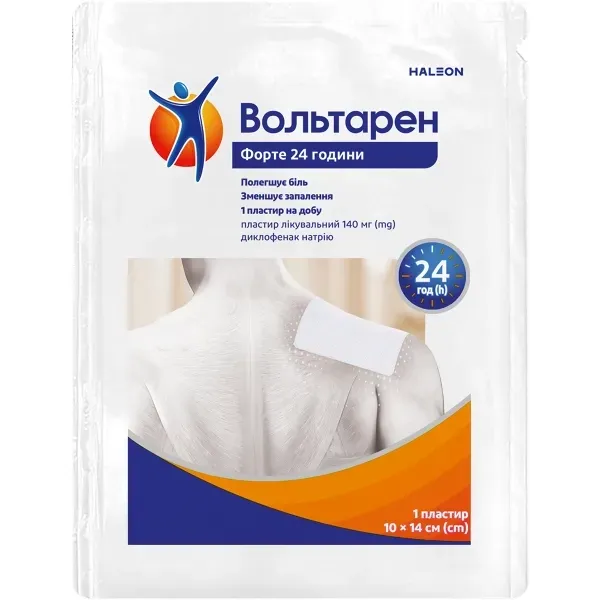
Table of Contents
INSTRUCTIONS FOR MEDICAL USE OF THE MEDICINAL PRODUCT VOLTAREN® 24-HOUR PATCH
Composition:
Active substance: diclofenac;
One patch with an area of 70 cm² or 140 cm² contains sodium diclofenac 15 mg or 30 mg, respectively;
Excipients: menthol, methylpyrrolidone, propylene glycol esters of fatty acids, anhydrous citric acid, styrene-isoprene-styrene block copolymer, polyisobutylene, ether gum, 2-mercaptobenzimidazole, butylated hydroxytoluene, mineral oil.
The composition is applied to a fabric backing, and the adhesive surface is covered with a protective film.
Pharmaceutical form. Transdermal patch.
Main physicochemical properties: a patch with a colorless transparent or slightly yellowish transparent adhesive layer evenly distributed over the backing surface; the adhesive side is covered with a transparent plastic film; the patch has a mild aromatic odor.
Pharmacotherapeutic group.
Agents used locally for joint and muscular pain. Topically applied non-steroidal anti-inflammatory agents. Diclofenac.
ATC code M02A A15.
Pharmacological properties.
Pharmacodynamics.
Diclofenac is a non-steroidal anti-inflammatory agent with pronounced anti-rheumatic, analgesic, anti-inflammatory, and antipyretic effects. The main mechanism of the therapeutic action of diclofenac is the inhibition of prostaglandin biosynthesis.
Pharmacokinetics. Protein binding of diclofenac is 99.7%, primarily to albumin (99.4%). Diclofenac is partially metabolized via glucuronidation, but mainly via hydroxylation, forming several phenolic derivatives, two of which are pharmacologically active, although to a significantly lesser extent than diclofenac.
The total systemic plasma clearance of diclofenac is 263 ± 56 mL/min, and the terminal elimination half-life is on average 1–2 hours. Four metabolites, including two active ones, also have short plasma elimination half-lives of 1–3 hours. Elimination of diclofenac and its metabolites occurs predominantly via the kidneys.
In patients with renal insufficiency, no accumulation of diclofenac and its metabolites is observed. In patients with chronic hepatitis or decompensated liver cirrhosis, the kinetics and metabolism of diclofenac are not altered.
Preclinical studies have not revealed any specific hazard associated with the use of diclofenac at recommended therapeutic doses. In animal studies, no effects of diclofenac on fertility or on fetal and offspring development were observed.
Clinical characteristics.
Indications.
Symptomatic treatment of pain, inflammation, and swelling associated with:
- muscle and joint injuries (including those due to dislocation, strain);
- localized forms of soft tissue rheumatism (tendinitis, including "tennis elbow");
- osteoarthritis of the knee joints.
Contraindications.
Hypersensitivity to diclofenac or to any of the excipients. History of asthma attacks, angioedema, urticaria, or acute rhinitis induced by acetylsalicylic acid or other nonsteroidal anti-inflammatory drugs (NSAIDs); damaged skin, regardless of the type of injury (exudative dermatitis, eczema, infected lesions, burns, or wounds); active peptic ulcer; pregnancy or planned pregnancy.
Interaction with other medicinal products and other forms of interaction.
There are no data regarding interactions with other medicinal products when the drug is used topically.
Do not use concurrently with other topical NSAIDs.
Special precautions for use
The possibility of developing systemic adverse effects (which occur with systemic forms of diclofenac) should be considered when the product is applied to larger areas of skin or for longer periods than recommended.
Voltaren® 24 Hour Patch should be applied only to intact, undamaged skin, avoiding contact with inflamed, wounded, or infected skin. Contact of the product with eyes and mucous membranes should be avoided.
Do not use the patch with an occlusive dressing.
If any skin rash occurs, treatment with the product should be discontinued.
The product contains propylene glycol esters and butylated hydroxytoluene, which may cause mild localized skin irritation in some individuals.
Prior to using the medicinal product, consult a physician if the patient:
- is currently undergoing treatment and/or using other medicinal products;
- has a history of allergy, including to medicinal products, either personally or among family members;
- has previously experienced a rash after using patches;
- has any of the following medical conditions: gastric ulcer, blood disorders, or diseases of the liver, kidneys, heart, hypertension, or influenza;
- is currently taking any of the following medicinal products: new quinolone antibiotics, triamterene, lithium, methotrexate, NSAIDs (e.g., acetylsalicylic acid), corticosteroids, diuretics, cyclosporine, or selective serotonin reuptake inhibitors;
- is elderly.
To minimize the risk of adverse reactions, it is recommended to use the lowest effective dose for the shortest duration necessary to control symptoms (see section "Dosage and administration").
Use during pregnancy or breastfeeding
The use of this medicinal product during pregnancy is contraindicated.
It is unknown whether diclofenac is excreted in breast milk following topical application; therefore, use of the product during breastfeeding is not recommended. However, if there are compelling reasons to use the product during breastfeeding, the patch should not be applied to the breast area or large skin areas, and should not be used in higher amounts or for longer durations than recommended.
There are no data available on the effect of topically applied diclofenac on human fertility.
Ability to influence the ability to drive or operate machinery
Diclofenac has no effect on reaction speed when applied topically.
Method of Administration and Dosage.
The product is intended for topical use only.
Apply the patch to intact, previously washed and dried skin. Before use, open the sealed pouch by tearing or cutting along the dotted line and opening it by pulling the ends apart. Remove one patch from the pouch and peel off the protective film, taking care not to touch the adhesive surface. Immediately after removing the protective film, apply the patch over the painful area for 24 hours. Only one patch should be used within 24 hours. Depending on the size of the painful area, either the 15 mg (70 cm²) or the 30 mg (140 cm²) patch may be used.
Hands must be washed after applying or removing the patch. After use, the pouch should be tightly closed.
The duration of treatment depends on the indication and therapeutic response. The product should not be used for more than 14 consecutive days unless otherwise directed by a physician.
Consult a physician if symptoms do not improve or worsen after 5–6 days of treatment.
Elderly patients may use the standard adult dosage.
Children. Voltaren® Patch 24 hours is not recommended for use in children under 16 years of age.
Overdose.
Overdose is unlikely due to the low systemic absorption of diclofenac following topical application. However, adverse effects similar to those seen with overdose of diclofenac-containing tablets may occur in case of accidental ingestion. In the event of accidental ingestion leading to significant adverse effects, treatment should consist of general supportive measures used in the management of poisoning with nonsteroidal anti-inflammatory drugs.
Adverse Effects.
The following adverse reactions have been observed during use of the medicinal product Voltaren® Patch 24 hours.
Infections and infestations
Rare (<1/10,000): pustular eruptions.
Immune system disorders
Rare (<1/10,000): hypersensitivity reactions (including urticaria), angioedema, anaphylactic-type reactions.
Respiratory system disorders
Rare (<1/10,000): bronchial asthma.
Skin and subcutaneous tissue disorders
Common (≥1/100; <1/10): rash, pruritus, eczema, erythema, skin irritation, dry skin, dermatitis including contact dermatitis.
Uncommon (≥1/1,000; <1/100): bullous dermatitis, skin discoloration, skin swelling.
Rare (<1/10,000): photosensitivity reactions.
Frequency not known: pain, increased skin temperature, skin roughness, skin desquamation, skin redness.
Shelf Life. 2 years.
Storage Conditions. Store at temperatures not exceeding 25 °C, in a place inaccessible to children, in the original packaging to protect from light and moisture.
Unused patches should remain stored in the pouch after opening. After completion of treatment, any remaining patches in an opened pouch should be discarded.
Packaging. 2 or 5 patches per pouch. 1 or 2 pouches per cardboard box.
Availability. Over-the-counter (without prescription).
Manufacturer.
- Dodjin Iyaku-Kako Co., Ltd. / Dojin Iyaku-Kako Co., Ltd.
(Production GLZ, primary packaging, quality control, secondary packaging, batch release)
- FAMAR A.V.E. - AVLON PLANT 48th KM NATIONAL ROAD ATHENS - LAMIA / FAMAR A.V.E. - AVLON PLANT 48th KM NATIONAL ROAD ATHENS - LAMIA
(Secondary packaging, batch release)
Manufacturer's Address and Location of Manufacturing Site.
- 8-1, Higashi Nakakawara, Senoue-mashi, Fukushima-shi, Fukushima 960-0101, Japan / 8-1, Higashi Nakakawara, Senoue-mashi, Fukushima-shi, Fukushima 960-0101, Japan.
- 48th km National Road Athens - Lamia, Avlona Attiki, 19011, Greece / 48th km National Road Athens - Lamia, Avlona Attiki, 19011, Greece.