Voxid®
Ukraine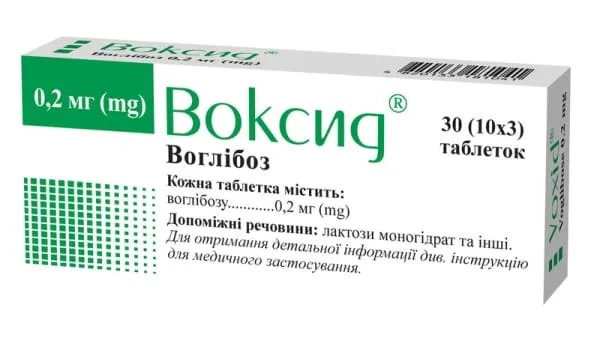
Table of Contents
INSTRUCTIONS FOR MEDICAL USE OF THE MEDICINAL PRODUCT VOKSIDÒ (VOXIDÒ)
Composition:
Active substance: voglibose;
1 tablet contains 0.2 mg or 0.3 mg of voglibose;
Excipients: lactose monohydrate, corn starch, povidone K30, sodium starch glycolate (type A), colloidal anhydrous silicon dioxide, magnesium stearate.
Pharmaceutical form. Tablets.
Main physicochemical properties:
Voxidò, 0.2 mg tablets: white, round, flat tablets with bevelled edges, embossed with "K" on one side and a break line on the other;
Voxidò, 0.3 mg tablets: white, round, flat tablets with bevelled edges, embossed with "K" on one side.
Pharmacotherapeutic group.
Antidiabetic agents, excluding insulin. ATC code A10BF03.
Pharmacological properties.
Pharmacodynamics.
Voglibose is an oral hypoglycemic agent, a competitive inhibitor of intestinal alpha-glucosidases (hydrolase class enzymes) involved in the breakdown of di-, oligo-, and polysaccharides. Inhibition of α-glucosidase activity leads to delayed breakdown of complex carbohydrates and glucose absorption, resulting in reduced postprandial blood glucose levels (postprandial hyperglycemia).
Voglibose does not affect the activity of β-glucosidase.
Pharmacokinetics.
Voglibose is slowly and poorly absorbed and is rapidly excreted in feces. To date, no metabolites of this substance have been detected in human blood or urine. Animal studies have demonstrated that voglibose penetrates through the placenta and into breast milk.
Clinical characteristics.
Indications.
- Treatment of type 2 diabetes mellitus when blood glucose levels cannot be adequately controlled by diet and/or physical exercise alone; as monotherapy or in combination therapy with other oral hypoglycemic agents or with insulin.
- Treatment of type 1 diabetes mellitus as part of combination therapy with insulin.
- Prevention of type 2 diabetes mellitus in patients with impaired glucose tolerance.
Contraindications.
- Hypersensitivity to the active substance or to any of the excipients.
- Diabetic ketoacidosis, precomatose states, diabetic coma.
- Severe infections.
- Major surgical procedures and trauma.
- Gastrointestinal disorders and pathological conditions that may worsen due to increased gas formation (including inflammatory bowel diseases, erosive and ulcerative gastrointestinal lesions, and complete or partial intestinal obstruction).
- Severe gastrointestinal disorders and diseases associated with impaired digestion and absorption.
Interaction with other medicinal products and other forms of interaction.
Combinations that require caution.
-
Antidiabetic agents: sulfonylurea derivatives and sulfonylureas, biguanide derivatives, insulin preparations, and agents improving insulin sensitivity (risk of hypoglycemia).
-
Medicinal products that enhance the hypoglycemic effect of antidiabetic agents
(including β-blockers, salicylate preparations, monoamine oxidase inhibitors, fibrate derivatives used for the treatment of hyperlipidemia, and warfarin). -
Medicinal products that reduce the hypoglycemic effect of antidiabetic agents (including adrenaline, corticosteroids, and thyroid hormones).
Special precautions for use.
VoksidÒ should be used with caution in the following situations:
- concomitant use of other hypoglycemic agents (risk of hypoglycemia) (see section "Adverse reactions");
- history of laparotomy or intestinal obstruction (risk of worsening patient's condition due to excessive gas formation in the intestine);
- chronic intestinal diseases associated with impaired digestion and absorption (risk of worsening patient's condition due to the mechanism of action of voglibose);
- Rehmel's syndrome (risk of worsening patient's condition due to excessive gas formation in the intestine);
- hernia, stricture, or ulcer of the colon (risk of worsening patient's condition due to excessive gas formation in the intestine);
- severe liver function disorders (risk of significant fluctuations in blood glucose levels due to metabolic disturbances);
- liver cirrhosis (risk of further deterioration of consciousness due to hyperammonemia);
- severe kidney function disorders (risk of significant fluctuations in blood glucose levels due to metabolic disturbances).
The use of VoksidÒ should be limited in patients who have been definitively diagnosed with diabetes mellitus or impaired glucose tolerance.
In patients with diabetes mellitus for whom diet and/or physical activity are indicated, voglibose should be prescribed only when postprandial blood glucose level remains at 11.1 mmol/L or higher 2 hours after a meal.
In patients with diabetes mellitus for whom diet, physical activity, oral hypoglycemic agents, or insulin are indicated, voglibose should be prescribed only when fasting blood glucose level is 7.77 mmol/L or higher.
During treatment with VoksidÒ, careful monitoring of the patient's condition and regular control of blood glucose levels are necessary. In addition, consistent intake of this medication is essential for achieving therapeutic effect.
If, after 2–3 months of continuous voglibose use (as monotherapy or combination therapy for diabetes mellitus), the hypoglycemic effect is unsatisfactory (postprandial blood glucose level remains at 11.1 mmol/L or higher 2 hours after a meal), appropriate adjustment of therapy is required.
If, during voglibose treatment (as monotherapy or combination therapy for diabetes mellitus), the hypoglycemic effect is satisfactory (postprandial blood glucose level is 8.88 mmol/L or lower 2 hours after a meal), the medication should be discontinued and the further course of the disease should be monitored.
If a patient has known intolerance to certain sugars, consultation with a physician is recommended before taking this medicinal product, as the drug contains lactose.
Use during pregnancy or breastfeeding.
VoksidÒ tablets may be prescribed to pregnant women or women with possible pregnancy only if the expected therapeutic benefit outweighs any potential risk. The safety of using this drug during pregnancy has not been established.
It is advisable to avoid using voglibose in women who are breastfeeding. However, if use is necessary, breastfeeding should be discontinued.
Ability to affect reaction speed when driving or operating machinery.
Adverse reactions may occur during treatment with this drug that could impair the ability to drive or operate machinery.
Dosage and Administration.
VoksidÒ should be taken orally, immediately before each meal, with water.
The usual initial dose of VoksidÒ for adults is 0.2 mg three times daily. If the therapeutic effect is insufficient, the dose may be increased to 0.3 mg three times daily, provided that the patient's condition is carefully monitored.
For elderly patients, the initial dose of VoksidÒ is 0.1 mg three times daily. If the therapeutic effect is inadequate, the dose may be increased to 0.2–0.3 mg three times daily, provided that the patient's condition is carefully monitored.
Children.
There are no data regarding the use of voglibose in children; therefore, the drug should not be prescribed to this age group of patients.
Overdose.
In case of overdose, the patient should seek medical advice.
Adverse reactions.
Metabolic disorders: hypoglycemia.
Gastrointestinal disorders: loose stools, diarrhea, bloating, flatulence, abdominal pain, abdominal discomfort, nausea, vomiting, intestinal pneumatosis, intestinal obstruction.
Hepatobiliary disorders: fulminant hepatitis, severe liver function abnormalities, increased levels of liver transaminases (AST, ALT), jaundice, severe cholestasis.
Nervous system disorders: dizziness.
Shelf life.
4 years.
Storage conditions.
Store in the original packaging at a temperature not exceeding 25 °C.
Keep out of the reach of children.
Packaging.
10 tablets per blister. 3 or 10 blisters per cardboard pack.
Prescription status.
Prescription only.
Manufacturer.
LLC "KUSUM PHARM" (for dosage of 0.2 mg, 0.3 mg)
Manufacturer's location and address of its business activity.
40020, Ukraine, Sumy region, Sumy, Skryabina St., 54.
or
Manufacturer.
LLC "GLEDPHARM LTD" (for dosage of 0.2 mg)
Manufacturer's location and address of its business activity.
40020, Ukraine, Sumy region, Sumy, Davydovskoho Hryhoriia St., 54.