Vocasept lozenges
Ukraine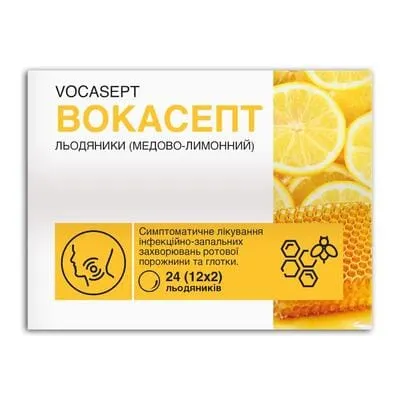
Table of Contents
INSTRUCTIONS FOR MEDICAL USE OF THE MEDICINAL PRODUCT VOKASEPT LOZENGES
Composition:
Active substances: amylocresol; 2,4-dichlorobenzyl alcohol;
1 lozenge contains:
amylocresol 0.6 mg; 2,4-dichlorobenzyl alcohol 1.2 mg;
Excipients:
REGULAR menthol, anise oil, peppermint oil, sodium lauryl sulfate, anhydrous citric acid, carmoisine dye (E 122), Ponceau 4R dye (E 124), caramel mass (sucrose, glucose syrup);
ORANGE menthol, orange flavor, anhydrous citric acid, sunset yellow FCF dye (E 110), caramel mass (sucrose, glucose syrup);
HONEY-LEMON menthol, lemon flavor, honey flavor, carmine dye (E 120), caramel mass (sucrose, glucose syrup);
MENTHOL-EUCALYPTUS menthol, eucalyptus oil, anhydrous citric acid, sodium saccharin, indigo carmine dye (E 132), caramel mass (sucrose, glucose syrup).
Pharmaceutical form. Lozenges.
Main physicochemical properties:
REGULAR
raspberry-colored, round lozenges predominantly with an anise-like odor and a characteristic sour taste;
ORANGE
orange-colored, round lozenges predominantly with an orange odor and a characteristic sour taste;
HONEY-LEMON
yellow to light brown in color, round lozenges predominantly with a honey-lemon odor and a characteristic sour taste;
MENTHOL-EUCALYPTUS
blue-green in color, round lozenges predominantly with a menthol-eucalyptus odor and a characteristic sour taste.
Pharmacotherapeutic group. Preparations used in throat disorders. ATC code R02A A20.
Pharmacological properties.
Pharmacodynamics.
Vokasept is a combined antiseptic preparation for topical use in infectious diseases of the oral cavity and pharynx. The main active ingredients – amylmetacresol and 2,4-dichlorobenzyl alcohol – exert a synergistic effect and demonstrate antimicrobial activity against a relatively broad spectrum of gram-positive and gram-negative microorganisms, preventing secondary bacterial infection in viral upper respiratory tract diseases. The natural medicinal additives contained in the preparation reduce throat pain and exert a soothing effect on the mucous membrane.
Clinical characteristics.
Indications.
Symptomatic treatment of infectious and inflammatory diseases of the oral cavity and throat.
Contraindications.
Hypersensitivity to any component of the drug.
Interaction with other medicinal products and other forms of interaction.
Clinically significant interaction with medicinal products from other groups is unknown.
Special precautions for use.
Do not exceed the stated maximum dose.
If symptoms do not begin to improve within 3–4 days, or if the patient's condition worsens, or if adverse reactions occur, consult a physician to determine whether continued use of the drug is appropriate.
When prescribing this medication to patients with diabetes mellitus, consider the sugar content of the lozenges (1 lozenge contains approximately 2 g of sugar, equivalent to 1/6 carbohydrate exchange unit (CEU)).
Since the formulation contains sucrose, this medication should not be used in patients with rare hereditary conditions such as fructose intolerance or sucrase-isomaltase deficiency.
Vokasept lozenges (Orange) contain the colorant Sunset Yellow FCF (E 110), and Vokasept lozenges (Regular) contain the colorant Ponceau 4R (E 124), which may cause allergic reactions.
Use during pregnancy or breastfeeding.
Safety of use has not been established.
Ability to influence reaction rate while driving or operating machinery.
No effect.
Dosage and Administration.
For adults and children aged 7 years and older, one lozenge is recommended to be sucked every 2–3 hours, but not more than 8 lozenges per day. Treatment should be continued until symptoms disappear, but not longer than 5 days.
Children. Do not use in children under 7 years of age.
Overdose.
May manifest as gastrointestinal discomfort, which resolves spontaneously after discontinuation of the drug and does not require specific therapeutic measures. Increased intensity of adverse reactions is possible.
Side effects.
The side effects listed below were observed during short-term use of
2,4-dichlorobenzyl alcohol and amylmetacresol at over-the-counter doses. Other side effects may occur during treatment of chronic conditions or with prolonged use.
Side effects are classified by system organ class and frequency. Frequency is defined as follows: very common: ≥1/10; common: ≥1/100 and <1/10; uncommon: ≥1/1000 and <1/100; rare: ≥1/10,000 and <1/1000; very rare: <1/10,000.
Immune system disorders.
Uncommon: hypersensitivity reactions.
Respiratory, thoracic and mediastinal disorders.
Uncommon: pharyngeal edema (throat swelling).
Gastrointestinal disorders.
Uncommon: oral discomfort (burning sensation in mouth), throat irritation (burning sensation in throat), oral paresthesia (tingling sensation in mouth), oral edema.
Rare: glossodynia (painful tongue), stomatitis.
Very rare: dyspepsia, nausea.
Skin and subcutaneous tissue disorders.
Uncommon: skin rash, pruritus, urticaria, erythema.
Shelf life. 3 years.
The expiry date is indicated on the packaging.
Storage conditions.
Store in a dry, light-protected place, out of reach of children, at a temperature not exceeding 25 °C.
Do not use after the expiry date stated on the packaging.
Packaging.
1 lozenge in a sachet, 100, 200, or 300 sachets with lozenges in a jar. 12 lozenges in a blister, 1 or 2 blisters in a cardboard box. 6 lozenges in a blister, 1 blister in a cardboard box.
Supply category. Over-the-counter.
Manufacturer. Maxon Healthcare Pvt. Ltd.
Manufacturer's address and place of business.
Plot No. 6-A, Sector D, AKVM Industrial Area, Mandideep, Raisen District, Madhya Pradesh 462046, India