Venoton
Ukraine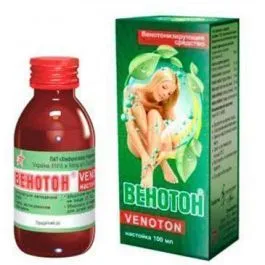
Table of Contents
INSTRUCTION FOR MEDICAL USE OF THE MEDICINAL PRODUCT VENOTON® (VENOTON)
Composition:
Active substances: 1 ml of the preparation contains an extract tincture from the mixture of herbal raw materials "Venoton®" (1:10) (extractant – 40% ethanol): Hippocastani semina (horse chestnut seeds) 40 mg; Sophorae japonicae fructus (Japanese sophora fruit) 15 mg; Avenae fructus (oat fruit) 15 mg; Coryli folia (hazel leaves) 10 mg; Sorbi fructus (rowan fruit) 10 mg; Meliloti herba (sweet clover herb) 5 mg; Chelidonii herba (celandine herb) 5 mg;
Excipients: none, except the extractant.
Pharmaceutical form. Tincture.
Main physicochemical properties: clear liquid, ranging in color from yellowish-brown to brown, with a pleasant odor. Sediment may form during storage.
Pharmacotherapeutic group.
Capillary-stabilizing agents.
ATC code C05CX.
Pharmacological Properties.
Pharmacodynamics.
Venoton® is a venotonic, capillary-protective, anti-exudative, anti-inflammatory, and anti-edematous agent.
Horse chestnut extract exerts venotonic, capillary-protective, anti-edematous, anti-aggregatory, and anticoagulant effects, which are due to the presence of the flavonoid glycoside esculin and the saponin aescin. Esculin reduces capillary permeability, enhances serum antithrombotic activity, increases antithrombin production in the vascular reticuloendothelial system, and enhances venous blood filling, especially in the presence of pathological changes. Aescin reduces blood viscosity.
The main active component of Japanese sophora is rutin, which strengthens vascular walls by reducing their fragility. It restores vascular elasticity and exerts a calming and anti-inflammatory effect.
The amino acid composition of oats promotes the elimination of excess cholesterol from the body and provides general strengthening effects.
Rowan berries exert anti-inflammatory, capillary-protective, and hypotensive effects.
Hazel leaves have anti-inflammatory and vasoconstrictive actions and strengthen the walls of blood vessels.
The biological activity of masterwort herb is determined by its content of coumarin. Coumarin increases arterial blood pressure, enhances cardiac minute volume, and improves cerebral and peripheral blood supply.
Greater celandine herb exerts an anti-inflammatory effect.
Clinical characteristics.
Indications.
Venous disorders of the lower limbs: varicose veins, venous insufficiency (edema of the lower limbs, calf muscle cramps, numbness, pain and heaviness in the legs), leg ulcers, phlebitis, thrombophlebitis; hemorrhoidal nodes, pain and swelling due to muscle and joint strain; ligament sprains and overexertion; traumatic hematomas.
Contraindications.
Hypersensitivity to any component of the drug, internal bleeding, acute and chronic renal failure, history of liver disease, angina pectoris, bronchial asthma, neurological syndromes, epilepsy.
Interaction with other medicinal products and other forms of interaction.
The drug should not be used concomitantly with aminoglycosides, as nephrotoxicity increases. If concomitant use with anticoagulants is necessary, the dose of the latter should be reduced. It should not be taken with cephalosporin antibiotics.
Special precautions for use.
The medicinal product should only be used diluted. A precipitate may form during storage; however, this does not affect the drug's efficacy. Shake well before use.
In case of sudden onset of unusual and serious symptoms, especially affecting only one leg—such as swelling, skin discoloration, sensation of tension or warmth, pain—the patient should immediately consult a physician, as these signs may indicate venous thrombosis in the leg.
Other non-invasive treatment methods should be necessarily applied, such as leg compresses, wearing supportive elastic stockings, or cold water dousing. Renal function should be monitored during the use of this medicinal product. Treatment with Chelidonium preparations is permitted only upon physician's prescription and under medical supervision.
Use during pregnancy or breastfeeding.
The tincture should not be used during pregnancy or breastfeeding.
Ability to influence reaction rate when driving or operating machinery.
The drug should not be administered to drivers or patients working with machinery and equipment requiring high attention and quick psychomotor reactions.
Dosage and Administration.
The medication is intended for adult use. Take orally, 1 teaspoon (5 ml) of the tincture diluted in ¼ cup of water, 30 minutes before meals, 3–4 times daily. The treatment course is 20 days. After a 10-day interval, the course may be repeated. The maximum daily dose is 20 ml.
Children.
The tincture is not intended for use in children.
Overdose.
An increased incidence of adverse reactions is possible.
When doses exceeding the recommended amounts are used, symptoms such as headache, dizziness, nausea, vomiting, respiratory disturbances, and gastrointestinal disorders may occur.
When high doses of the medication are used, poisoning symptoms associated with horse chestnut (Aesculus hippocastanum) seed ingestion may occur, including nephrotoxic reactions, thrombosis, feelings of restlessness; severe diarrhea accompanied by vomiting; mydriasis, drowsiness, delirium, and potentially fatal outcome due to respiratory paralysis within 24–48 hours.
Treatment: discontinue the medication; if vomiting is not present and a large amount of the drug has been ingested, gastric lavage and administration of activated charcoal are recommended; symptomatic treatment.
Side effects.
Cardiovascular system: chest pain, tachycardia, arterial hypotension.
Skin: hypersensitivity reactions, including rash, redness, itching, sensation of heat, urticaria, angioneurotic edema.
Gastrointestinal tract: dyspeptic symptoms, epigastric pain, nausea, vomiting, heartburn, diarrhea.
If adverse reactions occur, discontinue use of the drug and consult a physician.
Shelf life.
2 years.
Do not use after the expiry date stated on the packaging.
Storage conditions.
Store in the original packaging at a temperature not exceeding 25 °C.
Keep out of reach of children.
Packaging.
100 ml in bottles No. 1, 100 ml in jars No. 1, in a cardboard box.
Availability category.
Over-the-counter.
Manufacturer.
JSC "Chemical and Pharmaceutical Plant "Chervona Zirka".
Manufacturer's address and place of business.
1 Gordienkovska Street, Kharkiv, 61010, Ukraine.