Turusol
Ukraine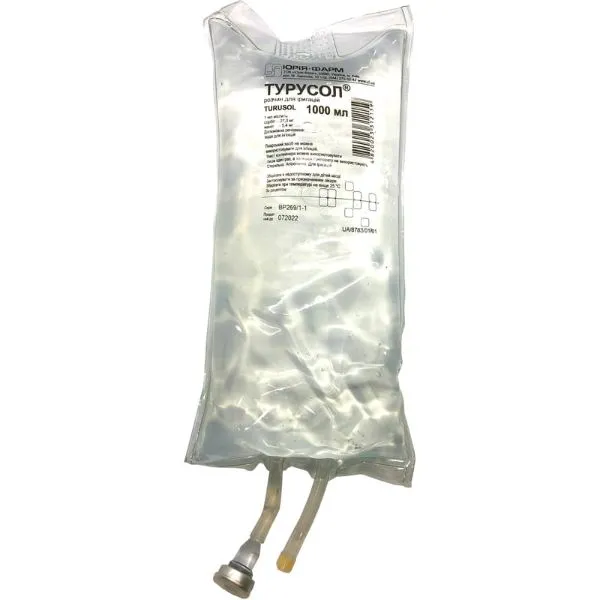
Instructions for Use
INSTRUCTIONS FOR MEDICAL USE OF THE MEDICINAL PRODUCT TURUSOL® (TURUSOL)
Composition:
Active substances: sorbitol, mannitol;
1 ml of solution contains sorbitol 27 mg and mannitol 5.4 mg;
Excipient: water for injections.
Pharmaceutical form. Solution for irrigation.
Main physicochemical properties: clear, colorless liquid.
Pharmacotherapeutic group.
Solvents and diluents, including irrigation solutions.
ATC code V07AB.
Pharmacological properties.
Pharmacodynamics.
Upon absorption of the drug into the bloodstream, mannitol is minimally metabolized in the liver with the formation of glycogen and is excreted by the kidneys. Sorbitol absorption causes a slight increase in plasma lactate levels, since sorbitol participates in lactate metabolism from pyruvate; however, the plasma lactate level is insufficient to induce metabolic acidosis. If the drug is absorbed, its components are rapidly excreted by the kidneys.
Pharmacokinetics.
Not studied.
Clinical characteristics.
Indications.
Used as an irrigation fluid during endoscopic surgeries and diagnostic procedures: transurethral resection of the prostate and other transurethral surgical procedures, hysteroscopy, arthroscopy.
Contraindications.
Hypersensitivity to the drug, severe heart failure, dehydration, hyperosmolar state, renal insufficiency with impaired renal filtration function, acute renal failure with anuria lasting more than 12 hours, pulmonary edema, hemorrhagic stroke, hyponatremia, hypochloremia, hypokalemia, coma.
Interaction with other medicinal products and other forms of interaction.
Not studied.
Special precautions for use.
Use with caution in patients with cardiovascular diseases and renal insufficiency.
When using a double-lumen irrigation needle for solution irrigation, the maximum outer diameter of the upper segment of the irrigation needle intended for air supply must not exceed 3 mm.
Use during pregnancy or breastfeeding.
Use during pregnancy or breastfeeding has not been studied; therefore, the use of the drug is not recommended in these patient groups.
Ability to affect reaction speed when driving or operating machinery.
The drug should be used only under inpatient conditions.
Administration and Dosage.
When using the Turusol® preparation, a single-use sterile system is employed. The recommended height of the container above the level of the surgical field should not exceed 60 cm, as this minimizes the possibility of intravascular absorption of the solution. The amount of the preparation used depends on the volume and duration of the surgical procedure.
Children.
Use in children has not been studied; therefore, the use of this preparation in this patient category is not recommended.
Overdose.
Rapid administration of doses exceeding 5000 ml may lead to an increase in extracellular fluid volume, hyponatremia, hyperkalemia, and volume overload of the heart, particularly in patients with acute or chronic renal insufficiency and in those with dehydration.
Treatment is symptomatic.
Adverse Reactions
Metabolic and nutritional disorders: dehydration, disturbances of water and electrolyte balance, hyponatremia, hypokalemia, hyperosmolarity of blood plasma.
Cardiac disorders: tachycardia, chest pain, decreased arterial pressure, pulmonary edema, worsening of circulatory insufficiency.
Neurological disorders: seizures, hallucinations, headache.
Gastrointestinal disorders: dyspepsia, nausea, vomiting, diarrhea.
Other: weakness, facial swelling.
Reporting of Adverse Reactions
Reporting of adverse reactions following drug registration is of great importance. It enables continuous monitoring of the benefit-risk balance of the medicinal product. Healthcare and pharmacy professionals, as well as patients or their legal representatives, are encouraged to report all suspected adverse reactions and lack of drug efficacy via the Automated Information System for Pharmacovigilance at the following link: https://aisf.dec.gov.ua.
Shelf Life
3 years.
Storage Conditions
Store at a temperature not exceeding 25 °C.
Keep out of reach of children.
Packaging
1000 ml, 3000 ml in polymer bags.
Prescription Status
Prescription only.
Manufacturer
LLC "Yuria-Pharm"
Manufacturer's Address and Location of Business Activity
108, Kobzarska Street, Cherkasy, Cherkasy region, 18030, Ukraine. Tel.: (044) 281-01-01.
Frequently Asked Questions
What is Turusol prescribed for?
The drug is used as an irrigation fluid during endoscopic surgeries and diagnostic procedures, such as hysteroscopy, arthroscopy, transurethral resection of the prostate, and other similar surgical interventions.
How should Turusol be used correctly?
The drug is used only in hospital settings using a single-use sterile system. The amount of solution depends on the duration and volume of the operation. To minimize the risk of the drug entering the blood vessels, the height of the container above the surgical field should not exceed 60 cm.
What are the possible side effects of Turusol?
Possible side effects include electrolyte imbalances and dehydration, cardiac problems (tachycardia, chest pain, low blood pressure, pulmonary edema), neurological disorders (seizures, hallucinations, headache), as well as nausea, vomiting, diarrhea, weakness, or facial edema.
Who should not use this drug?
Contraindications include hypersensitivity to the components, severe heart failure, dehydration, renal failure (specifically acute renal failure with anuria for more than 12 hours), pulmonary edema, hemorrhagic stroke, comatose states, as well as imbalances in blood sodium, chloride, or potassium levels.
Can the drug be used by pregnant women, breastfeeding women, or children?
Use during pregnancy, breastfeeding, or in children is not recommended, as data regarding their use have not been studied.
What should be done in case of overdose?
Rapid administration of large doses (over 5000 ml) can lead to cardiac overload, electrolyte imbalance, and increased fluid volume in the tissues. In such cases, treatment should be symptomatic.
This page has been machine-translated and may contain inaccuracies. The original data is available in the manufacturing country's language.
Last data check: July 21, 2026 · Data source: Державний реєстр лікарських засобів України