Cefepime astra
Ukraine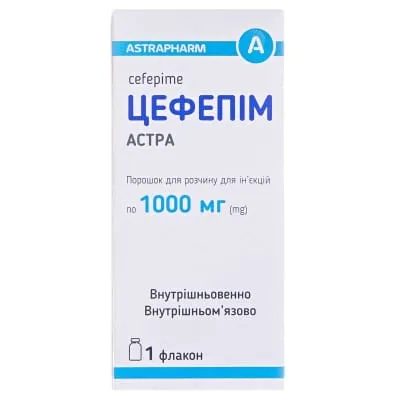
Table of Contents
INSTRUCTIONS FOR MEDICAL USE OF THE MEDICINAL PRODUCT CEFEPIME ASTRA
Composition:
Active substance: cefepime;
1 vial contains cefepime hydrochloride equivalent to cefepime 500 mg or 1000 mg;
Excipient: L-arginine.
Pharmaceutical form. Powder for solution for injection.
Main physicochemical properties: white to yellowish powder.
Pharmacotherapeutic group. Antibacterial agents for systemic use. Other β-lactam antibiotics. Fourth-generation cephalosporins. Cefepime.
ATC code J01D E01.
Pharmacological Properties
Pharmacodynamics
Clinical Experience
The safety and efficacy of cefepime for the empirical treatment of patients with febrile neutropenia were evaluated in two multicenter, randomized clinical studies. In 317 patients, cefepime monotherapy (2 g intravenously every 8 hours) was compared to ceftazidime monotherapy (2 g intravenously every 8 hours).
The characteristics of the evaluated patient population are presented in the table below.
Demographic data of patients (first episode only)
| Cefepime |
Ceftazidime |
|
| Total |
164 |
153 |
| Mean age (years) |
56.0 (range 18–82) |
55.0 (range 16–84) |
| Male |
86 (52 %) |
85 (56 %) |
| Female |
78 (48 %) |
68 (44 %) |
| Leukemia |
65 (40 %) |
52 (34 %) |
| Other hematologic malignancies |
43 (26 %) |
36 (24 %) |
| Solid tumors |
54 (33 %) |
56 (37 %) |
| Median absolute neutrophil count (cells/µL) |
20.0 (range 0–500) |
20.0 (range 0–500) |
| Mean duration of neutropenia (days) |
6.0 (range 0–39) |
6.0 (range 0–32) |
| Central venous catheter |
97 (59 %) |
86 (56 %) |
| Prophylactic antibiotic therapy |
62 (38 %) |
64 (42 %) |
| Bone marrow transplantation |
9 (5 %) |
7 (5 %) |
| Systolic blood pressure* < 90 mmHg at baseline |
7 (4 %) |
2 (1 %) |
* SBP — systolic blood pressure.
Clinical response rates are presented in the table below. According to all measurement criteria, cefepime was therapeutically equivalent to ceftazidime.
Summary response rates for empirical treatment of febrile neutropenia
| Measurement criteria |
% response |
|
| Cefepime (n = 164) |
Ceftazidime (n = 153) |
|
| Primary episode completed without change in treatment regimen, without new febrile episode or infection, with oral antibiotic therapy allowed until end of treatment |
51 |
55 |
| Primary episode completed without change in treatment regimen, without new febrile episode or infection, without oral antibiotic therapy after completion of treatment |
34 |
39 |
| Survival rate with any allowed changes in treatment |
93 |
97 |
| Primary episode completed without change in treatment regimen, with oral antibiotic therapy allowed until completion of treatment |
62 |
67 |
| Primary episode completed without change in treatment regimen and without oral antibiotic therapy after treatment |
46 |
51 |
There are insufficient data demonstrating the efficacy of cefepime monotherapy in patients at increased risk of severe infections (including patients with a recent history of bone marrow transplantation, arterial hypotension at the start of treatment, concomitant malignant hematological disorders, or severe or prolonged neutropenia). There are no data available for patients with septic shock.
Cefepime minimum inhibitory concentration (MIC) breakpoints
The cefepime minimum inhibitory concentration (MIC) breakpoints as defined by the European Committee on Antimicrobial Susceptibility Testing (EUCAST):
| Microorganisms |
Breakpoint values (mg/l) |
|
| Susceptible |
Resistant |
|
| Aeromonas spp. |
≤ 1 |
> 4 |
| Enterobacterales |
≤ 1 |
> 4 |
| Haemophilus influenzae |
≤ 0.25 |
> 0.25 |
| Moraxella catarrhalis |
≤ 4 |
> 4 |
| Pseudomonas spp. |
≤ 0.001 |
> 8 |
| Staphylococcus spp. |
Note1 |
Note1 |
| Streptococcus spp. (groups A, B, C and G) |
Note2 |
Note2 |
| Streptococcus pneumoniae |
≤ 1 |
> 2 |
| Viridans group streptococci |
≤ 0.5 |
> 0.5 |
-
Susceptibility of staphylococci to cephalosporins is determined based on susceptibility to cefoxitin.
-
Susceptibility of group A, B, C, and G streptococci to cephalosporins is determined based on susceptibility to benzylpenicillin.
Antibacterial spectrum of activity of cefepime
The prevalence of acquired resistance in certain bacterial species may vary depending on geographical region and change over time. Therefore, information on local resistance patterns is useful, especially for the treatment of severe infections.
The data below can serve only as a rough guide to the likely susceptibility of a bacterial strain to cefepime.
Susceptible species
Gram-positive aerobes: Staphylococcus Meti-S, Streptococcus, Streptococcus pneumoniae.
Gram-negative aerobes: Acinetobacter baumannii, Branhamella catarrhalis, Citrobacter freundii,
Citrobacter koseri, Enterobacter, Escherichia coli, Haemophilus influenzae, Klebsiella, Morganella morganii, Neisseria, Proteus mirabilis, Proteus vulgaris, Providencia, Salmonella, Serratia, Shigella.
Anaerobes: Clostridium perfringens, Fusobacterium, Peptostreptococcus, Prevotella.
Moderately susceptible bacterial species (intermediate in vitro susceptibility)
Gram-negative aerobes: Pseudomonas aeruginosa.
Resistant bacterial species
Gram-positive aerobes: enterococci, Listeria, Staphylococcus (methicillin-resistant*).
Gram-negative aerobes: Burkholderia cepacia, Stenotrophomonas maltophilia.
Anaerobes: Bacteroides fragilis, Clostridium difficile.
* Methicillin resistance among staphylococci is approximately 30 to 50% and occurs predominantly in healthcare settings.
Pharmacokinetics
The pharmacokinetics of cefepime are linear over the dose range of 250 mg to 2 g following intravenous administration and 500 mg to 2 g following intramuscular administration, and remain unchanged throughout the treatment period.
Absorption
After intramuscular administration, absorption is rapid and complete.
Distribution
Mean plasma concentrations of cefepime in adult males after single 30-minute intravenous (i.v.) / intramuscular (i.m.) administration are shown in the table below.
Mean plasma concentrations of cefepime (μg/mL)
| Cefepime dose |
0.5 hour |
1 hour |
2 hours |
4 hours |
8 hours |
12 hours |
| 250 mg IV |
20.1 |
10.9 |
5.9 |
2.6 |
0.5 |
0.1 |
| 500 mg IV |
38.2 |
21.6 |
11.6 |
5 |
1.4 |
0.2 |
| 1 g IV |
78.7 |
44.5 |
24.3 |
10.5 |
2.4 |
0.6 |
| 2 g IV |
163.1 |
85.8 |
44.8 |
19.2 |
3.9 |
1.1 |
| 500 mg IM |
8.2 |
12.5 |
12 |
6.9 |
1.9 |
0.7 |
| 1 g IM |
14.8 |
25.9 |
26.3 |
16 |
4.5 |
1.4 |
| 2 g IM |
36.1 |
49.9 |
51.3 |
31.5 |
8.7 |
2.3 |
Cefepime concentrations in tissues and body fluids are shown in the table below.
Average cefepime concentrations in tissues and body fluids
| Tissues or biological fluids |
Dose / route of administration |
Sampling: mean time interval (hours) |
Mean concentration in tissue (μg/g), biological fluid (μg/mL) |
Mean concentration in blood plasma (μg/mL) |
| Urine |
500 mg IV 1 g IV 2 g IV |
0–4* 0–4* 0–4* |
292 926 3120 |
4.9** 10.5** 20.1** |
| Bile |
2 g IV |
9 |
11.2 |
9.2 |
| Peritoneal fluid |
2 g IV |
4.4 |
18.3 |
24.8 |
| Interstitial fluid |
2 g IV |
1.5 |
81.4 |
72.5 |
| Bronchial mucosa |
2 g IV |
4.8 |
24.1 |
40.4 |
| Appendix |
2 g IV |
5.7 |
5.2 |
17.8 |
| Gallbladder |
2 g IV |
9.6 |
8.1 |
8.5 |
* Urine is collected during the first 4 hours after administration.
** Plasma was taken 4 hours after injection.
Cefepime distribution in tissues does not change within the dose range of 250 mg – 2 g. The mean volume of distribution at steady state is 18 liters. The mean elimination half-life is 2 hours. Cefepime accumulation was not observed in patients receiving a 2 g intravenous dose every 8 hours for 9 days. Protein binding is less than 19% and is independent of cefepime plasma concentration. The elimination half-life is prolonged in patients with renal impairment.
Metabolism
Cefepime is poorly metabolized. Approximately 7% of the administered dose is converted to the N-methylpyrrolidine oxide metabolite and excreted in urine.
Excretion
The mean total clearance is 120 mL/min. The mean total renal clearance of cefepime is 110 mL/min, with elimination occurring predominantly via glomerular filtration. 85% of the administered dose is excreted unchanged in urine. After intravenous administration of 500 mg cefepime, plasma concentrations fall below the quantitation limit within 12 hours and in urine within 16 hours. The mean urinary concentration 12–16 hours after administration is 17.8 mcg/mL. After intravenous administration of 1 or 2 g, the mean urinary concentration during the 12–24 hour interval is 26.5 and 28.8 mcg/mL, respectively. At 24 hours, cefepime plasma concentrations are below the quantitation limit.
Patients with renal impairment
In patients with renal impairment of varying degrees, the elimination half-life of cefepime is significantly prolonged. A linear correlation exists between total clearance and creatinine clearance in patients with impaired renal function (see section "Dosage and administration"). The elimination half-life of cefepime in patients undergoing dialysis is 13–17 hours.
Patients with hepatic impairment
In patients with hepatic dysfunction, the pharmacokinetics of cefepime after a single 1 g dose were not altered. Therefore, dosage adjustment is not necessary.
Geriatric patients
For geriatric patients (>65 years) with normal renal function, dose adjustment is not required. For patients with renal impairment (glomerular filtration rate <50 mL/min), the dose should be adjusted to compensate for reduced renal elimination (see sections "Dosage and administration" and "Special precautions"). Cases of reversible encephalopathy have been reported, primarily in patients with renal impairment receiving doses higher than recommended, especially in geriatric patients (see sections "Adverse reactions" and "Overdose").
Children aged 2 months with body weight < 40 kg
The pharmacokinetics of cefepime in children aged 2 months with body weight < 40 kg do not differ from those in adults.
Clinical Characteristics
Indications
Infections caused by microorganisms sensitive to cefepime:
Adults and children with body weight > 40 kg
Use for treatment of patients suffering from bacteremia associated or potentially associated with one of the following infections:
- lower respiratory tract infections, including severe pneumonia;
- complicated and uncomplicated urinary tract infections;
- febrile episodes in patients with neutropenia.
Monotherapy with cefepime is indicated for empirical treatment of patients with febrile neutropenia. For patients at high risk of severe infections (e.g., patients after recent bone marrow transplantation, as well as patients with arterial hypotension, underlying hematological malignancy, or severe or prolonged neutropenia), monotherapy with antimicrobials may be inappropriate. Data on the efficacy of cefepime monotherapy in these patients are insufficient (see section "Pharmacological Properties");
- biliary tract infections.
Children aged 2 months and older with body weight ≤ 40 kg
- Febrile episodes in patients with neutropenia when the expected duration of neutropenia is short.
Available clinical data in children do not allow recommendation of cefepime as monotherapy.
Official recommendations on the appropriate use of antibacterial agents should be taken into account.
Contraindications. Hypersensitivity to cefepime or L-arginine, as well as to cephalosporin antibiotics, penicillins, and other β-lactam antibiotics.
Interaction with other medicinal products and other types of interactions
Bacteriostatic antibiotics
Concomitant treatment with bacteriostatic antibiotics may influence the activity of β-lactam antibiotics.
Specific issues related to international normalized ratio (INR) imbalance
Increased activity of oral anticoagulants has been reported in patients receiving antibiotics. Risk factors include severe infectious or inflammatory disease, advanced age, and poor general condition. Under these circumstances, it is difficult to distinguish between the effect of the infection itself and the effect of its treatment on the international normalized ratio (INR). These effects are most commonly associated with the following antibiotic classes: fluoroquinolones, macrolides, tetracyclines, certain cephalosporins, and drugs containing co-trimoxazole.
Special precautions for use
Hypersensitivity
Severe, and sometimes fatal, hypersensitivity reactions have been observed during treatment with β-lactam antibiotics, including cefepime. If severe hypersensitivity reactions occur, cefepime therapy must be discontinued immediately and appropriate emergency measures initiated.
Prior to initiation of therapy, it is essential to determine whether the patient has a history of severe hypersensitivity reactions to cefepime, other cephalosporins, or other β-lactam agents. The drug should be administered with caution to patients with a history of non-severe hypersensitivity reactions to other β-lactam antibiotics.
Administration of cephalosporins to patients with penicillin sensitivity must be undertaken with extreme caution; strict medical supervision is required from the first dose.
Cefepime should be used cautiously in patients with asthma or allergic diathesis. Patients should be closely monitored at the beginning of treatment. If an allergic reaction occurs, the drug should be discontinued immediately. Severe hypersensitivity reactions may require administration of epinephrine and other supportive therapies.
Antibiotics should be prescribed with caution in patients with any type of allergy, especially drug allergies. If an allergic reaction occurs, the drug should be discontinued and appropriate treatment initiated.
For patients at high risk of severe infections (e.g., after bone marrow transplantation with reduced marrow activity due to severe progressive haematological malignancy with severe neutropenia), monotherapy may be insufficient, and combination antimicrobial therapy is indicated.
Encephalopathy
When using beta-lactam antibiotics, there is a risk of developing encephalopathy, including confusion, altered consciousness, seizures, or abnormal movements, particularly in cases of overdose and/or renal impairment, and in elderly patients.
Clostridium difficile-associated diarrhea
Cases of diarrhea associated with Clostridium difficile have been reported with nearly all broad-spectrum antibiotics. Severe diarrhea may lead to life-threatening pseudomembranous colitis. Therefore, this condition should be considered in any patient who develops diarrhea during or after administration of the drug, as cases have been reported up to 2 months after discontinuation of therapy.
If Clostridium difficile-associated diarrhea is suspected, antibiotic treatment should be stopped immediately and appropriate specific therapy initiated. Products that cause constipation should be avoided.
Renal impairment
In patients with renal impairment (creatinine clearance ≤ 50 mL/min) or other conditions that may affect renal function, the dose of cefepime should be adjusted (see section "Dosage and administration") to compensate for reduced drug clearance and increased plasma concentrations.
Dosage adjustments should be based on the stage of renal impairment, severity of infection, and susceptibility of the causative microorganism (see sections "Dosage and administration" and "Pharmacokinetics").
Superinfection
As with other antibiotics, cefepime use may lead to colonization with resistant microorganisms. Appropriate measures should be taken if superinfection develops during treatment.
Elderly patients
The pharmacokinetics of cefepime have been studied in elderly individuals (> 65 years). Among 6400 adults included in clinical trials, 35% were aged 65 years or older, and 16% were aged 75 years or older. Dose adjustment is not required in patients with normal renal function. However, since renal function declines with age, dosage should be adjusted according to the patient’s renal function (see sections "Dosage and administration" and "Pharmacokinetics").
Monitoring of renal function is recommended when cefepime is used concomitantly with potentially nephrotoxic antibiotics (especially aminoglycosides) and potent diuretics.
Effect on diagnostic test results
Positive Coombs' test results have been reported in patients receiving cefepime twice daily, without clinical signs of hemolysis.
False-positive urine glucose test results may occur. For this reason, glucose oxidase-based methods should be used to determine glucose in urine during cefepime therapy.
Antibacterial activity
Due to its limited antibacterial spectrum, cefepime is not indicated for the treatment of certain types of infections, except when the causative organism has been identified as susceptible to cefepime or there are strong grounds to assume the likely pathogen is susceptible (see section "Pharmacodynamics").
Use during pregnancy or breastfeeding
Animal studies have shown no effect on reproductive function and no harmful effects on the fetus. However, adequate and well-controlled studies in pregnant women have not been conducted; therefore, cefepime should be used during pregnancy only if the potential benefit to the mother outweighs the potential risk to the fetus.
Cefepime is excreted in small amounts into breast milk; therefore, breastfeeding should be discontinued during treatment with this drug.
Fertility
Animal studies have not shown any adverse effects on fertility. There are no data on the effect of cefepime on human fertility.
Ability to affect reaction speed when driving or operating machinery. The drug may significantly affect reaction speed when driving vehicles or operating machinery, particularly due to the possible development of encephalopathy (see sections "Special precautions for use", "Adverse reactions", "Overdose").
Method of Administration and Dosage
Dosage
Patients with normal renal function
Adults and children with body weight > 40 kg
Recommended doses for monotherapy or combination therapy:
| Type of infections |
Single dose, route of administration |
Frequency of administration |
| Community-acquired respiratory tract infections Uncomplicated pyelonephritis |
1 g IV or IM |
Twice daily |
| Severe infections: sepsis/bacteremia, pneumonia, complicated urinary tract infections, biliary tract infections |
2 g IV |
Twice daily |
| Febrile episode in patients with neutropenia* |
2 g IV |
2–3 times daily |
| Severe Pseudomonas infections |
2 g IV |
Three times daily |
* The dose of 2 g three times daily was used only as monotherapy.
Children aged 2 months and older with body weight < 40 kg
50 mg/kg intravenously three times daily. Available clinical data in infants and children do not permit recommendation of cefepime as monotherapy.
The usual duration of treatment is generally 7–10 days; more severe infections may require longer treatment. For treatment of febrile episodes in neutropenic patients, the usual duration of therapy should not be less than 7 days or until resolution of neutropenia.
Patients with renal impairment
Cefepime is eliminated primarily by the kidneys through glomerular filtration. Therefore, the dose must be adjusted in patients with renal impairment (glomerular filtration rate < 50 mL/min) to compensate for reduced elimination. The glomerular filtration rate should be assessed to determine the maintenance dose.
Dose adjustments for patients with renal impairment are described in the table below.
| Creatinine clearance, mL/min |
||||
| Usual dosage |
50–30 |
29–11 |
≤ 10 |
Hemodialysis |
| 1 g twice daily |
1 g once daily |
500 mg once daily |
250 mg once daily |
Loading dose — 1 g, then — 500 mg once daily* |
| 2 g twice daily |
2 g once daily |
1 g once daily |
500 mg once daily |
Loading dose — 1 g, then — 500 mg once daily* |
| 2 g three times daily |
1 g three times daily |
1 g twice daily |
1 g once daily |
Loading dose — 1 g, then — 500 mg once daily* |
| 50 mg/kg three times daily |
25 mg/kg three times daily |
25 mg/kg twice daily |
25 mg/kg once daily |
|
- On dialysis days, the dose should be administered after the dialysis session.
If only serum creatinine concentration is known, the Cockcroft formula can be used to estimate creatinine clearance. The serum creatinine concentration should reflect a stable renal function status.
For males:
| creatinine clearance (ml/min) = |
body weight (kg) × (140 – age) |
| 7.2 × serum creatinine (mg/dl) |
For women: multiply the obtained value by 0.85.
In patients undergoing hemodialysis, the pharmacokinetics of cefepime indicate the need for dose reduction. These patients should receive a loading dose of 1 g on the first day, followed by 500 mg on subsequent days. Approximately 68% of the total amount of cefepime present in the body is removed during 3 hours of dialysis. On dialysis days, cefepime should be administered after dialysis. If possible, cefepime should be administered daily at the same time.
For patients undergoing continuous ambulatory peritoneal dialysis, cefepime may be administered at doses recommended for patients with normal renal function, but every 48 hours.
Administration method
The medicinal product is administered intravenously (0.5 g, 1 g, 2 g) as a slow intravenous infusion over 3–5 minutes or as a 30-minute infusion, or intramuscularly (0.5 g, 1 g) via deep intramuscular injection.
Intravenous administration
Reconstitute the powder for injection solution with water for injections or any other compatible diluent (see section "Compatibility" below).
Reconstituted volume prior to administration
| Vial |
Volume of diluent for reconstitution (ml) |
Approximate volume of resulting solution (ml) |
Approximate concentration of cefepime (mg/ml) |
| 500 mg IM |
1.5 |
2.2 |
240 |
| 500 mg IV |
5.0 |
5.7 |
90 |
| 1 g IM |
3.0 |
4.4 |
240 |
| 1 g IV |
10.0 |
11.4 |
90 |
Diluted solutions intended for intravenous administration may be used directly by slow intravenous infusion (3–5 minutes) or by drip infusion as part of a compatible infusion solution over 30 minutes.
Intramuscular administration
For intramuscular administration, 500 mg or 1 g of cefepime (as a powder for injection solution) should be reconstituted with water for injections or with 0.5% or 1% lidocaine hydrochloride solution.
Compatibility
Cefepime is compatible with the following solutions: 0.9% sodium chloride solution (with or without 5% glucose), 5% or 10% glucose solution, Ringer's solution (with or without 5% glucose), and M/6 sodium lactate solution.
Cefepime may be administered simultaneously with other antibiotics provided that separate syringes are used and administration is performed at different infusion or injection sites.
As with other cephalosporins, the diluted solution may change color to yellow-amber, which does not indicate loss of activity.
Stability and storage conditions
The reconstituted solution is chemically and physically stable for 24 hours at room temperature. To prevent microbiological contamination, it is recommended to use the solution immediately after reconstitution. If not used immediately, the physician is responsible for the duration and storage conditions. The total time between reconstitution, dilution, refrigerated storage at 2–8 °C, and administration must not exceed 7 days.
Visual inspection
As with other parenteral medicinal products, prepared cefepime solutions should be inspected visually for particulate matter prior to administration.
Identification of causative microorganism(s)
Appropriate microbiological investigations should be performed to identify the causative microorganism(s) and determine susceptibility to cefepime. However, cefepime may be used as monotherapy prior to identification of the causative microorganism due to its broad-spectrum antibacterial activity against both gram-positive and gram-negative microorganisms. In patients at risk of mixed aerobic/anaerobic infections (particularly Bacteroides fragilis), treatment with cefepime may be initiated in combination with an agent active against anaerobes, prior to identification of the causative organism.
Children. The medicinal product may be administered to children aged 2 months and older.
Overdose
Symptoms
When beta-lactam antibiotics are administered, there is a risk of developing encephalopathy, including confusion and impaired consciousness, seizures, or abnormal movements, particularly in cases of overdose and/or renal impairment.
Treatment
In cases of severe overdose, especially in patients with impaired renal function, serum cefepime levels can be reduced by hemodialysis. Peritoneal dialysis is ineffective.
Adverse Reactions
Below is a list of adverse reactions reported during treatment with this medicinal product. Frequencies are defined as follows: very common (≥ 1/10); common (≥ 1/100 to < 1/10); uncommon (≥ 1/1,000 to < 1/100); rare (≥ 1/10,000 to < 1/1,000); very rare (< 1/10,000); frequency not known (cannot be estimated from available data).
Infections and infestations
Uncommon: oral candidiasis.
Rare: candidiasis.
Very rare: vaginal infections.
Blood and lymphatic system disorders
Common: anaemia, eosinophilia.
Uncommon: thrombocytopenia, leukopenia, neutropenia.
Frequency not known: aplastic anaemia*, haemolytic anaemia*, agranulocytosis.
Immune system disorders
Rare: anaphylactic reactions, angioedema.
Very rare: anaphylactic shock.
Psychiatric disorders
Frequency not known: hallucinations**, confusion**.
Nervous system disorders
Rare: headache, paraesthesia.
Very rare: convulsions, dysgeusia, dizziness.
Frequency not known: encephalopathy**, seizures**, decreased attention and altered consciousness**, epilepsy**, myoclonus**, coma**.
Vascular disorders
Uncommon: phlebitis at the site of intravenous injection, thrombophlebitis at the site of intravenous injection.
Very rare: arterial hypotension, vasodilatation.
Frequency not known: haemorrhage*.
Respiratory, thoracic and mediastinal disorders
Rare: dyspnoea.
Gastrointestinal disorders
Common: diarrhoea.
Uncommon: nausea, vomiting.
Rare: constipation.
Very rare: pseudomembranous colitis, colitis, abdominal pain, oral ulceration.
Skin and subcutaneous tissue disorders
Common: rash.
Uncommon: erythema, urticaria, pruritus.
Frequency not known: toxic epidermal necrolysis*, Stevens–Johnson syndrome*, erythema multiforme*.
Renal and urinary disorders
Rare: renal failure.
Frequency not known: toxic nephropathy*.
Reproductive system and breast disorders
Rare: genital pruritus.
General disorders and administration site conditions
Common: infusion site reaction.
Uncommon: inflammation at infusion site, pain and inflammation at site of intravenous or intramuscular injection, pyrexia.
Rare: chills.
Investigations
Very common: positive Coombs test.
Common: increased levels of alkaline phosphatase, alanine aminotransferase, aspartate aminotransferase, bilirubinaemia, prolonged prothrombin time and activated partial thromboplastin time.
Uncommon: transient increase in serum urea and creatinine levels.
Very rare: decreased serum phosphorus levels.
Frequency not known: false-positive urine glucose test*.
* These adverse effects are mainly observed with the use of other drugs of the same class.
** When using beta-lactam antibiotics, there is a risk of developing encephalopathy, including confusion and impaired consciousness, epilepsy or abnormal movements, particularly in cases of overdose and/or renal impairment, and in elderly patients (see section "Overdose"). Symptoms of neurotoxicity usually improve after discontinuation of treatment and/or haemodialysis. However, several fatal cases have been reported.
Reporting of adverse reactions
Reporting suspected adverse reactions after marketing authorization is important. It allows continuous monitoring of the benefit-risk balance of the medicinal product. Medical and pharmaceutical professionals, as well as patients or their legal representatives, should report all suspected adverse reactions and lack of efficacy via the Automated Pharmacovigilance Information System at: https://aisf.dec.gov.ua.
Shelf life. 3 years (from the date of manufacture of the in bulk form).
Storage conditions
Store in the original packaging, out of reach of children, at a temperature not exceeding 25 °C. Prepared solutions for intramuscular and intravenous administration may be stored for up to 24 hours at room temperature or for up to 7 days in a refrigerator (2–8 °C).
Incompatibilities
Do not mix with other medicinal products in the same container. Use only the solvents specified in the sections "Method of administration and dosage" and "Interaction with other medicinal products and other forms of interaction".
Packaging
Vial with powder. 1 or 10 vials per cardboard box.
Prescription status. Prescription only.
Manufacturer. TOV "ASTRAFARM" (packaging from in bulk form: Hebei Huamin Pharmaceutical Co., Ltd., China).
Manufacturer's address and location of operations. 08132, Vyshneve, Buchanskyi district, Kyiv region, Kyivska St., 6, Ukraine.