Cefasol
Ukraine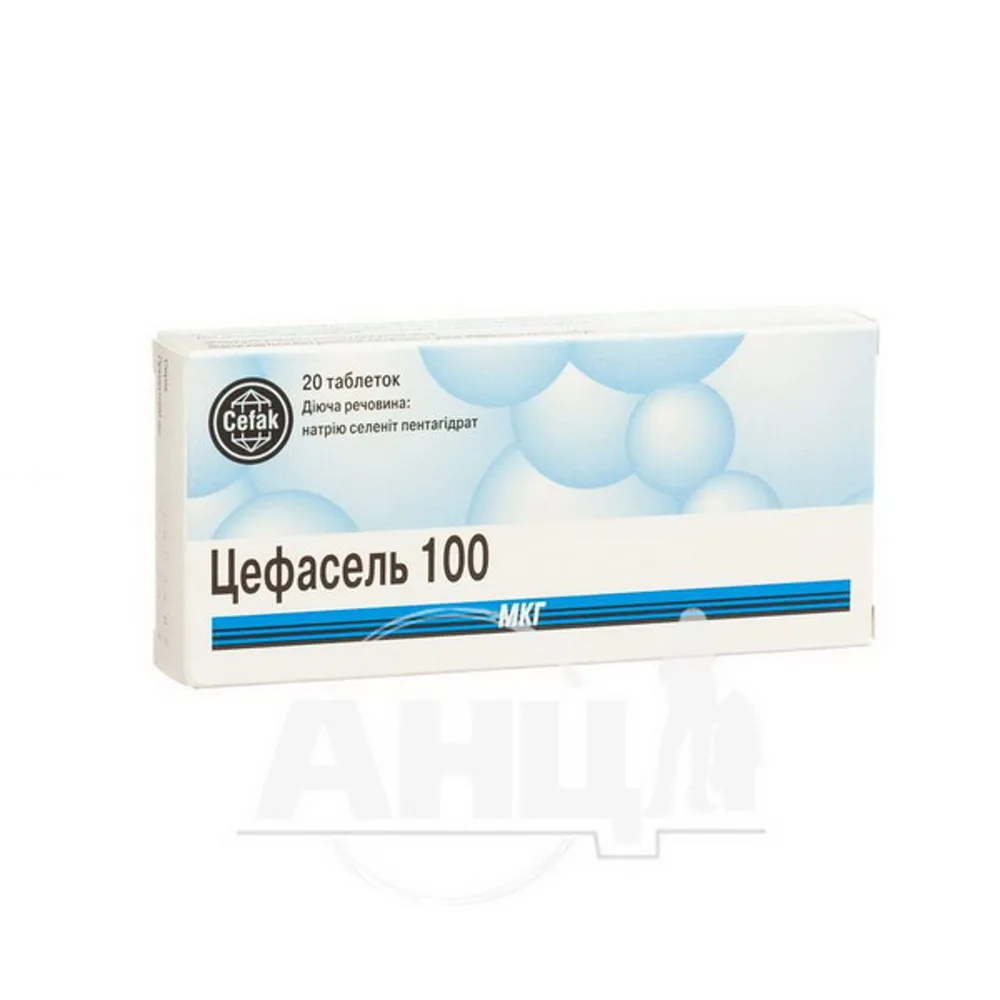
Table of Contents
Instructions for Medical Use of the Medicinal Product CEFASEL® (CEFASEL)
Composition:
Active substance: sodium selenite;
One tablet of Cefasel 100 μg contains 0.219 mg of sodium selenite (equivalent to 100 μg of selenium);
One tablet of Cefasel 300 μg contains 0.657 mg of sodium selenite (equivalent to 300 μg of selenium);
Excipients: povidone, mannitol (E 421), sucrose, magnesium stearate.
Pharmaceutical form. Tablets.
Main physicochemical properties: round, biconvex tablets, white in colour.
Pharmacotherapeutic group.
Mineral supplements. Other mineral supplements. Selenium. Sodium selenite.
ATC code A12CE02.
Pharmacological Properties
Pharmacodynamics
Selenium is one of the most important trace elements.
Selenium performs various functions in the body, typically in association with proteins in the form of the amino acid selenocysteine, an essential component of selenium-containing proteins, so-called selenoproteins. Over 25 selenium-containing proteins and protein subunits have currently been identified. These include glutathione peroxidase, selenoprotein P, deiodinases, thioredoxin reductase, and methionine sulfoxide reductase.
Glutathione peroxidase, for example, accelerates the breakdown of hydroperoxides and helps protect cells from oxidative damage (e.g., thyroid cells during the synthesis of thyroid hormones).
Selenoprotein P is the main selenium-carrying fraction in blood plasma and, among other roles, acts as a selenium-transporting protein. The selenocysteine-containing deiodinases are responsible, among other functions, for catalyzing the conversion of thyroxine (T4) into the active thyroid hormone triiodothyronine (T3).
Dietary intake of selenium is generally sufficient in Central Europe. Selenium-rich foods include, for example, egg yolk, fish, meat—particularly poultry and pork—as well as organ meats. The European Food Safety Authority recommends an adequate daily intake of selenium of 70 µg for adults and pregnant women, and 85 µg for breastfeeding women. The German Nutrition Society recommends a daily selenium intake of 60–70 µg.
Inadequate selenium intake leads to reduced glutathione peroxidase activity in humans and animals, although clinical symptoms may not be apparent. Selenium-dependent glutathione peroxidase influences the metabolism of leukotrienes, thromboxanes, and prostacyclins. Selenium deficiency both activates and suppresses immune response reactions and affects the activity of certain liver enzymes. Additionally, selenium deficiency potentiates oxidative or chemical liver injury and increases the toxicity of heavy metals such as mercury and cadmium.
In humans, Keshan disease (an endemic cardiomyopathy), as well as Kashin-Beck disease—an endemic osteoarthropathy with severe joint deformities—have been described as conditions arising from selenium deficiency.
In clinical cases of selenium deficiency, which have also been observed following prolonged parenteral nutrition and unbalanced diets, cardiomyopathies and skeletal muscle myopathies, in addition to changes in hair and nails, may occur.
Selenium deficiency can be diagnosed by reduced selenium levels in whole blood or plasma, or by decreased glutathione peroxidase activity in whole blood, plasma, or platelets. Reduced plasma selenium levels may be observed in patients with renal insufficiency as well as gastrointestinal disorders.
Pharmacokinetics
After oral administration, sodium selenite is absorbed in the small intestine. In the blood, selenium is predominantly taken up by erythrocytes and enzymatically reduced to hydrogen selenide. Hydrogen selenide serves as a central intermediate for incorporation into specific selenoproteins and for elimination from the body. The total selenium content in an adult human body is approximately 5–15 mg.
Excess hydrogen selenide is primarily metabolized into selenosugar and/or methylated selenium compounds, such as dimethylselenide or trimethylselenonium ions. Selenium undergoes an enterohepatic circulation. Selenium is excreted in feces or urine, depending on the body's selenium status and the administered dose. Following absorption of a toxic dose, elimination occurs via the lungs in the form of volatile methylated selenium compounds.
Clinical characteristics.
Indications.
Established selenium deficiency that cannot be compensated through diet.
Selenium deficiency may occur in cases of:
- impaired digestion and malabsorption,
- inadequate nutrition (e.g., total parenteral nutrition).
Contraindications.
Hypersensitivity to the components of the medicinal product, selenium intoxication.
Interaction with other medicinal products and other forms of interaction.
There are no clinical studies on the interaction of the medicinal product Cefasel with other medicinal products. Concomitant administration with ascorbic acid should be avoided, as formation of a precipitate of elemental selenium cannot be excluded. Elemental selenium is insoluble in aqueous environments and is not bioavailable. Therefore, an interval of at least 1 hour should be maintained between the administration of the medicinal product Cefasel and ascorbic acid.
Special precautions for use.
Patients with such rare hereditary disorders as fructose intolerance, glucose-galactose malabsorption, or sucrase-isomaltase deficiency should not take this medicinal product.
During therapy, serum/blood selenium levels should be monitored regularly.
Children (under 18 years of age)
There is insufficient data on the use of this medicinal product in this age group; therefore, its use is not recommended.
Use during pregnancy or breastfeeding.
Pregnancy
Selenium crosses the placenta. Data on the use of sodium selenite in pregnant women are limited. Reproductive toxicity studies in animals are insufficient.
Since Cefasel is used only when selenium deficiency has been established, adverse effects on pregnancy or the fetus are not expected. However, the medicinal product should be administered only after careful assessment of the benefit-risk ratio.
Breastfeeding period
Selenium passes into breast milk; however, at therapeutic doses, the medicinal product Cefasel does not exert a negative effect on the breastfed infant.
Fertility
There are no clinical data on the effect of selenium on fertility. In animal studies, effects were observed only at very high doses. In general, doses used to correct selenium deficiency do not cause adverse reactions affecting fertility.
Ability to influence reaction speed when driving vehicles or operating machinery.
Studies have not been conducted. Given the pharmacological properties of the medicinal product, no influence on the ability to drive vehicles or operate machinery is expected.
Method of Administration and Dosage
Tablets should be taken whole, without chewing, with a small amount of liquid, after meals. Unless otherwise prescribed, the dose is 100 mcg of selenium per day. This dose may be increased short-term up to 300 mcg of selenium. Treatment should be continued until normalization of selenium levels in plasma (80–120 ng/mL) and in blood (100–140 ng/mL).
Patients with hepatic or renal impairment.
Since the dose is determined based on measuring the actual selenium concentration in the patient's blood, there are no specific recommendations for dose reduction in particular patient groups, such as patients with hepatic or renal impairment.
Children.
The drug is not intended for use in children (under 18 years of age).
Overdose.
Symptoms of acute overdose may include garlic odor of breath, fatigue, nausea, diarrhea, and abdominal pain. Chronic overdose may lead to nail and hair growth abnormalities, as well as peripheral polyneuropathies.
Selenium levels in blood should be monitored at appropriate intervals. Possible treatments include forced diuresis or administration of high doses of ascorbic acid. In cases of acute overdose, elimination of selenite may be achieved through dialysis. Dimercaprol is not recommended, as it increases selenium toxicity.
Side effects.
No adverse reactions have been reported to date with the use of the medicinal product Cefasel as directed.
Reporting of adverse reactions after marketing authorization is of great importance. Cases of suspected adverse reactions or lack of efficacy should be reported to a physician or through the Automated Information System for Pharmacovigilance at the following link: https://aisf.dec.gov.ua.
Shelf life.
5 years.
Storage conditions.
No special storage conditions required. Keep out of reach and sight of children.
Packaging.
20 tablets in a blister; 1 blister per cardboard box.
Supply classification.
Over-the-counter (without prescription).
Manufacturer/Applicant.
Cefak KG.
Address of manufacturer’s location and place of business / applicant’s location and applicant’s representative.
Ostbahnhofstrasse 15, 87437 Kempten, Germany.
Contact details of the manufacturer's/applicant's representative in Ukraine – LLC "Megakom":
195-B Klochkivska Street, Kharkiv, 61145, Ukraine; phone: +38 (057) 701 37 55.