Troxevazin
Ukraine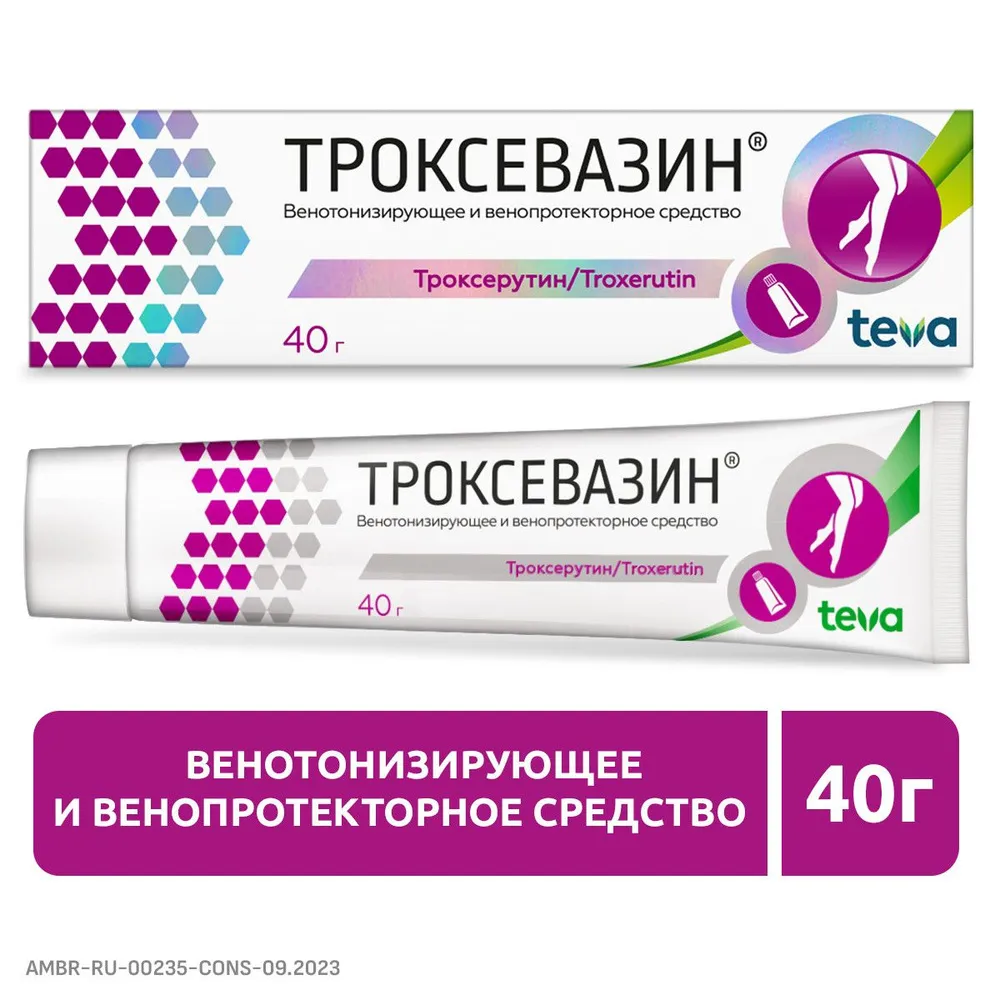
Table of Contents
INSTRUCTIONS FOR MEDICAL USE OF THE MEDICINAL PRODUCT Troxevasin® (Troxevasin®)
Composition:
Active substance: troxerutin;
1 g of gel contains troxerutin 20 mg;
Excipients: carbomer, triethanolamine, disodium edetate, benzalkonium chloride, purified water.
Pharmaceutical form. 2% gel.
Main physicochemical properties: gel of yellow to light brown color.
Pharmacotherapeutic group. Angioprotectives. Capillary-stabilizing agents. Bioflavonoids. Troxerutin. ATC code C05CA04.
Pharmacological properties.
Pharmacodynamics.
Troxevazin® is a mixture of bioflavonoids containing not less than 95% troxerutin. Troxerutin selectively accumulates in the endothelial layer of venules and deeply penetrates the subendothelial layer of the venous wall, where its concentration is higher than in adjacent tissues. The drug prevents oxidative damage to cell membranes.
The antioxidant effect is manifested by reduction and elimination of oxygen's oxidative properties, inhibition of lipid peroxidation, and protection of vascular endothelium from the oxidative action of hydroxyl radicals. Troxerutin reduces increased capillary permeability and exerts a venotonic effect. The cytoprotective effect results from inhibition of neutrophil activation and adhesion, reduction of erythrocyte aggregation, increased resistance of erythrocytes to deformation, and decreased release of inflammatory mediators.
It increases venous-arterial reflux, prolongs the time of venous refill, and improves microcirculation and microvascular perfusion.
The action of Troxevazin® is directed towards reducing edema and pain, improving trophicity, and eliminating various pathological disorders associated with venous insufficiency.
Pharmacokinetics.
After topical application of Troxevazin® gel, the active ingredient is readily released from the water-soluble gel base and penetrates into the dermis within approximately 30 minutes and into the subcutaneous fat tissue within 2–5 hours.
Clinical characteristics.
Indications.
Troxevazin®, gel, is indicated for symptomatic treatment of the following conditions:
- venous insufficiency;
- pre-varicose and varicose syndrome;
- superficial thrombophlebitis, phlebitis, and post-phlebitic conditions;
- complex treatment of hemorrhoidal disease;
- muscle cramps (spasmodic contraction of calf muscles).
Contraindications.
Hypersensitivity to troxerutin or to any excipient of the medicinal product. Troxevazin®, gel, should not be applied to mucous membranes, open wounds, or areas of skin affected by eczema.
Interaction with other medicinal products and other forms of interaction.
The drug enhances the effect of ascorbic acid on strengthening the vascular wall structure and reducing its permeability.
Special precautions for use.
Hypersensitivity reactions are more commonly observed in patients with skin and/or allergic disorders.
Benzalkonium chloride contained in the medicinal product has an irritating effect and may cause skin reactions. Troxevasin® gel should not be applied to the eyes or inflamed skin.
Prolonged use of the drug is not recommended in patients with severe renal function impairment.
If the severity of disease symptoms does not decrease during treatment with the drug, medical advice should be sought.
Use during pregnancy or breastfeeding.
There are no data regarding negative effects of the drug when used during pregnancy or breastfeeding. However, use of Troxevasin® gel during the first trimester of pregnancy is not recommended. This medicinal product should not be applied to the mammary glands of breastfeeding mothers, as it may enter the infant's body during breastfeeding.
Ability to affect reaction rate while driving or operating machinery.
Has no effect.
Method of Administration and Dosage
For topical use only.
Apply the gel evenly in a thin layer to the affected area twice daily (in the morning and evening), gently massaging until completely absorbed. If necessary, a tight or elastic bandage may be applied. The gel is odorless and does not leave greasy stains on clothing. In severe cases, combination therapy with Troxerutin® capsules is recommended. In chronic venous insufficiency, combination therapy should be continued until complete disappearance of symptoms.
The dosage and duration of treatment are determined by a physician, depending on the severity and course of the disease.
Children
There are no contraindications regarding the use of the drug in children.
Overdose
With topical application, cases of overdose have not been reported. In case of accidental ingestion of a large amount of the drug, general measures for removing the drug should be taken (e.g., inducing vomiting), along with symptomatic treatment. If necessary, perform peritoneal dialysis.
Side effects.
Very rarely, skin irritation or allergic reactions may occur during the use of Troxevasin® gel, including redness, itching, skin rash, dermatitis, angioedema. Usually, these symptoms quickly resolve after discontinuation of the medicinal product.
Reporting suspected adverse reactions. All suspected adverse reactions and cases of lack of efficacy should be reported via the following link: https://aisf.dec.gov.ua/.
Shelf life. 5 years.
Storage conditions.
Store in the original packaging at a temperature not exceeding 25 °C.
Do not freeze!
Keep out of reach of children.
Packaging.
20 g, or 40 g, or 100 g in tubes. One tube per cardboard box.
Availability. Over-the-counter.
| Manufacturer. |
Balkanpharma-Troyan AD.
Manufacturer's location and address of its business operations.
1 Krayarachna Str., Troyan, 5600, Bulgaria.