Triombrast®
Ukraine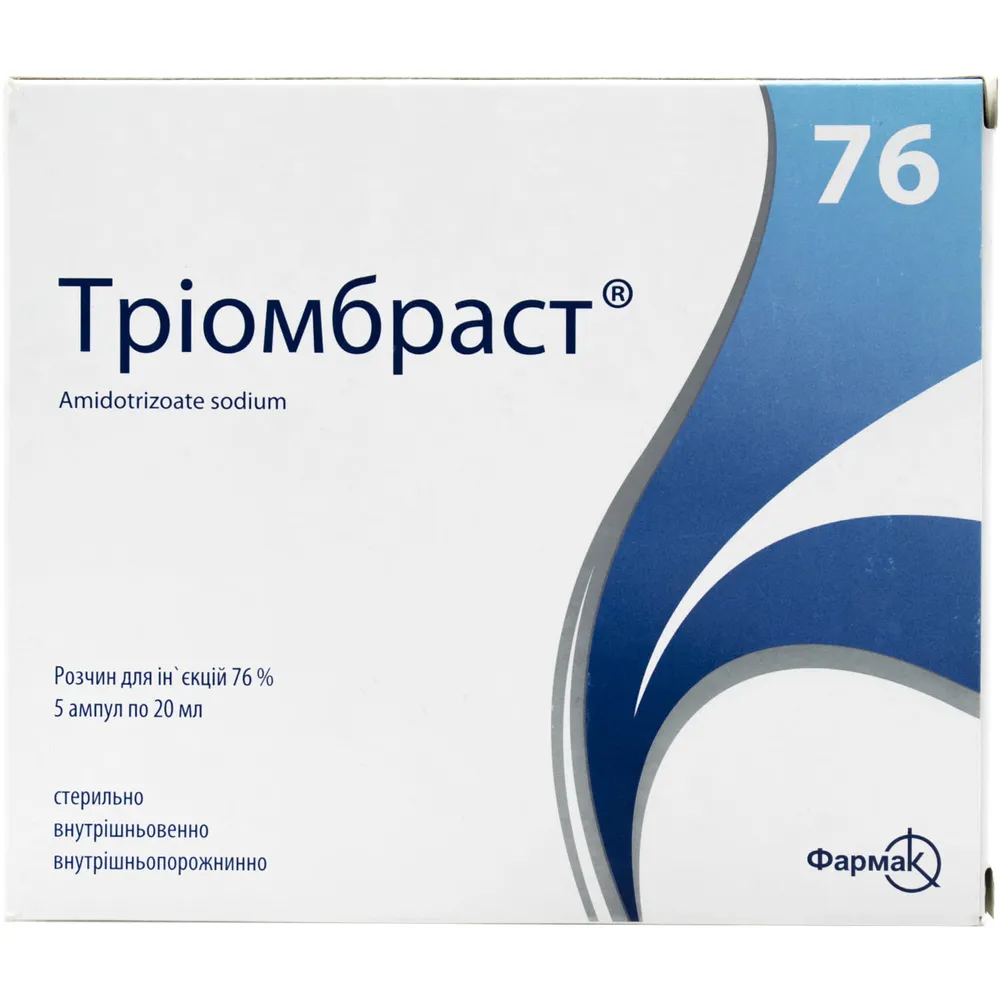
Table of Contents
INSTRUCTION FOR MEDICAL USE OF THE MEDICINAL PRODUCT TRIOBRAST® (TRIOMBRAST®)
Composition:
Active substances: 1 ml of 60 % solution contains diatrizoic acid dihydrate, recalculated to 100 % anhydrous substance – 471.6 mg; meglumine (N-methylglucamine), recalculated to 100 % dry substance – 125.7 mg;
1 ml of 76 % solution contains diatrizoic acid dihydrate, recalculated to 100 % anhydrous substance – 597.3 mg; meglumine (N-methylglucamine), recalculated to 100 % dry substance – 159 mg;
Excipients: sodium hydroxide, disodium edetate, water for injections.
Pharmaceutical form. Injection solution.
Main physicochemical properties: clear, colorless or slightly yellowish, slightly viscous liquid.
Pharmacotherapeutic group. Iodine-containing radiopaque agents. ATC code V08A A01.
Pharmacological Properties
Pharmacodynamics
The radiopaque agent Triombrost® is a salt of amidotrizoic acid containing bound iodine, which absorbs X-rays.
Pharmacokinetics
Distribution. After intravenous administration, the amount of drug bound to plasma proteins does not exceed 10%. Within 5 minutes after intravenous bolus injection of Triombrost® 60 at a dose of 1 ml/kg body weight, a plasma concentration corresponding to 2–3 g of iodine per liter is achieved. Over the next 3 hours, a relatively rapid decline in drug concentration is observed during the first 30 minutes, followed by a gradual decrease with a half-life of 1–2 hours. Amidotrizoic acid does not penetrate erythrocytes; after intravascular administration, it rapidly distributes into the extracellular space but does not cross the intact blood-brain barrier. The agent passes into breast milk only in minimal amounts.
Metabolism and Elimination. When administered in diagnostic doses, amidotrizoic acid undergoes glomerular filtration in the kidneys. Approximately 15% of the administered dose is excreted unchanged in urine within 30 minutes after administration, and over 50% within 3 hours; no metabolites have been detected.
The kinetic properties regarding distribution and elimination of Triombrost® are independent of dose within the clinically relevant range. This means that when a double or half dose is administered, the drug concentration in blood and the amount of contrast agent eliminated from the body, in grams per unit time, will respectively double or halve. However, due to increased osmotic diuresis with a double dose, the concentration of contrast agent in urine does not increase to the same extent.
Characteristics in Patients. In patients with impaired renal function, amidotrizoate may also be eliminated via extrarenal pathways through the liver, although at a significantly reduced rate. Renally eliminated contrast agents can be readily removed from the body by extracorporeal hemodialysis. Regardless of the site of administration, complete elimination from tissues occurs within a short period of time.
Safety Preclinical Study Data
Systemic Toxicity
Results from acute toxicity studies indicated no risk of acute intoxication following administration of the drug.
In studies evaluating systemic tolerability of meglumine or sodium amidotrizoate after multiple daily intravenous administrations, no data were obtained that would contraindicate the safe single diagnostic use in humans.
Genotoxic and Carcinogenic Potential
Studies of the genotoxic effects of amidotrizoate in vivo and in vitro showed no mutagenic potential.
Carcinogenicity studies have not been conducted.
In the absence of genotoxic effects and considering the metabolic stability, pharmacokinetic properties, lack of evidence of toxic effects of amidotrizoate on rapidly proliferating tissues, and the fact that the drug is administered as a single dose, carcinogenic effects in humans are not expected.
Local Tolerability and Potential for Contact Sensitization
Except for studies on local irritation after intramuscular injection, local tolerability of the drug in animals has not been investigated. However, local tolerability studies of meglumine amidotrizoate after extravascular, intravenous, intraperitoneal administration, and instillation into the fallopian tubes were conducted. Additionally, in general tolerability studies, injection sites were examined after repeated intravenous doses of meglumine or sodium amidotrizoate. The results of these studies should be considered applicable to meglumine amidotrizoate as well.
In these studies, no findings were observed that would suggest the occurrence of adverse local effects on blood vessels or on mucous or serous membranes in humans. Following accidental extravascular administration, mild local intolerance reactions may occur.
Animal studies, including those assessing contact sensitization, did not reveal any evidence of sensitizing potential of amidotrizoate.
Clinical characteristics.
Indications.
Intravenous and retrograde urography.
For all angiographic examinations, as well as arthrography, intraoperative cholangiography, endoscopic retrograde cholangiopancreatography (ERCP), sialography, fistulography, hysterosalpingography, and other procedures.
Triombrast® should not be used for myelography, ventriculography, or cisternography, since neurotoxic reactions may occur during these procedures.
Contraindications.
Proven or suspected hypersensitivity to iodine-containing contrast agents or to any component of the medicinal product.
Hyperthyroidism, decompensated heart failure.
Hysterosalpingography should not be performed during pregnancy or in the presence of acute inflammatory processes in the pelvic cavity.
ERCP is contraindicated in acute pancreatitis.
Triombrast® must not be used for myelography, ventriculography, or cisternography due to the risk of provoking neurotoxic reactions (pain, convulsions, and coma, often with fatal outcome) during these procedures.
Interaction with other medicinal products and other forms of interaction.
In patients who have received interleukin, the incidence of delayed reactions (e.g., fever, rash, influenza-like symptoms, joint pain, and pruritus) following contrast agent administration is higher.
Interaction with diagnostic tests.
After intravascular administration of iodine-containing contrast agents, the ability of thyroid tissue to uptake radioisotopes for diagnostic evaluation of thyroid disorders may be reduced for up to 2 weeks, and in some cases, even longer.
Special precautions for use.
For use in all indications
The warnings and precautions listed below apply to any route of administration; however, the risk of the situations described below is higher with intravascular administration.
Hypersensitivity
Hypersensitivity reactions resembling allergy occasionally occur after administration of radiopaque contrast agents such as Triombrast® (see section "Adverse reactions"). These are usually manifested by mild respiratory or cutaneous symptoms such as mild respiratory distress, skin flushing (erythema), urticaria, pruritus, or facial edema. Severe adverse reactions such as angioneurotic edema, subglottic edema, bronchospasm, and anaphylactic shock may also occur. Such reactions usually occur within 1 hour after administration of the contrast agent. However, delayed reactions (after several hours or days) are possible in isolated cases.
Patients with known hypersensitivity or previous reaction to iodine-containing contrast agents have an increased risk of developing severe complications.
Prior to administration of any contrast agent, the patient's history should be reviewed for allergic reactions (e.g., allergy to seafood, hay fever, urticaria), iodine sensitivity, previous reactions to radiographic contrast agents, or bronchial asthma, as adverse reactions to contrast agents have been reported more frequently in patients with these conditions. In such cases, premedication with antihistamines and/or glucocorticoids may be considered.
Patients with bronchial asthma are at increased risk of bronchospasm or hypersensitivity reactions.
Hypersensitivity reactions may be exacerbated in patients receiving beta-blockers, especially those with bronchial asthma. In addition, it should be noted that patients taking beta-blockers may be unresponsive to standard treatment of hypersensitivity reactions with beta-agonists.
If hypersensitivity reactions occur (see section "Adverse reactions"), administration of the contrast agent must be stopped immediately, and, if necessary, specific intravenous therapy should be initiated. Therefore, flexible indwelling cannulas (catheters) are recommended for intravenous administration of contrast agents. Emergency resuscitation equipment (appropriate medications, endotracheal intubation tube, and ventilator) must always be readily available to initiate emergency measures immediately.
Thyroid dysfunction
A small amount of free inorganic iodide from iodine-containing contrast agents may affect thyroid function. Therefore, special caution is required when performing imaging studies in patients with latent hyperthyroidism or goiter.
Cardiovascular diseases
There is an increased risk of severe reactions in individuals with severe cardiac disease, especially in patients with heart failure or coronary artery disease.
Elderly patients
Vascular and neurological disorders commonly observed in elderly patients increase the risk of adverse reactions to iodine-containing contrast agents.
Poor general health status
Special caution is required when performing imaging studies in patients with severely compromised general health.
Intravascular administration
Renal impairment
Transient renal impairment may occur in isolated cases. Preventive measures aimed at preventing acute renal failure after contrast agent administration include:
-
identification of high-risk patients, such as those with a history of kidney disease, renal insufficiency, contrast-induced nephropathy, diabetic nephropathy, dehydration, multiple myeloma, patients aged 60 years or older, patients with advanced vascular disease, paraproteinemia, severe or chronic hypertension, gout, or patients receiving large or repeated doses of the agent;
-
ensuring adequate hydration in patients at risk before contrast agent administration, preferably by maintaining intravenous infusion before and after the procedure until the contrast agent is excreted by the kidneys;
-
avoiding additional renal stress from nephrotoxic drugs, oral cholecystographic agents, arterial compression, renal angioplasty, major surgery, etc., until the contrast agent is eliminated;
-
postponing any subsequent contrast-enhanced study until renal function returns to baseline levels.
Patients on dialysis may receive contrast agents for radiological procedures, as iodine-containing substances are removed during dialysis.
Metformin therapy
Intravascular radiopaque contrast agents may cause transient impairment of renal function. This may lead to lactic acidosis in patients taking biguanides.
To prevent complications, biguanide therapy should be discontinued 48 hours before contrast agent administration and not restarted until at least 48 hours after administration, and only after renal function has returned to normal.
Cardiovascular diseases
In patients with cardiac valve disorders or pulmonary hypertension, administration of contrast agents may cause pronounced hemodynamic changes. Reactions including ECG ischemic changes and severe arrhythmias are more common in elderly patients and those with a history of heart disease.
Intravenous administration of contrast agents may lead to pulmonary edema in patients with heart failure.
Central nervous system (CNS) disorders
Special attention should be paid to patients with acute ischemic stroke, acute intracranial hemorrhage, and other conditions involving disruption of the blood-brain barrier, cerebral edema, or acute demyelination when administering contrast agents intravascularly. Intracranial tumors or metastases and a history of epilepsy may increase the frequency of seizures after administration of iodine-containing contrast agents.
Neurological symptoms may be exacerbated due to cerebrovascular disease, intracranial tumors or metastases, degenerative or inflammatory conditions. Vascular spasm and, consequently, cerebral ischemia may be caused by intra-arterial administration of contrast agents. Patients with symptomatic cerebrovascular disease who have recently experienced an acute cerebrovascular event or frequent transient ischemic attacks are at increased risk of neurological complications.
Severe hepatic dysfunction
In cases of severe renal impairment, concomitant severe hepatic dysfunction may significantly delay excretion of the contrast agent, possibly necessitating hemodialysis.
Myeloma and paraproteinemia
Myeloma or paraproteinemia may predispose to renal failure after contrast agent administration. Adequate hydration is mandatory.
Pheochromocytoma
Patients with pheochromocytoma may develop severe (sometimes uncontrollable) hypertensive crisis after intravenous administration of contrast agents. Premedication with alpha-receptor blockers is recommended.
Patients with autoimmune disorders
Cases of severe vasculitis or Stevens-Johnson-like syndromes have been reported in patients with a history of autoimmune disorders.
Bulbospinal paralysis (myasthenia gravis)
Administration of iodine-containing contrast agents may exacerbate symptoms of bulbospinal paralysis.
Alcoholism
Acute or chronic alcoholism may increase blood-brain barrier permeability. This facilitates passage of the contrast agent into brain tissue, potentially leading to CNS reactions. Special attention should be paid to patients with alcohol or drug dependence due to the possible lowered seizure threshold.
Coagulation
Ionic iodine-containing contrast agents have greater in vitro anticoagulant activity than non-ionic contrast agents. However, medical personnel performing vascular catheterization should be aware that, in addition to the contrast agent, numerous factors may contribute to thromboembolic events, including procedure duration, number of injections, catheter and syringe material, underlying disease status, and concomitant use with other drugs. Therefore, these factors must be considered during vascular catheterization procedures. Angiographic technique should be carefully monitored, the catheter should be frequently flushed with saline (preferably with added heparin, if possible), and procedure duration should be minimized to reduce the risk of procedure-related thrombosis and embolism.
It has been reported that using plastic syringes instead of glass reduces, but does not eliminate, the likelihood of in vitro blood coagulation.
Special attention is recommended for patients with homocystinuria due to increased risk of thrombosis and embolism.
Triombrast®, 60% injection solution, contains 0.125 mmol (or 2.9 mg)/ml of sodium. Caution is advised when administering to patients on a sodium-restricted diet.
Triombrast®, 76% injection solution, contains 0.158 mmol (or 3.6 mg)/ml of sodium. Caution is advised when administering to patients on a sodium-restricted diet.
Administration into body cavities
Before performing hysterosalpingography, pregnancy must be excluded.
Inflammation of the biliary or fallopian tubes may increase the risk of reactions after cholangiography, ERCP, or hysterosalpingography.
Instructions for use
Triombrast® is a clear, colorless or slightly yellow solution ready for use. Contrast agents should not be used if there is significant discoloration, presence of mechanical particles, or container damage. The contrast solution should be drawn into a syringe or infusion bottle connected to infusion equipment only immediately before the start of the procedure.
Any unused contrast solution remaining after a single procedure should be discarded.
Use during pregnancy or breastfeeding
Reproductive toxicology studies have not revealed teratogenic or embryotoxic properties of meglumine or sodium amidotrizoate (diatrizoic acid) following accidental use of Triombrast® in pregnant women.
However, the safety of Triombrast® use in pregnant patients has not been established. Therefore, radiation exposure during pregnancy should be avoided, and the benefit-risk ratio of any radiographic examination (with or without contrast agent) should be carefully evaluated.
Contrast agents similar to Triombrast®, which are excreted by the kidneys, are excreted in very small amounts in breast milk.
Available data suggest that the risk of diatrizoic acid passing into the infant via breast milk is low. Breastfeeding is likely safe.
Ability to affect reaction speed when driving or operating machinery
After administration of a contrast agent, as with all iodine-containing contrast agents, delayed reactions may occur in isolated cases, which could impair the ability to drive or operate machinery.
Administration and Dosage
Dietary Recommendations
The diagnostic value of urography and abdominal angiography increases if the bowel is free of fecal matter and gas. Therefore, two days prior to the examination, patients should avoid foods that promote gas formation, such as peas, beans, lentils, salads, fruits, fresh bread, rye bread, and any raw vegetables. One day before the examination, patients should refrain from eating after 6 p.m. It may be necessary to use a laxative in the evening. Prolonged fasting and use of laxatives are contraindicated in newborns, infants, and young children.
Hydration
Adequate hydration of the patient should be ensured before and after administration of the contrast agent. This is particularly important for patients with multiple myeloma, diabetes mellitus associated with nephropathy, polyuria, oliguria, hyperuricemia, as well as for newborns, young children, and elderly patients. If imbalances are present prior to the examination, correction of the water-electrolyte balance is required.
Newborns (< 1 month) and young children (1 month–2 years)
Infants (under 1 year of age), and especially newborns, are sensitive to disturbances in water-electrolyte balance and hemodynamic changes. The dose of contrast agent to be administered should be carefully calculated, the radiological procedure performed cautiously, and the patient's condition closely monitored.
Anxiety
Anxiety, apprehension, and pain may increase the risk of adverse effects or intensify reactions related to the contrast agent. Sedatives are recommended for such patients.
Warming Prior to Use
Contrast agents warmed to body temperature prior to administration are better tolerated and easier to inject due to reduced viscosity. Using a thermostat, the required number of vials for examinations performed within one day should be heated to 37°C. Provided protection from daylight, chemical purity remains unchanged. However, the storage period should not exceed three months.
Premedication Testing
Sensitivity testing using a small dose of contrast agent is not recommended due to lack of predictive value. Moreover, in individual cases, sensitivity testing may provoke serious, even fatal, hypersensitivity reactions.
Doses for Intravascular Administration
Intravenous administration of the contrast agent should, whenever possible, be performed while the patient is in a supine position. After the examination, careful monitoring of the patient is required for at least 30 minutes, as most adverse reactions occur during this period.
Doses may vary depending on age, body weight, cardiac output, and the patient's general condition.
For patients with severe renal or cardiac insufficiency and for those in poor general condition, the lowest possible dose of contrast agent should be used. In such patients, renal function should be monitored for at least 3 days following administration.
To normalize elevated serum osmolality, sufficient intervals between injections should be maintained to allow interstitial fluid replenishment. For adequately hydrated patients, these intervals are 10–15 minutes. If, in individual cases, a total dose exceeding 300–350 ml is required for adults, additional water and possibly electrolytes should be administered.
Recommended Doses:
Intravenous Urography
Injection
Triombrast® 76% and 60% are equally suitable for intravenous urography.
The usual rate of intravascular injection is 20 ml/min. For patients with cardiac insufficiency receiving a dose of 100 ml or more, an injection time of at least 20–30 minutes is recommended.
Dosing
For adults:
Dose of Triombrast® 76% – 20 ml; dose of Triombrast® 60% – 50 ml. Increasing the dose of Triombrast® 76% to 50 ml significantly improves diagnostic accuracy. Further dose increases are possible if clinically indicated.
For children:
Due to reduced physiological concentrating capacity of the immature renal nephrons, children require relatively high doses of Triombrast® 76%:
Children under 1 year – 7–10 ml;
1 to 2 years – 10–12 ml;
2 to 6 years – 12–15 ml;
6 to 12 years – 15–20 ml;
12 years and older – same as for adults.
Timing of Imaging
Optimal contrast visualization of renal parenchyma is achieved when imaging is performed immediately after completion of contrast agent injection.
To visualize the renal pelvis and urinary tract, the first image should be taken 3–5 minutes and the second 10–12 minutes after contrast injection. For younger patients, the shorter interval should be used; for elderly patients, the longer interval.
For newborns and infants and young children, the first image is recommended as early as 2 minutes after contrast injection.
If images appear poorly contrasted, later imaging may be necessary.
Angiography
Triombrast® may also be used for angiographic examinations. The 76% solution is preferred when a particularly high iodine concentration is important, such as in aortography, angiocardiography, or coronary angiography. The dose should be determined according to the diagnostic objective, examination technique, and nature and extent of the vascular area under investigation.
Administration into Body Cavities
Retrograde Urography
For retrograde urography, a 30% solution is usually sufficient. Triombrast® 60% may also be used. Despite its higher concentration, irritation symptoms are extremely rare. To avoid ureteral spasm caused by lower solution temperature, it is recommended to warm the contrast agent to body temperature.
Other Body Cavities
During arthrography, hysterosalpingography, and especially ERCP, contrast agent injections should be performed under fluoroscopic control.
Children
Due to reduced physiological concentrating capacity of the immature renal nephrons, children require relatively high doses of Triombrast® 76%.
Infants (under 1 year), and especially newborns, are sensitive to disturbances in water-electrolyte balance and hemodynamic changes. The dose of contrast agent to be administered should be carefully calculated, the radiological procedure performed cautiously, and the patient's condition closely monitored.
Overdose
In case of accidental overdose during intravascular administration, fluid and electrolyte loss should be compensated by infusion. Renal function should be monitored for at least 3 subsequent days.
If necessary, hemodialysis may be used to remove the majority of the contrast agent from the patient's circulatory system.
Side effects
The following terms are used to denote the frequency of adverse reactions:
frequent (≥ 1:100); uncommon (< 1:100, but ≥ 1:1,000); rare (< 1:1,000).
Intravascular administration
Adverse effects associated with intravascular administration of iodine-containing contrast agents are usually mild or moderate in severity and transient in nature. However, severe, life-threatening reactions, as well as fatal outcomes, have been reported. The incidence of adverse reactions in patients receiving ionic contrast agents has been reported to exceed 12%, compared to over 3% with non-ionic contrast agents.
The most frequently observed reactions include nausea, vomiting, pain, and a general sensation of warmth.
Anaphylactic reactions/hypersensitivity
The most commonly reported reactions include mild angioedema, conjunctivitis, cough, pruritus, rhinitis, sneezing, and urticaria. These reactions, which may occur independently of the administered dose and route of administration, may be early signs of the initial stage of shock. Administration of the contrast agent should be stopped immediately, and if necessary, specific therapy with intravenous medications should be initiated (see section "Special precautions").
Severe reactions requiring emergency treatment may, in rare cases, manifest as circulatory disturbances accompanied by peripheral vasodilation and subsequent hypotension; reflex tachycardia, dyspnea, agitation, confusion, and cyanosis, which may lead to loss of consciousness.
Hypotension, bronchospasm, laryngeal spasm, or laryngeal edema may occur uncommonly.
Delayed reactions associated with contrast agents may occur rarely (see section "Special precautions").
General disorders
Frequent reactions include sensation of warmth and headache. Malaise, fever, sweating, and vasovagal reactions are uncommon. Changes in body temperature and salivary gland swelling may occur rarely.
Respiratory system
Frequent reactions include transient changes in respiratory rate, dyspnea, respiratory distress, and cough. Respiratory arrest and pulmonary edema occur rarely.
Cardiovascular system
Clinically significant transient changes in heart rate, blood pressure, cardiac arrhythmias, or cardiac function, including cardiac arrest, are uncommon.
Severe reactions requiring emergency treatment may, in rare cases, manifest as circulatory disturbances accompanied by peripheral vasodilation and subsequent arterial hypotension, reflex tachycardia, dyspnea, agitation, confusion, and cyanosis, which may lead to loss of consciousness. Rare cases of severe thromboembolic events leading to myocardial infarction have been reported.
Gastrointestinal tract
Frequent reactions include nausea and vomiting. Abdominal pain has been reported as an uncommon event.
Cerebrovascular system
Cerebral angiography and other procedures during which the contrast agent reaches the brain in high concentrations via arterial blood may be accompanied by uncommon transient neurological complications such as dizziness, headache, agitation or confusion, amnesia, speech, visual or hearing disturbances, seizures, tremor, paresis/paralysis, photophobia, temporary vision loss, coma, and somnolence.
Rare cases of severe, sometimes fatal, thromboembolic events leading to stroke have been reported.
Renal system
Impaired renal function or development of renal failure has been reported rarely.
Skin
Frequent adverse reactions include mild angioedema, erythema with vasodilation, urticaria, pruritus, and erythema. Rarely, severe skin reactions such as toxic skin reactions may develop, including mucocutaneous syndromes (e.g., Stevens-Johnson syndrome or Lyell's syndrome).
Local irritation (at injection site)
Pain at the injection site is frequent, particularly in peripheral angiography. Extravasation of the contrast agent, including Triombrast®, into the extravascular space increases pain and swelling at the injection site, which usually resolve without sequelae. However, inflammation and even tissue necrosis have been observed rarely. Thrombophlebitis and venous thrombosis occur uncommonly.
Administration into body cavities
After administration of contrast agents into body cavities, adverse reactions occur rarely. Most of these reactions develop several hours after administration due to slow absorption from the site of administration and systemic distribution, primarily via controlled diffusion.
After ERCP, increased amylase levels are a frequent finding. It has been established that opacification of the pancreatic duct is associated with an increased risk of post-ERCP pancreatitis. Rare cases of necrotizing pancreatitis have been described.
Vasovagal reactions associated with hysterosalpingography are uncommon.
Anaphylactic reactions/hypersensitivity
Systemic hypersensitivity occurs rarely, usually mild in severity, and typically presents as skin reactions. However, the possibility of severe hypersensitivity reactions cannot be entirely excluded. A full description of anaphylactic reactions is provided in the section "Intravascular administration" above.
Shelf life. 3 years.
Do not use the medicinal product after the expiry date stated on the packaging.
Storage conditions.
Store in the original packaging at a temperature not exceeding 25 °C. Do not freeze.
Keep out of reach of children.
During storage, crystallization of the solution may occur. In such cases, the ampoule should be heated in boiling water bath. If the crystals dissolve completely and the solution becomes clear, and no crystals reappear after cooling to 33–36 °C, the solution is suitable for use.
Incompatibility.
Contrast agents should not be mixed with other medicinal products to avoid possible incompatibility.
Packaging.
20 ml in an ampoule. 5 ampoules per pack.
20 ml in an ampoule. 5 ampoules in a blister, 1 blister per pack.
Prescription status. Prescription only.
Manufacturer.
JSC "Farmak".
Manufacturer's address and place of business.
74, Kyrylivska Street, Kyiv, 04080, Ukraine.