Tiogama®
Ukraine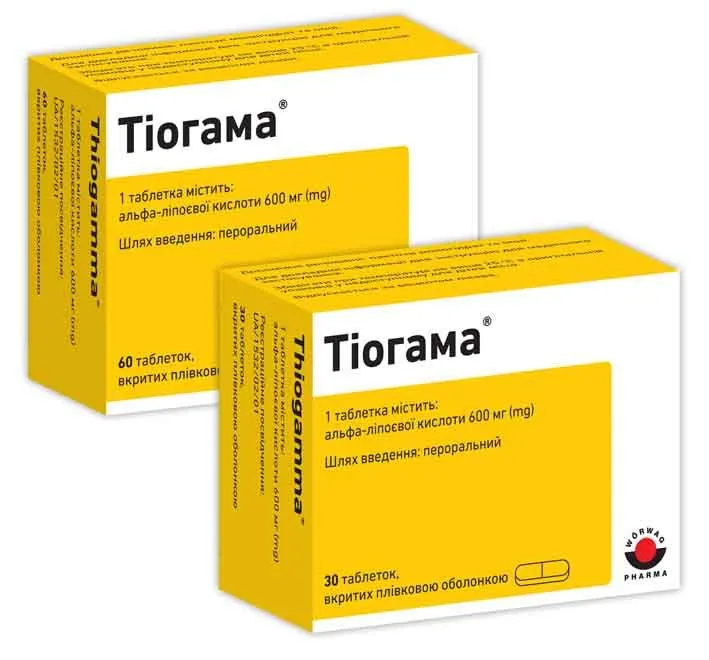
Table of Contents
INSTRUCTION FOR MEDICAL USE OF THE MEDICINAL PRODUCT TIOGAMMA® (TIOGAMMA®)
Composition:
Active substance: alpha-lipoic acid;
Composition per tablet: contains alpha-lipoic acid 600 mg;
Excipients: methylhydroxypropylcellulose, colloidal anhydrous silicon dioxide, microcrystalline cellulose, lactose monohydrate, sodium carboxymethylcellulose, talc, dimethicone, magnesium stearate;
Film coating: polyethylene glycols, methylhydroxypropylcellulose, talc, sodium dodecyl sulfate.
Pharmaceutical form. Film-coated tablets.
Main physicochemical properties: film-coated tablets, light yellow in color with lighter and darker (white) specks, elongated, biconvex, with a score line on both sides. The color of the tablet cross-section is light yellow.
Pharmacotherapeutic group.
Agents affecting the digestive system and metabolic processes. Thioctic acid.
ATC code A16AX01.
Pharmacological properties.
Pharmacodynamics. Alpha-lipoic acid is a substance synthesized in the body that acts as a coenzyme in the oxidative decarboxylation of α-keto acids and plays an important role in cellular energy production. It promotes a reduction in blood glucose levels and increases hepatic glycogen content. Deficiency or impaired metabolism of alpha-lipoic acid due to intoxications or excessive accumulation of certain breakdown products (e.g., ketone bodies) leads to impaired aerobic glycolysis. Alpha-lipoic acid exists in two physiologically active forms (oxidized and reduced), both of which possess antitoxic and antioxidant effects. Alpha-lipoic acid affects cholesterol metabolism and participates in the regulation of lipid and carbohydrate metabolism, improving liver function (due to hepatoprotective, antioxidant, and detoxifying actions). Pharmacologically, alpha-lipoic acid is similar to the vitamin B complex.
Pharmacokinetics. After oral administration, alpha-lipoic acid is rapidly and almost completely absorbed from the gastrointestinal tract. It is primarily excreted by the kidneys, mostly in the form of metabolites. Metabolite formation occurs through side chain oxidation and conjugation. The elimination half-life of Thioctacid® from blood plasma is 10–20 minutes.
Clinical characteristics.
Indications.
Prevention and treatment of diabetic polyneuropathy.
Contraindications.
- Hypersensitivity to α-lipoic acid or to any of the excipients of the medicinal product.
- There is no clinical experience with the use of the medicinal product in children and adolescents.
Interaction with other medicinal products and other forms of interaction.
α-Lipoic acid reacts with ionic metal complexes (e.g., cisplatin); therefore, Thioctacid® may reduce the efficacy of cisplatin. α-Lipoic acid forms poorly soluble complex compounds with sugar molecules.
α-Lipoic acid acts as a metal chelator; therefore, it should not be administered simultaneously with metal-containing compounds (e.g., preparations containing iron or magnesium, or dairy products, as they contain calcium).
If the total daily dose of Thioctacid® is taken 30 minutes before breakfast, iron- and magnesium-containing preparations should be administered during lunch or in the evening.
When used concomitantly, alpha-lipoic acid enhances the effect of insulin and oral hypoglycemic agents. Therefore, careful monitoring of blood glucose levels is required, especially during the initial phase of therapy with alpha-lipoic acid. To avoid symptoms of hypoglycemia, in some cases it may be necessary to reduce the dose of insulin or the dose of oral antidiabetic medicinal products.
Caution:
Alcohol abuse is a significant risk factor for the development and progression of neuropathic clinical manifestations and may therefore interfere with the success of treatment with the medicinal product. In general, patients with diabetic polyneuropathy should avoid alcohol consumption. This also applies to periods when alpha-lipoic acid therapy is not being administered.
Special precautions for use.
Cases of autoimmune insulin syndrome have been reported during treatment with alpha-lipoic acid. Patients with certain human leukocyte antigen (HLA) genotypes, particularly HLA-DRB1*04:06 and HLA-DRB1*04:03, are more susceptible to developing autoimmune insulin syndrome (a hormonal disorder affecting glucose regulation, characterized by marked decrease in blood sugar levels) during treatment with alpha-lipoic acid. The HLA-DRB1*04:03 allele (odds ratio for susceptibility to autoimmune insulin syndrome 1.6) is more common among Caucasian populations and more prevalent in Southern Europe than in Northern Europe; the HLA-DRB1*04:06 allele (odds ratio for susceptibility to autoimmune insulin syndrome 56.6) is predominantly found in patients from Japan and Korea.
The possibility of autoimmune insulin syndrome should be considered in patients receiving thioctic acid when making a differential diagnosis of spontaneous hypoglycemia.
Patients with hereditary galactose intolerance, lactase deficiency, or glucose-galactose malabsorption should not take this medicinal product.
Use during pregnancy or breastfeeding.
There is insufficient data on the use of the drug during pregnancy and breastfeeding; therefore, Thioctacid® is not recommended during these periods. It is unknown whether alpha-lipoic acid is excreted in breast milk.
Ability to influence reaction rate when driving or operating machinery.
Adverse reactions may include dizziness, visual disturbances, etc. This should be taken into account when driving or operating machinery.
Method of Administration and Dosage
The medication is intended for adult use. Tablets should be taken orally, swallowed whole with sufficient water. The daily dose is 1 tablet of Thioctacid® (corresponding to 600 mg of α-lipoic acid), taken as a single dose approximately 30 minutes before the first meal. Treatment duration is 1–4 months.
In cases of severe disease manifestations, therapy should preferably be initiated with parenteral administration of Thioctacid® Turbo for infusion. Subsequently, treatment should be continued with oral Thioctacid® tablets at a daily dose of 600 mg.
Concomitant food intake may interfere with drug absorption.
Children
The efficacy and safety of the medication in children have not been established; therefore, it should not be prescribed to this age group.
Overdose
In case of overdose, symptoms such as nausea, vomiting, and headache may occur.
In cases of accidental ingestion or suicide attempts involving oral doses of 10–40 g of alpha-lipoic acid in combination with alcohol, severe intoxication has been observed, in some cases resulting in fatality.
Clinical manifestations: restlessness or impaired consciousness associated with generalized seizures and lactic acidosis. Additionally, symptoms of hypoglycemia, shock, rhabdomyolysis, hemolysis, disseminated intravascular coagulation, bone marrow depression, and multiorgan failure due to high-dose alpha-lipoic acid intoxication have been reported.
Treatment in case of intoxication: Even if there is only suspicion of alpha-lipoic acid intoxication (e.g., >10 tablets of 600 mg in an adult or >50 mg/kg body weight in a child), the patient must be transported to a clinic as quickly as possible, and standard treatment for poisoning should be initiated (e.g., induction of emesis, gastric lavage, activated charcoal, etc.). In cases of generalized seizures, lactic acidosis, or other life-threatening conditions, modern intensive care therapy should be administered according to symptoms. Hemodialysis, hemoperfusion, or technical filtration have not demonstrated effective elimination of alpha-lipoic acid.
Side effects
Very common (≥ 1/10), common (≥1/100 – <1/10), uncommon (≥1/1,000 – < 1/100), rare (≥1/10,000 – < 1/1,000), very rare (< 1/10,000), frequency not known (unknown).
From the nervous system: very rare: altered or impaired taste sensations.
From the gastrointestinal tract: very rare: nausea, vomiting, abdominal pain and gastro-intestinal discomfort, diarrhea.
Metabolic disturbances: as glucose utilization improves, blood glucose levels decrease. Cases of hypoglycemic states have been reported, including dizziness, increased sweating, headache, and visual disturbances.
From the immune system: very rare: allergic reactions, including skin rashes, urticaria (hives), itching, difficulty breathing.
Frequency not known: autoimmune insulin syndrome.
Shelf life. 3 years.
Storage conditions.
Store at a temperature not exceeding 25 °C in the original packaging, in a place inaccessible to children.
Packaging. 10 tablets per blister; 3 or 6 blisters per cardboard box.
Prescription category. Prescription only.
Manufacturer. Dragenufarm Apotheker Pueschl GmbH, Germany / Dragenopharm Apotheker Pueschl GmbH, Germany.
Manufacturer's address.
Goellstrasse 1, 84529 Tittmoning, Germany.