Teicoplanin-pharmex
Ukraine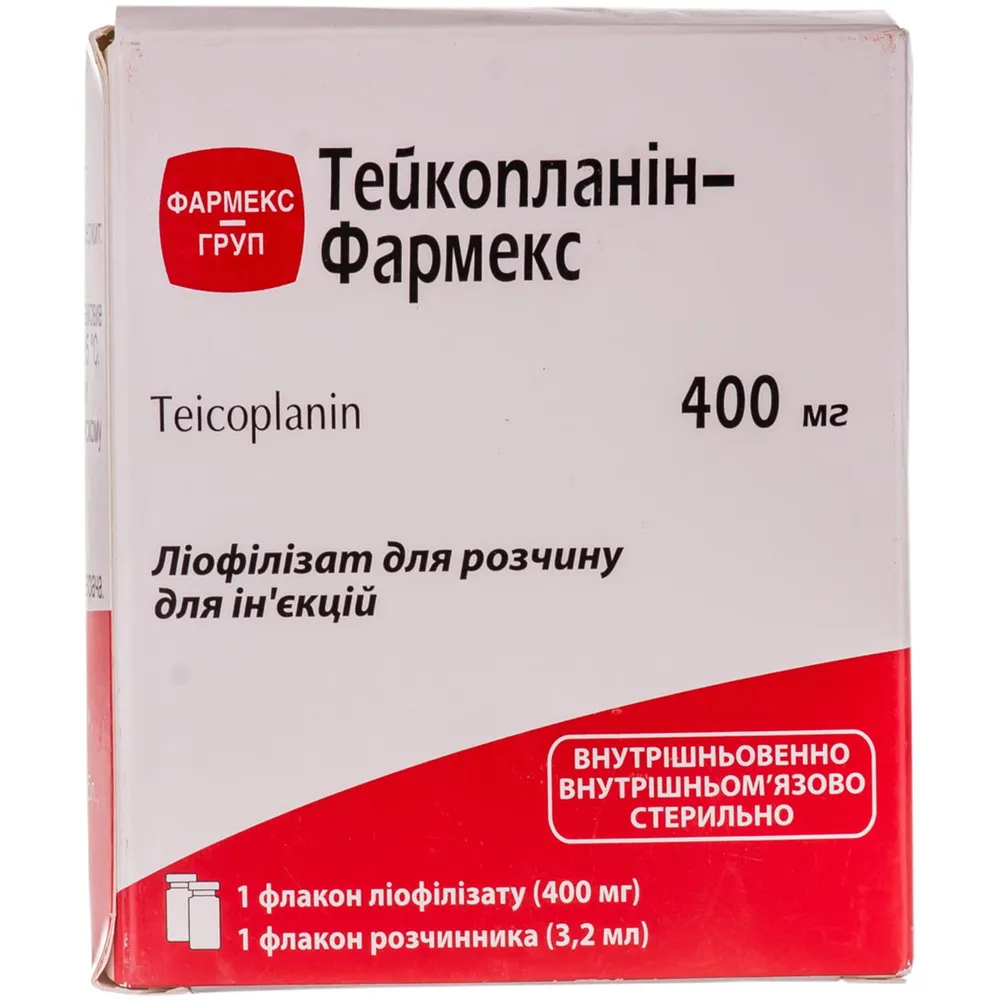
Table of Contents
INSTRUCTIONS FOR MEDICAL USE OF THE MEDICINAL PRODUCT TEICOPLANIN-PHARMEX (TEICOPLANIN-PHARMEX)
Composition:
active substance: teicoplanin;
1 vial contains 200 mg or 400 mg of teicoplanin;
excipient: sodium chloride;
solvent – water for injections.
Pharmaceutical form. Lyophilisate for solution for injection.
Main physico-chemical characteristics:
- vial with lyophilisate: yellowish porous mass or powder;
- vial with solvent: clear, colorless liquid.
Pharmacotherapeutic group.
Glycopeptide antibiotics. ATC code J01XA02.
Pharmacological properties.
Pharmacodynamics.
Mechanism of action
Teicoplanin inhibits the growth of susceptible microorganisms by interfering with the biosynthesis of the cell membrane at a site different from the site of action of beta-lactam antibiotics. Synthesis of peptidoglycan is blocked through specific binding to D-alanyl-D-alanine residues.
Resistance to teicoplanin may develop according to the following mechanisms:
- Modified target structure: this form of resistance is particularly characteristic of Enterococcus faecium. The modification is based on the substitution of the terminal D-alanine-D-alanine amino acid chain in the muramic precursor with D-ala-D-lactate, resulting in reduced affinity for vancomycin. The responsible enzymes are newly synthesized D-lactate dehydrogenase or lipase;
- Reduced susceptibility or resistance of staphylococci to teicoplanin is caused by the synthesis of excessive amounts of muramic precursors to which teicoplanin binds.
Cross-resistance may occur between teicoplanin and the glycopeptide vancomycin. Some vancomycin-resistant enterococci remain susceptible to teicoplanin (Van-B phenotype).
Breakpoints in antimicrobial susceptibility testing
The minimum inhibitory concentration (MIC) breakpoints established by the European Committee on Antimicrobial Susceptibility Testing (EUCAST), version 3.1, dated February 11, 2013, are presented in Table 1.
Table 1.
Minimum inhibitory concentration (MIC) breakpoints established by EUCAST
| Microorganisms |
Susceptible |
Resistant |
| Staphylococcus aureus a Coagulase-negative staphylococci a Enterococcus species (Enterococcus spp.) Streptococcus species (Streptococcus spp.) (Groups A, B, C, G) b Streptococcus pneumoniae b Viridans group streptococci b Gram-positive anaerobes, except Clostridium difficile Breakpoints for determination of PK/PD (not species-specific) c,d |
≤2 mg/L ≤4 mg/L ≤2 mg/L ≤2 mg/L ≤2 mg/L ≤2 mg/L ND ND |
>2 mg/L >4 mg/L >2 mg/L >2 mg/L >2 mg/L >2 mg/L ND ND |
a The minimum inhibitory concentration (MIC) for glycopeptides depends on the method used and should be determined by broth microdilution method (ISO 20776). Staphylococcus aureus (S. aureus) with vancomycin MIC values of 2 mg/L are at the breakpoint between wild-type and non-wild-type isolates and may negatively affect clinical response. The resistance breakpoints for Staphylococcus aureus have been reduced to 2 mg/L to avoid reporting glycopeptide intermediate-resistant Staphylococcus aureus (GISA) isolates, as serious infections caused by GISA isolates do not respond to treatment with higher doses of vancomycin or teicoplanin.
b Isolates with MIC values exceeding the susceptibility breakpoints occur very rarely or have not yet been observed. Susceptibility testing for any such isolates should be repeated, and if confirmed, the isolate should be sent to a reference laboratory. Until clinical evidence of response to the drug is available for confirmed isolates with MIC values exceeding the current resistance breakpoint, these isolates should be reported as resistant.
c "ND" means that currently there is insufficient evidence to support that the indicated species are a good target for therapy with this agent.
d MIC values may be reported with a comment but without accompanying categorical interpretation: S (susceptible), I (intermediate resistance), or R (resistant).
Pharmacokinetic/Pharmacodynamic Relationship
The antimicrobial activity of teicoplanin is largely dependent on the duration of time during which the drug concentration remains above the minimum inhibitory concentration (MIC) for the causative pathogen of the specific infection.
Susceptibility
For certain bacterial species, resistance prevalence may vary depending on geographic region and over time; therefore, local resistance data should be obtained, especially when treating severe infections. Consultation with a specialist is recommended if local resistance prevalence renders the utility of this agent questionable, at least for certain types of infections.
Typically Susceptible Microorganisms
Aerobic Gram-Positive Bacteria
Corynebacterium jeikeium a
Enterococcus faecalis
Staphylococcus aureus (including methicillin-resistant strains)
Streptococcus agalactiae
Streptococcus dysgalactiae subsp. equisimilis a
(Group C & G streptococci)
Streptococcus pneumoniae
Streptococcus pyogenes
Viridans group streptococci a, b
Anaerobic Gram-Positive Bacteria
Clostridium difficile a
Peptostreptococcus species a
Microorganisms with Potential Acquired Resistance
Aerobic Gram-Positive Bacteria
Enterococcus faecium
Staphylococcus epidermidis
Staphylococcus haemolyticus
Staphylococcus hominis
Resistant Microorganisms
All Gram-negative bacteria
Chlamydiae
Chlamydophila
Legionella pneumophila
Mycoplasma
a Recommendations on standard dosing and treatment are based on predicted susceptibility.
b Resistance rates may vary depending on the specific streptococcal species.
Pharmacokinetics
Absorption
After intramuscular administration, the bioavailability of teicoplanin (relative to intravenous administration) is nearly complete (90%). Following six daily intramuscular doses of 200 mg, the mean (with standard deviation, SD) maximum concentration of teicoplanin (Cmax) is 12.1 (0.9) mg/L, reached 2 hours after administration.
After intravenous administration of a loading dose of 6 mg/kg given every 12 hours for 3 to 5 doses, Cmax values ranged from 60 to 70 mg/L, and the trough concentration (Ctrough) usually exceeds 10 mg/L. After intravenous administration of a loading dose of 12 mg/kg given every 12 hours for 3 doses, mean Cmax and Ctrough are estimated to be approximately 100 mg/L and 20 mg/L, respectively.
After administration of a maintenance dose of 6 mg/kg given once daily, Cmax and Ctrough are approximately 70 mg/L and 15 mg/L, respectively. After administration of a maintenance dose of 12 mg/kg given once daily, Ctrough values range from 18 to 30 mg/L.
Distribution
Protein binding to human serum proteins ranges from 87.6% to 90.8%, without significant changes in teicoplanin concentrations. Teicoplanin binds primarily to human serum albumin. It does not penetrate into erythrocytes.
The volume of distribution at steady state (Vss) ranges from 0.7 to 1.4 L/kg. Higher Vss values were observed in more recent studies where samples were collected more than 8 days after the start of treatment.
Teicoplanin distributes mainly into the lungs, myocardium, and bone tissue, with tissue-to-serum ratios exceeding 1. In blister fluid, synovial fluid, and peritoneal fluid, the tissue-to-serum ratio ranges from 0.5 to 1. Elimination of teicoplanin from peritoneal fluid occurs at the same rate as from serum. In pleural fluid and subcutaneous adipose tissue, the tissue-to-serum ratio ranges from 0.2 to 0.5. Teicoplanin does not readily penetrate into cerebrospinal fluid (CSF).
Biotransformation
The unchanged form of teicoplanin is the main compound found in plasma and urine, indicating minimal metabolism. Two metabolites are formed, likely via hydroxylation, accounting for 2% to 3% of the administered dose.
Elimination
Teicoplanin is excreted unchanged primarily in urine (80% within 16 days), and 2.7% of the administered dose is excreted in feces (via biliary excretion) within 8 days after administration.
The elimination half-life of teicoplanin ranges from 100 to 170 hours, based on recent studies where blood samples were collected approximately 8–35 days after the start of treatment.
Teicoplanin has low total clearance, ranging from 10 to 14 mL/h/kg, and renal clearance ranging from 8 to 12 mL/h/kg, indicating that teicoplanin is primarily eliminated via the kidneys.
Linearity
Teicoplanin exhibits linear pharmacokinetics when administered at doses ranging from 2 to 25 mg/kg.
Special Patient Populations
- Renal Impairment
Since teicoplanin is eliminated by the kidneys, its elimination decreases proportionally with the degree of renal impairment. Total and renal clearance of teicoplanin depend on creatinine clearance.
- Elderly Patients
In elderly patients, the pharmacokinetics of teicoplanin are not altered, except in cases of renal impairment.
- Pediatric Population
Higher total clearance (15.8 mL/h/kg in neonates; 14.8 mL/h/kg in children with a mean age of 8 years) and shorter elimination half-life (40 hours in neonates; 58 hours in children with a mean age of 8 years) are observed compared to adult patients.
Clinical characteristics.
Indications.
Infections caused by gram-positive bacteria, including methicillin-sensitive or methicillin-resistant strains, particularly in patients allergic to beta-lactam antibiotics.
In adults and children:
skin and soft tissue infections;
complicated upper and lower urinary tract infections;
respiratory tract infections;
bone and joint infections;
septicaemia;
endocarditis;
peritonitis associated with continuous ambulatory peritoneal dialysis.
When necessary, teicoplanin should be used in combination with other antibacterial agents. Official recommendations on the appropriate use of antibacterial agents should be taken into account.
Contraindications.
Hypersensitivity to teicoplanin or to any of the excipients.
Interaction with other medicinal products and other forms of interaction.
No specific interaction studies have been conducted for this medicinal product.
Teicoplanin and aminoglycoside solutions are incompatible and should not be mixed during injection; however, they are compatible in dialysis fluid and may be used in the treatment of patients with peritonitis undergoing continuous ambulatory peritoneal dialysis.
Teicoplanin should be used with caution in combination with other medicinal products known to have nephrotoxic and/or neurotoxic/ototoxic potential, either concomitantly or sequentially. These include, for example, aminoglycosides, colistin, amphotericin B, cyclosporine, cisplatin, furosemide, and ethacrynic acid (see section "Special precautions for use", "Nephrotoxicity" and "Ototoxicity"). However, there is no evidence of synergistic toxic effects of these agents when used in combination with teicoplanin.
In clinical studies, teicoplanin was administered to many patients who were already receiving various medicinal products, including other antibiotics, antihypertensive agents, anaesthetics, cardiac medications, and antidiabetic agents, without observing any adverse interactions.
Paediatric population
Interaction studies have been conducted only in adult patients.
Special precautions for use.
Hypersensitivity reactions
Severe, life-threatening hypersensitivity reactions, sometimes fatal (e.g., anaphylactic shock), have been reported during treatment with teicoplanin. If an allergic reaction to teicoplanin occurs, therapy should be discontinued immediately and appropriate emergency measures should be initiated.
Teicoplanin should be used with caution in patients with known hypersensitivity to vancomycin, as cross-reactivity may occur, including fatal anaphylactic shock.
However, a history of pseudoallergic reactions associated with vancomycin use is not a contraindication for teicoplanin administration.
Infusion reactions
Rarely (even after the first dose), pseudoallergic reactions (a complex of symptoms including pruritus, urticaria, erythema, angioneurotic edema, tachycardia, hypotension, and dyspnea) have been observed. Discontinuation or slowing of the infusion may lead to resolution of these reactions. Infusion-related reactions can be minimized by administering the daily dose not as a bolus injection but by infusion over a 30-minute period.
Severe bullous reactions
Life-threatening or even fatal skin reactions, including Stevens-Johnson syndrome (SJS) and toxic epidermal necrolysis (TEN), have been reported with teicoplanin use. If symptoms or signs of SJS or TEN occur (e.g., progressive skin rash, often with blistering or mucosal involvement), teicoplanin should be discontinued immediately.
Antibacterial spectrum of activity
Teicoplanin has a limited antibacterial spectrum (gram-positive bacteria). It is not suitable for use as monotherapy for certain infections unless the causative pathogen has been documented to be sensitive to this agent, or there is high confidence that the likely pathogens will be susceptible to teicoplanin therapy.
For rational use of teicoplanin, the bacterial spectrum of activity, safety profile, and suitability of standard antibacterial therapy for the individual patient should be considered. Based on this, teicoplanin is expected to be used primarily for the treatment of severe infections in patients for whom standard antibacterial therapy is considered unacceptable.
Teicoplanin must not be administered intrathecally.
Thrombocytopenia
Cases of thrombocytopenia have been reported during teicoplanin use (see section "Adverse reactions"). Periodic hematological monitoring, including complete blood count, is recommended during therapy.
Nephrotoxicity
Cases of nephrotoxicity and renal failure have been reported in patients receiving teicoplanin (see section "Adverse reactions"). Patients with renal impairment receiving high loading doses of teicoplanin, and those receiving teicoplanin concomitantly or sequentially with other medicinal products known to have nephrotoxic potential (e.g., aminoglycosides, colistin, amphotericin B, cyclosporine, and cisplatin) should be closely monitored and undergo hearing tests (see "Ototoxicity" below).
Since teicoplanin is primarily excreted by the kidneys, dosage adjustment is required in patients with impaired renal function (see section "Dosage and administration").
Ototoxicity
Ototoxicity (hearing loss and tinnitus) has been reported during treatment with teicoplanin, as with other glycopeptides (see section "Adverse reactions"). Patients who develop signs and symptoms of hearing impairment or inner ear disorders during teicoplanin therapy should be carefully evaluated and monitored, especially during prolonged treatment and in patients with renal impairment. Close monitoring is required in patients receiving teicoplanin in combination with medicinal products known to have nephrotoxic and/or neurotoxic/ototoxic potential (e.g., aminoglycosides, colistin, amphotericin B, cyclosporine, cisplatin, furosemide, and ethacrynic acid), and the benefit-risk ratio of continuing teicoplanin should be assessed if hearing deteriorates.
Particular precautions are necessary when using teicoplanin in patients requiring concomitant therapy with ototoxic and/or nephrotoxic medicinal products, for whom regular complete blood counts and laboratory tests of liver and kidney function are recommended.
Superinfection
As with other antibiotics, prolonged use of teicoplanin may result in overgrowth of microorganisms not susceptible to the drug. If superinfection occurs during therapy, appropriate measures should be taken.
This medicinal product contains sodium. The sodium content is less than 1 mmol per dose, i.e., this medicinal product is considered "sodium-free" in practice.
Use during pregnancy or breastfeeding.
Pregnancy. Animal studies have not shown teratogenic effects, and clinical data are limited. However, due to the high therapeutic efficacy of teicoplanin, its use may be considered during pregnancy if there is a life-threatening indication (regardless of the stage of pregnancy). In such cases, neonatal hearing function should be evaluated (otoacoustic emission) due to the potential ototoxic effects of teicoplanin.
Breastfeeding. There are no data on the passage of teicoplanin into breast milk; therefore, breastfeeding is not recommended during treatment with Teicoplanin-Farmeks.
Ability to influence the speed of reactions when driving or operating machinery.
TEICOPLANIN-FARMEKS has a negligible influence on the ability to drive vehicles or operate machinery.
Teicoplanin may cause dizziness and headache. These effects may impair the ability to drive vehicles or operate machinery. Patients experiencing these adverse effects should refrain from driving or operating machinery.
Method of Administration and Dosage
Dosage
The dosage and duration of therapy should be adjusted according to the type and severity of the existing infection, the patient's clinical response, and individual patient characteristics such as age and renal function.
Monitoring of Drug Concentration in Serum
Serum trough concentrations of teicoplanin at steady state should be monitored after completion of the loading dose period to ensure that the minimum serum trough concentration has been achieved:
- For most infections caused by Gram-positive bacteria, serum trough concentrations of teicoplanin should be at least 10 mg/L when measured by high-performance liquid chromatography (HPLC), or at least 15 mg/L when measured by fluorescence polarization immunoassay (FPIA).
- For endocarditis and other severe infections, serum trough concentrations of teicoplanin should be 15–30 mg/L when measured by HPLC, or 30–40 mg/L when measured by FPIA.
During maintenance therapy, monitoring of serum trough concentrations of teicoplanin can be performed at least once weekly to ensure that concentrations remain stable.
Table 2
Dosage for adult patients and children aged 12 years and older, and for elderly patients with normal renal function
| Indications for use |
Loading dose |
Maintenance dose |
||
| Dosing regimen during loading phase |
Target trough concentrations on day 3–5 |
Maintenance dose |
Target trough concentrations during maintenance therapy |
|
| Complicated skin and soft tissue infections Pneumonia Complicated urinary tract infections |
3 intravenous or intramuscular administrations of 400 mg (approximately 6 mg/kg body weight) every 12 hours |
>15 mg/L1 |
6 mg/kg body weight intravenously or intramuscularly once daily |
>15 mg/L1 |
| Bone and joint infections |
3–5 intravenous infusions of 800 mg (approximately 12 mg/kg body weight) every 12 hours |
>20 mg/L1 |
12 mg/kg body weight intravenously or intramuscularly once daily |
>20 mg/L1 |
| Infective endocarditis |
3–5 intravenous infusions of 800 mg (approximately 12 mg/kg body weight) every 12 hours |
30–40 mg/L1 |
12 mg/kg body weight intravenously or intramuscularly once daily |
>30 mg/L1 |
1 Determination by fluorescence polarization immunoassay (FPIA).
Duration of therapy
The duration of therapy is determined based on clinical response. For infective endocarditis, an appropriate duration of therapy is generally considered to be a minimum of 21 days. The duration of therapy should not exceed 4 months.
Combination therapy
Teicoplanin has a limited spectrum of antibacterial activity (gram-positive bacteria). It is not suitable for use as a single agent in the treatment of certain types of infections unless the causative organism has already been documented and is known to be susceptible to this agent, or there is high confidence that the likely pathogens will be susceptible to teicoplanin therapy.
Elderly patients
Dose adjustment is not required if the patient does not have renal impairment (see below).
Adult and elderly patients with impaired renal function
Dose adjustment is not required during the first four days of therapy, and during this period the dose should be such that the trough serum concentration of the drug is maintained at no less than 10 mg/L.
After the fourth day of therapy:
- in mild to moderate renal impairment (creatinine clearance 30–80 mL/min), the maintenance dose should be halved – either by administering the dose once every two days or by administering half the dose once daily;
- in severe renal impairment (creatinine clearance less than 30 mL/min) and in patients undergoing hemodialysis, the dose should be one-third of the usual dose; this can be achieved by administering the standard initial dose once every three days or by administering one-third of this dose once daily.
Teicoplanin is not removed from the body by hemodialysis.
Outpatient patients on continuous ambulatory peritoneal dialysis
After a single intravenous loading dose of 6 mg/kg body weight, administer 20 mg/L into the dialysis solution bag during the first week; 20 mg/L into separate bags during the second week, and then 20 mg/L into the nighttime bag during the third week.
Pediatric patients
The drug may be administered to children starting from the age of 2 months.
Dosing recommendations for children aged 2 months to 12 years
Loading dose: 10 mg/kg body weight administered intravenously every 12 hours for a total of 3 doses.
Maintenance dose: 6–10 mg/kg body weight administered intravenously once daily.
Dosing recommendations for children aged 12 years and older are the same as for adults.
Teicoplanin should be administered by intravenous or intramuscular route. Intravenous administration should be performed either as a bolus injection given over 3–5 minutes or as an infusion lasting 30 minutes.
Preparation of the drug solution
Slowly inject the entire contents of the solvent supplied in the package into the vial containing the powder.
Gently rotate the vial between the palms until the powder is completely dissolved. If foam appears in the solution, allow it to stand for approximately 15 minutes. Only a clear, yellowish solution is suitable for use.
The reconstituted solution contains 200 mg or 400 mg of teicoplanin in 3.0 mL.
| Nominal teicoplanin content in the vial |
200 mg |
400 mg |
| Vial capacity with powder |
10 ml |
20 ml |
| Volume to be withdrawn from the vial with solvent for solution reconstitution |
3.14 ml |
3.14 ml |
| Volume containing the nominal dose of teicoplanin (volume to be withdrawn with syringe) |
3.0 ml |
3.0 ml |
The prepared solution may be administered as such or may be further diluted.
Preparation of diluted solution prior to infusion:
TEICOPLANIN-PHARMEKS may be added to one of the following infusion solutions:
- sodium chloride 9 mg/mL (0.9%) solution;
- Ringer's solution;
- Ringer's lactate solution;
- 5% dextrose solution for injection;
- 10% dextrose solution for injection;
- 0.18% sodium chloride and 4% glucose solution;
- 0.45% sodium chloride and 5% glucose solution;
- peritoneal dialysis solution containing 1.36% or 3.86% glucose solution.
All unused remnants of the medicinal product and other waste must be disposed of in accordance with local requirements.
Children.
The medicinal product can be administered to children aged 2 months and older.
Overdose.
Cases of accidental administration of excessively high doses of the medicinal product to pediatric patients have been reported. In one case, excitation was observed in a 29-day-old newborn who received a 400 mg intravenous dose of the medicinal product (95 mg/kg).
Treatment of overdose should be symptomatic.
Teicoplanin is not removed from the body by hemodialysis and is only slowly eliminated during peritoneal dialysis.
Adverse reactions.
The table below lists all adverse reactions occurring more frequently than with placebo and in more than one patient, using the following categories:
Very common (≥ 1/10); common (≥ 1/100 to < 1/10); uncommon (≥ 1/1000 to < 1/100); rare (≥ 1/10000 to < 1/1000); very rare (< 1/10000); frequency not known (cannot be estimated from the available data).
Within each frequency group, adverse reactions are listed in order of decreasing frequency.
| System Organ Class |
Common (from ≥1/100 to <1/10) |
Uncommon (from ≥1/1000 to <1/100) |
Rare (from ≥1/10000 to <1/1000) |
Very rare (<1/10000) |
Frequency not known (cannot be estimated from available data) |
| Infections and infestations |
Abscess |
Superinfection (overgrowth of non-susceptible organisms) |
|||
| Blood and lymphatic system disorders |
Leukopenia, thrombocytopenia, eosinophilia |
Agranulocytosis, neutropenia, pancytopenia |
|||
| Immune system disorders |
Anaphylactic reaction (anaphylaxis) (see section "Special warnings and precautions for use"). |
Drug reaction with eosinophilia and systemic symptoms (DRESS), anaphylactic shock (see section "Special warnings and precautions for use"). |
|||
| Nervous system disorders |
Dizziness, headache |
Seizures |
|||
| Ear and labyrinth disorders |
Deafness, hearing loss (see section "Special warnings and precautions for use"), tinnitus, vestibular disorders |
||||
| Vascular disorders |
Phlebitis |
Thrombophlebitis |
|||
| Respiratory, thoracic and mediastinal disorders |
Bronchospasm |
||||
| Gastrointestinal disorders |
Diarrhea, vomiting, nausea |
||||
| Skin and subcutaneous tissue disorders |
Rash, erythema, pruritus |
Pseudoallergic reaction (i.e., redness of the upper part of the body) (see section "Special warnings and precautions for use"). |
Toxic epidermal necrolysis, Stevens-Johnson syndrome, erythema multiforme, angioneurotic edema, exfoliative dermatitis, urticaria (see section "Special warnings and precautions for use"). |
||
| Renal and urinary disorders |
Increased blood creatinine levels |
Renal failure (including acute renal failure) (see description of individual adverse reactions below)* |
|||
| General disorders and administration site conditions |
Pain, pyrexia |
Injection site abscess, chills (tremor) |
|||
| Investigations |
Increased transaminase levels (transient transaminase abnormalities), increased alkaline phosphatase levels in blood (transient alkaline phosphatase abnormalities). |
Description of individual adverse reactions
* Based on literature data, the probability of nephrotoxicity in patients who received a regimen with a low loading dose averaging 6 mg/kg twice daily, followed by a maintenance dose averaging 6 mg/kg once daily, is approximately 2%.
In an observational post-marketing safety study involving 300 patients with a mean age of 63 years (treated for bone and joint infections, endocarditis, or other severe infections), who received high loading doses of 12 mg/kg twice daily (mean of 5 loading doses), followed by a maintenance dose of 12 mg/kg once daily, the incidence of confirmed nephrotoxicity was 11.0% (95% CI = [7.4%; 15.5%]) within the first 10 days. The probability of nephrotoxicity from the start of treatment up to 60 days after the last dose was 20.6% (95% CI = [16.0%; 25.8%]). In patients who received more than 5 high loading doses of 12 mg/kg twice daily, followed by a maintenance dose of 12 mg/kg once daily, the cumulative incidence of nephrotoxicity from the start of treatment up to 60 days after the last dose was 27% (95% CI = [20.7%; 35.3%]) (see section "Dosage and administration").
Shelf life.
Lyophilisate for solution for injection 200 mg in a vial, 1 vial in a set with 1 vial of solvent (water for injections) 3.2 ml – 2 years.
Lyophilisate for solution for injection 400 mg in a vial, 1 vial in a set with 1 vial of solvent (water for injections) 3.2 ml – 3 years.
Storage conditions.
Store in the original packaging at a temperature not exceeding 25 °C.
Keep out of reach of children.
Packaging.
200 mg in a vial, 1 vial in a set with 1 vial of solvent (water for injections) 3.2 ml in a blister pack, 1 blister pack in a cardboard box, 15 blister packs in a cardboard box.
400 mg in a vial, 1 vial in a set with 1 vial of solvent (water for injections) 3.2 ml in a blister pack, 1 blister pack in a cardboard box.
Prescription status. Prescription only.
Manufacturer. LLC "FARMEKS GROUP".
Manufacturer's address.
100, Shevchenka Street, Boryspil, Kyiv region, 08301, Ukraine.