Tavegil
Ukraine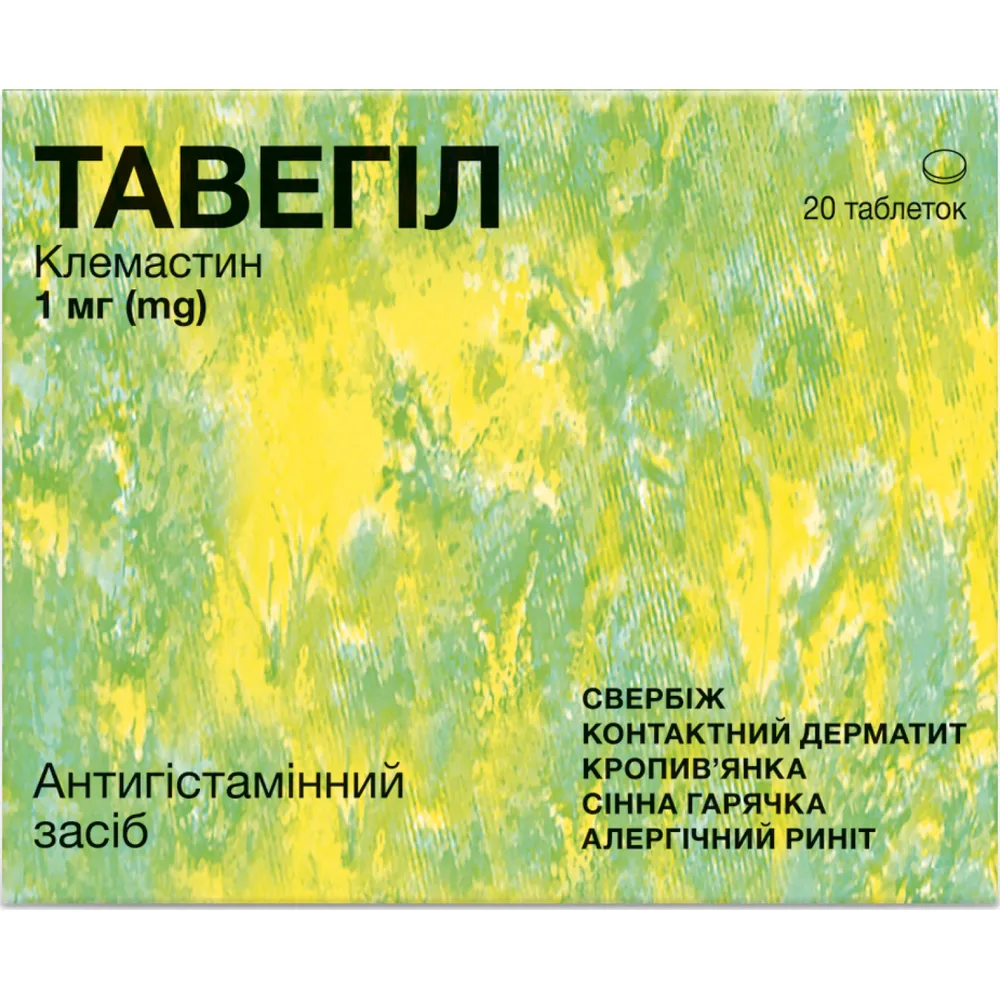
Table of Contents
I N S T R U C T I O N for medical use of the medicinal product TAVEGIL (TAVEGYL®)
Composition:
Active substance: clemastine;
1 tablet contains 1.34 mg of clemastine fumarate, equivalent to 1 mg of clemastine;
Excipients: magnesium stearate, povidone, talc, maize starch, lactose monohydrate.
Pharmaceutical form. Tablets.
Main physicochemical properties: white or almost white, round, flat tablets with bevelled edges. A score line and engraving O/T are present on one side.
Pharmacotherapeutic group. Antihistamines for systemic use.
ATC code R06A A04.
Pharmacological properties.
Pharmacodynamics.
Tavegil is an H1-receptor antagonist. It belongs to the antihistamine agents of the benzhydryl ether group. Tavegil selectively inhibits histamine H1-receptors and reduces capillary permeability. It exerts a pronounced antihistaminic and antipruritic effect characterized by rapid onset and significant duration (up to 12 hours).
Pharmacokinetics.
After oral administration, clemastine is almost completely absorbed from the gastrointestinal tract. Maximum plasma concentration is reached within 2–5 hours. The peak antihistaminic effect occurs within 5–7 hours and lasts for 10–12 hours, sometimes up to 24 hours. Plasma protein binding of clemastine is approximately 95%.
Elimination from plasma is biphasic, with elimination half-lives of 3.6±0.9 hours and 37±16 hours, respectively. Clemastine is extensively metabolized in the liver. The main route of metabolite excretion is via urine (45–65%). Only a small amount of unchanged active substance is found in urine. The drug is excreted in significant amounts into breast milk.
Clinical characteristics.
Indications.
Hay fever, allergic rhinitis, urticaria (including dermographic), pruritus, allergic dermatoses; as an adjunctive agent in acute and chronic eczema; contact dermatitis, as well as allergic reactions caused by medicinal products or insect bites.
Contraindications.
Hypersensitivity to clemastine or to excipients of the medicinal product, as well as to antihistamines of similar chemical structure; porphyria.
Interaction with other medicinal products and other forms of interaction.
Tavegyl, like other antihistamines, potentiates the sedative effect of medicinal products that depress the CNS (hypnotics, MAO inhibitors, tricyclic antidepressants, anxiolytics, opioid analgesics, and alcohol). Clemastine may enhance the effect of certain anticholinergic agents (e.g., atropine, tricyclic antidepressants). During treatment with this medicinal product, consumption of alcoholic beverages should be avoided.
Special precautions for use.
Tavegil tablets contain lactose. This medicinal product should not be used in patients with hereditary galactose intolerance, Lapp lactase deficiency or glucose-galactose malabsorption.
Tavegil should be used with caution in patients with epilepsy or a history of seizures, closed-angle glaucoma, peptic ulcer of the stomach with stenosis, pyloroduodenal stenosis, benign prostatic hyperplasia with urinary retention, and bladder neck obstruction. Use with caution in elderly patients, who are at higher risk of adverse reactions such as paradoxical excitation, and avoid use in cases of confusion.
Use during pregnancy or breastfeeding.
Tavegil should not be administered during pregnancy or breastfeeding. Antihistamines may pass into breast milk and affect the newborn.
Ability to influence reaction speed when driving or operating machinery.
Due to the antihistaminic sedative effect of clemastine, this medicinal product may impair the ability to drive or operate machinery.
Method of Administration and Dosage.
Tablets should be taken before meals, with water.
For adults and children aged 12 years and older, the recommended dose is 1 tablet in the morning and 1 tablet in the evening. In particularly severe cases, the daily dose may be increased up to 6 tablets; the maximum single dose of the drug is 2 tablets.
For children aged 6 to 12 years, the recommended dose is ½–1 tablet before breakfast and at bedtime.
Duration of use without medical consultation should not exceed 14 days. Do not exceed the recommended dose. For oral use only.
Children.
This medicinal formulation is intended for use in children aged 6 years and older.
Overdose.
Overdose of antihistamines may result in either depression or stimulation of the central nervous system (impaired consciousness, excitation, hallucinations, convulsions). Anticholinergic symptoms may also occur (dry mouth, mydriasis, hyperemia, gastrointestinal disturbances, and tachycardia).
Treatment consists of removing the drug from the body by gastric lavage, administration of adsorbents, and symptomatic therapy.
Adverse Reactions
The adverse effects listed below may occur with the following frequencies: very common (≥ 1/10), common (≥ 1/100, < 1/10), uncommon (≥ 1/1000, < 1/100), rare (≥ 1/10,000, < 1/1000), very rare (< 1/10,000).
Nervous system disorders: common – increased fatigue, sedative effect, drowsiness; uncommon – dizziness; rare – headache.
Psychiatric disorders: rare – excitement (especially in children).
Gastrointestinal disorders: rare – gastrointestinal disturbances, including epigastric pain, nausea, dry mouth; very rare – constipation.
Cardiovascular disorders: very rare – tachycardia, palpitations.
Skin disorders: rare – skin rashes.
Immune system disorders: rare – hypersensitivity reactions, dyspnea; isolated cases – anaphylactic shock.
General disorders: rare – asthenia.
Shelf life.
3 years.
Storage conditions.
Keep out of reach of children at a temperature not exceeding 30 °C.
Packaging.
20 tablets in a blister pack; 1 blister pack in a cardboard box.
Dispensing category.
Over-the-counter (without prescription).
Manufacturer.
HALEON ALCALA, S.A. / HALEON ALCALA, S.A.
STADA Arzneimittel AG
Manufacturer's address and place of business.
Ctra. de Ajalvir, Km. 2,500, Alcala de Henares, 28806 Madrid, Spain
Stadastrasse 2-18, 61118 Bad Vilbel, Germany